Hyperbaric Chamber Rules in Turkey: TİTCK Device Rules, the 2001 Centre Regulation, Wellness Licences and SGK Coverage
Researched and scored by Alex Evans. Last reviewed August 2026. Corrections are dated and public. See corrections
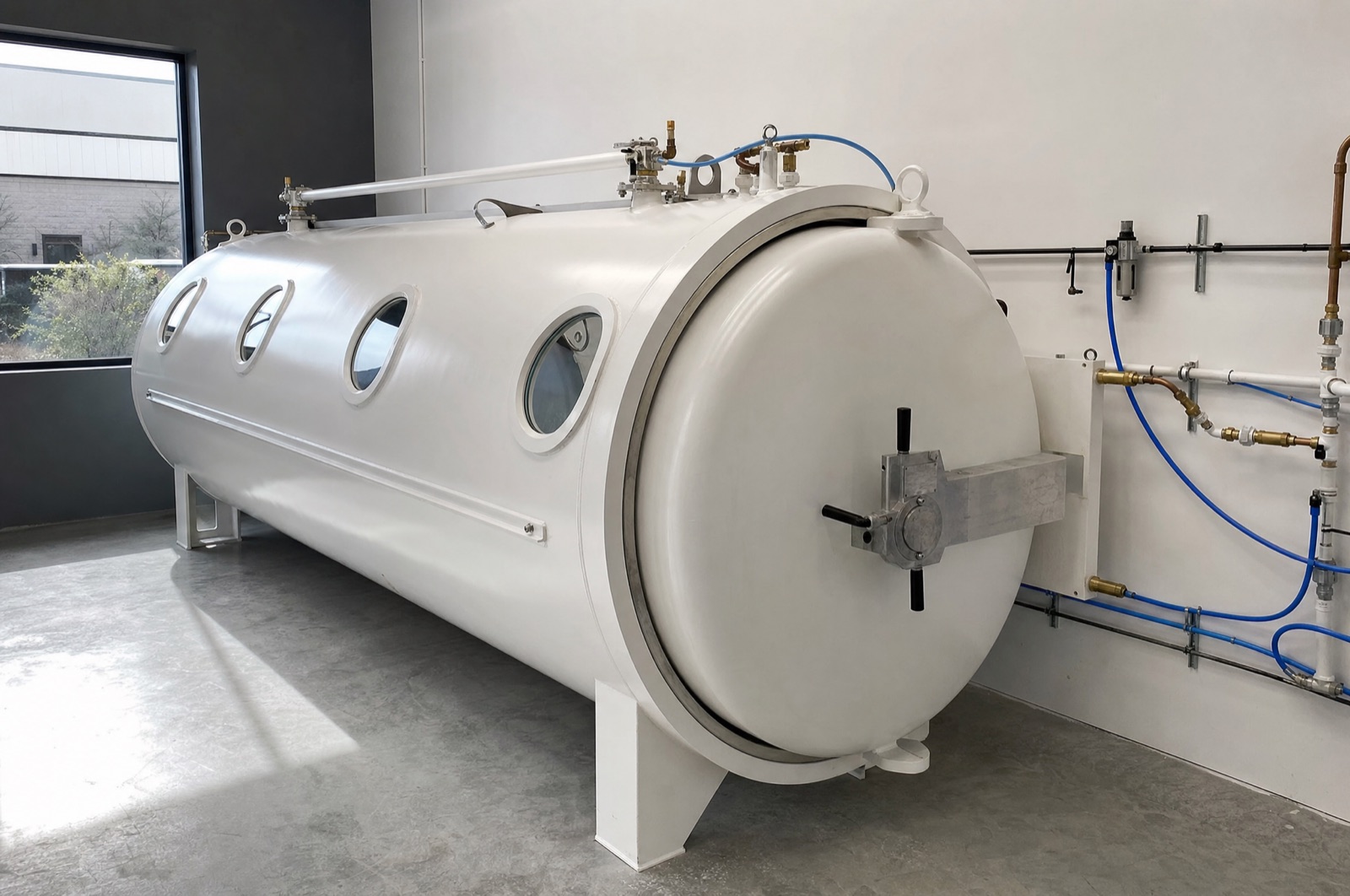
[ Clinic install ] Reference imagery; final photography in production
Hyperbaric chambers are legal in Turkey, and two sets of rules apply. The chamber itself is a medical device under the Tıbbi Cihaz Yönetmeliği (Medical Device Regulation) of 2 June 2021, issued by the Turkish Medicines and Medical Devices Agency (TİTCK) and aligned with EU Regulation 2017/745. The Turkish text does not name hyperbaric chambers, but its Rule 12 matches the EU rule under which EU guidance lists them as Class IIb. A private centre that treats patients with hyperbaric oxygen needs a Ministry of Health certificate under a 2001 regulation that also sets building, staffing and chamber standards. A 2026 regulation adds hyperbaric oxygen to the services a licensed wellness centre may offer without a treatment purpose. Health service ads are tightly limited, and SGK, the state insurer, pays for treatment only in set cases. This page uses the regulations as published on the state legislation portal and by TİTCK, a TİTCK guide, the SGK communiqué, the national specialty curriculum and one EU guidance document. All are in Turkish except the EU text, and the translations are ours. We do not say whether any treatment works, and we do not name or rate any clinic.
Legal, and regulated twice
We found no Turkish rule that bans hyperbaric chambers. The device regulation covers any apparatus or equipment the manufacturer intends for people for listed medical purposes, including the treatment or alleviation of a disease or an injury. So a chamber sold for treatment is a device, and the test is the maker's intended purpose. Article 7 bars labels, instructions and ads that give a device functions it does not have, or that create a false impression about treatment (our translation).
The second set of rules applies to the place where the chamber is used. The Regulation on Private Health Institutions Applying Hyperbaric Oxygen Treatment was published in the Official Gazette (Resmî Gazete) on 1 August 2001, issue 24480. It defines hyperbaric oxygen treatment as a method in which a patient in a pressure cabin, taken above 1 atmosphere, breathes 100% oxygen (our translation). Article 36 says no centre may operate without a certificate of conformity.
Who regulates: TİTCK and the Ministry of Health
TİTCK runs the device rules. The TİTCK copy of the device regulation opens with the agency's name and says its President carries it out. Article 51 sends classification disputes between a notified body and a manufacturer based in Turkey to TİTCK for a decision.
The Ministry of Health runs the facility rules. Under the 2001 regulation, an applicant files with the provincial health directorate. A three person inspection commission visits the site, and the file then goes to a five person technical commission. It includes a specialist or certified doctor, an anaesthesia specialist and an engineer who knows pressure chambers. That commission inspects within a month, and the ministry issues the certificate of conformity.
Device rules aligned with the EU MDR
The device regulation was published on 2 June 2021 in Official Gazette issue 31499 (repeated issue). Article 109 says it was prepared with Regulation (EU) 2017/745 and its corrections and amendments taken into account. Article 110 repealed the 2011 device regulation. Article 111 says most provisions apply from 26 May 2021, while some dates are tied to the EU database, Eudamed, and to the device identification (UDI) timetable.
Article 20 says compliant devices carry the CE mark, with exceptions for custom made and investigational devices. Because the text tracks the EU rules, the EU material on our CE marking page largely carries over. For how EU states handle the same device, see chamber rules in Germany and France and chamber rules in Ireland.
Which class a chamber falls in
Article 51 sorts devices into Classes I, IIa, IIb and III by intended purpose and risk, using Annex VIII. We searched the TİTCK text for hiperbarik (hyperbaric), basınç odası and basınç kabini (pressure chamber) and found none of them. So the class must come from the rules. Annex VIII, Rule 12, reads: all active devices intended to administer and/or remove medicinal products, body liquids or other substances to or from the body are Class IIa, unless this is done in a potentially hazardous way, in which case they are Class IIb (our translation). Rule 13 puts all other active devices in Class I.
The EU's MDCG 2021-24 Rev.1 classification guidance, dated April 2026, lists hyperbaric chambers among its Class IIb examples under Rule 12, next to ventilators and anaesthesia machines. The guidance says it is not legally binding. It is EU guidance, not a TİTCK decision. Our reading is that a chamber sold for treatment in Turkey would be Class IIb under the same rule, but we found no TİTCK document that says so. A soft or mild chamber sold with no medical purpose raises a separate question; see mild vs medical hyperbaric.
Importers, representatives and ÜTS
Article 11 says a device whose manufacturer is based outside Turkey and the EU may be placed on the market only if the manufacturer appoints an authorised representative. Article 13 says an importer must check that the device has the CE mark and an EU declaration of conformity, that a representative has been appointed, and that the device is labelled and comes with instructions. Article 10 says the information supplied with the device must be in Turkish.
Turkey also runs a national product tracking system, ÜTS (Ürün Takip Sistemi). Article 34 says economic operators, notified bodies, health institutions and health professionals in Turkey must meet their ÜTS duties, without prejudice to their Eudamed duties, and that TİTCK sets those duties. The ÜTS site did not load for us, so we could not read its own registration guidance.
Selling and advertising a chamber
The Medical Device Sales, Advertising and Promotion Regulation of 15 May 2014, issue 29001, as amended up to 3 July 2026, covers who may sell devices and how. Its key rules for a chamber seller are these:
- Article 26(1): only persons authorised under the regulation may sell devices. Article 5 says a sales centre applies to the provincial health directorate.
- Article 26(2): a sales centre may not sell devices that are not registered in TİTCK's registration and information system.
- Article 26(4): sales to consumers by newspaper, radio, television, telephone or direct selling are banned.
- Article 15(1)(b): devices meant to be used or applied only by health professionals may not be advertised to consumers.
- Article 15(1)(c): other devices may be advertised to consumers only on the website where the device is sold, unless they are on a short list in Annex 3, such as condoms and plasters.
- Article 15(5): after an unlawful ad, the sales centre is warned. If it does not fix the ad within three working days, its sales are suspended for 15 days.
We found no list that says whether a chamber counts as a professional only device. TİTCK's guide to the regulation (TCS-KLVZ-08, revision 2 of 9 January 2024) adds that promotion is aimed at health professionals and technical staff, and that any price information counts as advertising. A notice that a device is now on the market needs TİTCK permission, may appear only in print, and must not use slogans.
The 2001 regulation on private centres
Article 6 says doctors in private practice, licensed private hospitals and licensed private outpatient facilities may open a centre. Article 36 says a company may not run one if any partner is not a doctor. Article 5, as amended in 2002, says chambers go on the entry or ground floor of the building, inside a licensed hospital or outpatient facility or as a separate unit. A single person chamber may go on another floor if the building has a document from the relevant official body on its structural load and documented fire safety measures.
Article 27 says treatment may be given for the conditions published by the Undersea and Hyperbaric Medical Society (UHMS) and the European Committee for Hyperbaric Medicine (ECHM), and Annex 5 lists 17 indications. The list starts with decompression sickness and air or gas embolism. Article 34 sets routine inspections at least every six months, with suspension and then withdrawal of the certificate if faults are not fixed. Article 33 says patient records are kept for five years. The text on the portal shows amendments in 2002, 2007, 2008, 2009 and 2012.
Building and chamber standards
The regulation is unusually specific about hardware. Some of the rules, all our translations:
- Article 14: smoke sensors, sprinklers, a generator and an uninterruptible power supply able to run the chamber, and oxygen stored away from the chamber.
- Article 15: single and multiple person chambers must hold international pressure test, medical and materials certificates.
- Article 16: an audible and visual alarm when oxygen inside passes 22%, a closed exhaust that takes exhaled oxygen outside the building, and an entry hatch at least 50 cm in diameter.
- Article 18: compressor air is tested at least every six months by an official body, with oxygen at 20% to 22%, carbon monoxide at most 10 ppm and carbon dioxide at most 500 ppm.
- Article 19: maximum working pressure of 5.5 atmospheres for multiplace chambers, 3 atmospheres for single person chambers and 5.5 for steel single person chambers, with safety valve tests certified every five years.
A multiplace chamber must also be at least 180 cm in diameter, give each person at least 3 cubic metres, and have cameras and fire extinguishers that work under pressure. For the hazards behind these rules, see hyperbaric chamber safety. Our page on how loud a hyperbaric chamber is covers a 2020 study that measured sound inside 41 multiplace chambers in Turkish centres.
Who may run a treatment
Article 10 says a centre needs at least two doctors, one of them a specialist or certified doctor, and that this doctor must be in the centre whenever treatment is given. Article 36 says no treatment may be given without one. Article 4 defines a specialist as a doctor trained in marine and underwater medicine or in aerospace medicine. A certified doctor has passed a Ministry of Health course, the three month diving medical officer course at the navy's Rescue and Underwater Command, or at least three months of training abroad that the ministry accepts. Article 12 requires at least one chamber technician.
The specialty now has a newer name. The national core curriculum for Underwater Medicine and Hyperbaric Medicine, version 2.3, valid from 15 November 2017, says the field was first listed in 1962 as maritime medicine and later renamed twice. It sets training at three years. Trainees must operate the chamber in at least 50 treatments and accompany patients inside it in at least 50. For staffing elsewhere, see clinic staffing and certification.
Advertising a clinic
The Regulation on Promotion and Information Activities in Health Services, published on 12 November 2025, issue 33075, covers health professionals and private health facilities. Article 5 bans open or covert advertising in health service delivery. Promotion may give contact details, hours, specialties, staff titles and general health information. It may not:
- describe methods not proven scientifically and clinically, not established, or not defined by the ministry as a medical procedure, or say they treat or help treat disease;
- use patient thank you or satisfaction messages as advertising;
- give prices, discounts, campaigns or promotions;
- use lotteries or gifts.
Article 8 lets facilities authorised for health tourism run sponsored ads abroad in languages other than Turkish. Article 12 sends unlicensed providers to the trade ministry's Advertising Board and to prosecutors. The 2001 regulation adds its own limits: no ads for activities or prices the centre does not offer, no commercial appearance, and an outdoor sign that shows only the name and title on the certificate, with the words Hyperbaric Oxygen Centre after the name.
Wellness centres under the 2026 regulation
The Wellness Services Regulation (Esenlik Hizmetleri Yönetmeliği) was published on 4 July 2026, issue 33300, and took effect that day. Article 4 defines a wellness service as one offered to promote healthy living without a treatment purpose. Its list includes hiperbarik ve hipobarik oksijen uygulamaları, which we translate as hyperbaric and hypobaric oxygen applications, next to sauna, salt therapy and physiotherapy.
A wellness centre must sit in a hotel of at least ten rooms, a care home, a sports club, or a standalone building of at least 500 square metres. A smaller unit needs at least 300. Both need a licence from the provincial health directorate after an on-site inspection, a responsible manager who is a doctor with at least three years of practice, an emergency room and a deal with a hospital for emergencies. Article 10 says medical devices a service needs may be kept only with ministry permission, that convalescent patients may not receive services and that no products may be sold on site. Article 16 applies the 2025 promotion rules.
SGK coverage under the SUT
Section 2.4.4.B of the SGK Health Implementation Communiqué (SUT), as amended in 2022, covers hyperbaric oxygen. SGK pays when treatment is given at a contracted public provider with a hyperbaric centre, or a contracted private secondary or tertiary provider working under the 2001 regulation. Outside emergencies, a health board report must give the diagnosis and the number of sessions, capped by the SUT's annex EK-2/D-3.
For listed emergencies, including decompression sickness, gas embolism and carbon monoxide poisoning, a signed note from the referring or treating doctor replaces the board report. Treatment must start within ten days of the report. SGK pays for at most one session a day, except for up to seven days in sudden hearing loss and emergencies. We did not read the annex with the session caps.
Hospital centre and wellness chamber side by side
| Question | Hospital or private centre | Home or wellness chamber |
|---|---|---|
| Banned? | No | No ban found |
| Medical device? | Yes, if intended for treatment (definition eee) | Depends on the maker's intended purpose |
| Class | Not named; Class IIb under Rule 12 on our reading | Not addressed |
| Before sale | CE mark, authorised representative if maker is outside Turkey and the EU, ÜTS duties | Same, if it is a medical device |
| Seller | Authorised sales centre; device registered in TİTCK's system | Same, if it is a medical device |
| Device ads to consumers | Barred if professional only (Article 15(1)(b)) | Only on the sales website, if not professional only |
| Place of use | Certificate of conformity under the 2001 regulation | Wellness licence under the 2026 regulation, if offered as a service |
| Staff | Specialist or certified doctor present; chamber technician | Responsible manager who is a doctor |
| Facility ads | 2025 promotion regulation and the 2001 limits | 2025 promotion regulation (Article 16) |
| SGK pays? | In set cases, with a board report outside emergencies | No rule found |
Sources: Tıbbi Cihaz Yönetmeliği (TİTCK copy); MDCG 2021-24 Rev.1; Tıbbi Cihaz Satış, Reklam ve Tanıtım Yönetmeliği and TİTCK guide TCS-KLVZ-08; Regulation on Private Health Institutions Applying Hyperbaric Oxygen Treatment (2001); Regulation on Promotion and Information Activities in Health Services (2025); Wellness Services Regulation (2026); SGK SUT section 2.4.4.B; TUKMOS core curriculum v.2.3. All linked above, read 6 November 2026.
For the chambers we track and what we can verify about each, see the scorecard. For a country with a tighter quota system, see chamber rules in Israel.
What we have not verified
We found no TİTCK document that gives the class of a hyperbaric chamber, so Class IIb is our reading of Rule 12 and EU guidance, not a Turkish ruling. The ÜTS site did not load, so we could not read its registration guides or count registered chambers. We found no list that says whether a chamber is a device for professional use only under the sales regulation. We did not read the annexes of the 2026 wellness regulation, including its sanctions table, and we found no guidance on how it fits with the 2001 regulation, for example what pressure or gas a wellness chamber may use. We did not read the SUT annex with session caps or the SGK price lists. We did not check the 2001 regulation against later facility rules for public hospitals, and we found no national count of centres. We did not check Turkish rules on pressure equipment or medical gases. The 2001 regulation still uses the older specialty names, and we did not confirm how current specialists fit its definition.
Frequently asked
Are hyperbaric chambers legal in Turkey?
Yes. We found no ban. A chamber sold for a medical purpose is a device under the Tıbbi Cihaz Yönetmeliği of 2 June 2021, which TİTCK says it prepared in line with EU Regulation 2017/745. A private centre that gives hyperbaric oxygen treatment also needs a certificate of conformity from the Ministry of Health under a 2001 regulation on such centres.
What class is a hyperbaric chamber in Turkey?
The Turkish regulation does not name hyperbaric chambers. Its Rule 12 matches the EU text: active devices that give substances to the body are Class IIa, or Class IIb if done in a potentially hazardous way. The EU guidance MDCG 2021-24 Rev.1 lists hyperbaric chambers as a Class IIb example under Rule 12. That guidance is not legally binding, and we found no TİTCK ruling that applies it to chambers.
Who may open a hyperbaric centre in Turkey?
Under the 2001 regulation, doctors in private practice, licensed private hospitals and licensed private outpatient facilities may open one. If a company opens it, all partners must be doctors. The centre needs a Ministry of Health certificate of conformity, a responsible manager who is a specialist or certified doctor, at least two doctors and at least one chamber technician.
Can a Turkish clinic advertise hyperbaric sessions?
Only within narrow limits. A 2025 Ministry of Health regulation bans open or covert advertising of health services. Promotion may give contact details, hours, specialties and general health information. It may not include prices, discounts, patient thank you messages, or claims that a method not scientifically and clinically proven treats a disease. The 2001 regulation also bars a centre from giving its work a commercial appearance.
Does SGK pay for hyperbaric oxygen in Turkey?
In set cases. Section 2.4.4.B of the SGK Health Implementation Communiqué (SUT) says SGK pays when treatment is given at a contracted public provider with a hyperbaric centre, or a contracted private secondary or tertiary provider working under the 2001 regulation. Outside emergencies, a health board report must give the diagnosis and the number of sessions. SGK pays for at most one session a day, with exceptions.

Alex tests the machines himself, in clinics and studios on three continents. Every score comes from the same 27 public criteria, and no manufacturer has a say in them.
Six questions, and we'll match chamber, options, and install to your space and budget.