Hyperbaric Therapy, Insurance and CPT Codes: The Reality Check for Clinics
Researched and scored by Alex Evans. Last reviewed August 2026. Corrections are dated and public. See corrections
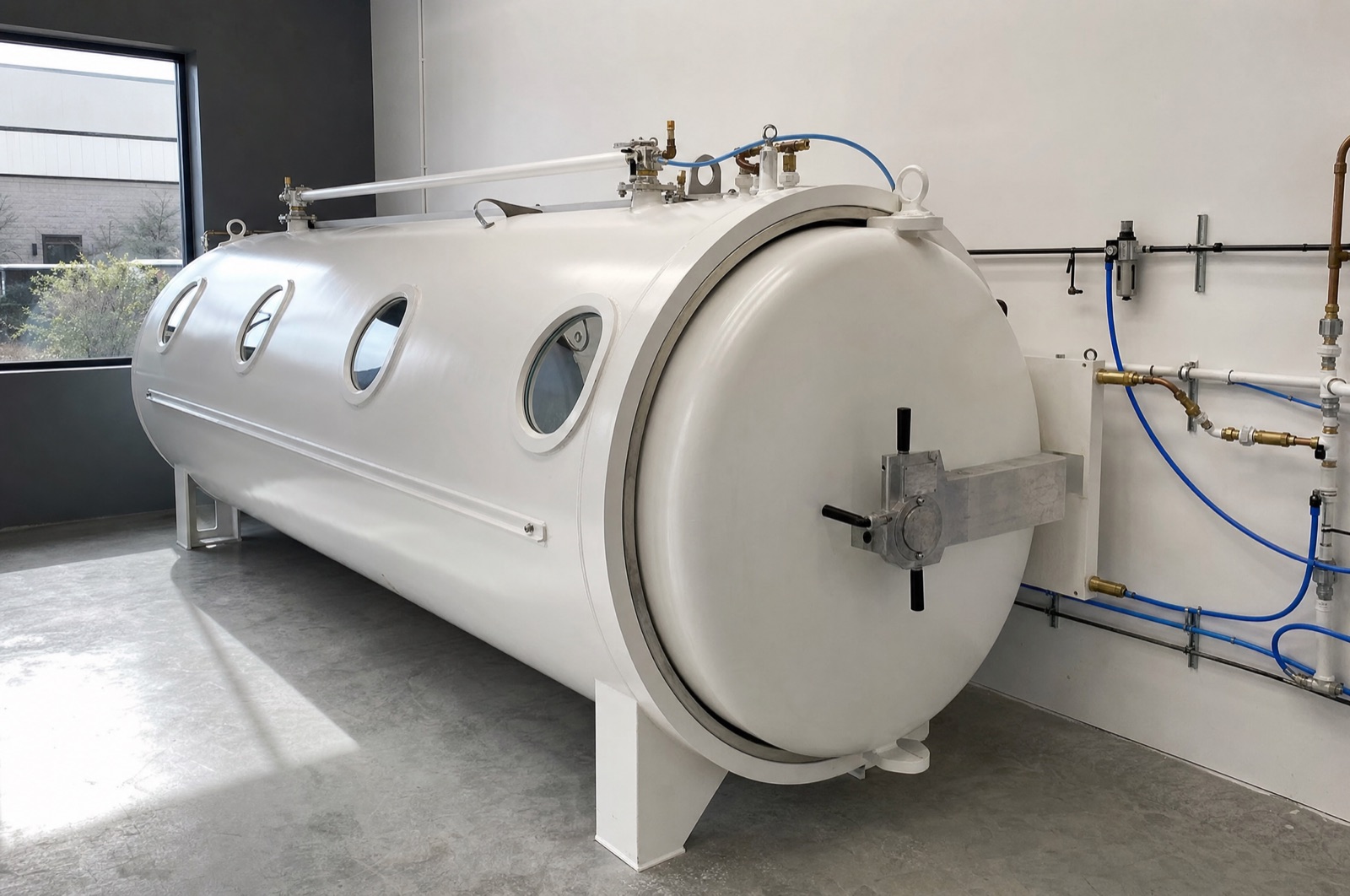
[ Clinic install ] Reference imagery; final photography in production
Clinics adding a chamber often hear that sessions can be billed to insurance. This page sets out what the payers themselves publish: the Medicare national rule, the two billing codes, the supervision rules, and two commercial policies. It does not say what hyperbaric oxygen does for any condition. The condition lists below are coverage lists, copied as the payers wrote them. For the business side of a clinic chamber, see our clinic buyer's guide.
What Medicare means by hyperbaric oxygen
The Medicare rule is National Coverage Determination 20.29, section 20.29 of the NCD Manual, publication 100-3. The current version took effect on 3 April 2017. It opens with a definition: for purposes of coverage under Medicare, HBO therapy is a modality in which the entire body is exposed to oxygen under increased atmospheric pressure.
The next sentence sets the scope. Program reimbursement is limited to HBO therapy administered in a chamber, including the one man unit, and to the conditions on the list. Two things are absent. The NCD does not name a minimum pressure, and it does not mention mild, soft or fabric chambers. Our mild vs medical guide covers the other ways the two tiers differ.
The 15 covered conditions
These are the conditions NCD 20.29 lists under section A, in its own order and wording. Some items carry qualifiers in the source, and we have kept those.
| No. | Condition as written in NCD 20.29 |
|---|---|
| 1 | Acute carbon monoxide intoxication |
| 2 | Decompression illness |
| 3 | Gas embolism |
| 4 | Gas gangrene |
| 5 | Acute traumatic peripheral ischemia, as an adjunct to accepted standard measures when loss of function, limb or life is threatened |
| 6 | Crush injuries and suturing of severed limbs, on the same adjunctive basis |
| 7 | Progressive necrotizing infections (necrotizing fasciitis) |
| 8 | Acute peripheral arterial insufficiency |
| 9 | Preparation and preservation of compromised skin grafts (not for primary management of wounds) |
| 10 | Chronic refractory osteomyelitis, unresponsive to conventional medical and surgical management |
| 11 | Osteoradionecrosis, as an adjunct to conventional treatment |
| 12 | Soft tissue radionecrosis, as an adjunct to conventional treatment |
| 13 | Cyanide poisoning |
| 14 | Actinomycosis, only as an adjunct to conventional therapy when the disease is refractory to antibiotics and surgical treatment |
| 15 | Diabetic wounds of the lower extremities, for patients who meet three criteria (below) |
Source: CMS NCD Manual, publication 100-3, chapter 1, section 20.29, Rev. 203, read 14 October 2026. Items 5, 6 and 14 are shortened; the manual has the full wording.
Item 15 has the most conditions attached. The patient must have type I or type II diabetes and a lower extremity wound due to diabetes, the wound must be Wagner grade III or higher, and the patient must have failed an adequate course of standard wound therapy. The NCD covers HBO only as adjunctive therapy after at least 30 days of standard wound care with no measurable signs of healing, and only alongside continued standard care. Wounds must be evaluated at least every 30 days during HBO therapy, and continued HBO is not covered if measurable signs of healing have not been shown within any 30-day period.
The 22 conditions Medicare will not pay for
Section B of the NCD says all other indications are not covered and no program payment may be made for any condition not on the covered list. It then names 22 conditions for which no payment may be made: cutaneous, decubitus and stasis ulcers; chronic peripheral vascular insufficiency; anaerobic septicemia and infection other than clostridial; thermal skin burns; senility; myocardial infarction; cardiogenic shock; sickle cell anemia; acute thermal and chemical pulmonary damage; acute or chronic cerebral vascular insufficiency; hepatic necrosis; aerobic septicemia; nonvascular causes of chronic brain syndrome, with Pick's, Alzheimer's and Korsakoff's disease given as examples; tetanus; systemic aerobic infection; organ transplantation; organ storage; pulmonary emphysema; exceptional blood loss anemia; multiple sclerosis; arthritic diseases; and acute cerebral edema.
A condition that appears on neither list is still excluded. Under section B, anything not on the covered list gets no Medicare payment, whether or not it is named.
Topical oxygen is a separate question
Topical oxygen means oxygen applied to a wound, not a pressurized body chamber. Section C of the NCD now says only that topical application of oxygen has been removed from NCD 20.29 and that the regional Medicare Administrative Contractors (MACs) may decide coverage of topical oxygen for chronic non-healing wounds.
The Claims Processing Manual, chapter 32 adds two points. In section 30.1 it says topical oxygen does not meet the Medicare definition of HBO therapy. In section 30.2 it says that, whatever a contractor decides, there shall be no coverage for any separate or additional physician professional service related to the procedure. One MAC, Noridian, explains the result in its billing article A56025: the two topical oxygen codes, E0446 and A4575, sit with the durable medical equipment contractors, so Noridian does not expect to see claims for the service in Part A or Part B.
The two billing codes
The Claims Processing Manual, chapter 32, section 30.1, lists the procedure codes for HBO therapy. Two of the commercial policies we read list the same codes with the same meaning.
| Code | Type | Description | Unit |
|---|---|---|---|
| 99183 | CPT | Physician attendance and supervision of hyperbaric oxygen therapy (CMS manual wording); UnitedHealthcare lists it as physician or other qualified health care professional attendance and supervision | Per session |
| G0277 | HCPCS | Hyperbaric oxygen under pressure, full body chamber | Per 30-minute interval |
| A4575 | HCPCS | Topical hyperbaric oxygen chamber, disposable | Not covered by Aetna or UnitedHealthcare |
| E0446 | HCPCS | Topical oxygen delivery system, not otherwise specified | Not covered by Aetna or UnitedHealthcare |
Sources: CMS Claims Processing Manual chapter 32 sections 30.1 and 30.2; Aetna Clinical Policy Bulletin 0172; UnitedHealthcare Medical Policy 2026T0632J. All read 14 October 2026.
The G0277 description itself names a full body chamber, which matches the NCD definition of the entire body under increased pressure. 99183 is the professional code for the practitioner who attends and supervises. A session therefore has two sides, a facility side for the chamber time and a professional side for the supervising practitioner.
Where the codes can be billed
The setting rules matter more to a clinic than the codes do. In section 30.1, the manual lists hospital bill types 11X, 13X and 85X for institutional claims. It then states that G0277 is not available for use other than in a hospital outpatient department. In skilled nursing facilities, HBO is part of the facility's prospective payment for covered Part A stays. Hospital inpatients are reported under revenue code 940 with no HCPCS code, and critical access hospitals electing Method I report revenue code 940 with 99183.
On payment, the manual says hospitals are paid through the Ambulatory Payment Classification for outpatients or the inpatient Diagnosis Related Group. Practitioner claims for 99183 go on the professional claim format and are paid from the Medicare Physician Fee Schedule Database. Deductible and coinsurance apply to both. We did not look up current payment amounts for either code, so this page gives none.
Supervision: what the regulations say
The supervision rules differ by setting. For therapeutic services in a hospital outpatient department, 42 CFR 410.27 sets the default at general supervision, or another level CMS specifies for a particular service. General supervision means the service runs under the practitioner's overall direction and control, and their presence is not required during the procedure. The same section defines direct supervision as the practitioner being immediately available to furnish assistance and direction throughout the procedure, which does not require being in the room.
In a physician's office the default is stricter. 42 CFR 410.26 says services furnished incident to a practitioner's service must in general be under direct supervision. It points to 42 CFR 410.32(b)(3)(ii), which defines direct supervision in the office setting as the practitioner being present in the office suite and immediately available throughout the service. Both sections now allow that presence to be virtual, through real-time audio and video, for services without a 010 or 090 global surgery indicator. We did not check which indicator 99183 carries.
Contractors have written their own wording in the past. A WPS comment response on its HBO policy L31357 quotes the policy as saying HBO professional services billed to Part B must be performed under the direct supervision of a physician, present in the facility and immediately available. The same document says the supervising physician must be able to treat complications. That LCD is not in the list of active final LCDs that the CMS coverage API returned on 14 October 2026, and no active LCD in that list has hyperbaric or HBO in its title. The nearest is Palmetto's L37873, Topical Oxygen Therapy. So for systemic HBO, the national rule plus the federal supervision regulations appear to be what applies today. Whether CMS has assigned HBO a supervision level above general in the hospital outpatient setting is a question we did not settle.
What commercial payers publish
Private insurers write their own policies, and the two we read are longer than the NCD. Both list their own covered conditions, which overlap with Medicare's but are not identical. Both, for example, add idiopathic sudden sensorineural hearing loss and intracranial abscess, which NCD 20.29 does not list.
| Point | Medicare NCD 20.29 | Aetna CPB 0172 | UnitedHealthcare 2026T0632J |
|---|---|---|---|
| Definition | Entire body exposed to oxygen under increased atmospheric pressure | Entire patient inside a pressurized chamber breathing 100% oxygen above 1 atmosphere | Near 100% oxygen in a chamber above 1 ATA; for clinical purposes at least 1.4 ATA |
| Pressure named | None | Greater than 1 atm | 1.4 ATA or more |
| Mild chambers | Not mentioned | No separate statement found | Unproven and not medically necessary for any indication |
| Topical oxygen | Left to MACs | Experimental, investigational or unproven | Unproven and not medically necessary for wounds or ulcers |
| Codes listed | 99183, G0277 (manual) | 99183, G0277 covered if criteria met | 99183, G0277, A4575, E0446 |
| Dates | Effective 3 Apr 2017 | Last review 21 Apr 2026 | Effective 1 May 2026 |
Sources: Aetna Clinical Policy Bulletin 0172; UnitedHealthcare Medical Policy 2026T0632J; CMS NCD 20.29. All read 14 October 2026.
Aetna says it considers systemic HBO medically necessary for a list of conditions, and gives a usual number of sessions for each in parentheses. Its policy also lists contraindications where safety has not been established, and calls topical HBO and limb-encasing pressure devices experimental, investigational or unproven. Aetna adds that its bulletins assist in administering plan benefits and are neither offers of coverage nor medical advice. The UnitedHealthcare policy applies to its commercial and individual exchange plans and says that listing a code does not imply coverage; the member's benefit plan decides.
What this means for a 1.3 ATA soft chamber
Take a soft chamber run at 1.3 ATA, the setup this page was written to answer. Here it is against each published rule in turn.
- Medicare. NCD 20.29 requires the entire body under increased atmospheric pressure, in a chamber, for a listed condition. It does not name a pressure and does not mention mild chambers. We found no CMS source that says a 1.3 ATA chamber does or does not meet the definition, so that is a question for the clinic's Medicare contractor, not something this page can answer.
- The G0277 setting rule. The manual says G0277 is not available outside a hospital outpatient department. A stand-alone wellness clinic is not one, whatever pressure its chamber runs at.
- UnitedHealthcare. Its policy defines mild hyperbaric oxygen therapy as low-pressure fabric chambers compressed with air and delivering oxygen below 1.4 ATA. It says mild therapy is unproven and not medically necessary for any indication, and adds that the device does not meet its definition of hyperbaric oxygen therapy.
- Aetna. Its definition requires the patient to breathe 100% oxygen inside the pressurized chamber. We did not find a statement in the policy text that addresses mild or fabric chambers directly.
The UnitedHealthcare policy also describes the FDA status of mild chambers, saying they are cleared for acute mountain sickness. Our FDA cleared vs registered guide explains what a clearance covers, and our prescription guide covers the Rx only label. Neither question is the same as coverage. A cleared, prescribed device can still sit outside every payer policy we read.
Questions to settle before you bill anything
If a vendor or consultant tells you chamber sessions can go to insurance, ask for the written source and check it against these points:
- Which payer, which policy number and which version, and whether the patient's condition is on that payer's covered list as written.
- Whether the chamber meets that payer's definition, including any pressure floor and the breathing gas.
- Which setting the claim comes from, and whether that payer allows G0277 there. For Medicare, the manual limits it to hospital outpatient departments.
- Who supervises, at what level, and whether that practitioner can bill 99183 under their license and state law.
- For Medicare diabetic wound claims, how the 30-day standard care period and the 30-day reviews will be documented.
- Whether your MAC has any local policy or article that applies, checked in the Medicare Coverage Database.
A clinic that sells cash wellness sessions is outside all of this, but it still has to describe those sessions honestly. For how the chambers we track score on what we can verify, see the scorecard. For the pressure tiers, see 2.0 ATA vs 1.3 ATA.
What we have not verified
We read the NCD, the Claims Processing Manual sections, three federal regulations, one MAC billing article, one retired LCD comment document and two commercial policies. We did not read any Cigna, Blue Cross or Medicaid policy. We did not look up Medicare payment rates for 99183 or G0277, the global surgery indicator for 99183, or whether CMS assigns HBO a supervision level above general in hospital outpatient departments. We did not find a CMS statement on mild chambers either way. We did not check state rules on who may supervise HBO. The CPT descriptor for 99183 appears here as CMS and UnitedHealthcare print it; the AMA owns the current CPT text. Payer policies change, so read the current version before relying on any line here. If you hold a payer document that settles one of these points, send it and we will check it.
Frequently asked
Does Medicare cover hyperbaric oxygen therapy?
Only under National Coverage Determination 20.29. It limits payment to HBO therapy administered in a chamber, including the one man unit, for 15 listed conditions, and says no program payment may be made for any condition not on that list. It also names 22 conditions it does not cover.
What are the CPT and HCPCS codes for hyperbaric oxygen?
The CMS Claims Processing Manual lists two. CPT 99183 is physician attendance and supervision of hyperbaric oxygen therapy, per session. HCPCS G0277 is hyperbaric oxygen under pressure, full body chamber, per 30-minute interval. The UnitedHealthcare policy gives the current CPT wording for 99183 as physician or other qualified health care professional attendance and supervision.
Can a wellness clinic bill G0277?
The CMS Claims Processing Manual says G0277 is not available for use other than in a hospital outpatient department. We did not find a CMS source that allows it in any other setting. How a commercial payer treats the code outside a hospital depends on that payer and the member plan.
Will insurance pay for sessions in a 1.3 ATA soft chamber?
We found no payer source that covers it. UnitedHealthcare says mild hyperbaric oxygen therapy is unproven and not medically necessary for any indication and that the device does not meet its definition of hyperbaric oxygen therapy, which needs at least 1.4 ATA with near 100% oxygen. Medicare NCD 20.29 does not name a pressure or mention mild chambers.
Does Medicare cover topical oxygen for wounds?
Not through the national rule. CMS removed topical oxygen from NCD 20.29 effective 3 April 2017 and left coverage to the regional Medicare contractors. CMS also says there shall be no separate payment for any physician professional service related to topical oxygen, whatever the contractor decides.

Alex tests the machines himself, in clinics and studios on three continents. Every score comes from the same 27 public criteria, and no manufacturer has a say in them.
Six questions, and we'll match chamber, options, and install to your space and budget.