Mild vs Medical Hyperbaric: Pressure, Oxygen, Setting and Rules
Researched and scored by Alex Evans. Last reviewed August 2026. Corrections are dated and public. See corrections
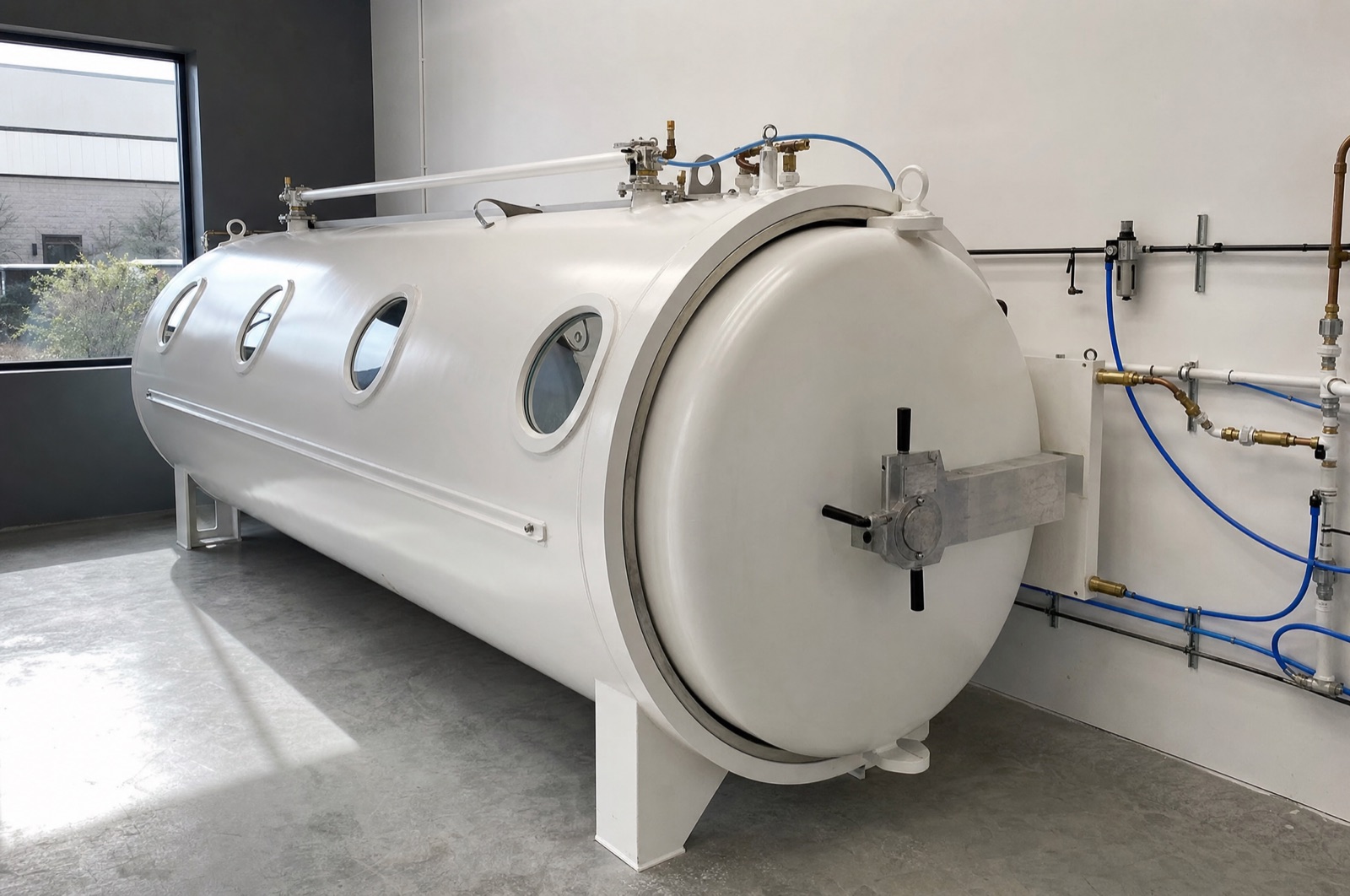
[ Clinic install ] Reference imagery; final photography in production
Where the line sits
The terms mild and medical come from the Undersea and Hyperbaric Medical Society (UHMS), a professional society, not a regulator. Its HBO indications page defines hyperbaric oxygen as a medical procedure requiring a physician's prescription and oversight. The whole body goes inside a hard-sided chamber that meets ASME PVHO-1 and NFPA 99, at not less than 2.0 ATA (202.65 kPa), breathing physician-prescribed medical grade oxygen, typically for 90 to 120 minutes per treatment. The same page says medical grade oxygen, above 99.0% purity and meeting the United States Pharmacopeia standard, is the only acceptable gas.
The same page calls exposures below 1.5 ATA mild hyperbaric oxygen. So the society leaves a band between 1.5 and 2.0 ATA that fits neither label. Its position statement on low-pressure fabric chambers, written by Nick Bird, MD, for the UHMS Safety and Oxygen Therapy committees and revised on 10 July 2018, uses a different number. It describes fabric chambers as operating below 1.4 ATA. The two UHMS documents do not use one cut-off, and this page quotes each where it applies.
The pressure numbers themselves, and how 1.3 ATA compares with 2.0 ATA, are covered in our 2.0 ATA vs 1.3 ATA guide and our pressure ratings guide. This page covers the rest of the gap: the gas, the room, the staff, the paperwork and the codes.
Mild and medical side by side
Each cell below comes from a document we read for this page. Where a source describes a typical setup, the table says so.
| Mild | Medical (UHMS definition) | |
|---|---|---|
| Pressure | Below 1.5 ATA (UHMS); 2 to 4.5 psi typical (Minnesota SFM); 1.3 ATA in clearance K171899 | Not less than 2.0 ATA; a cleared monoplace in K140559 goes to 3 ATA |
| Shell | Often fabric; mild sessions also run in hard chambers (UHMS) | Hard-sided, to ASME PVHO-1 and NFPA 99 |
| Gas breathed | Usually well under 95% oxygen by loose mask (UHMS); 90 to 95% by mask or cannula (Minnesota SFM); fabric chambers built for air only | Medical grade oxygen above 99.0%, prescribed by a physician |
| Oxygen delivery | Mask or nasal cannula inside an air-filled chamber | 100% oxygen in a cleared monoplace (K140559); mask or hood in a multiplace (Cleveland Clinic) |
| Typical setting | Wellness centers, health spas, shopping centers (UHMS) | Hospital or clinic hyperbaric unit |
| Who is present | Generally not physician-prescribed or supervised (UHMS) | Physician prescription and oversight; a provider in the room (Cleveland Clinic) |
| FDA class | Class II, 21 CFR 868.5470, product code CBF | Class II, 21 CFR 868.5470, product code CBF |
| FDA-cleared use | Zippered bags: altitude sickness only | 13 conditions listed by the FDA as of July 2021 |
| Fire code | NFPA 99 Chapter 14 in scope (0 to 100 psi); applied to mild chambers by the Minnesota SFM | NFPA 99 Chapter 14 |
| Accreditation | None we found | Voluntary UHMS facility accreditation |
| Medicare NCD 20.29 | Not addressed | 15 covered conditions, in a chamber |
Sources: UHMS HBO indications page; UHMS position statement on low-pressure fabric chambers (2018); Minnesota State Fire Marshal Division interpretation on mild hyperbaric oxygen therapy; FDA 510(k) summaries K171899 and K140559; 21 CFR 868.5470; FDA consumer update "Hyperbaric Oxygen Therapy: Get the Facts" (archived copy, content current as of 26 July 2021); Cleveland Clinic patient page; CMS NCD 20.29. All read 12 October 2026.
Pressure
The two device records we opened sit far apart. The K171899 summary for the Revitalair 430F, a portable fabric chamber, lists an operating pressure of 4 psi, or 1.3 ATA, and describes the device as a chamber for low pressures, no greater than 1.4 ATA. It is inflated with atmospheric air through an electric compressor, and its relief valves open above 1.3 ATM.
The K140559 summary for the Sechrist 3300H/HR and 3600H/HR monoplace chambers describes pressure chambers designed to give 100% oxygen at pressure greater than ambient, up to 3 atmospheres absolute. It states that typical monoplace chambers can pressurize to 3 ATA, which it gives as 29.4 psig above atmospheric pressure. It also says oxygen exposure is set by selecting the pressure reached in the vessel.
The Minnesota State Fire Marshal Division, writing about mild chambers in commercial use, says they typically operate between 2 and 4.5 psi. That range runs from about 1.14 to 1.31 ATA. The UHMS position statement uses the same 2 psig figure, written as 1.14 ATA, as the point where the ASME PVHO-1 vessel standard begins to apply. Our ASME PVHO-1 guide covers that standard.
Oxygen: what is breathed and where it comes from
Pressure is one half of the comparison. The gas is the other, and the sources differ more here than on pressure. The UHMS medical definition requires medical grade oxygen above 99.0% purity. The Sechrist monoplace summary describes chambers designed to give 100% oxygen, and the Cleveland Clinic patient page says that in a multiplace chamber you receive oxygen through a special mask, or at some facilities a lightweight, see-through hood.
The UHMS indications page describes the mild side differently. It says most clients in mild chambers receive breathing gas mixes well under 95% oxygen. It adds that the masks used often do not seal tightly and let the gas mix with the chamber air, which lowers the concentration further. The Minnesota fire marshal's interpretation describes the setup it was asked about as oxygen given by mask or nasal cannula at 90 to 95 percent.
Fabric chambers have their own limit. The UHMS position statement says they are designed to be compressed only with air and are not designed for use with supplemental oxygen. The FDA consumer update "Hyperbaric Oxygen Therapy: Get the Facts" says the zippered bags it cleared provide pressure but do not attach to oxygen tanks, and that the FDA has not cleared them for use with oxygen tanks or oxygen concentrators. The live fda.gov address for that update returned a 404 when we checked on 12 October 2026, so the link is an archived copy.
The oxygen source is regulated on its own. Under 21 CFR 201.161, oxygen labeled for drug use must carry a warning. Where oxygen may be provided without a prescription for emergency use, that warning must say a prescription is required for all other medical applications. The FDA's archived consumer update on pulse oximeters and oxygen concentrators says concentrators are medical devices required to be sold and used only with a prescription. Our oxygen concentrator guide covers that device in detail.
Setting and who runs the session
The UHMS indications page says mild treatments have become widely available in wellness centers and health spas outside medical facilities, and that they are generally not physician-prescribed or supervised. It also mentions chambers in commercial properties such as malls and shopping centers. The position statement adds that mild sessions are offered in clinical hard chambers as well as in fabric ones, so the shell does not settle which category a session falls in.
The Minnesota interpretation describes one commercial model in more detail. In the setup the fire marshal was asked about, a telemedicine appointment comes before the session and a licensed registered nurse oversees the procedure. The interpretation notes that many of these chambers are in buildings that are not health care occupancies. That is one state's description of the cases it was asked about, not a national rule.
On the medical side, the Cleveland Clinic page says a health care provider is in the room for the whole procedure to answer questions and monitor you. The UHMS position statement recommends that a physician, or a trained non-physician provider where local rules allow, be available immediately throughout a hyperbaric oxygen session. The FDA letter to health care providers of 25 August 2025 asks facilities to keep staff trained and to monitor and supervise the patient for the whole treatment. Our monoplace vs multiplace guide covers how staffing changes with chamber type, and what a session feels like walks through a hospital visit.
The K171899 summary gives a third setting for a fabric chamber. It says the Revitalair 430F is designed for use at physician offices and health institutions. A low-pressure chamber can therefore be labeled for a clinical setting even though the UHMS mild description points to spas and wellness centers.
One FDA category, different clearances
The federal classification does not split mild from medical. 21 CFR 868.5470 defines a hyperbaric chamber as a device intended to raise the environmental oxygen pressure by pressurization greater than atmospheric pressure, and classes it as Class II (performance standards). The FDA's August 2025 letter says HBOT devices are cleared through the 510(k) process and can be found under product code CBF.
The difference is in what each clearance covers. The FDA consumer update lists 13 conditions for which hyperbaric chambers were cleared as of July 2021. It lists the zippered bag separately, as cleared to treat altitude sickness only. The K171899 indications page states its intended use as treating acute mountain sickness under the prescription of a health professional. The UHMS position statement says marketing or operating fabric chambers for anything other than acute mountain sickness is off-label. Our FDA cleared vs FDA registered guide explains how to read a clearance.
Prescription
The UHMS definition makes a prescription part of medical hyperbaric oxygen. The UHMS indications page describes mild sessions as generally not physician-prescribed. The clearances are a separate question. The K171899 fabric chamber is indicated for use under the prescription of a health professional, and the UHMS position statement says hyperbaric therapy requires a physician prescription for procurement and use. Our prescription guide reads seven FDA records on this point and covers the federal Rx only label rule.
Fire code and chamber class
NFPA 99, the Health Care Facilities Code, has a hyperbaric chapter. The Minnesota interpretation quotes its scope: Chapter 14 covers electrical, explosive, implosive and fire hazards of chambers used for medical applications and experimental procedures at gauge pressures from 0 to 690 kPa, which is 0 to 100 psi. A mild chamber at 2 to 4.5 psi sits inside that range. Chapter 14 sorts chambers into three classes.
| NFPA 99 class | Occupancy | Common name |
|---|---|---|
| Class A | Human, multiple occupancy | Multiplace |
| Class B | Human, single occupancy | Monoplace |
| Class C | Animal, no human occupancy | Animal chamber |
Source: NFPA 99 Chapter 14 classes as quoted by the Minnesota State Fire Marshal Division interpretation on mild hyperbaric oxygen therapy, read 12 October 2026.
The class depends on who is inside, not on the pressure, so a one-person mild chamber and a one-person 3 ATA hospital chamber are both Class B. The Minnesota State Fire Marshal Division interprets the 2020 Minnesota State Fire Code, Section 609, to bring mild chambers and the facilities housing them under NFPA 99 Chapter 14. The state fire code and building code both adopt the 2012 edition of NFPA 99 for hyperbaric facilities. The interpretation rejects the argument that Chapter 14 applies only in health care facilities. It says the chamber occupant faces the same hazards whatever the building's occupancy type.
The UHMS position statement points to the same codes. It says chamber construction must meet ASME PVHO-1, that the room housing a chamber must meet the NFPA 99 Chapter 14 housing requirements, and that the UHMS does not endorse in-home therapy at any time. Our NFPA 99 guide covers how cities adopt and enforce the code, and our safety guide covers the hazards it addresses.
Accreditation
Accreditation applies to the facility, not the chamber. The UHMS indications page says the society has set criteria for accrediting hyperbaric treatment facilities. The FDA consumer update advises that, if your provider recommends HBOT, you go to a hospital or facility that has been inspected and is properly accredited by the UHMS. It also says explosions and fires have occurred in HBOT chambers that the FDA had not reviewed, at unaccredited facilities.
AdventHealth Carrollwood, announcing its own UHMS accreditation, says the program is voluntary, takes months of preparation, and that its survey team was a physician, a nurse and a technician who all specialize in hyperbaric oxygen therapy. The UHMS position statement encourages all hyperbaric facilities to become accredited. We found no accreditation program aimed at mild chamber studios. Our clinic buyer's guide covers what a clinic install involves.
Medicare coverage
The Medicare rule is National Coverage Determination 20.29, in manual 100-3, effective 3 April 2017 in its current form. It limits payment to HBO therapy administered in a chamber, including the one man unit, for 15 listed conditions. It lists 22 conditions it does not cover. Topical oxygen was removed from the NCD and left to the regional Medicare contractors. The NCD does not name a pressure, and it does not mention mild chambers. The billing codes, the supervision rules and what two commercial payers say about mild chambers are in our guide to hyperbaric insurance and CPT codes.
None of the sources here tell you whether a given chamber is a good buy. For how the chambers we track compare on what we can verify, see the scorecard, and for the shell question, see hard shell vs soft shell.
What we have not verified
We have not read NFPA 99 itself for this page. The Chapter 14 scope and classes above are as quoted by the Minnesota State Fire Marshal Division, and we have not checked how other states apply the code to mild chambers. We could not open the UHMS accreditation pages on uhms.org, which returned 404 errors, so the size and criteria of the program, and any recognition by The Joint Commission, are open questions. We have not checked whether any state licenses mild chamber studios or sets staffing rules for them. We read two FDA clearances, one fabric and one hard monoplace, not the whole CBF list. We have not found a CMS statement on mild chambers. The Mayo Clinic page we tried returned a 403 error, so the setting and staffing cells rely on one hospital page. If you hold a document that settles one of these points, send it and we will check it.
Frequently asked
What pressure counts as mild hyperbaric?
The UHMS indications page calls exposures below 1.5 ATA mild. Its position statement on fabric chambers uses a different number, describing those chambers as operating below 1.4 ATA. The fabric chamber clearance we read, K171899, lists an operating pressure of 4 psi, or 1.3 ATA. The Minnesota State Fire Marshal describes mild chambers as typically running between 2 and 4.5 psi.
Are mild and medical chambers regulated by different FDA rules?
No. Both fall under the same classification, 21 CFR 868.5470, as Class II devices under product code CBF. What differs is the clearance for each model. The FDA says the zippered bags it cleared are for altitude sickness only. The hard monoplace clearance we read, K140559, covers 100% oxygen at up to 3 ATA for indications set by a UHMS committee.
Can oxygen be added to a soft mild chamber?
The FDA says it has not cleared the zippered altitude bags for use with oxygen tanks or oxygen concentrators. The UHMS position statement says fabric chambers are designed to be compressed only with air and are not designed for use with supplemental oxygen. Our oxygen concentrator guide covers the concentrator side.
Does the fire code apply to a mild chamber in a wellness studio?
In Minnesota, yes. The State Fire Marshal Division interprets the state fire code to bring mild chambers and the buildings that house them under NFPA 99, Chapter 14, whatever the building type. Chapter 14 covers chambers from 0 to 100 psi. Other states may read their codes differently, so ask your local fire authority in writing.
Does Medicare cover mild hyperbaric sessions?
We found nothing in Medicare NCD 20.29 that covers sessions by pressure tier. The NCD limits payment to HBO therapy administered in a chamber, including the one man unit, for 15 listed conditions, and lists 22 conditions it does not cover. It does not name a pressure, and we did not find a CMS source on mild chambers.

Alex tests the machines himself, in clinics and studios on three continents. Every score comes from the same 27 public criteria, and no manufacturer has a say in them.
Six questions, and we'll match chamber, options, and install to your space and budget.