Pros and Cons of Owning a Home Hyperbaric Chamber
Researched and scored by Alex Evans. Last reviewed August 2026. Corrections are dated and public. See corrections
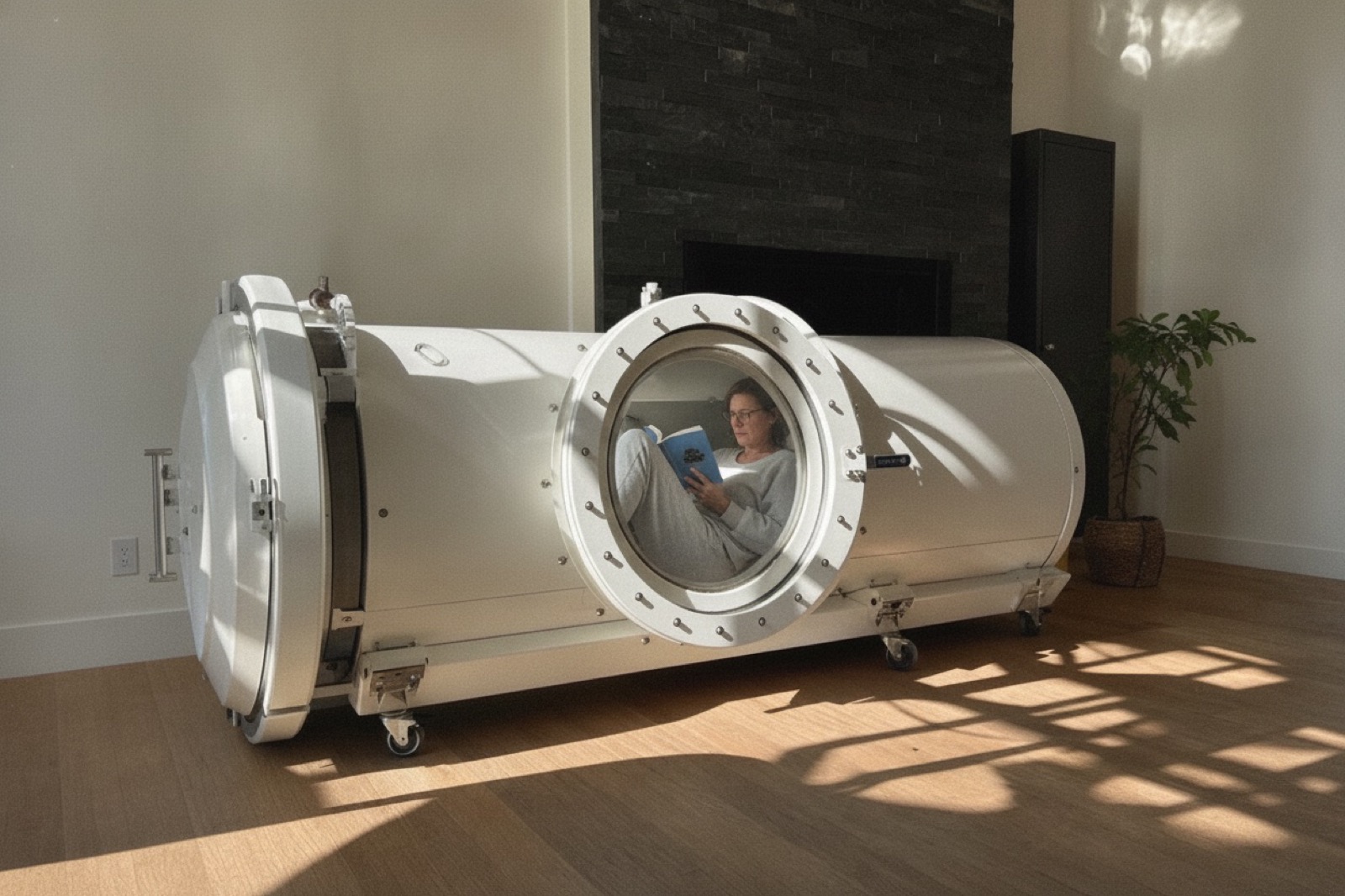
[ Home session ] Reference imagery; final photography in production
The trade-offs, side by side
This page is about owning the machine. It does not weigh what hyperbaric therapy does for anyone, and nothing here is a claim that it does anything. If that is your question, the benefits review sets out what the research supports and what it does not. What follows assumes you have already decided you want regular sessions and are choosing between a chamber in your house and a chamber in someone else's.
Every row below uses a figure already published on this site or a source we checked this month. Where nobody publishes the number, the row says so.
| Factor | Pro | Con | What decides it |
|---|---|---|---|
| Purchase | One payment; after that a session costs cents in power | About $61,000 to $70,000 installed for a hard-shell capsule | How many sessions you will really run |
| Convenience | No booking, no drive, any hour | Only worth paying for if it gets used | Distance to the nearest clinic and your calendar |
| Household use | One unit serves several people and spreads the fixed cost | A monoplace capsule holds one person at a time | How many people will use it, and when |
| Space | A capsule fits through a standard door on casters | 175 to 195 kg, about the floor area of a small couch, permanently | The delivery path and the floor |
| Power | About 2 kWh peak, about $0.34 a session | Needs a circuit you trust; UPS backup is $1,080 to $2,880 | The maker's electrical spec, in writing |
| Heat | You control the room | Chambers warm up under pressure; the air conditioning option is $4,150 | Whether the room can shed heat |
| Noise | You choose when it runs | No published dBA figure for home capsules that we have found | Hearing one run before you buy |
| Upkeep | Power is negligible | Concentrator filters, service intervals, annual safety inspection | The service network near you |
| Resale | Documented hard shells do resell, at 40 to 60% of list | Thin market; soft shells barely resell | Service records and the original crating |
| Supervision and rules | Private, on your schedule | No trained operator; oxygen brings fire rules and a prescription | What you plan to breathe in the chamber |
Prices from the Price Index and the manufacturer 2026 price list cited in the cost guide; weights and power from space and power; supervision from the FDA consumer update and UHMS, linked below. Checked October 2026.
Cost: the purchase is the easy number
The sticker is the part everyone looks at, and it is the smallest part of the decision. The two hard-shell home capsules we track list at $55,500 and $58,500, and land at $61,000 to $67,000 and $64,000 to $70,000 once the options a home actually needs are added. Those options are not trim. The air conditioning option costs $4,150, because a chamber gets warm under pressure. A 20 L/min oxygen concentrator is $5,700. UPS backup power runs $1,080 to $2,880 depending on chamber size.
| Line | Figure | Where it comes from |
|---|---|---|
| Hard-shell capsule, list | $55,500 to $58,500 | Manufacturer 2026 USD price list |
| Hard-shell capsule, installed | $61,000 to $70,000 | Price Index estimate |
| Air conditioning option | $4,150 | Manufacturer 2026 USD price list |
| Oxygen concentrator, 20 L/min | $5,700 | Manufacturer 2026 USD price list |
| UPS backup power | $1,080 to $2,880 | Manufacturer 2026 USD price list |
| Electricity per session, home capsule | About $0.34 | Our analysis at about $0.17 per kWh |
| Electricity per year, daily use | About $124 | Our analysis at about $0.17 per kWh |
| Clinic sessions to cover $64,000 | 427 at $150, 853 at $75 | Break-even analysis |
Sources: cost guide, Price Index and break-even page. Wellness Vaults analysis where marked.
The real cost question is how many clinic sessions the chamber replaces. At $64,000 installed and the $75 to $150 that clinics commonly advertise per session, the answer is roughly 430 to 850. Electricity barely moves that figure: a year of daily sessions costs about $124 in power. Filters, service and the annual inspection move it more, and so does the money you will not get back on resale. The break-even page works through the arithmetic in full, so we will not repeat it here. The short version is that ownership is a bet on frequency, and the cost column is only a con if the frequency does not show up.
Financing changes the shape of the payment, not the total. Chambers qualify for standard equipment financing, which turns a lump sum into a monthly line, but the break-even count does not change because the money arrives in instalments.
Convenience and household use
This is the strongest pro, and it is the one owners mention most. A chamber in the house removes the booking, the drive and the waiting room. If the nearest clinic is forty minutes away, a single session costs an evening, and a regular schedule costs a lot of evenings. At home a session fits wherever the day has a gap.
Shared use is the second pro, and it is what moves the arithmetic most. Two people running sessions on the same chamber roughly halve the per-person cost, which is why couples and families reach break-even where a single user often does not. The catch is capacity. The home capsules we track seat one person, so a household of three running hour-long sessions is booking its own chamber the way it used to book the clinic, just with shorter travel. Multi-seat chambers solve that, but they start at $133,200 list and weigh 670 kg and up, which makes them a clinic purchase rather than a home one; the monoplace versus multiplace guide covers that split.
The con hiding inside convenience is that nobody makes you show up. A clinic booking has a time and a cancellation fee. A chamber in the spare room has neither, and the sessions you meant to run are the easiest ones to skip.
Space and delivery
A hard-shell home capsule weighs 175 to 195 kg, fits through a standard door, and rolls on casters. That is what "portable" means in this market. In practice it takes about the floor area of a small couch and does not move once it is placed. If you rent, expect to move house, or need the room for something else in two years, that permanence is a real con.
The room is rarely the problem. The delivery path is: every door, stair, turn and lift between the truck and the final wall. Floors deserve one question too, mainly on older timber joists above the ground floor. We do not publish a floor-loading figure because the limit belongs to your building, not to the chamber. The space and power guide has the full room checklist and the volumes and weights for each model, and the portability guide covers what a later move involves.
Power, heat and noise
Power is a small con. A home capsule draws about 2 kWh at peak, per the manufacturer electrical specs, which works out to about 34 cents a session at the average US residential rate. Voltage and circuit rating vary by market, so get the electrical specification in writing and hand it to an electrician before you accept a delivery date. Because a pressurized chamber that loses power mid-session is the scenario UPS backup exists for, most buyers should count that line as part of the price.
Heat is a bigger con than people expect. Chambers warm up under pressure, and the room has to put that heat somewhere. That is why the $4,150 air conditioning option is on the price list and why we count it as close to mandatory for daily use.
Noise is an open question, and we would rather say so than guess. We have not found a published noise figure for any home capsule we track. The published measurements we could find come from treatment centers rather than homes: a 2025 study of 41 hyperbaric oxygen therapy centers in Turkey, in the Journal of Ear Nose Throat and Head Neck Surgery, recorded a maximum equivalent continuous level of 81.9 dB(A), and found ventilation during treatment was a main driver. That tells you chambers and their air systems can be loud. It does not tell you what a home capsule sounds like. If a concentrator is part of the setup, it is a second motor in the room; Open Critical Care treats under 50 dBA as the preferred level for one, as our concentrator guide notes. Ask the manufacturer for a dBA figure at a stated distance, in writing, and hear one running before you sign.
Upkeep and the paperwork that holds value
The recurring work is modest but real. The concentrator has filters to clean and replace on the manufacturer's schedule. The chamber has service intervals and an annual safety inspection. None of it is expensive in the way the purchase is, and none of it is optional if you want the chamber to keep working and keep its resale value.
The useful habit is to treat paperwork as part of the machine. Keep every service record with a date, keep the original pressure test certificate, and keep the original crating. Those three things are most of what a future buyer will pay for. Ask before you order what the warranty excludes, who services the chamber in your area, and the response window when something fails. We have not seen these published as standard terms, so get them in writing.
Resale: plan on keeping it
Resale is the con most buyers skip. The used market for home chambers is thin and largely unproven. Used hard shells do surface, at 40 to 60% of list, and the ones that sell well come with a full service history, the original pressure test certificate and a pre-purchase inspection by someone who did not sell them. A shell without those is a pressure vessel of unknown fatigue, and buyers price it that way.
Soft shells resell worse. Zippers and seams wear in ways that are hard to see, and a replacement costs most of the price of a new unit, which is why we would not buy one used. The practical rule for either type: treat the purchase price as spent rather than parked, and buy only if you would be content to keep the chamber for years.
Supervision, regulation and fire
This is where home and clinic differ most, and it is the con with the least room for workarounds. A clinic chamber has staff, procedures and, in a hospital setting, a physician. A home chamber has you.
The regulators and the medical society are direct about it. The FDA's consumer update "Hyperbaric Oxygen Therapy: Get the Facts" says high concentrations of oxygen pose a risk of fire, and that this is one reason the FDA recommends treatment at an accredited facility. The Undersea and Hyperbaric Medical Society, on its HBO indications page, defines hyperbaric oxygen as a medical procedure needing a physician's prescription and oversight, in a hard-sided chamber meeting ASME PVHO-1 and NFPA 99, at not less than 2.0 ATA. It describes mild hyperbaric exposures, below 1.5 ATA, as not physician-prescribed or supervised. Home capsules sit at or below that line, so home use falls outside the setting UHMS describes.
Oxygen is the part that carries rules into your house. In the US an oxygen concentrator is a prescription device, and a fire authority may have a view on the chamber in your room; our concentrator guide covers the prescription, the fire guidance and one fire department's ruling. If the plan involves oxygen, settle those questions before the chamber arrives, not after. Whether your home insurer has a view is a question we have not seen answered in public, so ask your insurer directly.
A soft shell changes the list
A soft shell moves several cons off the table. It costs near $8,000, weighs 30 to 60 kg, and folds away, so space, permanence and resale matter much less. It also changes what you own. Soft shells sit near 1.3 ATA, and the FDA consumer update says it cleared these zippered bags to treat altitude sickness only, that they do not attach to oxygen tanks, and that it has not cleared them for use with oxygen tanks or oxygen concentrators. Bundles that pair one with a concentrator are two devices in one box, not a cleared combination.
So the soft-shell pros are real on cost and space, and the cons sit in what the device is for. The hard shell versus soft shell comparison sets out the line between them.
Who it suits
Ownership fits a household that already runs sessions at a steady weekly rate and has done so for long enough to trust the habit. It fits best where more than one person will use the chamber, because that is what pulls the break-even forward. It fits a buyer with a permanent ground-floor room, a clean delivery path and a circuit an electrician has signed off. And it fits someone far from a clinic, where the hours saved count as much as the dollars. If that describes you, the remaining question is which chamber, and the scorecard is where we answer it.
Who it does not suit
Ownership is a poor fit if you have not yet run a sustained block of sessions, because most people overestimate how often they will keep going. It is a poor fit for renters, for anyone likely to move within a couple of years, and for upper floors with a tight stair. It is a poor fit if the realistic plan is a session or two a month, where a clinic stays cheaper for years. And it is a poor fit if you want a trained operator in the room, because a home chamber does not come with one.
The low-cost test is the same one we give on the break-even page: book twenty or so clinic sessions at the frequency you intend, and see whether the habit survives your calendar. That costs a few thousand dollars rather than sixty, and it turns the biggest unknown on this page into a number.
Frequently asked
What are the main pros of owning a home hyperbaric chamber?
Convenience and shared use. You can run a session at any hour without booking or travel, power costs about 34 cents a session for a home capsule, and one chamber can serve everyone in the household, which spreads the fixed cost. None of that is a health claim; for what the research says about hyperbaric therapy itself, see our benefits review.
What are the main cons?
Price, permanence and the lack of supervision. A hard-shell home capsule costs roughly $61,000 to $70,000 installed, weighs 175 to 195 kg, needs cooling and backup power, and resells thinly. At home there is no trained operator, and the FDA recommends treatment at an accredited facility, in part because high oxygen concentrations carry a fire risk.
How loud is a home hyperbaric chamber?
We have not found a published noise figure for any home capsule we track, so ask the manufacturer for a dBA figure in writing and listen to one running before you buy. The published figures we have are for other equipment: a 2025 study of 41 treatment centers in Turkey measured a maximum equivalent level of 81.9 dB(A), and Open Critical Care treats under 50 dBA as the preferred level for an oxygen concentrator.
Is a soft-shell chamber a cheaper way to get the pros?
It is cheaper, near $8,000, and lighter at 30 to 60 kg, so the space and resale cons shrink. But it is a different product. Soft shells sit near 1.3 ATA, the FDA cleared them for altitude sickness only, and the FDA has not cleared them for use with oxygen tanks or concentrators.
Does a home chamber hold its value?
Not reliably. Used hard shells surface at 40 to 60% of list when they come with a full service history, the original pressure test certificate and an independent inspection. Without that paperwork they are hard to sell. We would not buy a used soft shell at all, because zipper and seam wear is hard to see.

Alex tests the machines himself, in clinics and studios on three continents. Every score comes from the same 27 public criteria, and no manufacturer has a say in them.
Five questions, and we'll match chamber, options, and install to your space and budget.