2.0 ATA vs 1.3 ATA Hyperbaric Chambers: Head to Head
Researched and scored by Alex Evans. Last reviewed August 2026. Corrections are dated and public. See corrections
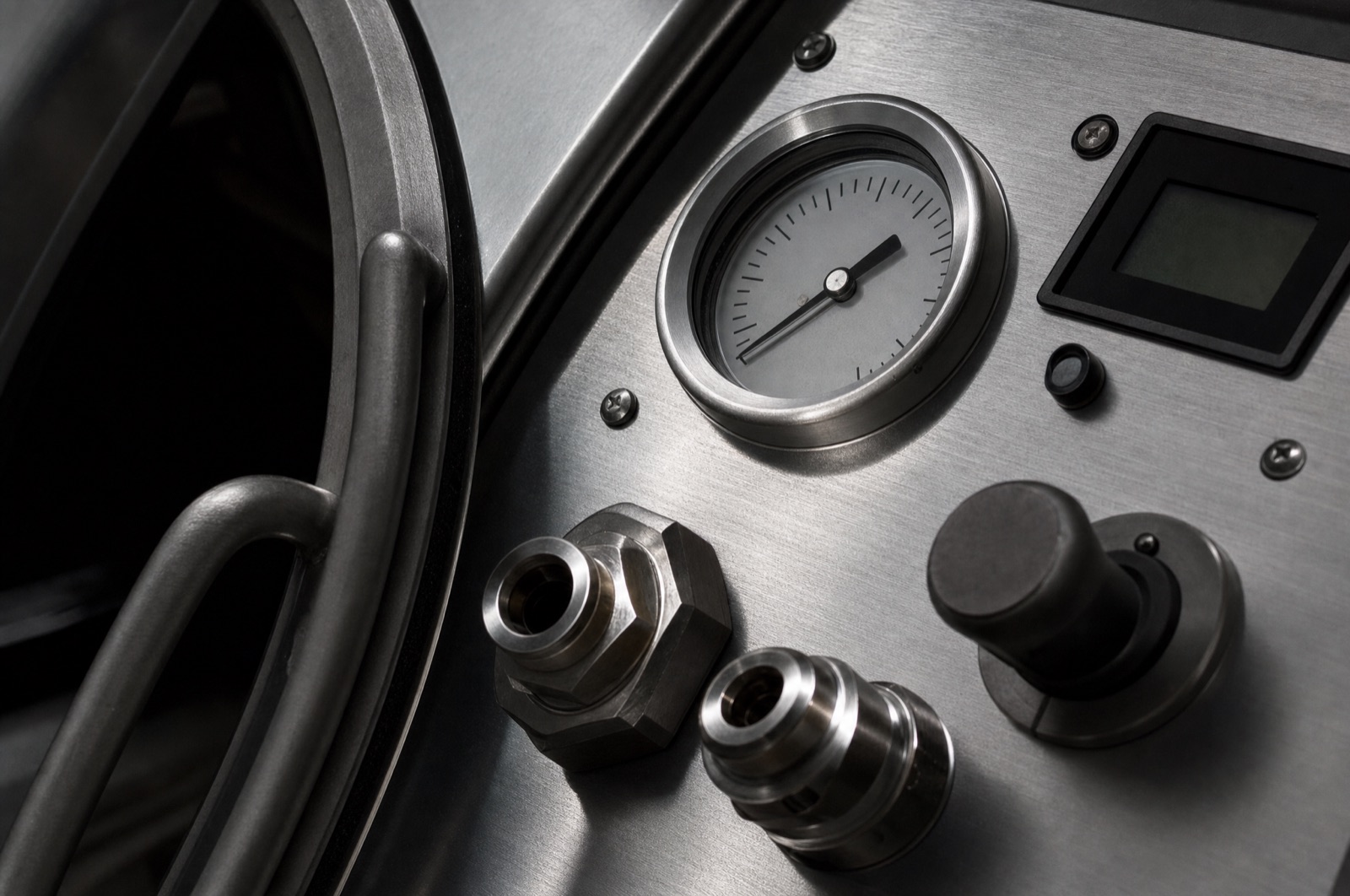
[ Pressure gauge ] Reference imagery; final photography in production
What the two numbers mean
ATA stands for atmospheres absolute: the total pressure on you, counting the atmosphere that is already there. Sea level is 1.0 ATA. The US National Institute of Standards and Technology defines the standard atmosphere as 101.325 kPa, and NIST's factor of 6.894757 kPa per psi turns that into 14.696 psi. NOAA gives the diving version: at sea level the air presses on you at 14.7 psi, and every 33 feet (10.06 meters) of seawater adds one more atmosphere.
So 1.3 ATA is 0.3 atmospheres above ambient: 4.41 psi, 30.4 kPa, about 9.9 feet of seawater, or roughly 3 meters. 2.0 ATA is a full atmosphere above ambient: 14.70 psi, 101.3 kPa, 33 feet of seawater, 10.06 meters. When the Undersea and Hyperbaric Medical Society writes its 2.0 ATA floor as 202.65 kPa, it is quoting the absolute figure, exactly twice 101.325.
The gap between the pair is 0.7 atmospheres: 10.29 psi, about 23 feet of seawater. Check which kind of number a spec sheet is using. Absolute figures (ATA, psia) and gauge figures (psig, kPa above ambient, feet of seawater) differ by exactly one atmosphere, so a 1.3 ATA chamber can be written up as 19.1 psi absolute or 4.4 psi gauge, and both are correct. Our pressure ratings guide covers all three tiers and the altitude framing, and it links back here for this particular pair.
The head-to-head
The pair in one table, with the 1.5 ATA home hard shell added for reference, because that is where most of the market we score sits.
| 1.3 ATA | For reference: 1.5 ATA | 2.0 ATA | |
|---|---|---|---|
| Above sea-level pressure | 4.41 psi / 30.4 kPa / 9.9 fsw | 7.35 psi / 50.7 kPa / 16.5 fsw | 14.70 psi / 101.3 kPa / 33 fsw |
| Absolute pressure | 19.10 psia / 131.7 kPa | 22.04 psia / 152.0 kPa | 29.39 psia / 202.65 kPa |
| Outward load per square meter of shell | About 3.1 tonnes-force | About 5.2 tonnes-force | About 10.3 tonnes-force |
| Typical shell | Fabric with zippers and seams | Tested aluminum cylinder | Hard-sided, to ASME PVHO-1 and NFPA 99 |
| FDA position | Zippered bags cleared for altitude sickness only; not cleared with oxygen tanks or concentrators | Varies by model; ask for the 510(k) number | Class II under 21 CFR 868.5470; clearance is per device |
| UHMS category | Mild (below 1.5 ATA) | Above the mild line, below the medical floor | The medical floor |
| Who runs it | The owner | The owner, or trained clinic staff | Physician prescription and oversight |
| List price | Roughly $8,000 | $55,500 to $58,500 for a capsule | No published price in our index |
| Weight | 30 to 60 kg, folds away | 175 to 195 kg | Not in our data |
| Peak power | Not in our data | About 2 kWh | Not in our data |
Conversions from NIST and NOAA; load is pressure above ambient divided by standard gravity. FDA position from the FDA consumer update and 21 CFR 868.5470; categories and the 2.0 ATA requirements from the UHMS definition of hyperbaric oxygen. Prices, weights and power from the Price Index and manufacturer specifications.
The shell: fabric against a pressure vessel
Force is pressure times area, and a chamber is mostly area. At 1.3 ATA each square meter of shell carries about 3.1 tonnes-force pushing outward. At 2.0 ATA it is about 10.3 tonnes-force, 3.3 times as much, on every seam, seal, hatch and window. That multiplier is the whole engineering story of this comparison, and most of the cost story too.
Fabric copes with low pressure by staying flexible and staying low. A position statement from the South African Undersea and Hyperbaric Medical Association, written with the UHMS Safety Committee and Oxygen Therapy Committee, describes low-pressure fabric chambers as operating at less than 1.4 ATA. The UHMS definition of hyperbaric oxygen goes the other way: it requires a hard-sided chamber that meets the ASME PVHO-1 code for pressure vessels for human occupancy and the NFPA 99 code and standards for hyperbaric chambers. Neither source describes a fabric chamber at 2.0 ATA, and we have not seen one with a published pressure test certificate. If you meet one advertised, ask for that certificate before any other question.
On a hard shell, the number to ask about is the gap between operating pressure and test pressure. The tested figure should sit well above the operating one, and both should be on paper with a date and a serial number. The construction side of this is covered in more depth in hard shell vs soft shell.
The rules: what each pressure is cleared and defined as
Start with the FDA. Every hyperbaric chamber sold in the US falls under 21 CFR 868.5470, which classifies it as Class II (performance standards). Clearance is granted per device, through a 510(k), for a stated list of uses, so the pressure rating alone tells you nothing about what a particular chamber is cleared for.
For 1.3 ATA chambers the scope is narrow and written down. In its consumer update "Hyperbaric Oxygen Therapy: Get the Facts", the FDA says it has cleared a large, zippered bag intended to treat altitude sickness only. Those bags provide pressure but do not attach to oxygen tanks, and the FDA has not cleared them for use with oxygen tanks or oxygen concentrators. The same update warns that homemade setups built from these bags can pose a risk of fire and suffocation. The page now returns a 404 on fda.gov; the link is the archived copy. The SAUHMA and UHMS position statement says the same thing in its own words: 510(k) clearance for acute mountain sickness only, compressed only with air.
For 2.0 ATA the relevant document is a definition rather than a clearance. The UHMS defines hyperbaric oxygen as a medical procedure that requires a physician's prescription and oversight, a hard-sided chamber built to ASME PVHO-1 and NFPA 99, a pressure of not less than 2.0 ATA, and physician-prescribed medical grade oxygen, typically for 90 to 120 minutes per treatment. The same page treats exposures below 1.5 ATA as mild hyperbaric oxygen. A 1.3 ATA soft shell is therefore mild by the society's own line, and a 2.0 ATA session in a hard-sided vessel is the point where its medical definition begins.
These are categories, not results. Nothing on this page says what either pressure does for a body. If the question you are trying to answer is whether a chamber is cleared for something, read FDA cleared vs FDA registered before you read a sales page.
Who runs the session
A 1.3 ATA soft shell is run by its owner. You zip in, the compressor brings the bag up to pressure, and nobody else has to be in the room. That is the arrangement the product was designed around, and it is part of why it is cheap.
At 2.0 ATA the UHMS definition puts a physician in the loop: a prescription before the session and oversight during it. The FDA's consumer update points the same way. It advises anyone whose health care provider recommends hyperbaric oxygen to go to a hospital or facility that has been inspected and properly accredited by the UHMS. Read together, the two documents describe 2.0 ATA as facility territory with clinical staff, not a room in a house.
The 1.5 ATA hard shells sit in the middle here too. In a home the owner runs them; in a clinic, trained staff do, with intake screening and a written protocol, as our clinic guide sets out.
What each one costs
The soft shell in our Price Index lists at roughly $8,000, or about $9,000 with a concentrator, a pairing the FDA has not cleared. Across the soft-shell market we track prices from $5,000 to $25,000. Hard-shell home capsules list at $55,500 and $58,500 and land at $61,000 to $70,000 installed. Going from fabric to a tested 1.5 ATA cylinder multiplies the sticker by about seven.
For 2.0 ATA we cannot give you a number. The one scored chamber listed at or above that pressure is sold on quote only, and its installed cost sits as TBD in the index. We have not seen a published list price for a 2.0 ATA chamber that we could source, so treat any figure you are given as a quote to compare, and ask for it in writing with installation, oxygen supply and service included.
One trap in the price list: a bigger budget inside the hard-shell range we score buys seats, not pressure. The multi-seat chambers at $133,200 to $220,900 run at the same 1.5 ATA as the capsules. Our cost guide itemizes the options that sit on top of every one of these figures.
Space and power
A soft shell weighs 30 to 60 kg and folds away when it is not in use. A 1.5 ATA hard capsule is a permanent fixture: 1,060 or 1,350 liters of internal volume, 175 to 195 kg, through a standard door on casters, and about 2 kWh at peak. We have no weight, volume or electrical figure for a 2.0 ATA chamber that we could source, and the UHMS framing of physician oversight and facility accreditation already tells you what kind of building it expects. If a seller offers one for a home, get the weight, dimensions and electrical requirement in writing before you talk about price. The room-level checks are in space and power needs.
The real choice for most home buyers
Here is the part the search phrase hides. The hard-shell capsules we score are rated 1.5 ATA, not 2.0. The OxyHelp line, for example, operates at up to 50 kPa above ambient, which is about 1.5 ATA, and the other scored capsule's 1.5 ATA rating is still listed as claimed, not confirmed. So a home buyer comparing 1.3 and 2.0 is usually choosing between 1.3 and 1.5, unless they are buying clinical equipment.
That is a smaller step than the headline pair. 1.3 to 1.5 ATA is 0.2 atmospheres, 2.94 psi, about 6.6 feet of seawater. 1.5 to 2.0 is another 0.5 atmospheres, 7.35 psi. By the UHMS lines, 1.5 ATA is no longer mild and not yet medical. If what you want depends specifically on 2.0 ATA, a home capsule at 1.5 does not reach it, and you are shopping in a different category with different rules, staffing and prices.
Which scored chambers reach 2.0 ATA
Our data file lists four chambers on the scorecard. One of them is listed at or above 2.0 ATA: the OxyHealth Fortius 420, a US-made hard shell listed at 3.0 ATA and sold on quote. Its entry in the Certification Database records the claim as FDA-cleared devices used in clinical settings at up to 3.0 ATA, with the status partially verified while registry numbers are compiled. The OxyHelp OxyLife I90 and the OxyRevo Pro 32 are both listed at 1.5 ATA, the second as claimed. The remaining entry is a soft shell. This is a statement of what the data file lists, not a ranking or a recommendation; scores and reasoning stay on the scorecard.
What to get in writing
Whichever side of the pair you end up on, a pressure number on a sales page is a claim. These questions turn it into something you can check.
- What is the operating pressure, stated both in ATA absolute and in psi or kPa above ambient?
- What pressure was the shell tested to, by whom, on what date, and for which serial number?
- Does the chamber meet ASME PVHO-1, and will the seller put that in the contract?
- What is the 510(k) number, and which uses does that clearance list?
- At the rated pressure, who is expected to be present during a session?
- What is the installed price, and what weight, dimensions and electrical supply does it need?
A seller who answers all six on paper has told you most of what this comparison is about. A seller who answers none has told you something too.
Frequently asked
Is 2.0 ATA twice the pressure of 1.3 ATA?
No. In absolute terms 2.0 ATA is about 54% more total pressure than 1.3 ATA. The number that matters for the shell is the pressure above ambient: 14.7 psi at 2.0 ATA against 4.4 psi at 1.3 ATA, so the outward load on every seam, seal and window is about 3.3 times higher.
How deep underwater is 1.3 ATA and 2.0 ATA?
NOAA puts one extra atmosphere at every 33 feet (10.06 meters) of seawater. So 1.3 ATA equals about 9.9 feet of seawater, roughly 3 meters, and 2.0 ATA equals 33 feet, about 10 meters.
Is there a soft-shell chamber that reaches 2.0 ATA?
Not that we have seen documented. The FDA says the zippered bags it cleared are for altitude sickness only, and a position statement co-written by UHMS committees describes fabric chambers as operating below 1.4 ATA. The UHMS definition of medical hyperbaric oxygen requires a hard-sided chamber. If a seller advertises a fabric chamber at 2.0 ATA, ask for the pressure test certificate before anything else.
Can I buy a 2.0 ATA chamber for home use?
Of the chambers on our scorecard, one is listed at or above 2.0 ATA: the OxyHealth Fortius 420, listed at 3.0 ATA and sold on quote only, so we hold no published price for it. The UHMS defines hyperbaric oxygen at 2.0 ATA or more as a medical procedure with a physician prescription and oversight. Ask any seller in writing who is expected to be present when the chamber runs at that pressure.
Where does 1.5 ATA fit between the two?
The UHMS calls exposures below 1.5 ATA mild and sets its medical floor at 2.0 ATA, so 1.5 ATA sits between the two lines. It is the rating of the hard-shell home capsules we score, which is why most home buyers comparing 1.3 and 2.0 are really choosing between 1.3 and 1.5.

Alex tests the machines himself, in clinics and studios on three continents. Every score comes from the same 27 public criteria, and no manufacturer has a say in them.
Five questions, and we'll match chamber, options, and install to your space and budget.