Portable Hyperbaric Chambers: What "Portable" Really Means
Researched and scored by Alex Evans. Last reviewed August 2026. Corrections are dated and public. See corrections
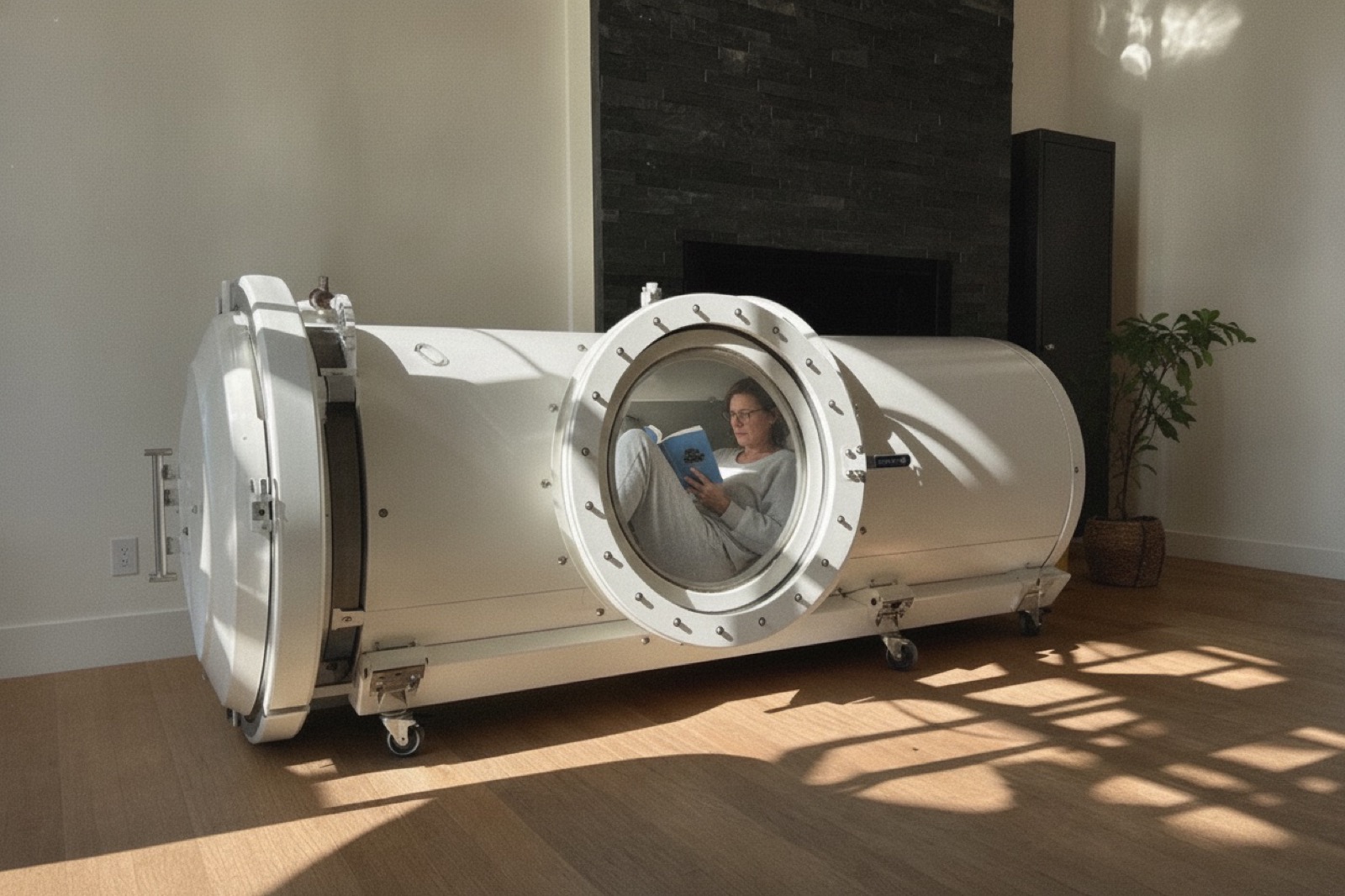
[ Home session ] Reference imagery; final photography in production
What portable actually means
In this market, portable is a spectrum with three honest points on it. A soft shell folds into a duffel and travels. A hard-shell capsule on casters rolls between rooms and survives a house move with professional help. A multiplace chamber goes where the rigging crew puts it and stays there. Every product page that says portable means one of these three things, and the price tells you which.
The numbers that matter
Skip the brochure adjectives and check four numbers against your actual space: weight, width, door clearance along the delivery path, and electrical draw.
| Model | Type | Weight | Width | Power |
|---|---|---|---|---|
| Typical soft shell | Fabric, folds | 30 to 60 kg | Varies | Household outlet |
| OxyLife I80 | Hard capsule, casters | 175 kg | 841 mm | 110/230V, 2 kW peak |
| OxyLife I90 | Hard capsule, casters | 195 kg | Wider bore, same footprint class | 110/230V, 2 kW peak |
| OxyLife C-series | Modular multiplace | 670 to 1,650 kg | Assembled from 76 cm modules | 230/240V, 3.5 kW |
Weights and dimensions from the manufacturer spec sheets, verified August 2026.
The C-series line deserves a note here: the modules are 76 cm wide, which means a multi-seat clinic chamber can enter a building through ordinary doors and get assembled in place. That is not portability for you, but for a clinic in a leased space it is the difference between a delivery and a construction project.
Doorways against published sizes
A hard capsule can roll, but only through a gap wider than it is. The US model home code sets a size for one door only. The AIBD summary of IRC section R311.2, which our delivery and installation guide cites, says every dwelling needs at least one side-hinged egress door with a clear width of at least 32 inches when open at 90 degrees. No size is set for the other doors in a house, so every one on the route needs a tape measure.
| Chamber | Published width or diameter | In inches | Against a 32 inch clear door |
|---|---|---|---|
| OxyRevo Quest30 | 75 cm diameter | 29.5 | Narrower |
| OxyLife I80 | 841 mm wide | 33.1 | Wider |
| OxyRevo Space60 (sitting) | 34 in wide | 34 | Wider |
| HERO LifeCare chamber | 35.4 in diameter | 35.4 | Wider |
| OxyRevo Quest36 | 36 in diameter | 36 | Wider |
OxyLife figure from the manufacturer spec sheet; the others are the published sizes collected in our delivery and installation guide. Inch conversions are Wellness Vaults arithmetic. This compares size only, not quality.
Wider than the door is not always the end of it. A chamber may pass on its side, with feet removed, or in sections, and we do not know which models allow each. OxyHelp says in its FAQ that it reviews the narrowest doorways, corridors, stairs or lift before confirming an order, and that a chamber can be delivered fully assembled or in sections assembled on site. Ask any seller the same question in writing, and ask again if you move.
Soft shells: the genuinely portable option
If travel is the actual requirement, a soft shell is the only honest answer, and you accept 1.3 ATA as part of the deal. The tradeoffs are covered properly in hard shell vs soft shell. What you should not do is pay hard-shell money for a product whose main selling point is a zipper.
Know what the clearance covers before you pack one. The FDA consumer update on hyperbaric oxygen therapy, quoted in our FDA cleared vs FDA registered guide, says the agency cleared a large zippered bag to treat altitude sickness only. It says these bags provide pressure but do not attach to oxygen tanks, and that the FDA has not cleared them for use with oxygen tanks or oxygen concentrators. A soft shell travels with its own electric compressor and runs on room air. A concentrator in the same luggage is a separate product, and the oxygen concentrator guide covers the fire risk NFPA describes in oxygen-enriched spaces.
Portability also cuts the other way at resale. Zippers and seams wear in ways that are hard to see, which is why our pros and cons guide says soft shells barely resell. A bag that has been on many trips is the hardest kind to sell on.
Before you buy
Measure the delivery path, not just the room: every door, stair, and turn between the truck and the final position. Check the floor if you live above a ground floor, because 195 kg concentrated on four casters is fine for concrete and worth a question for old joists. And get the electrical requirement in writing before the chamber ships, not after. Our concierge checks all three against your floor plan for free, which is exactly the kind of unglamorous work that prevents a very expensive doorstop.
The lightest hard shell we score is the OxyLife I80 at 175 kg, reviewed in full in our OxyHelp review. How it places against the rest of the field is on the scorecard.
The weight table nobody prints
Manufacturer pages bury mass in spec PDF footnotes, so here it is in one place for the hard-shell range we score, next to what that weight means in practice:
| Model | Weight | Reality |
|---|---|---|
| OxyLife I80 | 175 kg | Rolls on casters, moves with two people and a plan |
| OxyLife I90 | 195 kg | Rolls on casters, moves with two people and a plan |
| OxyLife C1E | 850 kg | Commercial delivery, planned route, possible structural review |
| OxyLife C2 | 670 kg | Commercial delivery, planned route, possible structural review |
| OxyLife C3 | 1,100 kg | Rolls on casters, moves with two people and a plan |
| OxyLife C4 | 1,450 kg | Rolls on casters, moves with two people and a plan |
| OxyLife C5 | 1,650 kg | Rolls on casters, moves with two people and a plan |
Weights from the manufacturer specification sheets; readiness notes are Wellness Vaults field judgement.
The relocation checklist
If a move is in your five-year picture, walk this list before buying, not after. Measure every doorway on the route, including the building entrance, and compare against the capsule diameter with hatch hardware. Note stairs: any flight means professional movers with equipment. Confirm the destination circuit and floor. Price the move itself before you commit: get a written quote from a crew that moves heavy equipment, because we hold no sourced figure for a capsule relocation, and a C-series is a logistics project in its own right. And keep the original crating, because resale value travels in that box.
Moving a chamber as freight
A hard capsule that leaves your building travels as freight, the same way it arrived. The sellers quoted in our delivery and installation guide say chambers ship by freight and arrive curbside. A freight broker quoted there says carriers will not take freight inside a home, so the move in and out of the room is a separate job for a white glove or specialist crew. Plan for that crew at both ends.
| Step | Window | Source |
|---|---|---|
| Note visible damage on the receipt | At delivery, before signing | Seller instructions |
| Report concealed damage | Commonly 5 days from delivery | NMFC as reported by Trinity Logistics |
| File a written claim with an amount | Carrier may not allow less than 9 months | 49 U.S.C. 14706(e) |
| Carrier acknowledges the claim | Within 30 days of receipt | 49 CFR 370.5 |
Windows as set out, with sources, in our delivery and installation guide.
A note on the receipt is evidence, not a claim. Under 49 CFR 370.3 a damage notation on a delivery receipt does not count as a claim by itself, so file the written claim too. After the move, the chamber needs the same checks as a first install: the circuit, the floor, and a first pressurization run by someone trained on the model. The space and power guide has the clearances and electrical figures, and the warranty guide shows warranty terms that exclude unauthorized installation, so ask the maker in writing whether a move and reinstall by a third party affects your cover.
What we have not verified
We hold no sourced price for moving a capsule, no maker's figure for crated dimensions, and no list of which models can pass a door on their side. We also have no published weight for most soft shells beyond the 30 to 60 kg range above. If a seller gives you any of these in writing, that is better evidence than anything on this page.
Frequently asked
Can a hyperbaric chamber fit through a normal door?
Not always. The OxyLife I80 capsule is 841 mm wide, about 33.1 inches. The US model home code sets a 32 inch minimum clear width for one egress door only, so a door built to that minimum is narrower than the capsule. Measure the clear width of every door on the route with the door open, plus any turns in the hallway, before ordering. OxyHelp says it checks the whole route before confirming an order, and that a chamber can arrive in sections.
Do portable chambers need special electrical work?
The single-person capsules run on ordinary household circuits at about 2 kW peak, similar to a space heater. Multi-seat C-series chambers want 230/240V circuits and up to 3.5 kW, which usually means an electrician visit.
How heavy is a portable hyperbaric chamber?
Soft shells run 30 to 60 kg and fold into cases. The lightest hard-shell capsule we score is 175 kg on caster wheels: movable across a floor, not movable to a second home for the weekend.
Can one person move a portable hyperbaric chamber?
A soft shell, yes: 30 to 60 kg in a duffel-sized bag. A hard-shell capsule, no. At 175 kg and up on casters it rolls on one level, but any threshold, stair, or vehicle means equipment and at least two trained people.
Do upper floors support a hard-shell chamber?
Usually, but check rather than assume. A 195 kg capsule spreads load across its stands and sits well inside residential floor ratings. The C-series at 670 kg and beyond is a structural engineering question, and installers will ask for the floor spec before delivery.
Can I travel with a soft-shell chamber and an oxygen concentrator?
You can carry both, but the FDA consumer update says it cleared the large zippered bags to treat altitude sickness only, that they do not attach to oxygen tanks, and that it has not cleared them for use with oxygen tanks or concentrators. It also warns that homemade oxygen setups built from these bags can pose a risk of fire and suffocation. Our FDA cleared guide quotes the update.
Who pays if a chamber is damaged during a move?
If a freight carrier moved it, you claim against the carrier. Under 49 U.S.C. 14706(e) a motor carrier may not give you less than 9 months to file a claim. Concealed damage has a much shorter notice window in most LTL carrier rules, commonly cited as 5 days from delivery. Note visible damage on the receipt before you sign, and photograph the crate.

Alex tests the machines himself, in clinics and studios on three continents. Every score comes from the same 27 public criteria, and no manufacturer has a say in them.
Six questions, and we'll match chamber, options, and install to your space and budget.