Do You Need a Prescription to Buy a Hyperbaric Chamber?
Researched and scored by Alex Evans. Last reviewed August 2026. Corrections are dated and public. See corrections
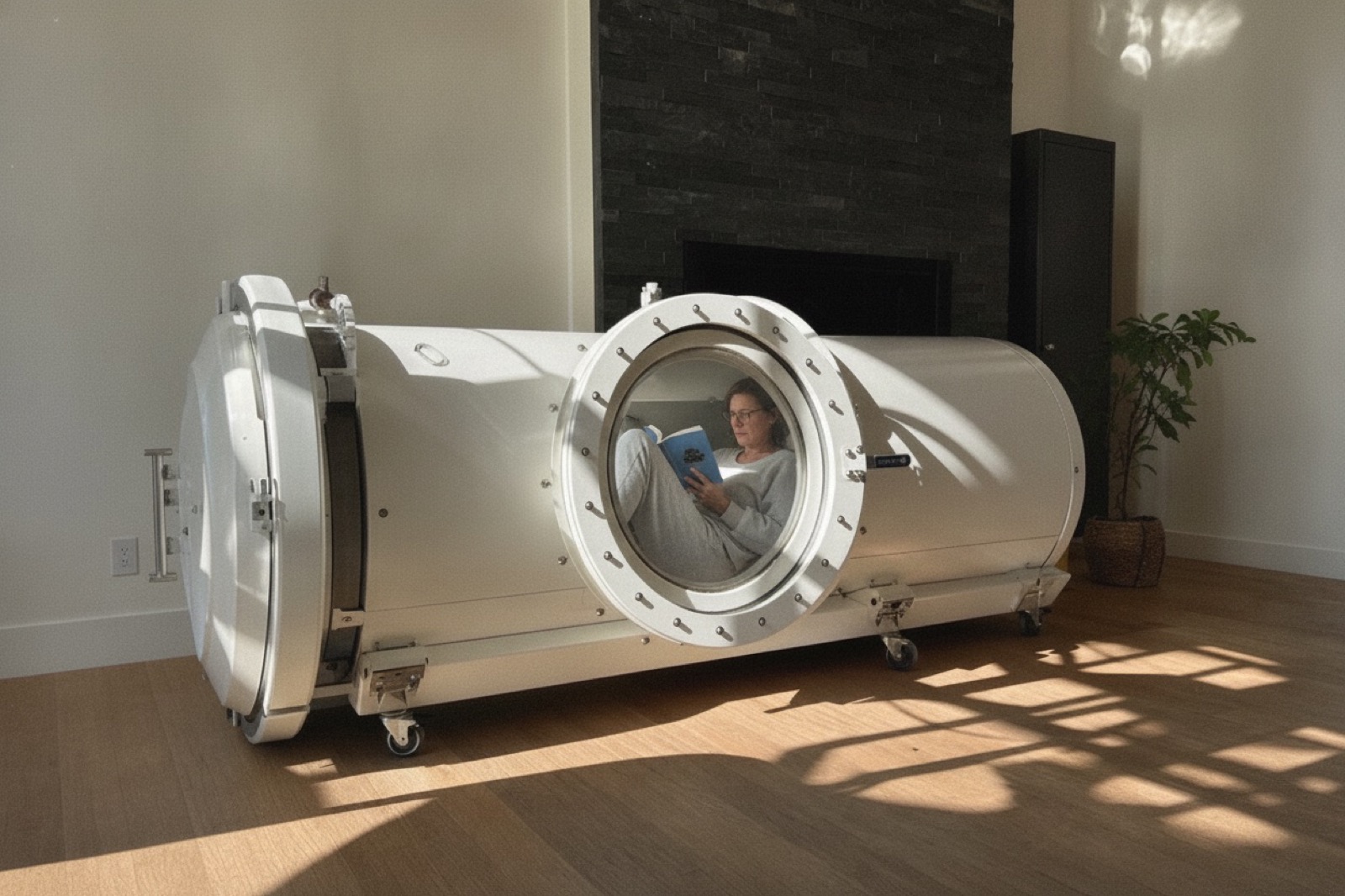
[ Chamber session ] Reference imagery; final photography in production
What the FDA calls a prescription device
The rule sits in the federal device labeling regulations. Under 21 CFR 801.109, a device is a prescription device when, because of its potential for harmful effect, its method of use or the measures needed to use it, it is not safe except under the supervision of a practitioner licensed by law to direct its use. For such a device, "adequate directions for use" cannot be written for a lay person, and the regulation exempts it from that requirement if a set of conditions is met.
The conditions are the part a buyer runs into. Paragraph (a) says the device is to be held by people lawfully in the business of making, storing or selling it, or by a licensed practitioner, and that it is to be sold only to or on the prescription or other order of such a practitioner for use in the course of professional practice. Paragraph (b) says the label must carry either the symbol statement "Rx only" or "℞ only", or the statement "Caution: Federal law restricts this device to sale by or on the order of a" followed by the word physician, dentist, veterinarian or another licensed practitioner. Paragraphs (c) to (e) cover the use information that must go to practitioners and the dating of labeling.
The other side of the line is the over-the-counter device. The definition section, 21 CFR 801.5, says adequate directions for use are directions under which a lay person can use a device safely and for the purposes for which it is intended. An OTC device has to carry those directions. A prescription device does not, because the practitioner is supposed to supply that judgment. So the prescription question comes down to how the maker's device was labeled and cleared. It is not a separate permit you apply for.
Where hyperbaric chambers sit
The classification regulation is 21 CFR 868.5470. It describes a hyperbaric chamber as a device intended to increase the environmental oxygen pressure to promote the movement of oxygen from the environment to a patient's tissue by pressurization greater than atmospheric pressure, and it excludes topical oxygen chambers for extremities. The classification line reads Class II (performance standards). Our FDA cleared vs FDA registered guide explains that this class reaches the US market through a 510(k) clearance, filed under product code CBF.
The classification itself does not say prescription or OTC. Class II describes the level of control the FDA applies. Prescription status is set by the labeling and indications the maker submits and the FDA clears. That is why the useful record is the clearance for a specific model, not the regulation for the whole category.
When we queried openFDA on 9 October 2026, it returned 69 510(k) records under product code CBF, the same total our cleared vs registered guide reported on 5 October. The list spans hard-sided monoplace and multiplace systems, oxygen hoods, control systems, and a handful of portable fabric chambers. Many records date from the 1980s and 1990s.
What the cleared soft chambers say
Soft chambers matter here because they are the ones sold to homes. We opened the five clearances in the CBF list that describe portable fabric chambers and read each one's Indications for Use page. All five have the Prescription Use box marked.
The K220290 record, for the Revitalair 430+ from US Hyperbaric Network, was decided on 4 May 2023. Its summary PDF states the intended use as treating acute mountain sickness under the prescription of a health professional, and says the device is designed for use at health institutions and physician offices. The Prescription Use box is marked, and the Over-The-Counter Use box is empty. Its comparison table has a row headed "Prescription - Rx Only" with Yes in every column. The form itself gives the device name as REVITALAIR 430F+.
The earlier K171899 summary, for the Revitalair 430F from Oxavita Srl, uses the same intended use wording and the same marked box. It describes a chamber of polyester-based plastic fabric inflated with atmospheric air through an electric compressor, at 4 psi or 1.3 ATA.
The K072757 record, for The Shallow Dive, The Dive and The Grand Dive from Summit to Sea, was decided on 8 February 2008. Its summary says the chambers are intended to treat acute mountain sickness as prescribed by or under the direction of a physician. The Indications for Use page carries the sentence "Caution: Federal Law restricts this device to sale by or on the order of a physician", with Prescription Use marked X. The same summary lists the home among the places the device is intended for use, alongside physicians' offices, outdoors and hospitals or clinics.
The two Flexi-Lite clearances read the same way. The K101262 summary from Pressure-Tech, Inc. and the K051759 summary from Performance Hyperbarics each describe a chamber intended for mild symptoms consistent with acute mountain sickness as prescribed by or under the direction of a physician, carry the federal law caution sentence, and mark Prescription Use. The K101262 comparison table lists home, physician office, outdoor, hospital, subacute facility and EMS as intended environments.
So the FDA record and the home setting are not in conflict on paper. Several of these clearances name the home as a place of use and still mark the device for prescription. What the paperwork describes is a device used at home on a practitioner's order, for one condition.
Seven FDA records side by side
We also opened two hard-sided chamber clearances to see whether the pattern held outside soft chambers. It did. The table lists every record we read for this page.
| Device or setup | FDA class | Prescription labeling | Source |
|---|---|---|---|
| Any hyperbaric chamber (category) | Class II, 21 CFR 868.5470 | Not set by the regulation; set per clearance | 21 CFR 868.5470 |
| Revitalair 430+ (soft, portable) | Class II, CBF | Prescription Use marked; "Prescription - Rx Only: Yes" | K220290, decided 4 May 2023 |
| Revitalair 430F (soft, portable) | Class II, CBF | Prescription Use marked | K171899, decided 22 Nov 2019 |
| Shallow Dive, Dive, Grand Dive (soft, portable) | Class II, CBF | Prescription Use X; federal law caution sentence | K072757, decided 8 Feb 2008 |
| Flexi-Lite (soft, portable) | Class II, CBF | Prescription Use X; federal law caution sentence | K101262, decided 10 Jun 2010 |
| Flexi-Lite (soft, portable, earlier filing) | Class II, CBF | Prescription Use checked; federal law caution sentence | K051759, decided 17 Nov 2005 |
| Sechrist 3300H/HR and 3600H/HR (hard, monoplace) | Class II, CBF | Prescription Use marked | K140559, decided 30 May 2014 |
| FINK chambers (hard, multiplace) | Class II, CBF | Prescription Use marked | K240569, decided 21 Nov 2024 |
| Oxygen concentrator | Class II, 21 CFR 868.5440 | FDA: to be sold and used only with a prescription | FDA consumer update, 2021 |
| Soft chamber plus concentrator | No clearance for the combination | FDA: bags not cleared for use with tanks or concentrators | FDA HBOT consumer update, 2021 |
Sources: FDA 510(k) summaries and database records for each K-number listed, read 9 October 2026; openFDA 510(k) data for product code CBF; 21 CFR 868.5470; FDA consumer updates on oxygen concentrators and on hyperbaric oxygen therapy.
Not one of the seven Indications for Use pages we read has the Over-The-Counter box marked. That is a finding about the records we opened, not about all 69. We did not open every CBF clearance, and we do not know of a CBF clearance marked OTC.
How to check a chamber yourself
The check takes about five minutes and needs no account.
- Ask the seller in writing for the K-number of the exact model on your quote.
- Open the FDA 510(k) Premarket Notification database and type the number into the 510(k) Number field.
- Check that the device name and applicant on the record match the model and the company on your quote.
- Open the Summary or Statement PDF linked on the record and find the page titled Indications for Use.
- Read the indications text. The soft chambers above name acute mountain sickness and a physician or health professional.
- Look at the Type of Use line near the bottom. Older forms say Prescription Use or Over-The-Counter Use with a blank to mark. Newer FDA Form 3881 versions show two boxes, one citing 21 CFR 801 Subpart D and one citing Subpart C.
- Compare that with the label on the chamber itself, which under 801.109 should carry "Rx only" or the federal law caution sentence if it is a prescription device.
If the seller cannot give a K-number, the clearance question is still open, and so is the prescription one. The certification database records which brands we have matched to a clearance and how far we got.
Oxygen concentrators have their own rule
A concentrator is a separate device with a separate status, and the FDA has been direct about it. In its consumer update "Pulse Oximeters and Oxygen Concentrators: What to Know About At-Home Oxygen Therapy", content current as of 19 February 2021, the FDA says oxygen concentrators are medical devices required to be sold and used only with a prescription. It says you may have seen concentrators for sale online without a prescription, and that the FDA has not approved or cleared any oxygen concentrator to be sold or used without one. The fda.gov address for that update now redirects to a different pulse oximeter page, so the link above is the archived copy.
The same update says you should not use a concentrator at home unless a health care provider has prescribed it. Our oxygen concentrator guide covers the device itself, its classification under 21 CFR 868.5440, and the fire rules that come with oxygen. The point for this page is simple. A chamber bundle that includes a concentrator brings a prescription device into the purchase even if the seller treats the chamber as a casual buy.
The FDA's "Hyperbaric Oxygen Therapy: Get the Facts" update adds a second layer. It says the FDA has cleared a large, zippered bag intended to treat altitude sickness only, that these bags provide pressure but do not attach to oxygen tanks, and that the FDA has not cleared them for use with oxygen tanks or oxygen concentrators. So a soft chamber and a concentrator sold together are two devices, each with its own label, and the pairing has no clearance of its own.
What the UHMS says
The Undersea and Hyperbaric Medical Society is a professional society, not a regulator, but its definitions are the ones hospitals use. Its HBO indications page defines hyperbaric oxygen as a medical procedure requiring a physician's prescription and oversight, in a hard-sided chamber meeting ASME PVHO-1, at a pressure of not less than 2.0 ATA, while breathing physician-prescribed medical grade oxygen. The same page describes mild hyperbaric exposures, below 1.5 ATA, as not physician-prescribed or supervised and delivered outside medical facilities. Our 2.0 ATA vs 1.3 ATA guide covers where that line falls.
The society's position statement on low-pressure fabric chambers, revised 10 July 2018, goes further on purchase. In its background section it says the FDA lists hyperbaric chambers as Class II medical devices and that hyperbaric therapy requires physician prescription for procurement and use, citing Title 21 of the Code of Federal Regulations. It says fabric chambers below 1.4 ATA have a 510(k) clearance for acute mountain sickness only and are designed to be compressed only with air.
Read together, the two UHMS documents describe a gap. The mild exposures sold to homes are, in the society's words, not physician-prescribed. The clearances behind the soft chambers that deliver them are marked for prescription use. Both statements can be true at once, and that gap is the reason this question gets different answers depending on who you ask.
What the FDA tells consumers
The FDA's hyperbaric consumer update does not use the word prescription for chambers. It recommends checking with your health care provider before using an HBOT device, and if your provider recommends HBOT, going to a hospital or facility that has been inspected and is properly accredited by the UHMS. It says explosions and fires have occurred in HBOT chambers that have not been reviewed by the FDA and are located at unaccredited facilities. It also says the FDA is aware of people using zippered altitude bags to create homemade HBOT devices, which can pose a risk of fire and suffocation.
The FDA's letter to health care providers dated 25 August 2025 is aimed at facilities rather than buyers. It says HBOT devices are Class II devices cleared through the 510(k) process, cites reports of fires with HBOT devices that caused serious injuries and deaths, and asks providers to follow the manufacturer's instructions for use, monitor and supervise the patient for the whole treatment, and keep staff trained. It does not mention prescriptions or sellers. The five newer clearance letters in our table also remind the maker that device labeling must be truthful and not misleading. For the device hazards themselves, see our hyperbaric chamber safety guide.
State law and the practice of medicine
Federal labeling is one layer. States license practitioners and regulate the practice of medicine, and we did not find a regulator source that applies state law to buying a chamber for home use. The closest source we read is a guide by Bay Legal, a California law firm, written for people buying a hyperbaric business. It argues that hyperbaric oxygen delivered in a Class II chamber is the practice of medicine, that California's corporate practice of medicine doctrine applies whether a business markets it as medical or wellness, and that medical-grade oxygen is a prescription drug. That is one firm's legal view on businesses in one state. It is not a ruling, and it is not about a private buyer.
Fire codes are a separate layer again. NFPA 99 governs hyperbaric facilities once a jurisdiction adopts it, and our NFPA 99 guide covers how that enforcement works. A prescription does not settle whether your fire authority accepts a chamber in a given room.
Outside the US
The EU does not use a federal Rx label in the same way. The medical device regulation, Regulation (EU) 2017/745, leaves it to member states. Article 1(15) says the regulation does not affect national law on the organisation, delivery or financing of health services, such as a requirement that certain devices may only be supplied on a medical prescription. Annex I, section 23.4(w), asks that devices intended for use by lay persons say in their instructions when the user should consult a healthcare professional. Whether a chamber needs a prescription in a given EU country is therefore a national question. For how chambers are classed and CE marked, see our CE marking guide.
None of this tells you whether a chamber is a good buy. For how the chambers we track compare on what we can verify, see the scorecard, and for what a session involves once the paperwork is settled, see what a session feels like.
What we have not verified
We have not seen an FDA statement on how 21 CFR 801.109 applies when a private buyer orders a prescription-labeled chamber for home use, or on what counts as a valid order for one. We have not checked whether US sellers ask buyers for a prescription in practice; we found no regulator or neutral source that reports it either way. We have not reviewed FDA warning letters to chamber sellers for this page. We opened seven of the 69 CBF clearances, so we cannot say no CBF clearance is marked OTC. We have not checked the physical labels on any chamber against its clearance. We found no state statute or medical board rule that addresses buying a chamber, and we have not checked any EU member state's national prescription rules. If you hold a document that settles one of these points, send it and we will check it.
Frequently asked
Do soft-shell hyperbaric chambers need a prescription?
The five soft or portable chamber clearances we opened in the FDA 510(k) database are all marked for prescription use on their Indications for Use forms. Their indications cover acute mountain sickness only, as prescribed by or under the direction of a physician or under the prescription of a health professional. A seller may still not ask for one. That is a question about the seller, not about how the device is labeled.
What does "Rx only" mean on a medical device?
It is one of the label statements allowed by 21 CFR 801.109 for a prescription device. The regulation lets the label say "Rx only" or "Caution: Federal law restricts this device to sale by or on the order of a" followed by the type of licensed practitioner, such as physician. A device labeled this way is to be sold only to, or on the prescription or other order of, a licensed practitioner.
How do I find out if a chamber is prescription or over the counter?
Ask the seller for the K-number, then look it up in the FDA 510(k) Premarket Notification database at accessdata.fda.gov. Open the summary PDF and find the Indications for Use page. Near the bottom it has two boxes: Prescription Use, under 21 CFR 801 Subpart D, and Over-The-Counter Use, under 21 CFR 801 Subpart C. The marked box tells you how the device was cleared.
Do I need a prescription for the oxygen concentrator sold with a chamber?
In the US, yes. The FDA has said oxygen concentrators are medical devices required to be sold and used only with a prescription, and that it has not approved or cleared any concentrator to be sold or used without one. The FDA has also said it has not cleared zippered soft chambers for use with oxygen tanks or concentrators.
Is a prescription enough to make home use legal?
We cannot answer that from the sources we checked. A prescription speaks to the federal sale and labeling rule. Fire codes, local permits and state rules on the practice of medicine are separate questions. Our NFPA 99 guide covers the fire code side, and for state law the safest route is to ask the prescriber and your local fire authority in writing.

Alex tests the machines himself, in clinics and studios on three continents. Every score comes from the same 27 public criteria, and no manufacturer has a say in them.
Five questions, and we'll match chamber, options, and install to your space and budget.