What Does a Hyperbaric Session Feel Like?
Researched and scored by Alex Evans. Last reviewed August 2026. Corrections are dated and public. See corrections
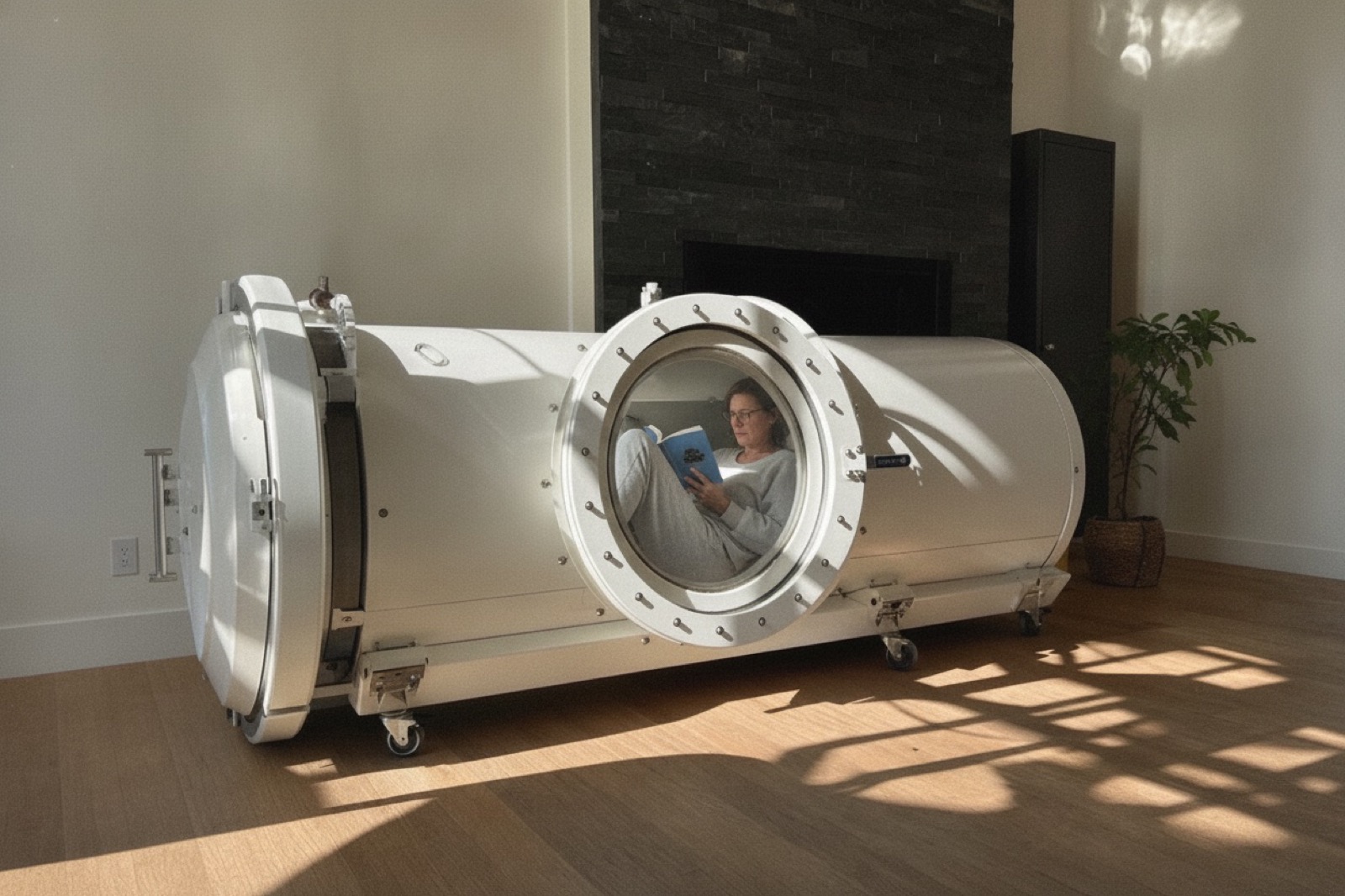
[ Inside a session ] Reference imagery; final photography in production
Before you get in
Every hospital page we read starts in the changing room. Fire is the reason. Pressurized oxygen makes things burn more easily, so what you wear and carry is controlled. Our hyperbaric chamber safety guide explains the fire risk itself. This page sticks to what you will be asked to do.
Clothing comes from the unit. Cleveland Clinic says you change into a hospital gown and remove metal objects and electronic devices. Mayo Clinic content syndicated by its care network says you get a hospital-approved gown or scrubs in place of your own clothes. The details differ by unit. Dartmouth Health asks patients to wear only the cotton gown it provides, with no underwear or socks. Prince of Wales Hospital in Sydney issues 100% cotton scrubs, 95% cotton socks and a blanket, and lets patients keep their underwear on.
The banned list is long and fairly consistent. Across the pages we read it includes:
- Phones, tablets, laptops, ear buds and other battery-operated devices.
- Lighters, matches, hand warmers and anything that makes heat or sparks.
- Makeup, perfume, aftershave, hair spray, lotions, creams and petroleum jelly.
- Jewelry, watches, wigs and hairpieces.
- Synthetic clothing such as nylon, rayon and pantyhose.
- Hard contact lenses and, at several units, hearing aids.
Dartmouth also asks that nail polish be at least 12 hours old and that no lotions, creams, oils or deodorant go on in the 12 hours before treatment. Royal Brisbane and Women's Hospital permits deodorant in its multiplace chamber. That is a good example of why the list your unit gives you is the one to follow.
A few small things are allowed. Cleveland Clinic lets patients bring a small bottle of water. Prince of Wales allows a water bottle and offers a long straw for drinking with a mask or hood on, since some patients get a dry mouth. It also allows a book, a magazine crossword and a pen. Cleveland Clinic suggests using the restroom first. Royal Brisbane asks patients to arrive 30 minutes early for a check, and asks every day about colds, ear problems or new dental work.
Pressurizing: what your ears notice
Hospitals call the start of a session compression, pressurization or descent. The door closes and air or oxygen flows in. The first thing most people notice is their ears.
Cleveland Clinic says your ears may feel clogged or start to pop, similar to flying in an airplane. Royal Brisbane compares it to descending in an aircraft. The reason is simple. The air pressure around you rises, and the small air space behind each eardrum has to catch up through the Eustachian tube. The MedlinePlus entry on ear barotrauma explains that trouble starts when that tube is blocked. It lists fullness or stuffiness, ear discomfort or pain, slight hearing loss and dizziness as symptoms.
The pace is controlled by staff. Royal Brisbane says its compression phase takes about 15 minutes. Prince of Wales says pressure is applied during the first 10 minutes. Both are multiplace units. If you are new to pressure, our pressure guide explains what ATA means and how far down a given session takes you.
You will also hear it. Cleveland Clinic says you might hear a slight hissing sound as the pressure slowly grows. The University of Maryland Medical Center describes a hissing type noise. Royal Brisbane says the compression phase is quite noisy because of the air coming in.
How hospitals teach ear clearing
Staff teach ear clearing before the first session, and they coach it during pressurizing. Royal Brisbane says it is only needed during the compression phase. The techniques on hospital pages fall into two groups.
Gentle moves. Swallowing and yawning appear on almost every page. UC San Diego Health names yawn and swallow. Maryland adds moving your jaw, or chewing. The Townsville Hospital in Queensland mentions chewing gum in its patient leaflet. Cleveland Clinic suggests taking a sip of water, holding your nose and swallowing. Dartmouth lists pinching the nose while swallowing, and turning the head as far to the side as you can.
The pinched-nose blow. This is the move many people know as the Valsalva maneuver. None of the hospital pages we read uses that name; they describe the move instead. Maryland tells patients to take a breath and blow it out gently through the nose while holding the mouth and nose closed. Royal Brisbane describes holding your nose closed and attempting to blow through it. MedlinePlus words it as inhaling, then gently exhaling while holding the nostrils closed and the mouth shut. The word every source uses is gently.
Hospitals also have fallbacks. Prince of Wales keeps nasal decongestant and balloons on hand. Maryland says that if you still have problems, tell the chamber staff, and the pressurization will be stopped until your ears are cleared. The Townsville leaflet says that sometimes small tubes called grommets are put in the ears to help. This is also why colds matter. Prince of Wales says a cold or flu can make it impossible to equalize and may delay treatment.
At pressure: heat, noise and passing the time
Temperature is the second thing people notice. Compressing air warms it. Prince of Wales says the chamber temperature increases as pressure rises and settles once the correct pressure is reached. Maryland explains how: once the prescribed pressure is reached, the air is exchanged to cool the chamber to a comfortable temperature, which it calls a vent. Royal Brisbane says it will seem warm at first and then adjust to a comfortable level.
Once at pressure, the ear work stops and the waiting starts. What you can do depends on the chamber. In Cleveland Clinic's description, monoplace patients can watch television or a movie, sleep, or listen to music, a podcast or an audiobook, while multiplace patients can play card games or read. Royal Brisbane allows reading, resting, sleeping, movies and music in its multiplace chamber. In its monoplace chamber, no reading material is permitted, though you can still watch a movie, rest or sleep. Dartmouth goes further and lists books, magazines, newspapers, writing implements and paper among the banned items.
You are not alone. Cleveland Clinic says a healthcare provider is in the room throughout. UC San Diego says a certified hyperbaric technician or EMT is inside its chamber with patients at all times. In Royal Brisbane's monoplace, a nurse runs the chamber from outside and can hear, see and talk to you. In a multiplace chamber at Prince of Wales, there is a toilet inside, and small items can be passed in through a small lock in the wall.
Hood, mask or a chamber full of oxygen
How you breathe oxygen depends on the chamber type. Our monoplace vs multiplace guide covers the machines. Here is how each one feels from the inside.
In a monoplace chamber you lie down alone in a clear tube. Mayo Clinic content says you lie on a bed that slides in, and the air inside is pressurized pure oxygen. Prince of Wales says no mask or hood is needed because the whole chamber is filled with oxygen. There is nothing to wear on your face.
In a multiplace chamber the room is pressurized with air and each person breathes oxygen through a mask or a clear hood. Townsville measures patients for a hood and neck seal, and uses a mask when the hood will not work. Maryland calls its version a head tent. The oxygen starts only after the chamber reaches pressure: Townsville places the hood once treatment pressure is reached.
Multiplace sessions include air breaks. Prince of Wales gives a 5-minute break when you take the mask or hood off, and says it is the best time to use the toilet. Townsville removes the hood twice. Maryland gives oxygen in two segments with a 5-minute air break between them.
Depressurizing
The end of the session runs the start in reverse. Hospitals call it decompression or ascent. Royal Brisbane says it generally takes 20 minutes, and Prince of Wales says the pressure is released slowly over the last 20 minutes.
Three things change. The ears pop by themselves. Royal Brisbane says you should feel them popping and should not have to equalize, and compares it to driving up a mountain range. The air cools: Royal Brisbane says the chamber becomes colder as air exits, and Prince of Wales says the temperature falls as pressure returns to normal. And there is more noise as air leaves.
One instruction stands out. Maryland tells patients to breathe normally during this phase and, in capital letters, not to hold their breath. Townsville notes you can keep watching a movie or reading.
After the session
Hospitals check you before you leave. Cleveland Clinic says staff take your blood pressure and pulse and examine your ears. The Mayo content describes the same check.
Then most people go about their day. Cleveland Clinic says you can return to normal activities right away, and that you may feel sleepy. Mayo content says you may feel somewhat tired or hungry. Townsville says some patients report being tired or lethargic.
Ear problems are the side effect hospitals list first. Dartmouth calls them the most common side effect, from a feeling of fullness to significant pain. UC San Diego names middle ear barotrauma as the most common. Prince of Wales describes barotrauma as pressure not released from the ear, which can cause pain and damage to the eardrum, and asks patients to speak up early. Several hospitals also mention temporary changes in eyesight over a course of daily sessions. Prince of Wales advises against getting a new glasses prescription during treatment. Cleveland Clinic and Royal Brisbane also list rarer effects, which your hyperbaric doctor covers before treatment begins.
A hospital session, phase by phase
Hospitals publish their own timings, and they differ. The table uses only figures each hospital states for its own unit.
| Phase | What happens | What you may feel | Timing a hospital states |
|---|---|---|---|
| Preparation | Change into unit-issued cotton clothing; banned items go in a locker | Nothing physical | Royal Brisbane: arrive 30 minutes early |
| Pressurizing | Air or oxygen flows in; staff coach ear clearing | Ear fullness, hissing noise, warmth | Royal Brisbane: about 15 minutes. Prince of Wales: first 10 minutes |
| At pressure | Oxygen by hood or mask (multiplace) or chamber oxygen (monoplace); air breaks | Warmth settles after a vent; ears quiet | Royal Brisbane: 75 minutes of oxygen breathing |
| Depressurizing | Pressure released slowly | Ears pop on their own, air cools, more noise | Royal Brisbane: about 20 minutes. Prince of Wales: last 20 minutes |
| After | Ear check, blood pressure and pulse | Some people feel sleepy, tired or hungry | Not stated |
| Whole session | One visit | Cleveland Clinic: 1 to 2 hours. Mayo Clinic content: 1 1/2 to 2 hours. UC San Diego: about 2 hours |
Sources: Royal Brisbane and Women's Hospital patient booklet; Prince of Wales Hospital patient information booklet; Cleveland Clinic; Mayo Clinic Care Network content; UC San Diego Health; University of Maryland Medical Center.
How a home soft chamber session differs
Home sessions are a different setup, and the sources are thinner. No hospital page we read describes one. What follows comes from regulator and medical society documents about the devices.
The breathing gas is different. The Undersea and Hyperbaric Medical Society position statement on low-pressure fabric chambers says they operate below 1.4 ATA, are designed to be compressed only with air, and hold FDA clearance for acute mountain sickness only. It also says the FDA prohibits their use with supplemental oxygen. So there is no hood and no oxygen phase. You breathe room air at a modest pressure. Our oxygen concentrator guide covers why that matters.
The pressure is lower. One soft chamber's FDA 510(k) summary, K171899, lists an operating pressure of 4 psi, or 1.3 ATA, the same as the two predicate chambers it is compared with. The chamber is inflated with room air by an electric compressor. It has relief valves, a pressure measurement, windows for checking on the person inside, and controls that work from the inside as well as the outside. Places of use listed for the predicate chambers include homes and gyms; this one lists hospitals and clinics.
The ears still have to equalize. The same summary lists blocked ear canals, blocked sinuses, colds or flu symptoms and otic barotrauma among its contraindications. That matches what MedlinePlus says about blocked Eustachian tubes. We found no hospital or regulator source that times pressurizing in a soft chamber, measures the temperature change inside one, or describes the noise. Our hard shell vs soft shell guide and portable chamber guide cover how the machines themselves differ.
Supervision is the other big difference. In a hospital, a nurse or technician watches every minute. The UHMS statement recommends that trained clinicians be available throughout hyperbaric oxygen therapy, and says it does not endorse in-home therapy at any time. At home, the person who notices a problem is often you. For the trade-offs of owning one, see home chamber pros and cons, and for the models we track, the scorecard.
What we have not verified
We could not load the Mayo Clinic or Johns Hopkins pages directly, so Mayo statements here come from Mayo Clinic content published through its care network. None of the hospital pages we read names the Valsalva maneuver; they describe the pinched-nose blow, and we link that name to the move only as common usage. We found no hospital, regulator or UHMS source describing a session in a hard-shell home chamber, or giving pressurizing time, temperature change or noise level for any home chamber. We do not know how long a typical home session runs, and we have not tested a chamber ourselves. Hospital rules on clothing and items differ, and the list your unit gives you overrides anything here. If you hold a document that settles one of these points, send it and we will check it.
Frequently asked
Does a hyperbaric session hurt?
The sensation hospitals describe most is ear fullness during pressurizing, like an airplane descent. Royal Brisbane and Women's Hospital tells patients that with a good equalization technique they should not have discomfort, and to tell the nurse at once if they do. Ear barotrauma, pain or damage to the eardrum when pressure is not equalized, is the side effect hospitals list most often.
How do you clear your ears in a hyperbaric chamber?
Hospitals teach a short list of moves: swallowing, yawning, moving the jaw or chewing, sipping water while holding the nose, and holding the nose and mouth closed while blowing gently. University of Maryland Medical Center says that if your ears will not clear, staff stop the pressurization until they do. You only need to clear on the way down; on the way up, ears pop on their own.
Does it get hot inside a hyperbaric chamber?
It warms as pressure rises. Prince of Wales Hospital in Sydney says the temperature increases during pressurizing and settles once treatment pressure is reached. University of Maryland describes a vent that exchanges air to cool the chamber. When the pressure comes back down at the end, the air cools.
What can you do during a hyperbaric session?
It depends on the chamber. Hospital multiplace chambers let patients read, rest, sleep, watch a movie or talk. In a hospital monoplace, Royal Brisbane allows movies, rest or sleep but no reading material. Phones, tablets and other battery devices are banned in every hospital chamber we read about.
How long does a hyperbaric session last?
At the hospitals we checked, about two hours. Cleveland Clinic says one to two hours, Mayo Clinic content says 1 1/2 to 2 hours, and UC San Diego Health says about 2 hours. Royal Brisbane breaks its routine session into about 15 minutes of pressurizing, 75 minutes of oxygen breathing and about 20 minutes of depressurizing.

Alex tests the machines himself, in clinics and studios on three continents. Every score comes from the same 27 public criteria, and no manufacturer has a say in them.
Five questions, and we'll match chamber, options, and install to your space and budget.