FDA Cleared vs FDA Registered: Hyperbaric Chambers
Researched and scored by Alex Evans. Last reviewed August 2026. Corrections are dated and public. See corrections
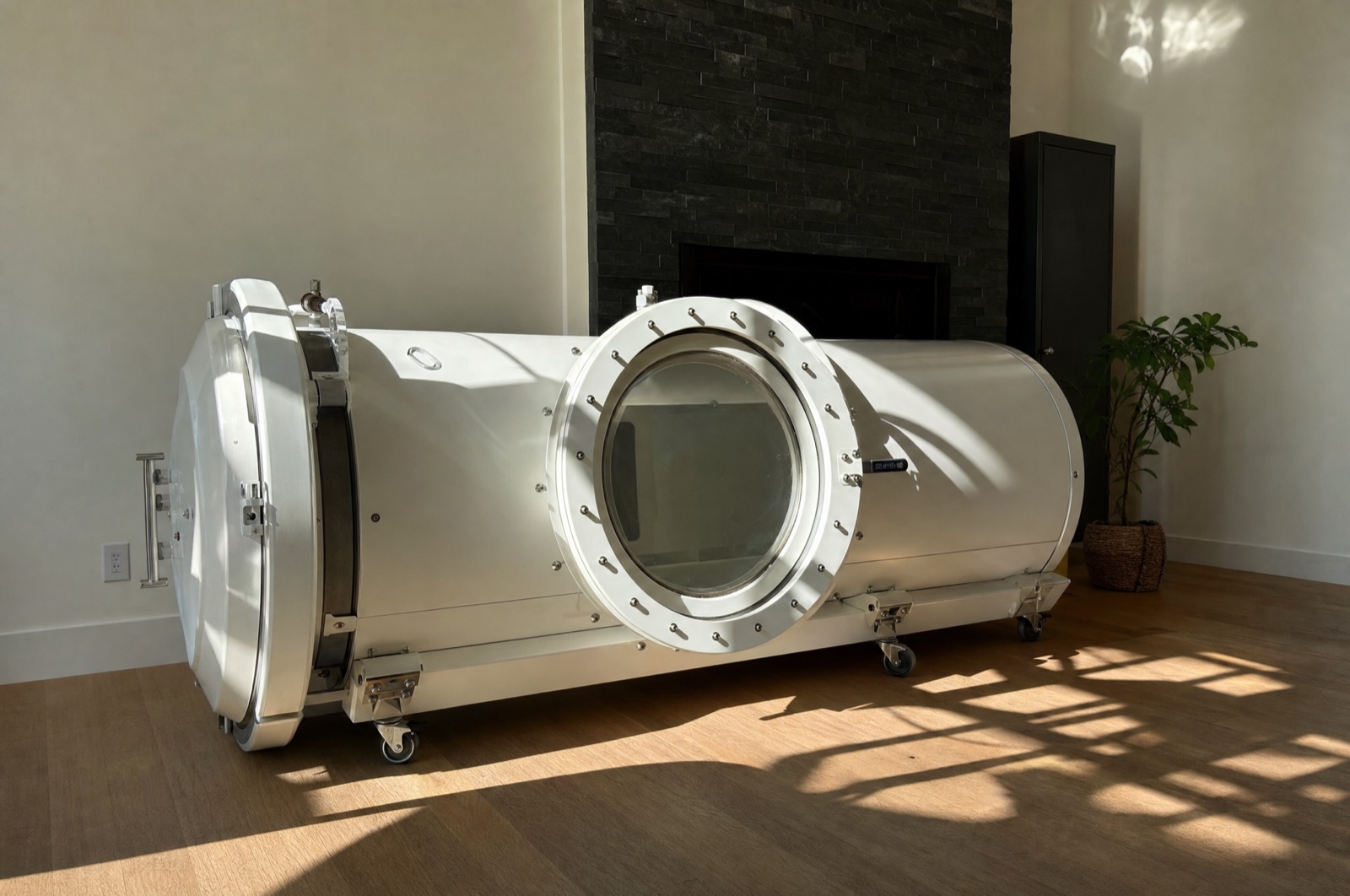
[ Home install ] Reference imagery; final photography in production
What "FDA cleared" means
Cleared is a specific word with a specific source. Under the FDA's premarket notification rules, a 510(k) is a submission a company makes before selling a device in the US, to show the device is as safe and effective as a device already legally on the market. That existing device is called the predicate. If the FDA agrees, it issues an order, in the form of a letter, finding the device substantially equivalent. The FDA's own page says that order "clears" the device for commercial distribution, and the device cannot be marketed until the letter arrives.
Substantially equivalent has a defined meaning. The FDA says a device qualifies if it has the same intended use as the predicate and either the same technological characteristics, or different ones that do not raise different questions of safety and effectiveness, backed by data showing it is as safe and effective. The FDA also says the two devices do not need to be identical. The data can be clinical, or bench testing such as engineering performance, electromagnetic compatibility and software validation.
Two details on the same FDA page matter to a buyer. First, the FDA does not typically inspect the factory before clearing a 510(k); the manufacturer should expect a quality system inspection at any time afterwards. Second, changes to the device after clearance may need a new 510(k). A clearance is a decision about a device as described in a submission. It is not a permanent badge that travels with a brand name.
Cleared, approved, registered, listed, CE marked
These five terms get printed side by side on chamber listings as if they were grades of the same thing. They are not. Two of them are FDA review decisions. Two of them are filings the company makes about itself. The fifth belongs to a different jurisdiction.
| Term | Who does what | Did a regulator review the device? | What to ask for |
|---|---|---|---|
| FDA cleared | FDA issues a substantial equivalence order on a 510(k) | Yes, against a predicate device | The K-number and the indications for use |
| FDA approved | FDA approves a PMA application, the route for Class III devices | Yes, on evidence of safety and effectiveness | The PMA number (unusual for a chamber) |
| FDA registered | The establishment files its annual registration | No. The FDA says it does not denote approval or clearance | Treat as a filing, not a review |
| FDA listed | The establishment lists the devices it makes or distributes | No. Same FDA statement applies | The 510(k) behind the listed device |
| CE marked | Manufacturer declares conformity for sale in the EEA | Not by the FDA; the EU says the mark does not mean an authority approved the product as safe | See the certification database |
Sources: FDA premarket notification 510(k) and premarket approval (PMA) pages; FDA, "Are There FDA Registered or FDA Certified Medical Devices?"; FDA, "Important Reminders about Registration and Listing"; European Commission CE marking page.
Approved is the word the FDA uses for the premarket approval (PMA) pathway. The FDA calls PMA the most stringent type of device marketing application and applies it to Class III devices, those that support or sustain life or present a potential unreasonable risk. In everyday speech people say approved when they mean cleared. On a listing, the difference is worth one question: which number?
Registered and listed are the terms most often used to borrow authority they do not carry. Companies that make or distribute devices for the US market are generally required to register their establishment every year and list the devices they handle. The FDA's consumer page on this exact question answers whether registered is the same as approved, cleared or authorized with one word: no. It states that the resulting database entry does not denote approval, clearance or authorization of that facility or its medical devices. The same page says the FDA does not issue registration certificates, does not certify registration information, and that firms displaying such certificates to imply FDA review misbrand the device. The FDA's registration reminders add that the FDA logo is for official FDA use and not for private sector materials.
CE marking sits outside the FDA system entirely. The European Commission's CE marking page describes it as a sign that products sold in the European Economic Area have been assessed against EU requirements, and notes that it does not indicate a product has been approved as safe by the EU or another authority. It says nothing about US clearance either way. Which brands claim which marks, and how far we have verified each, is tracked in the certification database.
How the FDA classifies hyperbaric chambers
The regulation is 21 CFR 868.5470. It identifies a hyperbaric chamber as a device intended to increase the environmental oxygen pressure to promote the movement of oxygen to a patient's tissue by pressurization greater than atmospheric, excluding topical oxygen chambers for extremities. The classification line reads Class II (performance standards).
The FDA's classification data, queried through openFDA for this page, lists the device as "Chamber, Hyperbaric", product code CBF, regulation number 868.5470, device class 2, reviewed by the anesthesiology panel, with 510(k) as the submission type and the life-sustain or life-support flag set. When we queried openFDA on 5 October 2026 it returned 69 510(k) records filed under product code CBF. That count is the number of submissions on record, not the number of chambers you can buy today; some records are decades old.
The practical reading is simple. A hyperbaric chamber reaches the US market through 510(k) clearance. If a seller tells you a chamber is FDA approved, the number they should be able to produce is a K-number. A PMA number on a chamber would be unusual enough to verify carefully.
A clearance covers a device and a list of uses
A 510(k) clearance is narrower than most marketing implies, in two directions. It covers a named device or set of named models, and it covers the indications for use stated in the submission. The FDA decision letters we read while preparing this page say the device was found substantially equivalent "for the indications for use stated in the enclosure", and that enclosure is an FDA Indications for Use form listing the device names and the conditions. The same letter says the substantial equivalence decision does not mean the FDA has found the device compliant with its other requirements, which include registration and listing, labeling and quality system rules.
So the useful question about any chamber is never just whether it is cleared. It is which model the clearance names, and which uses it covers. A brand can hold a clearance for one model and sell others that are not on the letter. A cleared device can be marketed with claims that sit outside its indications. Neither shows up in the phrase FDA cleared on a product page.
The FDA's consumer update on hyperbaric oxygen therapy describes clearance in the same terms: a determination that the device has the same intended use as, and is as safe and effective as, another legally marketed device of that type. It then lists the conditions for which the FDA had cleared hyperbaric chambers as of July 2021, thirteen in all, including decompression sickness, carbon monoxide poisoning, air and gas bubbles in blood vessels, crush injury, radiation injury and non-healing diabetic foot ulcers. We reproduce that as the FDA's list, not as a claim about outcomes. What the therapy does for any of them is a question for a physician, and our benefits guide keeps to the same line.
Soft shells and the altitude sickness clearance
The site has said since launch that soft-shell chambers are FDA-cleared for acute mountain sickness only. The FDA's consumer update supports that. Under "Other hyperbaric devices" it says the FDA has cleared a large, zippered bag intended to treat altitude sickness only. It says these bags provide pressure but do not attach to oxygen tanks, that the FDA has not cleared them for use with oxygen tanks or oxygen concentrators, and that the FDA is aware of people using the bags to build homemade oxygen setups, which can pose a risk of fire and suffocation.
For a buyer, that means a soft shell sold with an oxygen concentrator bundle is being sold in a configuration the FDA describes as not cleared. It also means the word cleared on a soft shell listing is accurate and still tells you very little, because the cleared use is narrow. The pressure gap between the two shell types is set out in the hard shell versus soft shell comparison, and what the pressure numbers mean is in the pressure guide.
What the FDA says about unproven claims
The FDA consumer update "Hyperbaric Oxygen Therapy: Get the Facts" (content current as of 26 July 2021) warns that some claims about what hyperbaric oxygen therapy can do are unproven. It names cancer, Lyme disease, autism and Alzheimer's disease as conditions HBOT devices are not proven to cure. It says the FDA has not cleared or authorized any HBOT device to treat COVID-19 or any condition beyond its listed ones, while noting HBOT is being studied for other conditions.
The same update recommends checking with a health care provider before using an HBOT device and, where HBOT is recommended, going to a hospital or facility inspected and accredited by the Undersea and Hyperbaric Medical Society. It notes that high oxygen concentrations carry a fire risk, and that explosions and fires have occurred in chambers that had not been reviewed by the FDA and were located at unaccredited facilities. For a clinic buyer, the accreditation point is part of the operating plan, which the clinic guide covers.
The update itself now has a moving address: the fda.gov URL we tried returned a not-found page on 5 October 2026, and we read the text from an archived copy of the FDA page. If the FDA has replaced or withdrawn it, we will update this section when we find the current version.
How to check a claim yourself
Every check below runs on public FDA databases and takes a few minutes. None of them need an account.
The 510(k) database. Go to the FDA 510(k) Premarket Notification database. If you have a K-number, type it into the 510(k) Number field and search. If you do not, put CBF in the Product Code field to see hyperbaric chamber clearances, or search by Applicant Name or Device Name. Open the record. Check that the applicant matches the company selling to you, or its manufacturer, and that the device name matches the model on the quote. Then open the decision PDF and read the Indications for Use page, which lists the device names the clearance covers and the conditions it covers.
The registration and listing database. Go to the FDA Establishment Registration and Device Listing database. Search by Establishment or Trade Name, Owner/Operator Name, Proprietary Name or Product Code. A result tells you the company has registered and listed. On its own it tells you nothing about review. If the seller's evidence stops here, the clearance question is still open.
The classification database. The FDA Product Classification database lets you search by device name or by regulation number 868.5470 to see the class and the submission route for a hyperbaric chamber. The FDA's consumer page also points to Devices@FDA for searching approved and cleared devices by device or company name.
What to ask the seller
Three questions, in writing, before any deposit. First, the K-number. A seller that holds a clearance has the number and gives it without fuss. Second, the indications for use statement for that K-number, the page from the decision letter, not a paraphrase. Third, which exact model and configuration the clearance names, and whether the unit on your quote is that model in that configuration. If the answer is that the clearance belongs to a related model, ask what changed between the two.
Then compare what you were told with what the paperwork says. A clearance for one set of indications does not extend to claims made in a sales call or on a product page. A registration number or a certificate is not a clearance. A soft shell sold with oxygen equipment sits outside what the FDA describes as cleared. Where a seller cannot produce the number, write it down as unverified rather than assuming the paperwork exists. That is how the certification database records every brand we score.
What we have not verified
We have not matched any specific brand or model sold to home buyers against a K-number on this page, and we are not publishing anyone's clearance number here until we have pulled it from the FDA database ourselves. The brand-level status lives in the certification database, and the scorecard applies it. We also have not seen an FDA statement on how clearances apply to chambers bought for private home use rather than clinical settings. If that matters to your purchase, ask the manufacturer in writing which indications and settings their clearance covers, and keep the answer.
Frequently asked
What is the difference between FDA cleared and FDA registered?
Cleared means the FDA reviewed a 510(k) premarket notification for that device and issued an order finding it substantially equivalent to a device already legally on the US market. Registered means the company that makes or distributes the device filed its annual establishment registration. The FDA states that a registration and listing entry does not denote approval, clearance or authorization of the facility or its devices.
Is a hyperbaric chamber FDA approved or FDA cleared?
Hyperbaric chambers are classified under 21 CFR 868.5470 as Class II devices, and the FDA classification data lists 510(k) as the submission type for the product code. That is the clearance route. Approval is the word the FDA uses for the PMA pathway, which applies to Class III devices. If a seller says approved, ask for the clearance number they mean.
Does the FDA issue registration certificates?
No. The FDA says it does not issue any type of device registration certificate to medical device facilities and does not certify registration information. A certificate presented as proof of FDA review is a reason to ask more questions, and the FDA says firms that use such certificates to imply review misbrand the device.
Are soft-shell hyperbaric chambers FDA cleared?
The FDA consumer update on hyperbaric oxygen therapy says the agency has cleared a large zippered bag intended to treat altitude sickness only, that these bags provide pressure but do not attach to oxygen tanks, and that the FDA has not cleared them for use with oxygen tanks or oxygen concentrators.
How do I check a K-number?
Open the FDA 510(k) Premarket Notification database at accessdata.fda.gov, type the K-number into the 510(k) Number field and search. The record shows the device name, the applicant, the product code and the decision date, and usually links the decision letter and the indications for use statement as a PDF.

Alex tests the machines himself, in clinics and studios on three continents. Every score comes from the same 27 public criteria, and no manufacturer has a say in them.
Five questions, and we'll match chamber, options, and install to your space and budget.