Oxygen Concentrators for Hyperbaric Chambers Explained
Researched and scored by Alex Evans. Last reviewed August 2026. Corrections are dated and public. See corrections
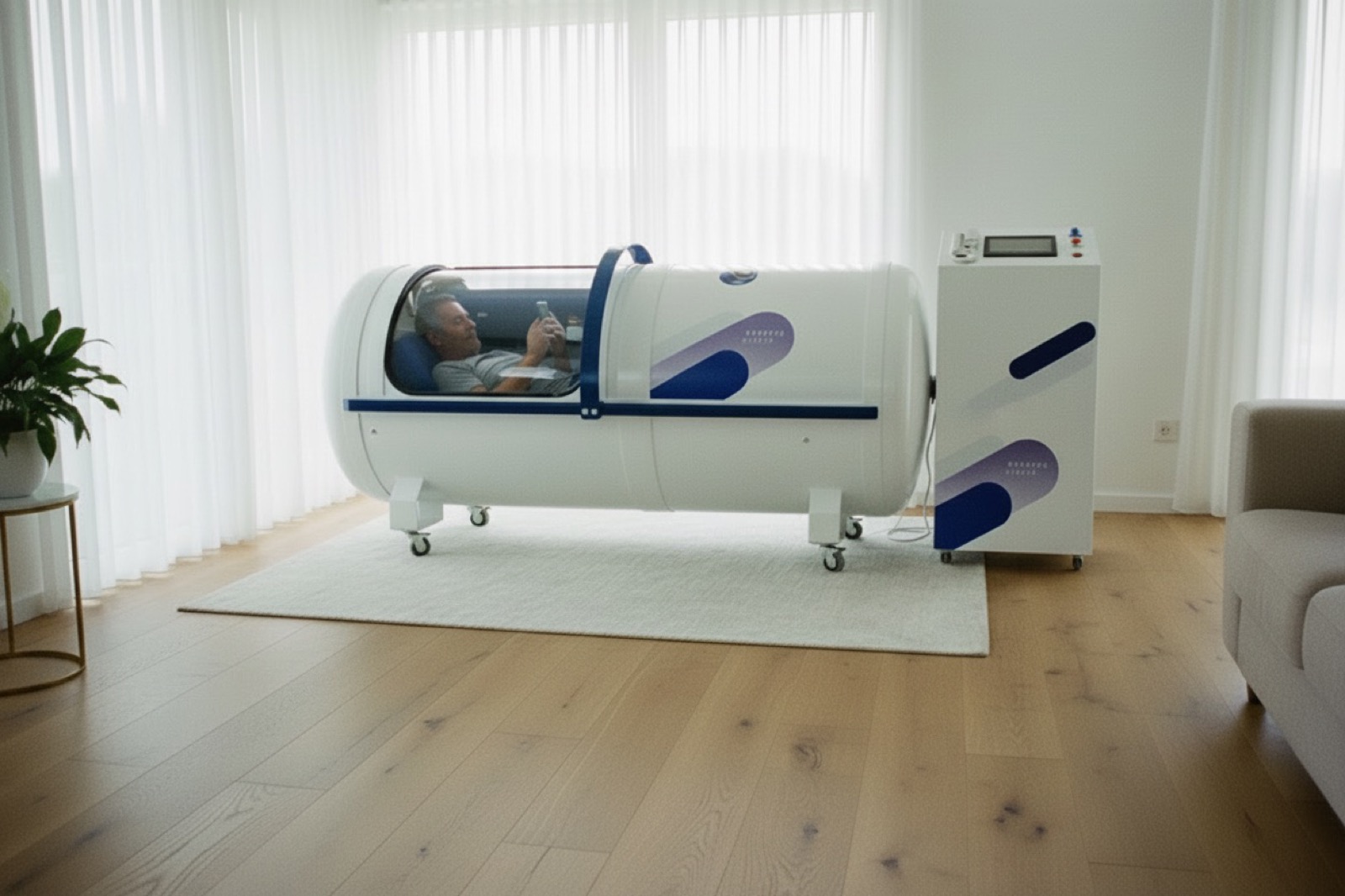
[ Wellness room ] Reference imagery; final photography in production
What an oxygen concentrator is
A concentrator is a box with a compressor, valves, filters and two canisters of mineral inside. It takes in the air around it, which is about 21% oxygen and mostly nitrogen, removes most of the nitrogen, and sends the remaining oxygen-rich gas out through a hose. The FDA describes concentrators as machines that take in room air and filter out nitrogen, and it separates them from tanks because they use electric pumps to make a continuous supply from the air in the room rather than storing oxygen.
That last point matters for buyers. A concentrator never runs out the way a cylinder does, but it also never works without power. It makes oxygen on demand, at a flow rate and purity set by its design, for as long as it is plugged in and its filters are clean.
In the hyperbaric market concentrators turn up in two places. Hard-shell chamber makers sell them as factory options: the price list behind our cost guide shows a 20 L/min concentrator at $5,700, next to a separate automated oxygen control option. And soft-shell sellers sell them in bundles, which is where most of the confusion sits, and which we cover below.
How pressure swing adsorption works
Medical concentrators use a process called pressure swing adsorption, or PSA, and sometimes a vacuum variant of it. Open Critical Care, a clinical reference site, describes the basic idea: air is compressed into a container of zeolite, a mineral that holds on to nitrogen more readily than oxygen, so the oxygen passes through and is collected.
FDA 510(k) filings describe the cycle in more detail. Air enters through the intake and goes to an internal compressor. Pressurized air flows into one of two sieve beds. As it passes through, nitrogen molecules collect on the sieve and the oxygen continues on. At the end of the cycle the trapped nitrogen is purged and the second bed takes over, one depressurizing while the other pressurizes. The oxygen then goes to a small product tank and past sensors that measure concentration and flow before it reaches the user.
So a running concentrator is a compressor and a set of valves working the whole time it is switched on. That is where its noise and its power draw come from, and the air filters in front of the compressor are why it has a cleaning schedule.
Output: liters per minute and purity
Concentrators are rated on two numbers. Flow is how much gas comes out, in liters per minute (L/min, often written LPM). Purity is how much of that gas is oxygen. They move against each other: push more flow through the same sieve beds and the purity tends to fall. A spec sheet that quotes the best purity without saying at what flow is telling you half of the story.
| Figure | Published value | Source |
|---|---|---|
| Minimum oxygen purity | More than 82% at maximum rated flow | WHO technical specifications, as cited by Open Critical Care |
| Typical purity, working unit | 92% to 96% | Open Critical Care |
| Example portable unit purity | 90% (plus 5.5%, minus 3%) | FDA 510(k) summary K250671 |
| Common continuous flow ratings | 3, 5, 8 or 10 L/min; some above 10 | Open Critical Care |
| Hard-shell chamber option | 20 L/min concentrator, $5,700 | Manufacturer 2026 price list, per our cost guide |
| Power, 10 L/min unit | About 350 to 600 W, not variable with flow | Open Critical Care |
| Preferred noise level | Under 50 dBA | Open Critical Care |
Sources: Open Critical Care, "Overview of oxygen sources"; FDA 510(k) summary K250671 (July 2025); manufacturer price list as cited in the cost guide. Checked October 2026.
There is also a split between continuous flow and pulse delivery. A continuous unit sends a steady stream. A pulse unit, according to one FDA 510(k) summary, releases a short burst of oxygen at the start of each breath, which saves battery on portable machines. We have not seen a chamber maker publish which delivery type its oxygen setup is designed around, so ask in writing.
Concentrator, cylinder, compressor
Three machines get confused in sales conversations, and they are not interchangeable. The chamber compressor raises the pressure. The concentrator and the cylinder are two ways of supplying oxygen to breathe. Only the first of the three is part of what makes a chamber a hyperbaric chamber.
| Chamber air compressor | Oxygen concentrator | Compressed oxygen cylinder | |
|---|---|---|---|
| What it delivers | Room air, about 21% oxygen, into the chamber | Oxygen-rich gas, typically 92% to 96%, through tubing | Stored medical oxygen through a regulator |
| Job | Raises chamber pressure | Supplies oxygen to breathe | Supplies oxygen to breathe |
| Needs power | Yes | Yes, continuously | No |
| Runs out | No | No, while powered | Yes; refill when residual pressure drops near 29 psi |
| Stored pressure | None | None to speak of | High, around 2,000 psi |
Sources: FDA 510(k) summaries K072757 and K171899 (chamber compressors); FDA 510(k) summary K250671 (concentrator); Open Critical Care (purity, cylinder pressures).
The soft-shell 510(k) filings we read are specific about the compressor. One describes an airtight bag zipped shut with a person inside and inflated with atmospheric air by a small electric pump. Another describes a fabric chamber inflated with atmospheric air through an electric compressor. Neither mentions an oxygen concentrator. The compressor is what produces the pressure covered in the pressure guide; the concentrator adds nothing to it.
Why soft shells get sold with one
Soft-shell sellers offer a concentrator as an add-on or a bundle, with a mask for the person inside to wear while the chamber holds room air at pressure. Our own price index records it: one soft shell lists at about $8,000 on its own and about $9,000 with a concentrator, from published retail pricing checked in August 2026. That figure is a record of what the market sells. It is not a recommendation to buy the bundle.
The bundle is easy to buy. The regulatory position, which the next section covers, is less convenient for the seller.
What the FDA has and has not cleared
Concentrators first. The FDA has stated that oxygen concentrators are medical devices required to be sold and used only with a prescription, and that it has not approved or cleared any oxygen concentrator for sale or use without one. Its 510(k) records place them under 21 CFR 868.5440, portable oxygen generator, as Class II devices, and one manufacturer summary on file states that concentrator use requires a physician's prescription.
Now the chambers. In its consumer update "Hyperbaric Oxygen Therapy: Get the Facts", the FDA says it has cleared a large, zippered bag intended to treat altitude sickness only, that these bags provide pressure but do not attach to oxygen tanks, and that the FDA has not cleared these bags for use with oxygen tanks or oxygen concentrators. The same update says the agency knows of people using these bags to build homemade setups, which can pose a risk of fire and suffocation. That page now returns a 404 on fda.gov; the link above is the archived copy, dated content current as of July 26, 2021.
The Undersea and Hyperbaric Medical Society, a professional society for hyperbaric medicine, says the same thing in its position statement on low-pressure fabric chambers: they are designed to be compressed only with air, their clearance covers acute mountain sickness only, and they are not designed to be used with supplemental oxygen.
Put together, a soft shell and a concentrator are each regulated products, and the combination is not one the FDA has cleared. A seller who lists the bundle is selling two devices in one box, not a cleared oxygen-delivering chamber. For the difference between a clearance and a registration, see FDA cleared vs FDA registered, and for the wider soft versus hard comparison see hard shell vs soft shell.
Hard shells sit under a different rulebook. In a 2024 fire department appeal record from Des Moines, Iowa, a hard-sided chamber carrying an ASME PVHO-1 placard and supplied from oxygen tanks was found acceptable after some additional work, while a soft-sided chamber with its own oxygen concentrator was ordered out of the building. The fire department said the soft chamber could not be shown to meet ASME PVHO-1, which NFPA 99 requires for hyperbaric chambers.
Fire: the risk that comes with the oxygen
The National Fire Protection Association's medical oxygen tip sheet puts it simply: fire needs oxygen to burn. It says that if a fire starts in an oxygen-enriched area, the burning material burns more quickly, and that oxygen saturates fabric-covered furniture, clothing, hair and bedding. It names smoking materials as the leading heat source in medical oxygen fires.
A fabric chamber is a closed space made of fabric with a person and their clothes inside. That is why the threshold matters. The Des Moines fire engineer's letter notes that normal air is about 20.95% oxygen, that OSHA defines anything above 23.5% as a hazardous atmosphere, and that NFPA 99 uses the same 23.5% figure to define an oxygen-enriched atmosphere. Oxygen leaking from a mask or hood into a sealed chamber pushes in that direction. We have not seen a soft-shell seller publish a measured oxygen level inside its chamber during mask use; ask for one.
The FDA raised fire again in an August 2025 letter to health care providers, citing reports of fires with hyperbaric devices that caused serious injuries and deaths, and warning of a heightened risk of fire with oxygen at high concentration. Its recommendations include fire prevention measures, keeping prohibited items such as electrical or static devices out of use, and hyperbaric-compatible clothing such as cotton. Concentrators carry their own record too: the FDA has posted a 2024 recall of one home concentrator model over incidents of device melting and fire. Before you buy any unit, search the FDA recall database for the model number.
The home rules from the two named authorities are short. NFPA: no smoking in a home where oxygen is used, no candles or other open flames, keep oil, grease and hand lotion away, no aerosol sprays nearby, and keep cylinders at least five feet from heat, open flame or electrical devices. FDA: do not use a concentrator near an open flame or while smoking, give it open space so it does not overheat, do not block its vents, and check it for alarms.
Power, noise and upkeep
A concentrator is a second motor running next to the chamber compressor, so it adds to both the power bill and the noise. Open Critical Care puts a 10 L/min unit at about 350 to 600 W, a draw that does not fall when you turn the flow down, and treats under 50 dBA as the preferred noise level. One FDA 510(k) summary for a small portable unit lists a maximum operating sound level of 43 dBA. We have not seen published power or noise figures for the concentrators bundled with soft shells, so ask. For the chamber side of the electrical budget, see space and power.
Maintenance is mostly filters. Open Critical Care's guidance, written for clinical use, calls for inspecting and cleaning the air inlet filter once or twice a week and replacing humidifier water daily where a humidifier is fitted. Home schedules vary by manufacturer, and the manual is the document that counts. Budget for filters and a periodic purity check, because a concentrator that still blows air is not proof that it is still making oxygen at its rated purity.
What to ask a seller
Get these answers in writing before you pay. If a seller cannot answer them, treat that as an answer too.
- Is the chamber cleared by the FDA for use with this concentrator? If yes, ask for the 510(k) number and check that the cleared indication and configuration include oxygen.
- What is the 510(k) number of the concentrator itself, and who will write the prescription it requires?
- What purity does it deliver at the flow rate you will use, and at its maximum rated flow?
- Is it continuous flow or pulse delivery, and does it have a low-purity alarm?
- Does oxygen exhaust outside the chamber, and what oxygen level has been measured inside the chamber during use?
- What does the concentrator draw in watts, and how loud is it in dBA?
- What is the filter schedule, what do replacement filters cost, and who services the sieve beds?
- Has the concentrator model ever been recalled? Check the FDA recall database yourself as well.
- Does the chamber meet ASME PVHO-1, and will your local fire authority accept it in the room you plan to use?
None of this tells you whether a chamber is worth buying, and nothing here is a claim about what added oxygen does for anyone. For what the evidence does and does not support, see the benefits review. For how the chambers themselves compare, the scorecard has the scored list.
Frequently asked
Does a soft-shell hyperbaric chamber need an oxygen concentrator?
No. A soft shell is pressurized by its own electric compressor using ordinary room air, and the FDA 510(k) summaries we read describe exactly that. The FDA states it has not cleared these zippered bags for use with oxygen tanks or oxygen concentrators. Sellers still offer bundles; our price index lists one soft shell at about $8,000 on its own and about $9,000 with a concentrator.
Do you need a prescription for an oxygen concentrator?
In the US, yes. The FDA has said concentrators are medical devices to be sold and used only with a prescription, and that it has not cleared any for sale or use without one. The FDA classifies them under 21 CFR 868.5440 as Class II devices.
How pure is the oxygen from a concentrator?
WHO technical specifications require more than 82% oxygen at the maximum rated flow, and most working units produce 92% to 96%, according to Open Critical Care. One FDA 510(k) summary for a portable unit lists 90%, plus 5.5% or minus 3%. Purity tends to drop as flow rises, so ask for the figure at the flow you will actually use.
Is an oxygen concentrator the same as the chamber compressor?
No. The compressor pushes room air, about 21% oxygen, into the chamber to raise the pressure. The concentrator separates oxygen from room air and sends it through tubing to a mask or cannula. They do different jobs, and one cannot stand in for the other.
Is it a fire risk to use oxygen near a hyperbaric chamber?
Yes, and that is the main safety issue. NFPA says material burns more quickly in an oxygen-enriched area and that oxygen soaks into fabric, hair and bedding. The FDA has warned about fires with hyperbaric devices and says homemade setups built from zippered bags can pose a risk of fire and suffocation.

Alex tests the machines himself, in clinics and studios on three continents. Every score comes from the same 27 public criteria, and no manufacturer has a say in them.
Five questions, and we'll match chamber, options, and install to your space and budget.