NFPA 99 Explained: Hyperbaric Fire Safety Code
Researched and scored by Alex Evans. Last reviewed August 2026. Corrections are dated and public. See corrections
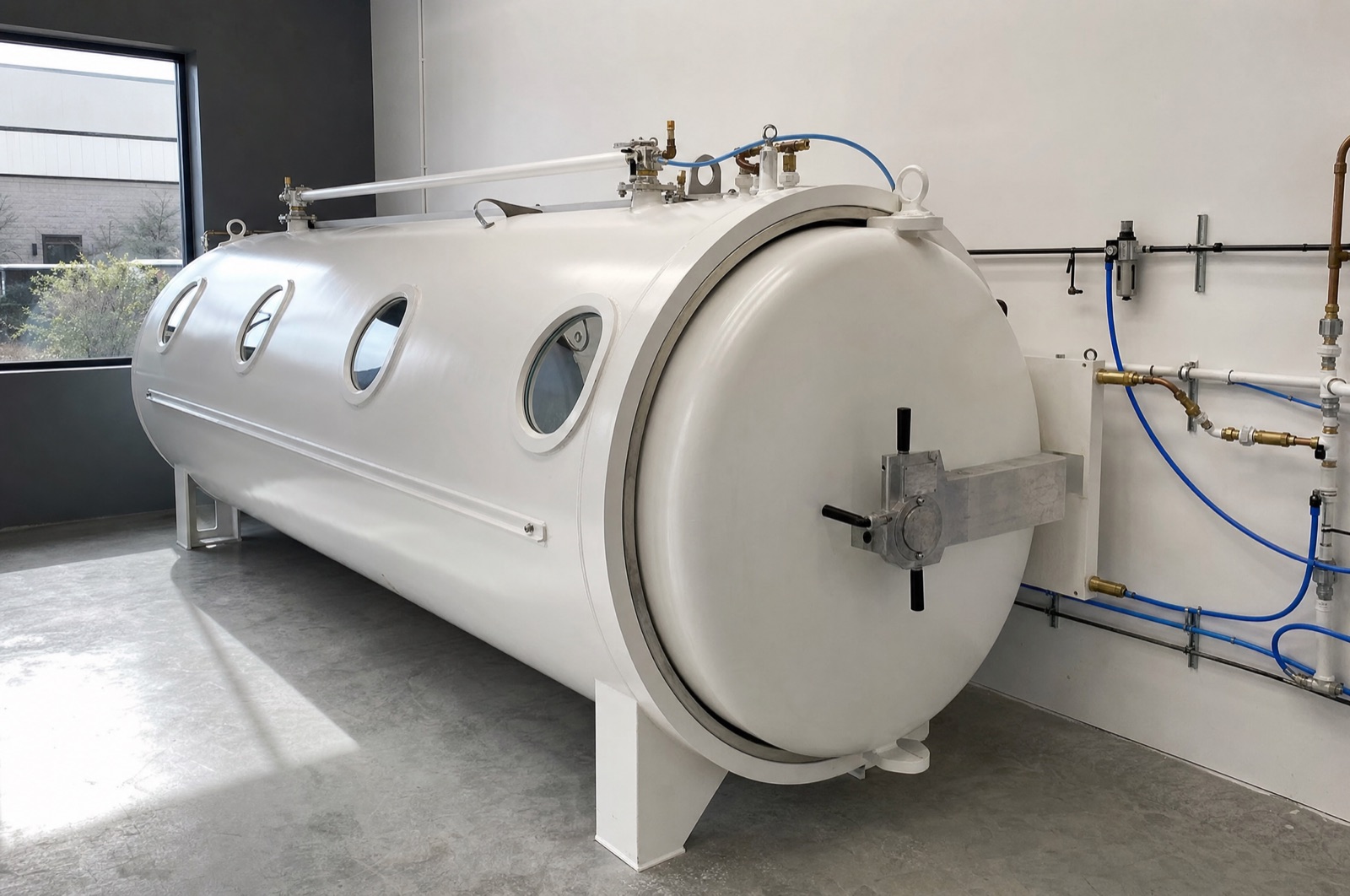
[ Chamber rooms ] Reference imagery; final photography in production
What NFPA 99 is
NFPA 99 is the Health Care Facilities Code. The National Fire Protection Association writes it. It covers health care buildings broadly; one committee member's comment, for example, points to its Chapter 5 rules on piped gas and vacuum systems. One chapter, Chapter 14, is about hyperbaric facilities. That chapter is the reason a fire marshal can walk into a wellness studio and ask about its chamber.
The code is not free to own. One retailer lists the 2024 edition as a 266-page softcover at $165. The International Association of Fire Chiefs offers free read-only access to NFPA technical documents, which cannot be downloaded or printed. We have not worked through the full current edition. This page works from public documents that quote it: a state fire marshal interpretation, a city fire department letter, the committee's own published ballot and revision reports, and the Undersea and Hyperbaric Medical Society (UHMS). Where they stop, we say so.
A useful way to hold it in your head: NFPA 99 is about the room and the operation. It asks how a chamber is housed, what goes into it, how fire is prevented and fought, and how staff are trained. The vessel itself has its own standard, ASME PVHO-1, which NFPA 99 points to. For the wider picture on chamber risks, including pressure and ear injury, see our hyperbaric chamber safety guide. This page sticks to the code.
Chapter 14 and the 0 to 100 psi range
The Minnesota State Fire Marshal quotes the scope of Chapter 14 in its interpretation on mild hyperbaric oxygen therapy. Section 1.1.12 says the chapter covers hazards of an electrical, explosive or implosive nature, and fire hazards, for chambers and facilities used for medical applications and experimental procedures at gauge pressures from 0 to 100 psi.
Zero is the important number. There is no lower pressure floor. A soft chamber at 1.3 ATA runs about 4.4 psi above sea-level air, as our pressure guide works out. That sits well inside the range. Minnesota's fire marshal reached the same view. Its interpretation says mild chambers typically run between 2 and 4.5 psi, and because they run above normal atmospheric pressure, they and the facilities that house them appear to fall within Chapter 14.
Location does not change that. Minnesota notes an argument that Chapter 14 only applies inside health care facilities, and answers that the annex to Section 1.1.12 has been updated to say the safeguards apply regardless of location. NFPA's 2024 first-revision report for the next edition goes further. It drops the words "for medical applications" from the definition of a hyperbaric facility, with the committee writing that risk mitigation and fire code adherence are necessary for all hyperbaric uses. That report is a draft stage, not a published edition.
Chapter 14 also sorts facilities into risk categories. Committee members quoting the code describe Category 3 as the case where failure of the gas supply or electrical service is not likely to cause injury to patients, staff or visitors. Several members wrote in 2023 that mild chambers already fall under Category 3. The same 2024 report deletes a reserved Category 4, with the committee stating there is always some risk in a hyperbaric operation.
Class A, Class B and Class C chambers
Section 14.1.2.2 classifies chambers by who is inside them. Minnesota's interpretation lists the three classes:
- Class A: human, multiple occupancy.
- Class B: human, single occupancy.
- Class C: animal, no human occupancy.
The 2024 first-revision report adds annex text saying the industry calls Class A chambers multiplace and Class B chambers monoplace. A vessel with several seats inside it is Class A. A capsule or tube built for one person is Class B, whether the shell is hard or soft. Class C is for animals.
The class matters because several rules name it. In the draft revisions we read, the clothing rules name Class A and Class B chambers, and the rule calling for qualified inside attendants names Class A only. Staff can ride inside a multiplace vessel. In a monoplace one, the occupant is alone.
How NFPA 99 reaches a building
NFPA writes the code. It gets force when a state or city adopts a law that points to it. Two public documents show the chain.
The Des Moines Fire Department's May 2024 appeal letter says the International Fire Code requires NFPA 99 for hyperbaric facilities, and that NFPA 99 requires ASME PVHO-1 as the construction standard for chambers. The city was enforcing the 2018 International Fire Code during the dispute and later adopted the 2021 edition, which references the 2021 edition of NFPA 99.
Minnesota does it through two codes. Section 609.1 of the 2020 Minnesota State Fire Code adopts the 2012 edition of NFPA 99 for hyperbaric facilities, and says they shall be inspected, tested and maintained to it. Section 425.1 of the Minnesota Building Code says hyperbaric facilities shall meet Chapter 14. Note the edition: a state can enforce a version of NFPA 99 that is several cycles old.
NFPA 101, the Life Safety Code, is the third route. In the 2023 committee ballot, one member wrote that NFPA 101 requires any occupancy containing a hyperbaric chamber to comply with NFPA 99. The UHMS position statement on low-pressure fabric chambers says the same, and adds that the room housing a chamber shall meet the housing requirements of Chapter 14. If you plan a chamber for a business, the fire marshal who covers that address decides which edition and which sections apply. Our clinic guide covers when to bring that conversation into planning.
Oxygen, clothing and fire equipment
Oxygen is what turns a pressure question into a fire question. The Des Moines letter sets out the numbers. Normal air is 20.95% oxygen. OSHA treats anything above 23.5% as a hazardous atmosphere, and NFPA 99 uses 23.5% in its definition of an oxygen-enriched atmosphere. The fire engineer wrote that items burn hotter and faster and ignite more easily with more oxygen, and that a static spark can be enough to start a fire.
That threshold is close to what mild chambers deliver in practice. Minnesota describes mild sessions where oxygen is given by mask or nasal cannula at 90 to 95 percent. One committee member wrote in 2023 that many soft chambers in doctors' offices are used with oxygen in the 95 to 97% range. Oxygen escaping from a mask into a closed chamber raises the level of the air around the occupant. Our oxygen concentrator guide covers what the FDA has said about soft chambers and concentrators.
The FDA has raised fire directly. In an August 25, 2025 letter to health care providers, it said it was aware of recent reports of fires with hyperbaric devices that resulted in serious injuries and deaths, and that the root cause was not known. It asked providers to use proper grounding equipment, dress patients in hyperbaric compatible materials such as cotton, and keep prohibited items, including electrical or static devices, out of use.
NFPA 99 handles the same risks through rules on what enters the chamber and what sits in the room. From the 2024 first-revision text:
- Silk, wool and synthetic textiles are prohibited in Class A and Class B chambers, with listed exceptions.
- Clothing worn by patients in Class A or Class B chambers must be issued by the facility or approved by the hyperbaric safety coordinator, be uncontaminated, and be free of prohibited articles before pressurization.
- The room housing a chamber of any class must hold at least one 2-A:10B:C portable fire extinguisher.
The annex to that extinguisher rule is worth reading closely. It says a water-filled extinguisher discharged inside a chamber would have less negative effect on occupants than an ABC or CO2 unit, and that ABC chemicals might permanently damage the acrylic windows of Class A or Class B chambers. It asks each facility to run a documented risk assessment to choose extinguishers. Chapter 14 also covers built-in fire suppression: the same report has rules for testing deluge systems and other chamber suppression systems. We have not confirmed which of these suppression rules apply to Class B chambers.
The 2023 ballot on mild chambers
In 2023 a wellness chain proposed Tentative Interim Amendment (TIA) 1735 to NFPA 99. It would have created a Category 4 for chambers under 5 psi with oxygen below 25 percent. Those chambers would be classed as Class B, and Sections 14.2 and 14.3 of Chapter 14 would not apply to them. The proposal listed what it would waive, including 2-hour fire-resistant-rated construction around the chamber and compliance with Section 14.2.6. It argued that ASME had said mild chambers sit outside PVHO-1.
The final committee ballot, dated July 21, 2023, shows 20 members eligible to vote. The result was 0 in favor, 17 against, 1 abstention and 2 not returned, on both technical merit and emergency nature. Passing needed a three-quarters affirmative vote.
The written comments are the most useful part for a buyer. Two members who said they sit on the ASME PVHO committees wrote that they knew of no ASME statement putting mild chambers outside PVHO-1. Several wrote that PVHO-1 covers any vessel above 2 psi and offers a code case route for non-standard designs such as fabric. One wrote that the proposed text did not require fire sprinklers while the existing code does. Another wrote that the proposed ventilation rate was too low to clear carbon dioxide, and that many such units lack gas monitors. One wrote that there have been injuries and fatalities in chambers that were not certified, or were not built, run and maintained to Chapter 14.
The committee came back to it in 2024. Its first-revision report deletes the reserved Category 4. The committee statement says at least one death has been reported inside one of the chambers the proposed category was meant to cover. The Des Moines letter cites the ballot directly, and concludes that the 2024 edition of NFPA 99 still requires all hyperbaric chambers to meet ASME PVHO-1.
Where each rule comes from
Five public documents carry most of what is known about NFPA 99 and mild or home chambers. Each one has a different author and a different kind of authority.
| Document | Author and date | What it says | What kind of authority |
|---|---|---|---|
| Mild hyperbaric oxygen therapy interpretation | Minnesota State Fire Marshal | Mild chambers at 2 to 4.5 psi and their facilities must comply with NFPA 99 Chapter 14; lists Class A, B and C | Official interpretation of the state fire code |
| Appeal letter, soft-sided chamber | Des Moines Fire Department, May 6, 2024 | IFC requires NFPA 99; NFPA 99 requires PVHO-1; soft chamber without PVHO-1 papers ordered out | Local enforcement record, recommendation to an appeal board |
| TIA 1735 final ballot | NFPA hyperbaric committee, July 21, 2023 | Proposal to lighten rules for mild chambers rejected 0 to 17 | Code committee vote and members' comments |
| First-revision report | NFPA hyperbaric committee, 2024 | Deletes Category 4; Class A, B and C annex; extinguisher and clothing text | Draft for the next edition, not yet final |
| Low-pressure fabric chamber statement | UHMS, revised July 10, 2018 | NFPA 101 and NFPA 99 apply; chamber construction must meet PVHO-1 | Medical society position, not a code body |
Sources: Minnesota Department of Public Safety, State Fire Marshal Division; Des Moines Fire Department appeal letter (2024); NFPA 99 TIA 1735 final ballot results (2023); NFPA 99 HEA-HYP first-revision report (2024); UHMS position statement on low-pressure fabric hyperbaric chambers (2018).
NFPA 99, PVHO-1 and FDA clearance
Three different documents get mixed up on chamber listings. NFPA 99 governs the facility and how it is run. ASME PVHO-1 governs how the vessel is designed, built and tested. An FDA 510(k) clearance is a federal decision about marketing a device for stated uses. Our page on ASME PVHO-1 explains the vessel standard, and FDA cleared vs FDA registered covers the federal side.
The link between the first two is direct. A committee member wrote in the 2023 ballot that Chapter 14 requires chambers to be fabricated to ASME PVHO-1, and housed, maintained and operated per the chapter. So a chamber that lacks PVHO-1 documents has a problem under NFPA 99 as well.
FDA clearance does not fill that gap on its own. In Des Moines, the chamber owner offered an FDA clearance in place of PVHO-1. The fire engineer wrote that without information comparing the scope and passing criteria of the two, he could not confirm the FDA clearance was equivalent in terms of fire safety. He recommended the appeal be denied. The UHMS definition of medical hyperbaric oxygen names both codes: a hard sided chamber that meets ASME PVHO-1 and NFPA 99. For how hard and soft chambers differ in build, see hard shell vs soft shell.
What to ask before you install
Ask in writing and keep the answers. For a home buyer, the seller is the first stop. For a business, the fire marshal is.
- To your fire marshal: which edition of NFPA 99 does this jurisdiction enforce, and through which code?
- To your fire marshal: will you review the chamber and the room before it goes in?
- To the seller: which NFPA 99 class is this chamber, and what is its maximum operating pressure?
- To the seller: can you send ASME PVHO-1 documentation for this unit, and the 510(k) number?
- To the seller: is the chamber designed for use with supplemental oxygen, and what oxygen level has been measured inside it during use?
- To the seller: what clothing and items does the manual prohibit inside the chamber?
- To the seller: how does the occupant get out if power fails, and how long does it take?
- For a business: what fire extinguisher type, signage and staff training do you recommend for the room?
A good answer to every question is not a reason to buy. It tells you the paperwork exists. For how the chambers we track compare on what we can verify, see the scorecard.
What we have not verified
We have not read the full text of any edition of NFPA 99. Section numbers and quotes on this page come from documents that cite it: the Minnesota interpretation, the Des Moines letter, the TIA 1735 ballot and the 2024 first-revision report. The first-revision text is a draft and may change before the next edition is issued. We have not confirmed which fire suppression rules in Chapter 14 apply to single-person chambers, or what the published 2024 edition says word for word on extinguishers and clothing. We do not know how many states or cities enforce Chapter 14 against home installations, as opposed to businesses. We make no claim that any brand meets or fails NFPA 99. If you hold a document that settles one of these points, send it and we will check it.
Frequently asked
What is NFPA 99?
NFPA 99 is the Health Care Facilities Code published by the National Fire Protection Association. Its Chapter 14 deals with hyperbaric facilities. Per the scope quoted by the Minnesota State Fire Marshal, that chapter covers electrical, explosive, implosive and fire hazards of chambers used at gauge pressures from 0 to 100 psi.
Does NFPA 99 apply to mild or soft-shell chambers?
Fire officials and the NFPA committee itself have said yes. The Minnesota State Fire Marshal interprets mild chambers running at 2 to 4.5 psi as inside the scope of NFPA 99 Chapter 14. In 2023 the NFPA committee voted 0 for and 17 against a proposal to put mild soft chambers in a lighter category, and several members wrote that existing Category 3 rules already apply to them.
What are Class A, B and C hyperbaric chambers?
NFPA 99 sorts chambers by who is inside. Class A is human, multiple occupancy, which the industry calls multiplace. Class B is human, single occupancy, called monoplace. Class C is for animals, with no human occupancy. A chamber built for one person, hard or soft, is Class B.
Is NFPA 99 the law where I live?
It becomes enforceable when a state or city adopts a code that points to it. Des Moines enforces the International Fire Code, which references NFPA 99 for hyperbaric facilities. Minnesota adopts the 2012 edition of NFPA 99 for hyperbaric facilities through its fire and building codes. Which edition applies to you depends on local adoption, so ask your fire marshal.
Can I read NFPA 99 for free?
You can read it, but not keep it. The International Association of Fire Chiefs offers free read-only access to NFPA technical documents, which cannot be downloaded or printed. Printed copies are sold; one retailer lists the 2024 softcover at $165. We have not read the full current edition ourselves.

Alex tests the machines himself, in clinics and studios on three continents. Every score comes from the same 27 public criteria, and no manufacturer has a say in them.
Five questions, and we'll match chamber, options, and install to your space and budget.