Hyperbaric Chamber vs Isolation Tank: Two Different Machines
Researched and scored by Alex Evans. Last reviewed August 2026. Corrections are dated and public. See corrections
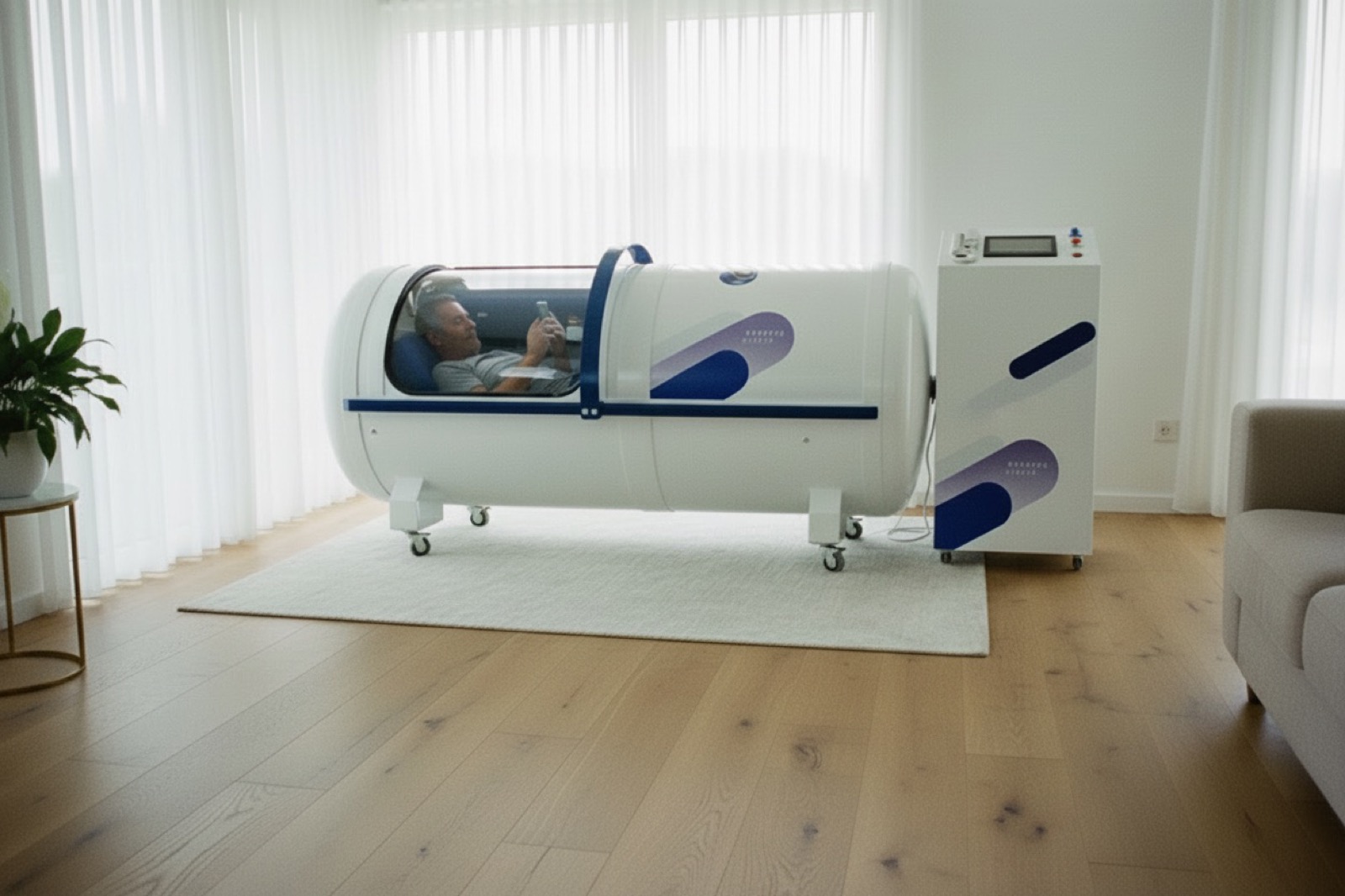
[ Hyperbaric chamber ] Reference imagery; final photography in production
What a float tank is
A float tank is a small pool of heavily salted water inside a dark, quiet enclosure. You lie on your back and the salt holds you up. It goes by several names: isolation tank, sensory deprivation tank, float pod, float pool. In research papers the method is called flotation-REST, where REST stands for restricted environmental stimulation technique or therapy. A 2025 systematic review in BMC Complementary Medicine and Therapies describes it as floating in a soundproof and lightproof chamber, in a shallow pool of water saturated with Epsom salt, which makes the water dense enough to float without effort.
The clearest published numbers come from the methods section of a 2024 trial in PLOS ONE run at the Laureate Institute for Brain Research in Tulsa, Oklahoma. Each of its float pools measured 2.44 meters across and 0.28 meters deep. That is about 11 inches of water. The water held over 800 kilograms of Epsom salt, which is magnesium sulfate, giving a specific gravity of about 1.26. Plain water is 1.0. The rooms were built to be lightproof and soundproof, and both the air and the water were set to match skin surface temperature, about 35.0 degrees Celsius.
Commercial pods are smaller. The Western Australia Department of Health's float tank guidelines describe typical units as clamshell pods holding around 1,000 liters of water, with Epsom salt at around 30 to 40 percent by weight and the water heated to around 35 degrees Celsius. The same document puts the salt in each tank at 500 to 550 kilograms, and notes that the water is changed rarely because of that cost.
Notice what is missing from every one of those descriptions: pressure. The float sources talk about salt, temperature, light and sound. None of them describes sealing the tank and raising the air pressure inside it. A float tank works by taking input away. You stop seeing, stop hearing much, and stop feeling your own weight.
Where the isolation tank came from
The name isolation tank goes back to the first one. The 2025 review credits John C. Lilly, a physician at the National Institute of Mental Health in the 1950s, and says it appears he built the first sensory deprivation tank in 1954. His version looked nothing like a modern pod. The person was submerged vertically under water and wore a breathing mask, with a safety operator watching the whole time. The review notes that it already had the core features still in use: a dark, soundproof enclosure and body-temperature water.
The horizontal design came later. Lilly worked with an engineer, Glenn Perry, on a tank where the person lies flat in water saturated with Epsom salt, and those tanks were released in the 1970s. Later models were shallower, added filtration, and moved from metal to fiberglass and acrylic, which made them cheap enough for commercial float centers. The review dates the enclosed, rounded pod most people picture today to the 1990s onward.
The term REST came from a different researcher. The same review says Peter Suedfeld began studying flotation in 1968 and later coined the phrase. It also describes a dry version, chamber-REST, in which a person lies on a bed in a dark, soundproof room with no water at all. So even within this field, the word chamber can mean a quiet room. It does not mean a pressure vessel.
What a hyperbaric chamber is
A hyperbaric chamber is a sealed vessel that holds a person at an air pressure higher than sea level. US federal regulation defines it in 21 CFR 868.5470 as a device intended to increase the environmental oxygen pressure by means of pressurization greater than atmospheric pressure, and places it in Class II. The FDA's August 2025 letter to health care providers says these devices are cleared through the 510(k) process and can be found under product code CBF in its 510(k) database.
Pressure is measured in atmospheres absolute, or ATA. Sea level is 1.0 ATA. Home soft shells run near 1.3 ATA and hard-shell home chambers near 1.5 ATA, as our pressure guide explains. The Undersea and Hyperbaric Medical Society (UHMS) defines medical hyperbaric oxygen as the whole body inside a hard-sided chamber at not less than 2.0 ATA, breathing medical grade oxygen prescribed by a physician.
The shell comes in two kinds. Soft chambers are fabric. The UHMS position statement on low-pressure fabric chambers says they operate at less than 1.4 ATA, hold an FDA 510(k) clearance for acute mountain sickness only, and are designed to be compressed with air only. Hard chambers are metal or acrylic. Our hard shell vs soft shell guide covers the differences. Either way, the person sits or lies in dry air. There is no water in a hyperbaric chamber.
The two machines side by side
The quickest way to see the gap is to put the two on the same rows. Every cell comes from a source linked on this page.
| Question | Float (isolation) tank | Hyperbaric chamber |
|---|---|---|
| What it does physically | Reduces light, sound and the feel of body weight | Raises the air pressure around the body above sea level |
| Pressure | No pressurization described in any source we read | Above 1.0 ATA; home units near 1.3 or 1.5 ATA; medical HBOT 2.0 ATA or more |
| Medium | Shallow water saturated with Epsom salt (magnesium sulfate), specific gravity about 1.26 in one trial | Air; medical HBOT uses medical grade oxygen; fabric chambers are designed for air only |
| Temperature | Air and water set near skin temperature, about 35 degrees Celsius | Not a defining feature |
| Enclosure | Lightproof, soundproof pod or room; open or enclosed pool | Sealed pressure vessel, fabric or hard shell |
| US federal device status | We found no FDA classification | Class II device, 21 CFR 868.5470, cleared by 510(k), product code CBF |
| Other rules | Varies by place; Florida treats float tanks as pools; Western Australia as aquatic facilities | Medical HBOT per UHMS requires a chamber meeting ASME PVHO-1 and NFPA 99 |
| Typical setting | Float centers, health salons, research labs | Hospitals and clinics; homes and wellness studios at lower pressure |
Sources: Garland et al., PLOS ONE (2024); Lashgari et al., BMC Complementary Medicine and Therapies (2025); Western Australia Department of Health float tank guidelines; Florida Department of Health public swimming pools page; 21 CFR 868.5470; FDA letter to health care providers (August 2025); UHMS HBO indications and fabric chamber position statement.
We left cost per session out of the table. We did not find a public source we could cite for a typical float price or a typical hyperbaric session price that would hold across cities.
Why the names get mixed up
Several words point at both machines. Chamber is the worst offender. Float research uses it for the dark room in chamber-REST, and the 2025 review calls the float pod a soundproof and lightproof chamber. Hyperbaric sellers use it for a pressure vessel. A search for isolation chamber can land on either.
Sensory deprivation chamber and isolation chamber both describe float equipment. Neither phrase appears in the FDA rule or the UHMS definitions we read for hyperbaric chambers. If a page uses them for a pressure vessel, it has borrowed the wrong word.
Healing chamber is looser still. We did not find it defined by the FDA, the UHMS or the flotation research we read. It is a sales phrase, and it tells you nothing about what the machine does. The two machines also overlap in where you find them: wellness studios sometimes offer both, and both are sold as a quiet hour lying down in a capsule. The physics is where they part.
The same naming problem shows up with diving words. People say decompression chamber when they mean a recompression chamber, which is a hyperbaric chamber. Our page on decompression vs hyperbaric chambers sorts those terms out.
How each one is regulated
Hyperbaric chambers sit under federal device law. Under 21 CFR 868.5470 they are Class II devices, and the FDA says they reach the market through 510(k) clearance. Facilities that run them also deal with fire and building codes. Our ASME PVHO-1 guide covers how NFPA 99 and the pressure vessel standard reach a building.
Float tanks, in the places we checked, are treated more like pools. The Florida Department of Health's public pools page states that Epsom salt float tanks fall under its jurisdiction and regulation responsibilities as pools. Florida enforces its pool sanitation and safety rules in Chapter 64E-9 of the Florida Administrative Code, through operating permits and inspections run by the health department in each county.
Western Australia goes the same way. Its guidelines say float tanks used for commercial purposes are regulated as aquatic facilities under the Health (Aquatic Facilities) Regulations 2007. An operator needs approval to construct, an inspection, a Certificate of Compliance and a Permit to Operate before the tank can be used. The document gives its reason: the salt water is not changed between users, so germs can pass from one floater to the next.
We did not find an FDA device classification for float tanks, and we have not surveyed every US state. Rules for float centers differ by state and county, and some places may have none specific to float tanks. Your local health department is the authority to ask.
What researchers study
Both machines are studied, by different fields, and this page makes no claim about what either one does for health.
On the float side, the Laureate Institute for Brain Research Float Clinic and Research Center, founded in 2014, studies flotation in people with anxiety, depression and eating disorders, including anorexia nervosa and body image. The 2024 PLOS ONE paper from that group is a safety and feasibility trial in anxious and depressed adults. The 2025 review covers flotation research more broadly and names Annette Kjellgren at Karlstad University in Sweden as a major contributor.
On the hyperbaric side, the UHMS keeps a list of conditions it accepts for medical hyperbaric oxygen, delivered at 2.0 ATA or more under a physician. It describes mild hyperbaric exposures below 1.5 ATA as unproven. What home chambers can and cannot claim is in our hyperbaric chamber benefits guide.
A finding about one machine says nothing about the other. If you read a claim about isolation chamber benefits, check which machine the study used before you apply it to a hyperbaric chamber, and the reverse.
What to check before you book either one
Start by asking what the machine physically does. If the answer involves water and salt, it is a float tank. If it involves a pressure gauge and a seal, it is a hyperbaric chamber. Then ask for the paperwork that fits it.
- For a float center: is it permitted and inspected by the local health department, and can you see the latest inspection report?
- For a float center: how is the salt water filtered and disinfected between users, and how often is it tested?
- For a hyperbaric chamber: what is the 510(k) number, and what uses does the clearance cover?
- For a hyperbaric chamber: what pressure does it run at, in ATA, and is it fabric or hard shell?
- For a hyperbaric chamber: is it built to ASME PVHO-1, and is oxygen added? The UHMS says fabric chambers are designed for air only.
- For either: if the listing says healing chamber, ask what the device is and what it is cleared or permitted for.
If you are shopping for a chamber to own, our hyperbaric chamber scorecard compares the models we track on the things we can verify. We do not review float tanks.
What we have not verified
We have not found a public source for typical float or hyperbaric session prices, so we give none. We checked float tank rules for Florida and Western Australia only. We did not find an FDA classification for float tanks, but we cannot rule out that some float products have one. The float tank parameters on this page come from one trial's methods section, one review and one government guideline, and commercial pods vary. If you have a source that settles any of these points, send it and we will check it.
Frequently asked
Is an isolation tank the same as a hyperbaric chamber?
No. An isolation tank, also called a float tank or sensory deprivation tank, is a shallow pool of very salty water kept near skin temperature inside a dark, quiet enclosure. You float on the surface. A hyperbaric chamber is a sealed vessel that raises the air pressure around you above sea level. One works by taking away light, sound and the feel of gravity. The other works by adding pressure. They share no hardware.
What is in a float tank?
Water saturated with Epsom salt, which is magnesium sulfate. A 2024 trial from the Laureate Institute for Brain Research describes pools 2.44 meters across and 0.28 meters deep holding over 800 kilograms of Epsom salt, for a specific gravity of about 1.26, with air and water set to about 35.0 degrees Celsius. The Western Australia Department of Health describes commercial pods holding around 1,000 liters at 30 to 40 percent salt by weight.
Who invented the isolation tank?
John C. Lilly, a physician working at the National Institute of Mental Health in the 1950s. A 2025 systematic review dates his first tank to 1954. In that version the person was submerged vertically and wore a breathing mask. The horizontal, salt-water design used today came later, from Lilly working with the engineer Glenn Perry, and reached the market in the 1970s.
Is a float tank pressurized?
None of the flotation sources we read describe pressurizing the tank. They describe the salt, the water temperature, and blocking light and sound. A hyperbaric chamber is defined by pressure: the FDA device rule describes it as raising pressure above atmospheric pressure.
What is a healing chamber?
It is a marketing phrase, not a device category. We did not find it defined by the FDA, the Undersea and Hyperbaric Medical Society or the flotation research we read. Sellers use it for hyperbaric chambers and for other wellness pods. Ask what the machine physically does and what paperwork it has.
Who regulates float tanks?
It depends on where you are. The Florida Department of Health states that Epsom salt float tanks fall under its jurisdiction as pools, with permits and inspections run through each county. Western Australia regulates commercial float tanks as aquatic facilities. We did not find an FDA device classification for float tanks. Check with your own state or county health department.

Alex tests the machines himself, in clinics and studios on three continents. Every score comes from the same 27 public criteria, and no manufacturer has a say in them.
Five questions, and we'll match chamber, options, and install to your space and budget.