How Loud Is a Hyperbaric Chamber? Compressor Noise Explained
Researched and scored by Alex Evans. Last reviewed August 2026. Corrections are dated and public. See corrections
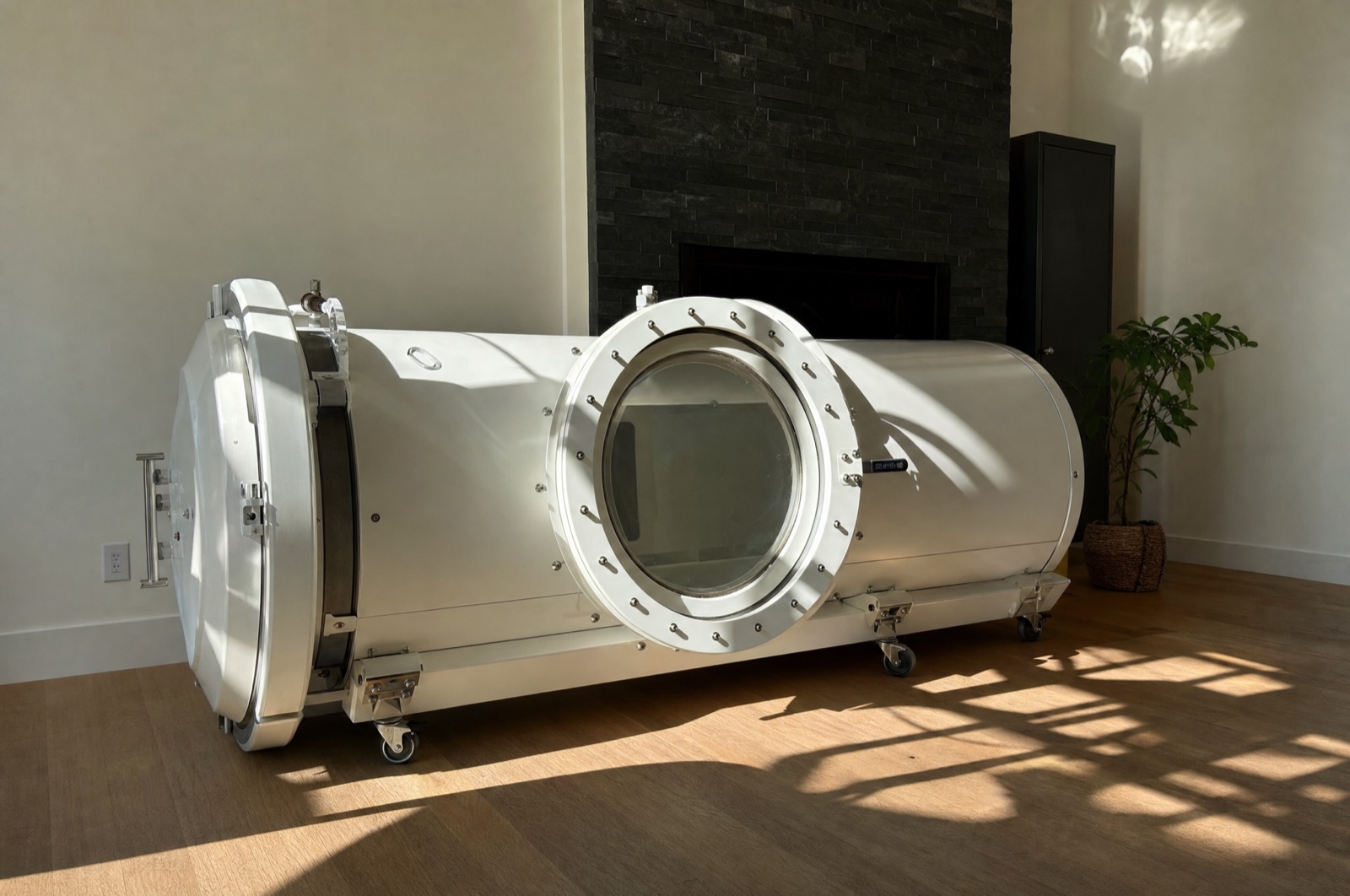
[ A chamber and its compressor at home ] Reference imagery; final photography in production
Where the noise comes from
A hyperbaric chamber is a sealed vessel that gets pumped full of air until the pressure inside is higher than the room. The sources we read tie the sound to moving that air, and point to four parts of the system.
- The compressor or air supply. Home soft chambers are inflated by an electric compressor. Several FDA 510(k) summaries for soft chambers name the same part, a Gast model 0523 oil-less compressor.
- Air flowing in. Hospitals describe a hiss as the chamber fills.
- Ventilation, also called flushing or a vent. Air is exchanged once the chamber is at pressure; Maryland says this cools the chamber. In the hospital study below, this was the loudest moment.
- Relief and exhaust valves. Relief valves open above a set pressure, and air leaves again when pressure comes down at the end. Makers sell quiet relief valves as a noise feature.
The FDA 510(k) summary for the Revitalair 430F, K171899, describes the layout plainly. The device has two parts, the chamber and a compressor cabinet. The chamber is inflated with atmospheric air through an electric compressor, connected by a supply hose. The same summary lists two predicate chambers from Summit to Sea, both inflated by a Gast 0523 compressor. The Flexi-Lite summary, K101262, names the Gast 0523/1023 too, and adds that the compressor weighs another 54 lbs on top of the 39 lb chamber. None of the six 510(k) summaries we opened states a sound level.
Hospitals describe the same sounds from the patient side. Cleveland Clinic says that once the door has closed, you might hear a slight hissing sound as oxygen fills the chamber. The University of Maryland Medical Center, which runs a multiplace chamber, says you will notice a hissing type noise as air flows in, and some noise again during decompression. The Royal Brisbane and Women's Hospital patient booklet is the most direct. It says the compression phase will be quite noisy due to the pressurised air entering the chamber.
What studies measured inside hospital chambers
We found one peer-reviewed study that put a sound level meter inside working treatment chambers and published the numbers. Zaman, Celebi, Mirasoglu and Toklu measured 41 hospital chambers in Turkey and published the results in Diving and Hyperbaric Medicine in 2020. The authors say it is, to their knowledge, the first study of noise in hospital-based chambers during medical treatments. Earlier research focused on chambers used for commercial diving.
The method matters for reading the numbers:
- All 41 chambers were multiplace, with similar dimensions and shapes. No monoplace or home chamber was measured.
- Each chamber got eight readings: three during compression, three during decompression, and two at treatment pressure, one with ventilation running and one without.
- Each reading was a 25-second sample, reported as an A-weighted equivalent level (LAeq) and a C-weighted peak (LCpeak).
The results spread widely. The highest level in the study was 100.4 dB(A) at treatment pressure while ventilation was underway. The lowest was 40.5 dB(A) at treatment pressure without ventilation. Most centres had levels between 70 dB and 85 dB throughout the treatment. The authors say ventilation caused a significant rise in noise, and that silencers are effective in reducing it. Their conclusion was that the chambers were generally safe in terms of noise exposure, but that hyperbaric chambers can be very noisy environments and should be fitted with noise control.
A follow-up looked at the staff who run these chambers. Özkan, Zaman, Türkmen and Yücel (2025), in the Journal of Ear Nose Throat and Head Neck Surgery, again covered 41 centres in Türkiye, with measurements taken in November and December 2021. They report a maximum equivalent continuous level of 81.9 dB(A) and a highest peak of 114.5 dB(C). In 63.4% of centres, a 70 dB(A) limit was exceeded at treatment depth when ventilation was on. The abstract does not say where in or around the chamber the meter sat. Its audiology findings concern operators, not patients.
Patients notice the noise too. A small interview study at Prince of Wales Hospital in Sydney, Chalmers and colleagues (2007), spoke with seven patients after a course of treatment in a multiplace chamber. The noise and cold of the chamber was one of the issues they raised, alongside mask and hood discomfort and boredom.
What makers claim for home chamber compressors
For home chambers we found no independent measurement at all. What exists is spec sheets and product listings. We report these as the maker's or seller's claim. None of them states the measuring distance, and most do not say whether the figure is A-weighted.
- Recover L Range (soft, UK). The maker's spec sheet lists the air compressor at 50db(A), with 72 L/min air flow and 550 W of power, and calls it a low noise, oil-free type. The oxygen concentrator and air dryer sold with it are listed without a noise figure.
- Oxyrevo Apex36 (soft). A product listing supplied by Oxyrevo gives a noise level of 50 dB and mentions extra-quiet relief valves. It lists an 85 L/min oil-free compressor. The figure appears on the page as "=50 dB", with no weighting or distance.
- Oxycell OxyPro Platinum (hard). An authorized dealer's listing claims quiet operation under 45 dB, with quiet pressure relief valves. The compressor and concentrator come as one unit listed at 190 lbs.
- Oxygen Health Systems (hard, 40 inch, 1.6 ATA). The seller's page says its systems run well below the standard at 52 dB, and that hyperbaric operation can be as loud as 68 dB without its noiseless relief valves. It does not name the standard.
- Summit to Sea Grand Dive (soft). The maker's instruction manual gives no dB figure. It says the chamber uses two compressors, both of which must run during treatment, and describes them as ultra quiet with patented sound suppression.
The compressor named in several soft chamber 510(k) filings is the Gast 0523. Gast's product page calls the series ultra-quiet, with internal sound suppression, but gives no dB figure. A septic parts reseller selling the 0523 as an air pump says its muffler and filter bring noise to approximately 55 to 60 dBA. That is a reseller's claim for a septic configuration, and we do not know if it matches the version supplied with any chamber.
Every figure in one table
The table puts each sourced number next to how it was taken. Reference levels come from the American Academy of Audiology noise chart and from US workplace limits published by NIOSH and OSHA.
| Figure | What it is | Conditions as stated | Type of source |
|---|---|---|---|
| 100.4 dB(A) | Highest level, 41 hospital chambers | Inside multiplace chambers, treatment pressure, ventilation running, 25 s LAeq | Peer-reviewed study, 2020 |
| 70 to 85 dB | Range where most centres sat | Inside multiplace chambers, throughout treatment | Peer-reviewed study, 2020 |
| 40.5 dB(A) | Lowest level, 41 hospital chambers | Inside multiplace chambers, treatment pressure, no ventilation | Peer-reviewed study, 2020 |
| 81.9 dB(A) | Highest equivalent continuous level | 41 centres in Türkiye, 2021; meter position not stated in abstract | Peer-reviewed study, 2025 |
| 114.5 dB(C) | Highest peak level | Same study; peak, C-weighted | Peer-reviewed study, 2025 |
| 68 dB | Hyperbaric operation without quiet valves | No distance or weighting given | Seller claim |
| 52 dB | Seller's own hard chamber systems | No distance or weighting given | Seller claim |
| 50 dB(A) | Recover L Range compressor | No distance given | Maker spec sheet |
| 50 dB | Oxyrevo Apex36 noise level | No distance or weighting given | Supplier listing |
| Under 45 dB | Oxycell OxyPro Platinum operation | No distance or weighting given | Dealer listing |
| 90 dBA | OSHA permissible exposure limit | 8-hour workday | US regulator |
| 85 dBA | NIOSH recommended exposure limit | Averaged over an 8-hour workday | US research agency |
| 90 dB | Lawnmowers, power tools | Reference chart | American Academy of Audiology |
| 70 dB | Traffic, vacuums | Reference chart | American Academy of Audiology |
| 60 dB | Normal conversation, dishwashers | Reference chart | American Academy of Audiology |
| 50 dB | Moderate rainfall | Reference chart | American Academy of Audiology |
| 40 dB | Quiet library | Reference chart | American Academy of Audiology |
Sources: Zaman et al., Diving and Hyperbaric Medicine 2020 (PMID 32957126); Özkan et al., Journal of Ear Nose Throat and Head Neck Surgery 2025; Oxygen Health Systems product page; Recover L Range spec sheet; Oxyrevo listing on MedicalSearch; Recovery For Athletes listing for Oxycell; OSHA; NIOSH; American Academy of Audiology 2023 noise chart.
Read the rows with care. The hospital figures were measured inside large chambers with a meter. The home figures are claims with no stated distance, so a 50 dB claim and a 50 dB reference sound may not describe the same experience. The OSHA and NIOSH limits are for workers exposed for a full workday. The Academy chart adds that NIOSH recommends hearing protection whenever noise exceeds 85 dB.
Inside the chamber vs the room around it
The person in the chamber and the people in the room hear different things. The 2020 study measured only inside the chamber. Its loudest reading came from ventilation, which is air being pushed through the space the patient sits in. Hospital pages describe the same experience from inside: hissing as air enters, and noise again as it leaves.
Two of the home claims point to the machine as heard from outside. The Recover figure is labelled as the compressor's noise. Oxygen Health Systems frames its 52 dB figure around practitioners worried about noise in their office. None of these sources gives a matching reading from inside the chamber.
Staff exposure is a third case. The 2025 Turkish study and a 2025 study in Physiology and Behavior by Zaman and colleagues both looked at operators. In the second, 28 participants spent 2 hours in a quiet room and then 2 hours next to a working hyperbaric chamber, which the authors call the noisy environment. The authors report changes in blood pressure and heart rate variability during the noisy period and say the clinical relevance is uncertain.
Soft shell, hard shell and where the compressor sits
The two home designs share the same noise sources but package them differently. Our hard shell vs soft shell guide covers the structural differences. For noise, three things stand out in the documents.
Soft chambers run on a separate compressor connected by a hose. The FDA summaries describe exactly that, and the OxyHealth Solace brochure lists a double-headed, oil-less 1/4 hp compressor and a 10 ft medical grade hose with quick-disconnect couplings. The hose length sets how far the compressor can sit from the chamber. Some soft chambers use more than one compressor. The Summit to Sea manual requires both of its two to run during treatment.
Hard chamber packages can add more machines. The Oxycell listing describes an all-in-one unit holding the air compressor and oxygen concentrator. A UNDP Moldova tender for a hard hyperbaric chamber shows how a buyer can write noise into a spec. It asks for two oxygen concentrators at a maximum of 60 dB(A) each and a recirculating chiller at a maximum of 60 dB(A) in standby mode. Our oxygen concentrator guide explains what a concentrator does and how it differs from the air compressor.
Multiplace hospital chambers are a different class of machine. The 2020 study measured these, and its numbers should not be read as a forecast for a home capsule. Our monoplace vs multiplace guide explains the split. We found no published dB measurement for any monoplace chamber.
Noise is not ear pressure
Noise and ear pressure arrive together, but they are separate things. Noise is sound from air moving through the system. Ear pressure is the air space behind each eardrum catching up with the rising pressure around you. Cleveland Clinic says your ears may feel clogged or start to pop, similar to flying. Royal Brisbane says you will feel the change in pressure in your ears, similar to descending in an aircraft, and that during decompression your ears should pop on their own.
The two do happen at the same time. Compression is when Royal Brisbane says the chamber is quite noisy and when your ears need clearing. Our guide to what a hyperbaric session feels like covers ear clearing step by step. Our hyperbaric chamber safety guide covers the device risks that matter more than sound.
What you can do about the noise
The sources support only a short list. We have left out tips we could not trace to a document.
- Ask for a measured figure with its conditions. A dB number means little without the distance, the weighting and the phase. Ask the maker for all three in writing.
- Ask about silencers and quiet valves. The 2020 study authors say silencers are effective in reducing chamber noise. Several makers sell quiet relief valves as a feature.
- Plan placement around the hose, not around a guess. With a 10 ft hose, the compressor sits within 10 ft of the chamber. Our space and power guide covers floor area and outlets.
- Do not swap the compressor. The Summit to Sea manual says not to replace the compressor with any other model, because the chamber is designed for the one supplied.
- Treat a new sound as a fault. The same manual says to stop use and contact the maker if you detect any unusual noise or odor.
- Check what the room needs. The UNDP tender above shows that concentrators and chillers carry their own noise limits, separate from the chamber.
For the wider ownership trade-offs, see home chamber pros and cons and our portable chamber guide. The models we track are on the scorecard.
What we have not verified
We found no independent dB measurement of any home chamber, soft or hard, and none of any monoplace chamber. Every home figure on this page is a maker, dealer or seller claim with no stated measuring distance. We could not open the full text of the 2020 study, so per-phase averages for compression and decompression, the chamber volumes and the ventilation flow rates come only from what the abstract says. The 2025 abstract does not name the regulation behind its 70 dB(A) limit or say where the meter sat. Oxygen Health Systems does not name the standard it calls 52 dB. Gast publishes no dB figure on its 0523 page, and the 55 to 60 dBA figure is a septic reseller's. We did not find a maker document approving a compressor in a separate room or a longer hose. We have not measured a chamber ourselves. If you hold a test report with conditions, send it and we will check it.
Frequently asked
How loud is a hyperbaric chamber in decibels?
It depends on the chamber and the phase. A 2020 study of 41 multiplace hospital chambers in Turkey measured from 40.5 dB(A) at treatment pressure with no ventilation up to 100.4 dB(A) at treatment pressure with ventilation running. Most centres sat between 70 and 85 dB throughout treatment. For home chambers we found only maker, dealer and seller claims, such as under 45 dB, 50 dB and 52 dB, with no stated measuring distance.
Is a hyperbaric chamber loud enough to damage hearing?
The 2020 study authors concluded the chambers they measured were generally safe in terms of noise exposure, while warning that chambers can be very noisy. For workplace context, NIOSH recommends a limit of 85 dBA averaged over an eight-hour workday, and OSHA's legal limit is 90 dBA for an eight-hour day. A 2025 study of the same country's centres found a threshold shift at 4,000 Hz in the right ear of chamber operators but no clinical noise-induced hearing loss.
What makes the hissing sound in a hyperbaric chamber?
Air or oxygen flowing in. Cleveland Clinic says you might hear a slight hissing sound as oxygen fills the chamber and the pressure grows. The University of Maryland Medical Center describes a hissing type noise as air flows in, and some noise again as pressure is released at the end.
Is a home hyperbaric chamber quieter than a hospital one?
We cannot say from measured data. The only home chamber figures we found are manufacturer or seller claims, such as 50 dB(A) for one maker's compressor, and none states where the microphone sat. The hospital study measured inside large multiplace chambers with a sound level meter. The two sets of numbers were not taken the same way, so they do not compare directly.
Can you put the compressor in another room?
Only as far as the hose reaches, and only in the way the maker allows. One OxyHealth brochure lists a 10 ft hose between compressor and chamber. Summit to Sea's manual warns not to replace the compressor with any other model. We found no maker document that approves moving a compressor into a separate room, so ask the maker in writing before you plan around it.

Alex tests the machines himself, in clinics and studios on three continents. Every score comes from the same 27 public criteria, and no manufacturer has a say in them.
Six questions, and we'll match chamber, options, and install to your space and budget.