Sitting vs Lying Hyperbaric Chambers: Configurations Compared
Researched and scored by Alex Evans. Last reviewed August 2026. Corrections are dated and public. See corrections
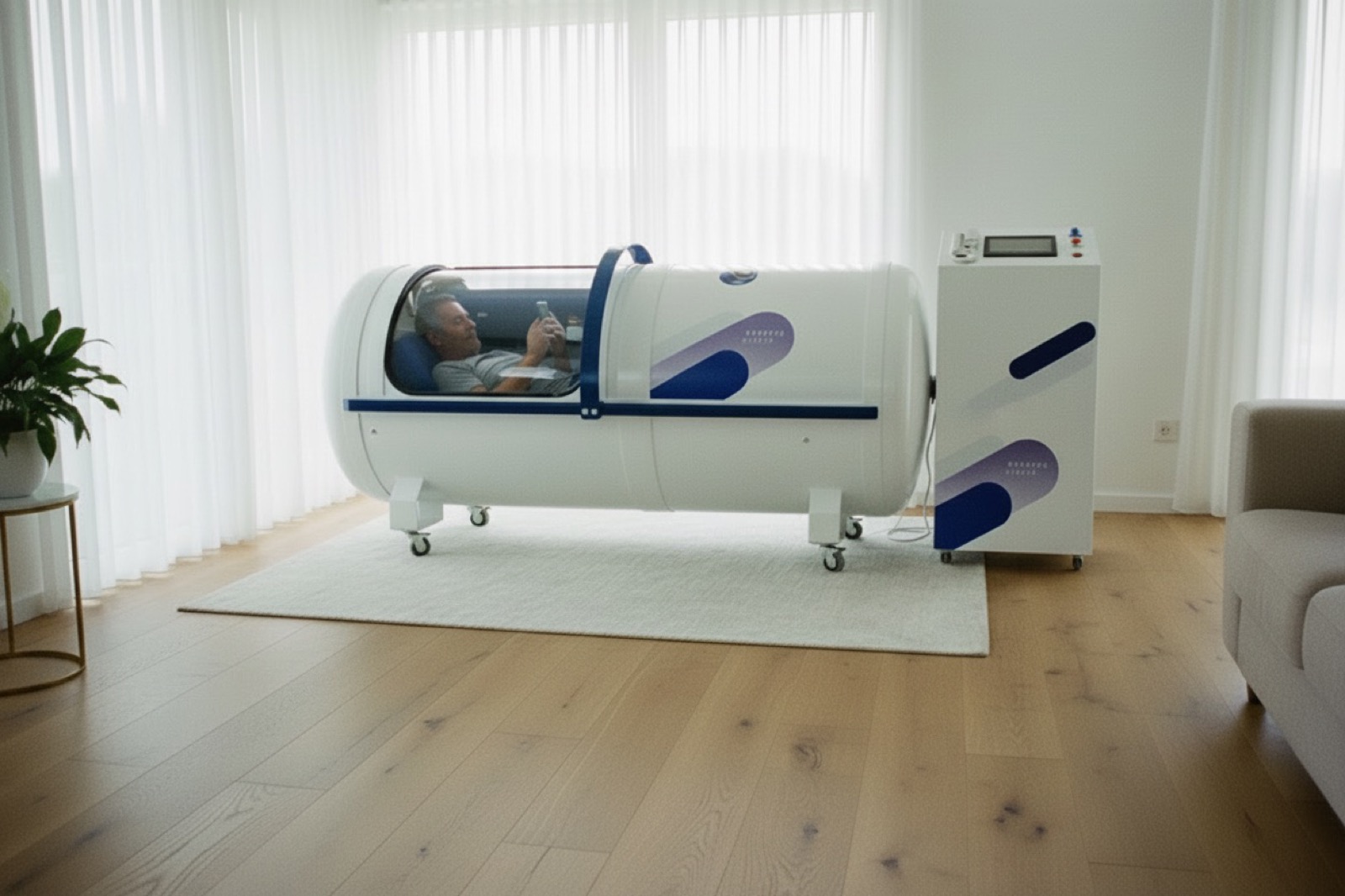
[ Chamber in a room ] Reference imagery; final photography in production
Three configurations
Chambers come in three shapes for the body inside. A lying chamber is a horizontal tube or capsule. You lie on a mat, a tray or a bunk. A seated or upright chamber stands on end or sits low and long, and you sit in a chair inside it. A multiplace chamber is a room under pressure, usually with rows of seats, and it holds several people at once.
The first two can be soft or hard. The third is almost always a hard steel or acrylic vessel in a hospital or clinic. The configuration changes how you get in, how much floor and ceiling the chamber needs, whether a wheelchair can reach the seat, and whether anyone shares the space with you. This page compares those points using dimensions from FDA 510(k) summaries, maker spec pages and hospital pages, each one named. It does not rank chambers or pick one.
Our monoplace vs multiplace guide covers the one-person versus many-person split in cost terms, and the hard-shell vs soft-shell guide covers materials. This page is about the body position and what follows from it.
Lying chambers in the FDA record
Product code CBF is where the FDA files hyperbaric chambers. When we pulled the list from openFDA on 12 October 2026 it held 69 records. We opened five portable fabric chamber summaries. Four give a size, and each of those describes a horizontal tube sized by length and width or diameter.
The K072757 summary from Summit to Sea describes the Shallow Dive and the Dive as 7 feet long and 27 inches wide, and the Grand Dive as 9 feet long and 40 inches wide. It says all dimensions are with the devices inflated, and that each uses a single airtight bag with a single zipper. The K051759 summary for the Flexi-Lite lists 8 ft x 30 in inflated diameter, four windows and a single zipper. The K171899 summary for the Revitalair 430F describes a cylinder 900 mm in diameter and 1850 mm long with ten windows, and says it can be operated from the inside as well as the outside.
Hard monoplace chambers in the same list are lying chambers too. The K140559 summary for the Sechrist 3300H/HR and 3600H/HR describes a horizontal acrylic cylinder with a door at one end. The K081506 summary for the Presidential HA-34 and HA-38 says the patient lies down on a foam bunk that rolls in on a retractable gurney. One record breaks the pattern. The K102831 summary for the RSI 4200 says its patient tray is designed to accommodate a lying or sitting patient. It is still a one-person tube.
Seated and upright chambers
We found no seated or vertical chamber in the CBF list. The dimensions for this group come from maker spec pages, one retailer listing and one US patent, and none of them is an FDA record.
Macy-Pan publishes three seated soft models. Its L1 page lists 150 x 105 x 170 cm (L x W x H), a vertical design and a chamber designed to hold a furniture chair. Its ST1700 page lists 185 x 110 x 120 cm (L x W x H) with a folding chair, and says a person can sit or semi-lie inside. That one is long and low, not tall. Its MC4000 page lists 155 x 150 x 175 cm (L x W x H) and says it holds two folding chairs.
For the Summit to Sea Dive Vertical we could not find a maker page. The Peak Primal Wellness listing, which calls itself an official distributor, gives a 40 inch diameter, an 85 inch height and a 5 foot vertical zipper that opens from inside or outside. The design is covered by US Patent 9,622,931, granted 18 April 2017 to Bruce Elgin McKeeman. The patent says the user can sit in a common chair inside the chamber instead of lying down.
Seated hard chambers exist as well. Macy-Pan lists an HP800-S single-seat chamber with an adjustable seat, a 550 kg chamber net weight and a combined equipment footprint of about 1.62 m², and an HE5000 FORT for one to two people at 2200 x 1000 x 1800 mm with a 500 x 1160 mm door.
Multiplace rooms with seats
A multiplace chamber is closer to a small room than a tube. The K082455 summary for the Gulf Coast Hyperbarics rectangular multiplace chamber lists dimensions of 9.3 ft wide, 8.3 ft high and 32 ft long, a weight of 113,000 lbs, three doors of 48 in wide by 76 in high, and a capacity of 12 seated patients. The K240569 summary for the FINK chambers gives patient capacities from 4 to 28 depending on the number of compartments, rectangular doors, and weights from about 15,432 lbs to about 145,000 lbs.
Hospitals describe the seating directly. DDRC Healthcare in the UK says its multiplace chamber seats up to eight patients sitting, and treats monoplace patients lying down. Penn Medicine says patients in its multiplace chamber sit in recliner chairs or lie on a stretcher, and that patients in its two monoplace chambers lie inside a clear acrylic chamber. In a multiplace chamber the air is ordinary air under pressure and each patient breathes oxygen through a mask or hood, which is why several people can share it.
Sourced dimensions side by side
Each figure below is given in the unit its source used. Where the source gave two units, both appear. We did not convert any number.
| Configuration | Model named in source | Listed size | Entry | Source |
|---|---|---|---|---|
| Lying, soft | The Dive | 7 ft long, 27 in wide (inflated) | Single zipper | FDA K072757 |
| Lying, soft | Grand Dive | 9 ft long, 40 in wide (inflated) | Single zipper | FDA K072757 |
| Lying, soft | Flexi-Lite | 8 ft x 30 in inflated diameter | Single zipper | FDA K051759 |
| Lying, soft | Revitalair 430F | 900 mm diameter, 1850 mm long | Not stated in summary | FDA K171899 |
| Lying, soft | ST801 | 240 x 82 cm (94.49 x 32.28 in), length x diameter | Two-layer zipper | Macy-Pan spec page |
| Lying, hard | Sechrist 3300H/HR | 32.50 in (83 cm) inside diameter; 106 in (269 cm) outside length; 59 in (150 cm) high | End door, hinged | FDA K140559 |
| Lying, hard | Sechrist 3600H/HR | 35.50 in (90 cm) inside diameter; 106 in (269 cm) outside length; 63 in (160 cm) high | End door, hinged | FDA K140559 |
| Lying, hard | Presidential HA-34 / HA-38 | 33.5 in / 38 in inside diameter; 92 in outside length | Bunk on retractable gurney | FDA K081506 |
| Lying, hard | BLKS-307 | 42.1 in (1080 mm) inside diameter; 90.4 in (2300 mm) long | Bed on portable gurney | FDA K060739 |
| Seated, soft, upright | L1 | 150 x 105 x 170 cm (60 x 42 x 68 in), L x W x H | Shaped zipper | Macy-Pan spec page |
| Seated, soft, low | ST1700 | 185 x 110 x 120 cm, L x W x H | Three-zipper seal | Macy-Pan spec page |
| Seated, soft, two people | MC4000 U / N | 155 x 150 x 175 cm (61 x 59 x 69 in), L x W x H | U or N zipper; N for wheelchair | Macy-Pan spec page |
| Seated, soft, upright | Dive Vertical | 40 in diameter, 85 in high | 5 ft vertical zipper | Retailer listing |
| Seated, hard | HE5000 FORT | 2200 x 1000 x 1800 mm | Door 500 x 1160 mm | Macy-Pan spec page |
| Multiplace, seated | Gulf Coast rectangular | 9.3 ft W x 8.3 ft H x 32 ft L; 12 seated | Three doors, 48 x 76 in, flush with floor | FDA K082455 |
| Multiplace, seated | FINK FESL / FEDL / FETL | 4 to 28 patients by compartment count | Rectangular doors | FDA K240569 |
Sources: FDA 510(k) summaries K072757, K051759, K171899, K140559, K081506, K060739, K082455 and K240569 at accessdata.fda.gov; Macy-Pan product pages at macy-pan.com; Peak Primal Wellness product listing. All read 12 October 2026. Model names identify the source of each figure and are not recommendations.
Two notes on the table. The Revitalair 430F summary gives 1850 mm long in its description and 1900 mm in its comparison table, and the later K220290 summary for the 430+ lists 36.2 in x 74.8 in. We show the description figure. The K072757 summary says the Dive chambers use a single zipper, while the Grand Dive manual we cite below describes two. We do not know which version a given unit ships with. The ST1700 page prints an inch conversion of 72.83 x 66.93 x 47.24 in, and 66.93 in does not match 110 cm, so we show the centimetre figures only.
Getting in and out
A lying soft chamber opens along its length. You crawl or slide in on a mat and lie down before the zipper closes. The Grand Dive instruction manual we read, a Summit to Sea branded PDF, says there are two zippers that stretch nearly the length of the chamber and that both can be worked from inside or outside. It gives separate step lists for an operator outside and for a user who zips themselves in. It also says never to take a treatment alone, and to always have someone outside the chamber to assist.
A lying hard chamber is loaded from one end. The Sechrist summary describes a door assembly at one end with a locking mechanism and a safety interlock, and says the HR version swaps the side the door opens toward. The Presidential and BLKS-307 summaries both describe a bed that slides out onto a wheeled gurney, the patient lies on it, and the bed rolls back in.
A seated chamber is entered on your feet. The McKeeman patent describes an access opening with an inside zipper, an outside zipper and buckles, and says the slit lets the user move in and out without outside help. The Peak Primal listing for the Dive Vertical describes a 5 foot vertical zipper. Macy-Pan describes its L1 zipper as shaped for easier entrance. A multiplace chamber has a walk-in door, and the Gulf Coast summary lists three at 48 in by 76 in. For what happens once the door closes, see what a session feels like.
Wheelchair and stretcher access
The sources split on this point by configuration. The McKeeman patent names the problem it set out to solve. It says some patients find it difficult or impossible to lie down, that a Hoyer lift has been used for patients who have trouble lying down, and that the methods in use carry drawbacks of expense, inconvenience and embarrassment.
- Lying hard chambers in the FDA record load the patient on a gurney or sliding bed. That suits a stretcher patient, and it means a transfer from a wheelchair to the bed.
- The Gulf Coast multiplace summary describes large sliding doors that fit flush with the floor so patients can be wheeled in without bumping over the doorjamb.
- Penn Medicine says its multiplace chamber can hold patients on a stretcher as well as in recliner chairs.
- Macy-Pan says its MC4000-N, with an N-shaped zipper, allows wheelchair access, and that wheelchair users can enter and exit comfortably. It does not list a maximum wheelchair width.
- Lying soft chambers in the FDA record list widths of 27 to 40 inches and are entered at floor level. None of those summaries mentions wheelchairs.
Who is inside with you
In a monoplace chamber you are alone and the attendant is outside. DDRC Healthcare says the attendant stays outside but in continual communication. Penn Medicine says a nurse or paramedic trained in hyperbaric medicine is present next to the chamber at all times. The Sechrist summary describes a two-way intercom between patient and attendant. A 2011 review by Lindell K. Weaver in Critical Care Medicine, hosted on the UHMS site, says hands-on care cannot be given to a patient inside a monoplace chamber.
In a multiplace chamber staff can be in the room. The UHMS credentialing guidelines say multiplace chambers use inside attendants. DDRC says an attendant is inside its multiplace chamber at all times. The FINK summary lists breathing systems for attendants and hoods for patients as separate items.
Soft chambers sit in between. The Revitalair 430F summary says it can be run from inside or outside. Macy-Pan's MC4000 page says the two-person layout allows a companion in the chamber. The Grand Dive manual asks for a second person outside. Our home chamber pros and cons page covers the household side of that.
What sources say about claustrophobia
No source we read measured claustrophobia by configuration. Several describe design choices meant to address it, in their own words.
- The McKeeman patent says confinement within a chamber can cause or worsen claustrophobia or discomfort, and presents the upright, seated design as the answer.
- The Gulf Coast multiplace summary says its chamber is fitted out to look like any other clinical room in a hospital to reduce patient anxiety.
- Willis Knighton Health says its multiplace chamber feels like an airliner cabin and is designed for people who have trouble with confined spaces.
- The RSI 4200 summary says its windows are placed and sized to give the patient a feeling of comfort and spaciousness.
- The Revitalair 430F summary lists ten windows and 360 degree viewing.
- Penn Medicine notes that its monoplace chambers are clear acrylic.
These are claims of intent from the people who built or run each chamber. We have no data on how many users feel confined in each type.
Floor space and room planning
A lying chamber needs length. The FDA soft chamber records run from about 6 to 9 feet long, and the Sechrist hard chambers list 106 inches outside length. Add room at the open end or the zipper side to get in. A seated soft chamber needs less length and more height. Macy-Pan lists the L1 at 170 cm tall and the MC4000 at 175 cm, and the Dive Vertical listing gives 85 inches. Check that against your ceiling and any light fixture. A multiplace chamber is a building project. The Gulf Coast unit is 32 feet long and weighs 113,000 lbs.
Footprint is not the whole room. Macy-Pan's HP800-S page says its 1.62 m² figure is the equipment base area only, not the room size, and asks buyers to check doorways, corridors, elevators and turning space. Our space and power guide and the portable chambers guide cover clearances, circuits and moving a chamber.
How to read a spec sheet for configuration
- Find the axis labels. A seated chamber listed as L x W x H can be tall and short or long and low. The L1 and ST1700 both carry a chair and have very different heights.
- Check whether the figures are inflated or deflated. The K072757 summary states its dimensions are inflated.
- Look for the entry: zipper shape and length, door size, or gurney. Compare a door size with the user's wheelchair if that matters.
- Check the occupant count and whether the maker allows operation from inside.
- Ask for the K-number. Our FDA cleared vs registered guide explains how to look it up and what the record shows.
- Check unit conversions printed on the page against the metric figure. The ST1700 page shows why.
Configuration narrows the field. It does not say which chamber to buy. For how the chambers we track compare on what we can verify, see the scorecard.
What we have not verified
We have not found a maker page for the Summit to Sea Dive Vertical, so its 40 inch and 85 inch figures come from a retailer. A second retailer listing that appeared in search results gave an 80 inch height, and we could not open that page to confirm it. The Grand Dive manual we quote sits on a file host and we could not confirm who published it. We did not find an FDA 510(k) for any seated or vertical soft chamber, and we did not find a CBF record for Macy-Pan or Shanghai Baobang in the openFDA list. The Macy-Pan figures are the maker's published specs and we have not measured any unit. We have not seen a maximum wheelchair size for any chamber. We could not read the supported patient weight in the Sechrist summary cleanly, so we left it out. No source we read gives the inside diameter of a seated soft chamber with its chair in place, or the seat height. We have no measured data on claustrophobia by configuration. If you hold a spec sheet or a measurement that settles one of these points, send it and we will check it.
Frequently asked
Are there FDA-cleared seated soft hyperbaric chambers?
We did not find one. We pulled all 69 510(k) records under product code CBF from openFDA and opened five portable fabric chamber summaries. Each one that gives a size describes a horizontal chamber, listed as a length and a width or diameter. None of the 69 device names says seated, sitting or vertical. That is a finding about the records we read, not proof that no such clearance exists.
How wide is the inside of a lying hard-shell chamber?
In the hard monoplace records we read, internal diameters run from 28.7 inches (730 mm) to 42.1 inches (1080 mm). The Sechrist 3300H and 3600H summary lists 32.50 inches (83 cm) and 35.50 inches (90 cm), with a predicate model at 41.00 inches (104 cm). The Presidential HA-34 and HA-38 summary lists 33.5 and 38 inches.
Can a wheelchair user get into a seated chamber?
Some makers say so. Macy-Pan publishes an MC4000-N version of its two-person soft chamber with an N-shaped zipper that it says allows wheelchair access. The Gulf Coast Hyperbarics multiplace summary describes sliding doors that fit flush with the floor so patients can be wheeled in. We have not tested either, and we have not seen a wheelchair dimension that either door is rated for.
Does anyone sit inside the chamber with the patient?
In hospital multiplace chambers, yes. DDRC Healthcare says an attendant is inside its multiplace chamber at all times, and Penn Medicine says its multiplace chamber treats several patients with a staff member inside. In a monoplace chamber the attendant stays outside. Penn says a trained nurse or paramedic is next to the chamber at all times.
Is a seated chamber smaller than a lying one?
Shorter on the floor, taller in the room. Macy-Pan lists its L1 seated soft chamber at 150 x 105 x 170 cm and its ST801 lying chamber at 240 cm long and 82 cm across. The retailer listing we read for the Summit to Sea Dive Vertical gives 40 inches across and 85 inches tall. The lying Dive in the FDA record is 7 feet long and 27 inches wide.

Alex tests the machines himself, in clinics and studios on three continents. Every score comes from the same 27 public criteria, and no manufacturer has a say in them.
Six questions, and we'll match chamber, options, and install to your space and budget.