Staffing and Certification Requirements to Run a Hyperbaric Clinic
Researched and scored by Alex Evans. Last reviewed August 2026. Corrections are dated and public. See corrections
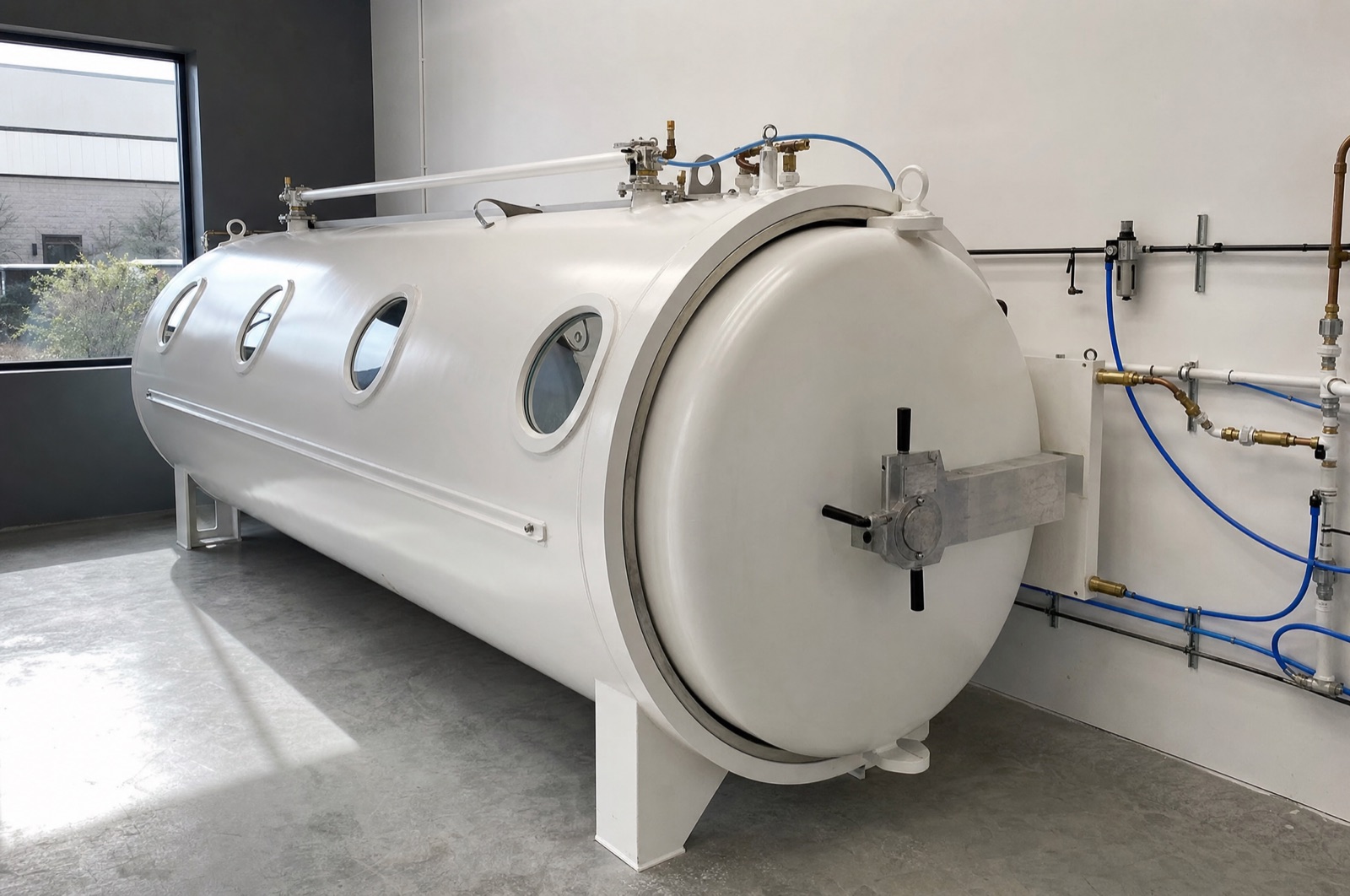
[ Clinic install ] Reference imagery; final photography in production
Who sets the rules
Staffing a hyperbaric clinic draws on four kinds of source, and they carry different weight. Private certifying boards set the rules for the staff credentials. The Undersea and Hyperbaric Medical Society (UHMS) publishes credentialing guidelines and runs a voluntary facility accreditation program. Medicare sets supervision rules for services it pays for. A few states have written hyperbaric rules into law or regulation. As the sections below show, most of the hyperbaric-specific layers are voluntary or tied to payment.
This page sets out what each source says, from the boards' and agencies' own documents. Our clinic buyer's guide covers the business side of adding a chamber, and our mild vs medical guide covers how the two categories differ on pressure, gas and setting.
The roles in a hyperbaric unit
The UHMS documents we read name a consistent set of roles. Not every facility fills every one, and some roles are marked "if designated" in the UHMS Fifth Edition Accreditation Manual.
| Role | Who fills it | Main training marker in the sources |
|---|---|---|
| Medical director | MD or DO only | UHM board certification preferred; board certification or UHMS PATH mandatory after 31 December 2027 |
| Attending provider | MD, DO, PA or nurse practitioner; podiatrists in limited cases | UHMS-approved 40-hour introductory course plus a proctored period |
| Hyperbaric nurse | Registered nurse | 40-hour course; CHRN when eligible |
| Chamber operator or technologist | RT, RN, LPN, paramedic, EMT, corpsman and other listed professions | 40-hour course; CHT, CHS or CHWS |
| Safety director | Named in writing by the facility | 40-hour course, a safety director course, and hyperbaric certification within 1 year |
| Technical director | Optional role | 40-hour course, 5 years in hyperbaric operations, CHT, CHS or CHWS |
Sources, read 14 October 2026: UHMS Fifth Edition Accreditation Manual, standards HBOHR 5 to 9; UHMS Guidelines for Credentialing, Privileging and Supervision of Hyperbaric Oxygen Treatment, revised April 2026; NBDHMT CHT Resource Manual, July 2026.
CHT: the technologist credential
The Certified Hyperbaric Technologist credential is run by the National Board of Diving and Hyperbaric Medical Technology (NBDHMT). Its CHT Resource Manual, revised July 2026, says the CHT is not an entry-level qualification but an additional certification beyond the applicant's qualifying profession. It lists nine qualifying pathways: respiratory therapist, registered nurse, licensed practical nurse, licensed vocational nurse, nurse practitioner, physician assistant, EMT or paramedic, active-duty military corpsman, and fully licensed physician. It also says the manual has no legal status.
To sit the exam, an applicant must be at least 18 with a high school diploma or equivalent, and must have completed an NBDHMT-approved introductory course within three years of the test date. After the course comes 480 hours of clinical work. Forty of those hours must be a directly supervised internship, and the board must be told the preceptor's name in writing before it starts. The preceptor should be a CHT or CHRN with at least two years of experience. Military personnel need 1,000 clinical hours unless they complete the 480-hour internship at an approved facility. Every applicant pays for a criminal background check, and some convictions bar an applicant for five years or permanently.
The exam is online at a testing center, with 120 multiple choice or true-false questions and a two-hour limit. A pass is 70%. Registration costs $175. A failed first attempt means a three-month wait; a second failure means another wait plus a repeat of the course and the internship. Certification lasts two years and expires on the last day of the month the exam was passed.
Recertification needs 24 continuing education hours in the two-year cycle, at least 12 of them Category A (technical, operations and safety topics), and a letter from a supervisor verifying at least 100 clinical work hours. The manual gives the fee as $100; the July 2026 recertification form lists $75 plus a $25 background check, so confirm the current figure with the board. The NBDHMT's codes and standards module is a mandatory one-time viewing for CHT renewal, needs a 70% score and earns 2.0 Category A credits for a $15 fee. A CHT who misses renewal has a 12-month grace period with a $100 penalty. A CHT-ADMIN status exists for holders who have moved into management and no longer work on the chamber.
CHRN: the nurse credential
The nurse credential is the Certified Hyperbaric Registered Nurse. The certifying body is the Baromedical Nurses Association Certification Board (BNACB), established in 1995, and the NBDHMT validates and administers the exam under contract, according to the CHRN Resource Manual (June 2024 update). The NBDHMT's nurse page says certificates are issued by the BNACB.
The manual lists the candidacy rules: a current unrestricted RN license in the state of practice; two years of clinical experience in a hospital or hospital-based clinic, or one year of critical care; at least one year of active hyperbaric experience within the last two years; a 40-hour BNACB-approved course within five years (older courses need 40 Category A credits on top); and a log of 480 hours of direct hyperbaric patient care after the course, signed by a CHRN or CHT/RN preceptor. A letter from the employer or program manager recommending the nurse is also required.
The exam is 120 multiple choice and true-false questions in two hours, with a 70% pass mark. The June 2026 registration form prices it at $250 for Baromedical Nurses Association members, $300 for UHMS or ACHM members and $400 for non-members, and asks for registration 30 days ahead. Certification is valid for four years.
| Item | CHT | CHRN |
|---|---|---|
| Run by | NBDHMT | BNACB; exam administered by NBDHMT |
| Who can apply | Nine listed professions | Registered nurses only |
| Course | Approved course within 3 years of the exam | 40-hour course within 5 years |
| Clinical hours | 480, including 40 directly supervised | 480 hours of direct patient care, signed by a preceptor |
| Exam | 120 questions, 2 hours, 70% pass | 120 questions, 2 hours, 70% pass |
| Exam fee | $175 | $250 to $400 by membership |
| Valid for | 2 years | 4 years |
| Renewal education | 24 hours, 12 Category A | 40 hours, 20 Category A |
| Renewal fee | $100 in the manual; $75 on the form | $150 to $250 by membership |
Sources, read 14 October 2026: NBDHMT CHT Resource Manual (July 2026) and CHT Recertification Form; CHRN Resource Manual (June 2024 update), CHRN Exam Registration Form (June 2026) and CHRN Recertification Form (August 2025).
On renewal, the CHRN form asks for a current RN license, 40 continuing education credits in four years with 20 in hyperbaric oxygen therapy, and a letter from a manager or medical director confirming at least one year of hyperbaric experience with 480 hyperbaric hours in the last 12 months. The manual says renewing nurses do not need to keep an hours log, so the two documents read differently on the hours point. The form adds a $100 reinstatement fee for a lapsed certification. Two advanced levels, ACHRN and CHRNC, need 60 credits in four years plus three or five years of experience and extra roles such as teaching or research.
The 40-hour introductory course
A 40-hour introductory course is the common entry point for every role. The NBDHMT's approved training course standard, last reviewed October 2022, says the required content must fit into a 40-hour frame, with set minimum hours per topic. Its hyperbaric safety section lists safety director roles and responsibilities, chamber fires, emergency procedures and applicable codes and standards. Its administration section covers chamber staffing.
The UHMS sets its own bar. Its credentialing and privileging guidelines, revised April 2026, say a UHMS-approved introductory program runs at least 40 hours, includes equipment and operations demonstration, a final exam and a course evaluation, and must be approved by the UHMS Education Committee. The guidelines call these courses the minimum education for privileging physicians and non-physician providers in a hospital or health system. The UHMS lists approved courses on its introductory courses page.
For technicians and nurses, a 2019 UHMS Associate Council position statement says each should attend a face-to-face 40-hour course approved by the NBDHMT, UHMS or American College of Hyperbaric Medicine, and be certified within 18 months of starting hyperbaric work. It recognizes four certifications (CHS, CHWS, CHT and CHRN), recommends 12 hyperbaric continuing education credits a year, and lists BLS, vital signs, blood glucose checks and safe patient transfers as minimum skills.
Physicians and advanced practice providers
The April 2026 UHMS guidelines sort providers into three groups. Independent supervisors are MDs and DOs who can attend treatments alone and supervise others. A second group can attend treatments alone but not supervise. The third group is providers in their proctored period, who need an independent supervisor immediately available, in person, through every treatment. Providers outside those groups, whatever their license, are described as not qualified to attend treatments.
The training steps for an independent supervisor are a valid unrestricted medical license, the UHMS-approved introductory course and a proctored experience program. The guidelines set a reasonable standard for that period at five proctored consultations and more than 25 hyperbaric sessions, followed by a review of the next 100 treatments. Training beyond the introductory course becomes a minimum standard for independent supervision on 31 December 2027. Physicians without board certification in undersea and hyperbaric medicine are to complete an accredited fellowship or the UHMS PATH program within two years of being privileged. For medical directors, board certification or PATH is mandatory after the same date.
Physician assistants and nurse practitioners can attend treatments within their scope after the course and a proctored period, and must finish PATH within two years. While they attend, an independent supervisor must be reachable by phone with an in-person response the guidelines say is generally 30 to 40 minutes. The guidelines say a facility must never be staffed solely by these providers and that they may not be medical director. Podiatrists may attend only where state law allows, and only routine monoplace treatment of stable patients with wounds below the knee. For continuing education, the guidelines ask for 12 hours of hyperbaric Category 1 CME a year or 24 in two years, and for renewal, supervision of 25 sessions in 12 months or 50 in 24.
The supervision definition matters most for daily operations. The guidelines say the attending provider must be immediately available whenever patients are in the chamber under pressure with the door closed. They define that as being in the same building or a connected building, able to reach the chamber as soon as asked. Attending a treatment by telephone, they say, is unacceptable. A separate 2021 UHMS statement on office-based facilities says office-based clinics should keep the same staff standards as hospital departments and recommends periodic facility accreditation.
Medicare supervision rules
Medicare coverage of hyperbaric oxygen is set by National Coverage Determination 20.29, effective in its current form from 3 April 2017. It limits payment to treatment in a chamber for 15 listed conditions. Its revision history notes a change that clarified a physician supervision requirement, but the coverage text we read does not set a supervision level itself. That comes from the payment regulations, and it depends on the setting.
In a hospital outpatient department, 42 CFR 410.27 sets general supervision as the default, meaning the service is furnished under the practitioner's overall direction and control, unless CMS assigns a higher level to a service. Direct supervision, where assigned, means the practitioner is immediately available to furnish assistance and direction, and the rule says this does not mean being in the room. CMS moved the default from direct to general for 2020. In that final rule (84 FR 61362), commenters asked that hyperbaric oxygen, radiation therapy and wound care stay at direct supervision. CMS kept the general default and said providers have the flexibility to set the level of supervision they think appropriate.
In a physician office, services billed incident to a physician must generally be furnished under direct supervision, under 42 CFR 410.26. The definition in 42 CFR 410.32(b)(3)(ii) says the supervising practitioner must be present in the office suite and immediately available, not necessarily in the room. The current text lets that presence be virtual, by real-time audio and video, for services without a 010 or 090 global surgery indicator. We did not confirm how that applies to hyperbaric oxygen codes, and the UHMS guidelines above ask for in-person availability whatever the payment rule allows.
The safety director
The safety director comes from the fire code. Our NFPA 99 guide covers Chapter 14 and how cities enforce it. The UHMS accreditation manual ties its safety director standards to Chapter 14 section numbers, which is how we read them here: we did not read the NFPA text itself for this page.
The manual asks that a safety director be designated in writing, citing NFPA 99 14.3.1.3.2. It asks that the safety director have written authority to restrict or remove any potentially hazardous supply or equipment from the chamber, citing 14.3.1.3.2.3. The safety director, or a technical director if one is named, works with the medical director to set the minimum staff qualifications, experience and numbers for the chambers in use. The manual also has the safety director approve the equipment allowed inside the chamber and set antistatic procedures. For training, it asks for a 40-hour introductory course, a UHMS-approved safety director course, and hyperbaric certification within one year of taking on the role.
The role also appears in the CHT exam material. The CHT manual lists NFPA 99 Chapter 14 as the first resource used to build the exam question bank. Our safety guide covers the hazards these rules address.
What UHMS accreditation asks of staff
The UHMS Hyperbaric Facility Accreditation program is voluntary, according to its Fifth Edition manual. The manual says that as of May 2026 the program had accredited more than 290 facilities and is the only hyperbaric-specific accreditation recognized by The Joint Commission as a complementary accrediting organization. It says some payers require accreditation, naming Utah Medicaid since 2006 and Mohawk Valley Physicians since 2014. Accreditation lasts three years, or four with distinction.
The staffing standards in the manual are specific. At least one CHRN or CHT/CHS is always on duty in the clinical area when a patient is being treated. Registered nurses hold a current state license, complete a 40-hour course, keep BLS current and get certified when eligible. A nursing director, if designated, has a bachelor's degree and 12 months of recent hyperbaric nursing. Chamber operations staff complete a 40-hour course, are licensed in their specialty where the state requires it, keep BLS current and hold a CHT, CHS or CHWS. The staff mix is set by chamber type and number, treatment load, emergency work, setting and staff experience. Every new staff member gets an orientation and a documented assessment against the job description.
Multiplace staffing ratios
Multiplace rooms, where staff ride inside, have their own guidance. A 2018 UHMS position statement on multiplace staffing recommends at least three personnel, at least one of them a CHRN: one as chamber operator, one as inside attendant and one outside attendant who stays in the room while the chamber is pressurized. It recommends one inside attendant per 6 stable patients, up to 8 with guidance from the safety and medical directors, 4 for higher-acuity patients, and 1 or 2 attendants per critically ill or intubated patient. The medical and safety directors may adjust the ratios. Our monoplace vs multiplace guide explains the two chamber types.
State rules we found
We found no state that currently licenses hyperbaric facilities or chamber operators as a category. We did not survey all 50 states, so treat that as the result of our search, not a settled fact. What we did find:
- Ohio. Section 4761.11 lets a certified hyperbaric technologist, defined as NBDHMT-certified, give hyperbaric oxygen without a respiratory care license when under the direct supervision of a physician, a podiatrist acting under a separate Ohio section, a physician assistant or an advanced practice registered nurse.
- Texas. Podiatric physicians who give hyperbaric oxygen need a hyperbaric oxygen permit from the state licensing department, with proof of a team training course recognized by the UHMS. The fee is $50 and the permit lasts two years.
- Mississippi. The state Medicaid hyperbaric rule requires treatment under UHMS standards, defines immediately available as close physical proximity in the same or a connected building, and requires a CPR team and a fully equipped emergency cart to be immediately available.
- Michigan (pending). Senate Bill 803, introduced 26 February 2026, would license freestanding hyperbaric facilities. It was referred to the Committee on Health Policy with no later action listed. The sponsor's release says the package would require accreditation, a medical director and at least one safety coordinator.
- North Dakota (draft). Bill draft 25.1404.01000 would create a state board to license facilities, providers and technicians, require an onsite safety director, a certified hyperbaric therapist, a provider and a clinical director, and require a provider to be physically present during treatment. It was on the 20 January 2026 Legislative Management agenda for review as a special session draft. We found no record that it was introduced or passed.
The clinical roles also sit on top of ordinary professional licenses. The UHMS manual says chamber staff should be licensed in their specialty where the state requires it, and the CHRN requires a current RN license in the state of practice.
Mild chambers and wellness businesses
Almost everything above is written for medical hyperbaric oxygen. The UHMS indications page defines it as a procedure that needs a physician's prescription and oversight, at not less than 2.0 ATA, in a hard-sided chamber. The April 2026 credentialing guidelines describe mild sessions below 1.5 ATA as generally not physician-prescribed or supervised, and often offered in wellness centers and spas outside medical facilities.
We found no rule in force that sets staff credentials for a mild chamber business. The North Dakota draft is the one source we read that tried: it defined its regulated therapy as a soft chamber below 1.5 atmospheres delivered by a licensed provider, exempted chambers used at home and hospitals, and would have required a provider in the building. It has not become law as far as we found. Whether a mild chamber operator should hold a CHT is an open question; the CHT is built around clinical chambers, and its pathways all start from a licensed or certified health profession. Our prescription guide covers the device rules for chambers, and for how the chambers we track compare on what we can verify, see the scorecard.
What we have not verified
We read the NBDHMT manuals and forms, the UHMS guidelines, position statements and Fifth Edition accreditation manual, the CMS coverage determination and regulations, and the state documents linked above, all on 14 October 2026. We did not read NFPA 99 itself; the safety director section numbers come from the UHMS manual. We did not read the NBDHMT facility accreditation manual, the UHMS safety director course content, or any current Medicare contractor coverage policy for hyperbaric oxygen, which may set its own supervision wording. We did not confirm whether virtual direct supervision applies to hyperbaric oxygen codes. The CHT renewal fee differs between the manual and the form, and the CHRN renewal hours read differently between the manual and the form. We did not survey every state, and we could not confirm the final text of the Michigan bills. If you hold a document that settles one of these points, send it and we will check it.
Frequently asked
Is a CHT certification a license?
The CHT comes from the National Board of Diving and Hyperbaric Medical Technology, a non-profit certifying board, not from a state. Its resource manual calls the CHT an additional certification beyond the holder's qualifying profession, such as respiratory therapist, registered nurse, paramedic or physician, and says the manual itself has no legal status. Ohio is one state whose law names the credential: it lets a certified hyperbaric technologist give hyperbaric oxygen without a respiratory care license under the direct supervision of a physician, podiatrist, physician assistant or advanced practice registered nurse.
How long does it take to become a certified hyperbaric technologist?
The NBDHMT manual sets three steps: an approved introductory course taken within three years of the exam, 480 hours of clinical work in hyperbaric, undersea or aviation medicine, of which 40 hours must be a directly supervised internship with a named preceptor, and a 120-question exam. Military applicants need 1,000 clinical hours unless they complete the 480-hour internship at an approved facility. The manual does not give a typical calendar time.
Does a physician have to be in the room during hyperbaric treatment?
Not in the room. The UHMS credentialing guidelines of April 2026 say the attending provider must be immediately available for every treatment, which they define as being in the same building or a connected building and able to reach the chamber as soon as asked. They call attendance by telephone unacceptable. Medicare's direct supervision definitions also say presence in the room is not required.
Does Medicare require direct supervision for hyperbaric oxygen in a hospital?
Not by default. Under 42 CFR 410.27, hospital outpatient therapeutic services default to general supervision unless CMS assigns a higher level to a service. When CMS made that change for 2020, commenters asked for direct supervision for hyperbaric oxygen; CMS kept general supervision as the minimum and said providers can set a higher level. In a physician office, services billed incident to a physician generally need direct supervision under 42 CFR 410.26.
Does a wellness studio with a mild chamber need certified staff?
We found no federal or state rule in force that requires it. The UHMS describes mild sessions below 1.5 ATA as generally not physician-prescribed or supervised. A North Dakota bill draft reviewed in January 2026 would have licensed facilities using soft chambers below 1.5 atmospheres and required a provider on site, but we found no record that it was introduced or passed.

Alex tests the machines himself, in clinics and studios on three continents. Every score comes from the same 27 public criteria, and no manufacturer has a say in them.
Six questions, and we'll match chamber, options, and install to your space and budget.