Hyperbaric Chamber Delivery and Installation: What Happens on the Day
Researched and scored by Alex Evans. Last reviewed August 2026. Corrections are dated and public. See corrections
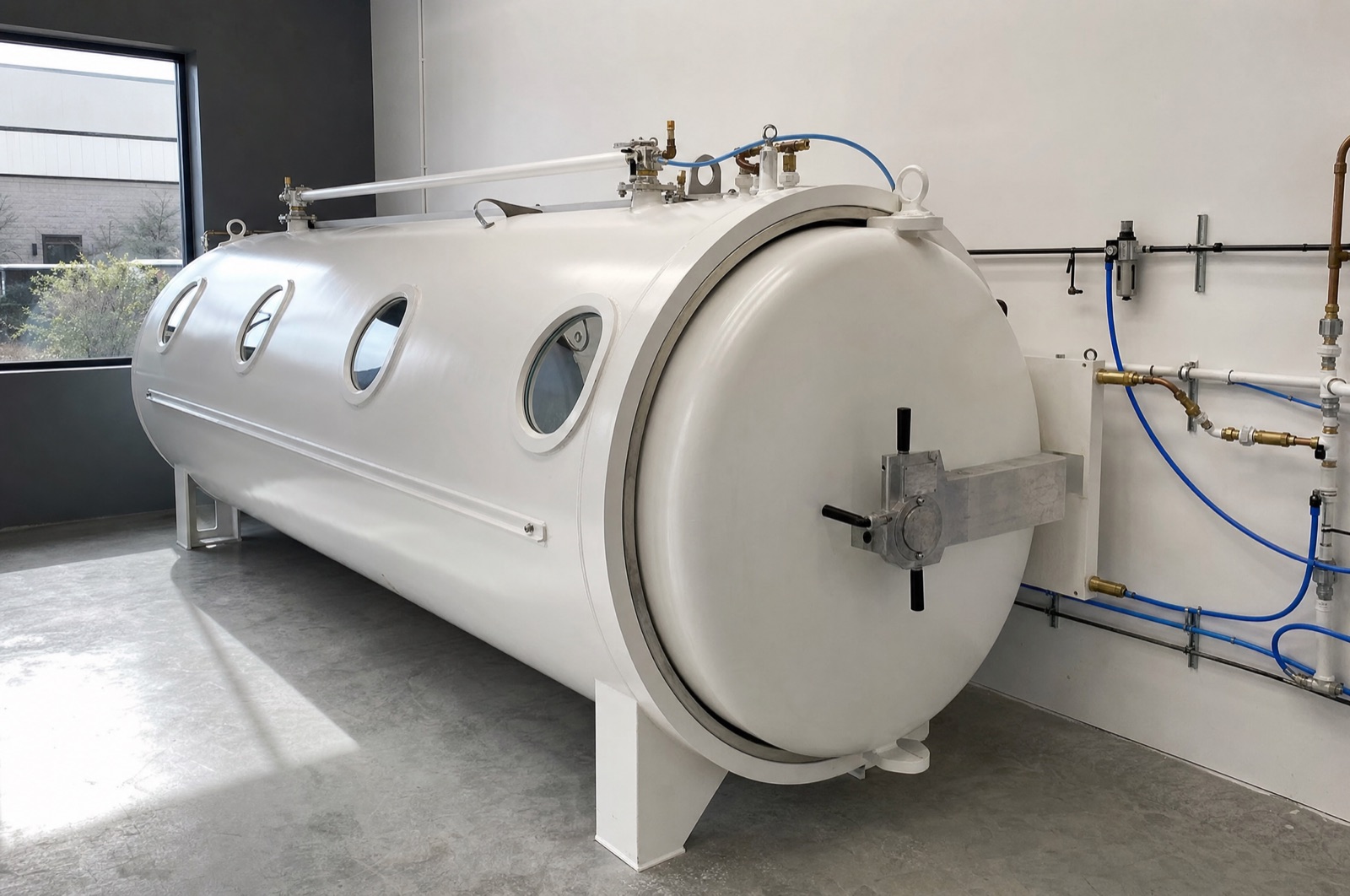
[ Installed capsule ] Reference imagery; final photography in production
How a hard chamber travels
A hard-shell chamber moves as freight on a truck, not as a parcel. The sellers we read say it the same way. Select Fitness, a US retailer, says on its Quest36 product page that all hyperbaric chambers ship via freight and are delivered curbside, or to a loading dock for commercial sites, and that a signature is required. It says hard shell chambers typically arrive mostly assembled in large crates. The same page says most hard shell chambers ship directly from an overseas factory.
That route adds steps before the truck. Recovery for Athletes says on its Quest30 page that you get a truck tracking number after the chamber arrives in the US and clears customs, and that the delivery team then contacts you to set a date and time. Select Fitness says the carrier contacts you by phone or email to schedule, and that refused or missed deliveries may bring re-delivery, storage or return freight charges. Lead times on the pages we read ran from about 4 to 8 weeks from order, and two pages used the words ship and arrive for the same window, so ask which one the date means.
This guide covers the day itself. How much room and power the chamber needs once it is in place is in our space and power guide, and we do not repeat those figures here.
Curbside, liftgate, inside and white glove
The words on your order decide where the driver stops. Freight carriers and sellers use four levels of service, and each one ends at a different point.
| Service | Where it ends | What a source says |
|---|---|---|
| Standard freight | Curb or loading dock | The trucking company delivers the crated chamber; offloading, uncrating and moving it in are the buyer's job (Recovery for Athletes) |
| Liftgate | Ground level at the truck | R+L Carriers lists 2,000 lb per pallet and a 48 by 60 inch maximum pallet size for its liftgate service |
| Inside delivery | Just across the threshold | Mothership says a carrier uses a pallet jack to cross the threshold; at a home that means the driveway, porch or garage, and carriers will not take freight inside a home |
| White glove | The chamber in place | Offloading, uncrating, moving the chamber into place, teaching you to use it and cleanup (Recovery for Athletes; Select Fitness) |
Sources, read 14 October 2026: Recovery for Athletes; R+L Carriers liftgate service; Mothership on inside delivery; Select Fitness. Each carrier sets its own terms in its tariff.
Two details are worth reading twice. First, white glove is not always done by the seller. Select Fitness says it can refer you to an installer who can offload, uncrate, place the chamber, give a walkthrough and clean up, and that this depends on your location. It lists white glove as a paid add-on, and the price is not the same across its own product pages, so get it in writing. Second, liftgates have limits. Mothership puts typical liftgate capacity at 1,500 to 3,500 lb depending on the truck and carrier, and says its own network handles units up to 86 inches long. The lying chambers in the table below run 86.6 to 90.6 inches long before any crate is added, so ask the seller how the crate will come off the truck at your address.
Published sizes and weights
We looked for published crate sizes and crated weights and did not find any. The pages we read give the chamber's own dimensions and net weight. These are examples of what is published, not a ranking.
| Model, as listed | Type | Chamber size | Chamber weight | Other pieces | Crate size |
|---|---|---|---|---|---|
| OxyRevo Quest30 | Lying | 220 cm long, 75 cm diameter | 507 lb | Operating unit 80 x 40 x 90 cm, 80 to 90 kg | Not published |
| OxyRevo Quest36 | Lying | 89 in long, 36 in diameter | 573 lb (260 kg) | Not listed | Not published |
| OxyRevo Space60 | Sitting | 79 x 34 x 60 in | 1,323 lb (one page); about 700 kg (another) | Not listed | Not published |
| HERO LifeCare chamber | Lying | 90.6 in long, 35.4 in diameter | 353 lb | Concentrator 195 lb, 42 in tall | Not published |
Sources, read 14 October 2026: Quest30; Quest36; Space60 at Select Fitness and Space60 on MedicalSearch; HERO LifeCare. The two Space60 weights do not agree; we print both.
The gap between the two Space60 figures is about 220 lb, which is the kind of number a delivery crew needs to know in advance. Ask the seller for the packing list before you book anything: crate length, width, height and gross weight for every piece, including the compressor or operating unit, the concentrator and any cooler.
Doorways, stairs and lifts
Measure the narrowest point on the route, then compare it with the chamber, not the crate. Crews usually uncrate outside. The US model home code sets a size for one door only. The AIBD summary of IRC section R311.2 says every dwelling unit must have at least one side-hinged egress door, with a minimum clear width of 32 inches when open at 90 degrees and a clear height of 78 inches from threshold to door stop. That summary sets no size for the other doors on your route, so measure each one.
Set the published diameters against that figure. The Quest36 is 36 inches across, the HERO chamber 35.4 inches, and the Space60 is 34 inches wide. All three are wider than a door built to the 32 inch minimum. The Quest30, at 75 cm, is about 29.5 inches. A chamber that is wider than a doorway may still fit through it on its side or with feet removed, and we do not know which models allow that. That is a question for the seller.
Some makers plan the route for you. OxyHelp says in its FAQ that it reviews the narrowest doorways, corridors, stairs or lift, and the space inside the room, and that it checks the entire route before confirming an order. It says a chamber may arrive fully assembled or in sections assembled on site, so a narrow door does not necessarily rule out installation. SMP says on its modular chamber page that its multi-place chamber is built from sections that can fit through standard doorframes. Lift and stair limits belong to your building. Ask the building manager for the lift's rated load and car size, and tell the seller about stairs before you order, as Select Fitness asks buyers to do.
Floor load
The building code gives a design figure, not a measured capacity of your floor. Table R301.5 of the International Residential Code sets minimum uniformly distributed live loads of 40 pounds per square foot for rooms other than sleeping rooms and 30 for sleeping rooms. We read the table in Minnesota Rules part 1309.0301, which reprints it, and the Lone Tree, Colorado design criteria list the same 40 and 30 for their adopted 2021 IRC.
A rough comparison helps you decide whether to ask an engineer. If you spread a chamber's published weight over the rectangle it covers, the Quest36 comes to about 26 lb per square foot empty and about 38 with a 120 kg occupant, the listed maximum. The Space60, at 1,323 lb on 79 by 34 inches, comes to about 71 lb per square foot before anyone sits in it. That is Wellness Vaults arithmetic, and it flatters the floor: a chamber on casters or feet puts its weight on a few points, not across its outline. A design live load is also not the same as the most a floor can hold. Treat a result near or above 40 as a reason to get a structural engineer to look, and remember the crew, a pallet jack and the crate may all be on the same floor on the day.
Inspect before you sign
The delivery receipt is the one document the driver will hand you, and what you write on it matters later. Select Fitness asks buyers to inspect the shipment before signing, write any visible damage on the receipt, with DAMAGED, NEEDS REVIEW as its example, photograph the packaging, labels and damage, and contact the seller within 2 to 3 business days.
- Count the pieces against the bill of lading. A chamber, an operating unit and a concentrator may be three crates.
- Walk around every crate. Look for crushed corners, punctures, forklift marks, tilt or shock indicators if fitted, and wet or stained wood.
- Photograph each crate and its labels on the truck, at the curb and as it is opened.
- Write what you see on the receipt in plain words, and ask the driver to sign or initial the note.
- If you cannot open the crates while the driver waits, say so on the receipt and inspect the same day.
A note on the receipt is evidence, not a claim. The FMCSA rule on cargo claims, 49 CFR 370.3(c), says damage notations on freight bills or delivery receipts do not by themselves count as a claim, even if they state a dollar amount. You still have to file one.
If damage shows up later
Damage found after the driver leaves is called concealed damage, and the first deadline is short. A carrier-industry guide from PNG Worldwide says no law or regulation sets a time limit for notice of concealed damage, but most LTL carriers set one in a tariff or in the National Motor Freight Classification. It says the report must include a request for inspection by the carrier, and that you must keep the container and contents in the same condition until then. Trinity Logistics reports that the window fell from 15 days to 5 from 18 April 2015. Your carrier's tariff is the document that binds, so ask for it.
| Step | Time limit | Source |
|---|---|---|
| Note visible damage | At delivery, before signing | Seller instructions |
| Report concealed damage and ask for inspection | Commonly 5 days from delivery, set by tariff | NMFC as reported by Trinity Logistics |
| File a written claim with an amount | Carrier may not allow less than 9 months | 49 U.S.C. 14706(e) |
| Carrier acknowledges the claim | Within 30 days of receipt | 49 CFR 370.5 |
| Carrier pays, declines or offers a settlement | Within 120 days, then status every 60 days | 49 CFR 370.9 |
| Sue after a written denial | Carrier may not allow less than 2 years | 49 U.S.C. 14706(e) |
Sources, read 14 October 2026: 49 U.S.C. 14706; 49 CFR 370.3; 370.5; 370.9. Part 370 covers motor carriers and freight forwarders on interstate and foreign moves.
A valid claim under 370.3(b) is in writing, identifies the shipment, asserts that the carrier is liable, and asks for a specified or determinable amount of money. A phone call or an email saying the crate was damaged does not meet that test. The carrier's liability under 14706(a) is for the actual loss or injury to the property, and 370.1 puts the rule under the Federal Motor Carrier Safety Administration. If the seller booked the freight, the seller may be the party that files, so tell the seller at once and agree in writing who is doing what. Our warranty guide covers how transit damage and warranty claims differ in the published terms we read.
Who assembles and connects it
It depends on what you bought. On a standard freight delivery, the buyer does the moving and the setup. Select Fitness describes the Quest36 as DIY-friendly with professional install on request, says many models can be running in under an hour depending on the configuration and how ready the space is, and says it partners with an installer network for assembly. HERO LifeCare lists a white glove delivery and installation option on its product page, and describes the system as plug-and-play: follow the instructions and connect the tubing provided.
Sectional and clinic chambers are a different job. OxyHelp says sectional chambers are assembled on site, and that installation depends on the room meeting its installation requirements. For hospital chambers, Perry Baromedical says on its ancillary equipment page that its technicians can hook up ancillary devices and show staff how to use them in a half day or one day workshop. A clinic install also brings fire code duties, which our NFPA 99 guide covers.
Power, compressor and concentrator
A hard chamber is usually a shell plus separate boxes that need their own floor space and their own sockets. The Quest30 page lists an operating unit of 80 by 40 by 90 cm weighing 80 to 90 kg, which takes 110V or 220V and draws 1,400 to 1,700 watts. HERO LifeCare lists its concentrator at AC 110V or 220V, 50 or 60 Hz, 2000 W. OxyHelp says a setup needs one cooling unit per chamber and one concentrator per person, and that the exhaust can be routed into suitable building ventilation or outdoors through a window. Select Fitness says some models may need a 220V dedicated circuit, installed by a licensed electrician.
The practical rule is that the electrician comes before the truck. Get the electrical specification for each box in writing, have any new circuit and outlet fitted and tested, and know where the exhaust hose will run before the crew arrives. The concentrator is a separate device with its own rules, which our concentrator guide explains. Where the compressor sits also decides how loud the room is, covered in how loud is a hyperbaric chamber.
First pressurization and training
The sources we read say little about the first run on site. Training is the better documented part. OxyHelp says its team explains the maintenance schedule and provides the instructions when the chamber is installed, and that every professional partner gets onboarding, operating protocols and ongoing support. Recovery for Athletes offers a video call training session with the Quest30. The Select Fitness white glove add-on is described as an install with a walkthrough and live support.
Pressure testing is mostly a factory step. SMP says on its pressure testing page that it tests its chambers above their working pressure, using water rather than compressed air to keep its technicians safe. That was a workshop test on a commercial chamber. We found no seller page that describes an on-site leak test or a supervised first session for a home chamber. Ask whether the installer will run the chamber through a full cycle with you present, check the seals and the depressurization controls, and show you the emergency release before leaving. How the shell is built and tested is set out in our ASME PVHO-1 guide, and what can go wrong in use is in the safety guide.
The paperwork to keep
Keep these together from the day the chamber arrives. Most of them have a deadline attached somewhere.
- The bill of lading and your signed copy of the delivery receipt, with any damage notes.
- Photos of each crate and its labels, dated, from the truck to the room.
- The packing list with crate dimensions and gross weights.
- The warranty for each device, since a chamber, compressor and concentrator may have different makers and start dates.
- The operating manual and maintenance schedule. Select Fitness says digital manuals are available on request; ask for them before delivery.
- The electrician's invoice for any new circuit, and the installer's sign-off if you used one.
- The carrier's name, the PRO or tracking number, and the tariff that sets its concealed damage window.
A delivery day checklist
In order, from the week before to the week after:
- Before booking. Packing list with crate sizes and weights; service level in writing (curbside, liftgate, inside or white glove); who installs and who trains.
- Two weeks out. Route measured at its narrowest point; floor checked if your arithmetic comes near 40 lb per square foot; electrician done; lift booked if the building needs it.
- On the day. Someone present to sign; enough people or the right equipment to move the crate; phone charged for photos.
- At the truck. Count the pieces, inspect each crate, write any damage on the receipt, photograph it, then sign.
- After uncrating. Inspect again; report concealed damage to the carrier and seller in writing at once, with a request for inspection; keep the crate and packing.
- Within the claim window. A written claim with a dollar amount if anything is damaged, filed with the right party.
What a chamber costs once delivery and installation are added is in our cost guide. How the brands we track score on what we can verify is on the scorecard.
What we have not verified
We did not find a published crate size or crated weight for any hard-shell chamber, so the dimensions above are for the chamber alone. The two published weights for the Space60 do not agree and we could not tell which is current. We read seller and maker web pages, not the shipping terms or tariffs that apply to a given order, and we did not check any carrier's current concealed damage window ourselves; the 5 day figure comes from a logistics firm's report of the NMFC change. We read the IRC live load table and the egress door rule through state, city and trade association pages, not the ICC text. We found no source describing an on-site pressure test, a commissioning sign-off or a supervised first session for a home chamber, and we do not know which chambers can turn on their side or lose their feet to pass a narrow door. The floor figures above are rough arithmetic, not an engineering assessment. If you have a packing list or an installer's commissioning checklist for a hard chamber, send it and we will add it.
Frequently asked
Does a hard-shell hyperbaric chamber come fully assembled?
Often it arrives mostly assembled. One US seller says hard shell chambers typically arrive mostly assembled in large crates and require planning. Some larger chambers are built in sections. OxyHelp says a chamber may be delivered fully assembled or brought in as separate sections and assembled on site.
Will the freight driver bring the chamber into my house?
Not on a standard freight delivery. One seller says the trucking company delivers the crated chamber and it is then your job to offload it, uncrate it and move it into the building. A freight broker says carriers will not take freight inside a home, and that inside delivery to a residence means the driveway, porch or garage. Moving the chamber into the room is what a white glove or installer service is for.
What should I write on the delivery receipt if the crate is damaged?
Describe the damage you can see, in writing, before you sign, and take photos. One seller gives DAMAGED, NEEDS REVIEW as an example notation and asks buyers to contact it within 2 to 3 business days. The note on the receipt is evidence, not a claim. Under 49 CFR 370.3 a damage notation on a delivery receipt does not count as a claim by itself.
How long do I have to file a freight damage claim?
Under 49 U.S.C. 14706(e), a motor carrier may not give you less than 9 months to file a claim or less than 2 years to sue after it denies the claim in writing. The bill of lading or contract can allow more. Concealed damage found after the driver leaves has a much shorter notice window in most LTL carrier rules, commonly cited as 5 days from delivery.
Do I need an electrician before delivery day?
Possibly. One seller says some models may require a 220V dedicated circuit, installed by a licensed electrician if required. Get the electrical specification for your exact model in writing and have any new circuit in place before the chamber arrives. Our space and power guide covers the published power figures.

Alex tests the machines himself, in clinics and studios on three continents. Every score comes from the same 27 public criteria, and no manufacturer has a say in them.
Six questions, and we'll match chamber, options, and install to your space and budget.