Hyperbaric Chamber Rules in New Zealand: Medsafe, WAND, ACC and Wellness Chambers
Researched and scored by Alex Evans. Last reviewed August 2026. Corrections are dated and public. See corrections
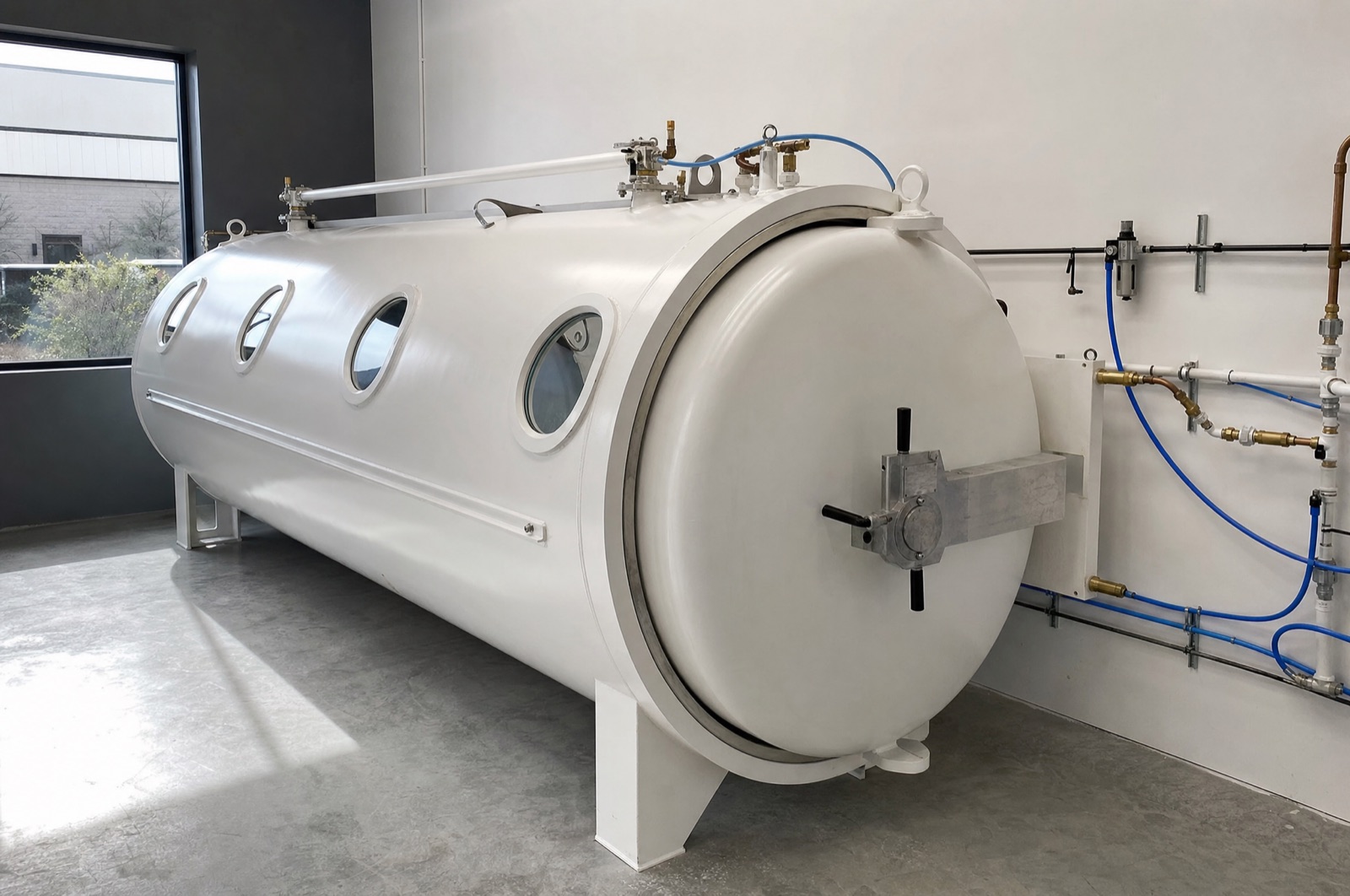
[ Clinic install ] Reference imagery; final photography in production
Hyperbaric chambers are legal in New Zealand, and no regulator approves them before sale. The only device rule is a notice to Medsafe's WAND database. The heavier rules sit elsewhere: the advertising law, which decides whether a chamber is a medical device at all, the pressure equipment regulations, and the contract terms ACC sets for the units it pays. This page covers each one for hospital units and for home or wellness chambers. It uses Medsafe guidance, a Ministry of Health briefing, the ACC service schedule, the ASA advertising code, a Commerce Commission fact sheet, a WorkSafe code of practice and two public hospital pages. We do not say whether any treatment works.
Legal, with no approval step for the device
New Zealand does not license medical devices before they are sold. Medsafe's explanation of the WAND database states it plainly: there is no approval system for medical devices under the Medicines Act 1981, and no mandatory requirement for a device to be approved before supply.
A Ministry of Health briefing to the Minister of Health, dated 26 February 2026 and released in June 2026, says the same thing in more detail. There is no pre-market assessment or approval for devices supplied in New Zealand. Suppliers do not have to show approval by any overseas regulator. The only requirement is to notify Medsafe through WAND. The briefing calls this an international outlier and says buyers of devices have limited assurance of safety and often manage the risks themselves.
So a hospital chamber and a soft chamber sold for home use reach the market by the same route. What differs is what happens around them: who buys them, what the seller says about them, which workplace rules apply, and whether a public payer is involved.
What Medsafe asks of a seller: WAND notification
WAND stands for Web Assisted Notification of Devices. It was set up by the Medicines (Database of Medical Devices) Regulations 2003. Medsafe's page on regulatory requirements for sponsors sets out the duties. The sponsor is the New Zealand importer, exporter or local maker that has legal responsibility for the device, per Medsafe's definitions page.
- Notify the device within 30 working days of becoming its sponsor. Medsafe reads this as starting when the device first arrives in New Zealand.
- Enter the risk class, sponsor and maker contact details and a GMDN product description (regulation 5).
- Declare that the information is accurate, the risk class is right and the device will be recommended only for its intended purpose (regulation 7).
- Correct changed details within 10 working days (regulation 8).
- Never suggest that a device on the database is endorsed by the Director-General or the Ministry of Health (regulation 10).
Breaching regulations 6, 8, 9 or 10 is an offence with a fine of up to $500, per the same page. The WAND explanation page adds that notification does not mean Medsafe has assessed the device for quality, safety, efficacy or performance. The public cannot search WAND. The ASA Therapeutic and Health Advertising Code notes that only Medsafe and the New Zealand sponsor can see it.
Medsafe's legislation page lists the other laws a device may fall under. For a chamber, two matter: the Electricity Act 1992 for powered devices, and the pressure equipment regulations of 1999 for pressure vessels. The page says it is the supplier's job to make sure a product meets every law that applies.
When a chamber counts as a medical device
In New Zealand the claim makes the device. Medsafe's definitions page says a product is regulated as a medical device or a medicine if the maker or sponsor claims or implies a therapeutic purpose for it. A medical device is an article intended for use in, on or for people for a therapeutic purpose.
The ASA code reprints the Medicines Act definition of therapeutic purpose. It covers six purposes:
- preventing, diagnosing, monitoring, alleviating, treating, curing or compensating for a disease, ailment, defect or injury;
- influencing, inhibiting or modifying a physiological process;
- testing people's susceptibility to a disease or ailment;
- influencing, controlling or preventing conception;
- testing for pregnancy;
- investigating, replacing or modifying parts of the human anatomy.
The second item is broad. A chamber sold with wording about oxygen levels in the body or recovery after exercise may count as making a claim about a physiological process. We found no Medsafe ruling on mild or soft chambers as a class, so we cannot say where a given sales line crosses over. For how the US draws the same line, see FDA cleared vs FDA registered.
The law that would have changed this
Parliament passed the Therapeutic Products Act in 2023 to replace the Medicines Act. The law firm Simpson Grierson, in a note on the repeal, says the bill passed in July 2023 and the Act was set to start in September 2026. Consumer NZ wrote that under that Act devices would have needed market authorisation before import, export or supply.
Simpson Grierson says the coalition government announced the repeal in November 2023. The government disclosure statement for the Therapeutic Products Act Repeal Bill says the Act had a start date of 1 September 2026 and that most of it had not commenced. It says the Medicines Act 1981 stays in force in the meantime, and that the repeal does not change the existing settings for therapeutic products. The February 2026 briefing confirms that position: no pre-market approval, WAND notice only.
What the Medical Products Bill proposes
The replacement is a Medical Products Bill. Cabinet agreed on 30 September 2024 to develop it, per the Cabinet paper and minute on modernising the rules for medicines and devices. That paper proposes a self-declaration route for low risk devices. The February 2026 briefing gives the model in more detail:
- Low risk devices, about half of all devices, would be approved automatically when the sponsor registers them on a Medical Products Register and declares they meet the standards that apply.
- Higher risk devices would generally rely on approval by at least one recognised overseas regulator.
- A small set of higher risk devices, such as implants, may need two overseas approvals or a direct Medsafe assessment.
- Almost 75% of devices would be approved automatically or through reliance routes. About 1% of new devices would need further review.
The briefing says the bill is still in development and gives 2030 as the expected start of the law that replaces the Medicines Act. It does not say which risk class a hyperbaric chamber would fall in. Until the bill passes, the rules on this page are the ones that apply.
Claims and advertising
Advertising is where the device rules have the most bite. Medsafe's page on advertising medical devices points to Part 4 of the Medicines Act, sections 56 to 62, and to regulations 7, 10 and 11 of the Medicines Regulations 1984. It says a claim can be stated outright or implied, that internet promotion counts, and that sponsors must also comply with the Fair Trading Act 1986.
The ASA Therapeutic and Health Advertising Code took effect on 1 April 2026 for new ads and 1 July 2026 for all ads. It applies to medical devices and to health services. For a chamber seller or clinic, these rules stand out:
- Any therapeutic purpose claim for a device must match the intended purpose listed in WAND (Rule 2(a)).
- Substantiation must exist before the claim is made (Rule 2(a)).
- No claim that a product is safe, cannot cause harm, works in all cases or is a sure cure (Rule 1(b)).
- No implied endorsement by health professionals, government agencies or professional bodies (Rule 2(e)). The code notes that section 58 of the Medicines Act bars medical advertisements that suggest a device has been used or recommended by a doctor, nurse or pharmacist.
- Testimonials must not make a therapeutic purpose claim or suggest the device improved a person's health (Rule 2(f)).
The Commerce Commission enforces the Fair Trading Act. Its fact sheet on unsubstantiated representations says a business must have reasonable grounds for a claim at the time it makes it. It expects a claim that a product can cure disease to be backed by credible scientific and medical evidence. Courts may fine a company up to $600,000 and an individual up to $200,000.
The pressure vessel side
A chamber is also a pressure vessel. New Zealand regulates pressure equipment through the Health and Safety in Employment (Pressure Equipment, Cranes, and Passenger Ropeways) Regulations 1999, often shortened to PECPR. WorkSafe's Approved Code of Practice for Pressure Equipment (Excluding Boilers), published in June 2001, explains how they work. A Certificate of Inspection is issued by an inspection body on an equipment inspector's advice. It lasts for the period on the certificate, or until a repair or alteration, or until the inspection body withdraws it. An inspection body may extend one once, by up to three months.
The code sorts equipment by hazard level under the standard AS 4343. Equipment at hazard level E needs no design verification, no Certificate of Inspection and no competent person. Its list of referenced standards has a heading for hyperbaric chambers that names ASME PVHO-1, the US standard for pressure vessels for human occupancy, and CSA Z275-1 for hyperbaric facilities. For more on PVHO-1, see our ASME PVHO-1 guide.
The main facility standard is AS/NZS 4774.2:2019, Work in compressed air and hyperbaric facilities, Part 2: Hyperbaric oxygen facilities. The publisher's listing says it covers the design, construction, operation and maintenance of hyperbaric facilities and staffing and training. It covers monoplace and multiplace chambers. It excludes hypobaric chambers and facilities such as sporting domes and clean rooms that run at very low raised pressures. We have not read the standard itself.
The workplace law applies to a clinic as a workplace. ACC's contract, covered below, also names the Health and Safety at Work Act 2015. We found no rule that brings a chamber used privately at home under WorkSafe.
The public hospital units
Health New Zealand runs at least two hyperbaric units. The Hyperbaric Medicine Unit at Christchurch Hospital sits on the lower ground floor of Parkside West. Its page says it runs a 24 hour acute service for all of New Zealand south of Taupō, and lists decompression sickness, air embolism, radiation tissue injury and some problem wounds among the conditions it treats. A healthcare provider refers patients. Most patients come Monday to Friday for sessions of about 2 to 2.5 hours.
The Slark Hyperbaric Unit of Waitematā is at 91 Calliope Road, Devonport, Auckland. Its Healthpoint listing says the chamber is pressurised with compressed air, to 2.8 atmospheres for most diving injuries and 2.4 for most medical conditions. Diving emergencies go through the Diving Emergency Service on 0800 4 DES 111, 24 hours a day. Elective services run Monday to Friday, 8:00am to 4:30pm, and there is no charge because it is a public health service.
The Slark listing also publishes a list of conditions it will not treat. It says there is no reliable clinical evidence for mild treatment in soft shell chambers that reach up to 1.5 atmospheres, and that it endorses the Undersea and Hyperbaric Medical Society's position statement. That is the unit's stated policy, not a law. For the pressure differences between the two kinds of chamber, see mild vs medical hyperbaric.
What ACC pays for
ACC, the Accident Compensation Corporation, pays for treatment of accepted injury claims. Its service schedule for non-acute hyperbaric oxygen therapy runs from 1 July 2024 to 30 June 2029. It defines treatment as the whole patient inside a pressurised chamber breathing 100% oxygen at more than one atmosphere, usually for less than 120 minutes. Its prices, excluding GST:
| Code | Service | Price excl. GST |
|---|---|---|
| CS100 | Simple assessment, initial | $205.53 |
| CS200 | Complex assessment, initial | $314.91 |
| CS400 / CS900 | Second opinion, simple / complex | $205.53 / $314.91 |
| CS500 | Reassessment | $205.53 |
| HBO01 | Non-acute chamber, per hour | $342.14 |
| HBO10 | Inpatient bed, per 24 hour stay | $648.14 |
Source: ACC Service Schedule for Non-Acute Hyperbaric Oxygen Therapy Services, Part A, Table 1, linked above. The copy we read is labelled 1 July 2026 on its first pages.
The schedule sets these conditions on a funded unit:
- Referrals only from ACC or a vocationally registered medical specialist, and ACC's prior approval before treatment starts.
- A medical team led by a named clinician, a nursing team led by registered nurses with hyperbaric training, and technical staff with suitable qualifications.
- Compliance with AS/NZS 4774.2:2019 and membership of the Hyperbaric Technicians and Nurses Association.
- Compliance with the pressure equipment regulations, and a current Certificate of Inspection displayed beside the pressure vessel.
- Compliance with the Health and Safety at Work Act 2015.
Its Appendix B lists selected problem wounds as the funded non-acute condition, with prior approval. ACC will not pay for chronic refractory osteomyelitis, radiation induced tissue injury, soft tissue, musculoskeletal, traumatic brain or sports injuries, or for topical oxygen. For how US insurers handle the same treatment, see hyperbaric insurance and CPT codes.
Hospital unit and wellness chamber side by side
| Question | Hospital or ACC funded unit | Home or wellness chamber |
|---|---|---|
| Banned? | No | No ban found |
| Device approval | None exists; WAND notice within 30 working days | None exists; WAND notice if it is a medical device |
| Medical device? | Yes, by its therapeutic use | Depends on the seller's claims; no Medsafe ruling found |
| Pressure | 2.4 or 2.8 atmospheres at the Slark unit | Up to 1.5 atmospheres for soft chambers, per the Slark listing |
| Breathing gas | 100% oxygen, per the ACC definition | Not set by any rule we found |
| Facility standard | AS/NZS 4774.2:2019, required by ACC | No rule found that requires it |
| Pressure vessel certificate | Certificate of Inspection, required by ACC | Not confirmed |
| Who pays | Public health service or ACC, $342.14 per chamber hour | The buyer or client |
| Advertising | Medicines Act, ASA code, Fair Trading Act | Same laws; claims must be substantiated before use |
Sources: Medsafe WAND, sponsor, definitions, legislation and advertising pages; Ministry of Health briefing of 26 February 2026; ASA Therapeutic and Health Advertising Code; ACC non-acute HBOT service schedule; Health New Zealand Christchurch and Slark unit pages. All linked above, read 29 October 2026.
For the same question in other countries, see hyperbaric chamber rules in Australia, Canada and the UK, chamber rules in Japan, chamber rules in Germany and France and chamber rules in the UAE. For fire and other hazards, see hyperbaric chamber safety. For the chambers we track and what we can verify about each, see the scorecard.
What we have not verified
We could not load the Medicines Act, the 2003 database regulations, the PECPR regulations or the Therapeutic Products Act Repeal Act on the government legislation site, which blocked our requests. The rules above come from Medsafe, the ASA code and the Cabinet and disclosure papers that quote them. Search listings give 17 December 2024 as the date the repeal Act received assent; we did not confirm that date from the Act. We did not read AS/NZS 4774.2:2019 itself, or check whether any soft or home chamber falls inside the PECPR regulations by hazard level. We found no Medsafe ruling, recall or warning on hyperbaric chambers, and no Commerce Commission or ASA decision naming a chamber seller. We did not check whether any New Zealand law limits who may give oxygen in a wellness chamber. We did not confirm whether the Slark unit has any link to the Navy, or which public or private units hold ACC contracts. The 2001 WorkSafe code may have been updated; we read the copy WorkSafe still hosts.
Frequently asked
Are hyperbaric chambers legal in New Zealand?
Yes. We found no ban. New Zealand has no approval system for medical devices under the Medicines Act 1981, per Medsafe. The sponsor, meaning the New Zealand importer, exporter or local maker, must notify the device to Medsafe's WAND database within 30 working days of becoming the sponsor. Medsafe says notification does not mean the device has been assessed for quality, safety, efficacy or performance.
Does Medsafe approve hyperbaric chambers?
No. Medsafe says there is no mandatory requirement for medical devices to be approved before supply. A Ministry of Health briefing dated 26 February 2026 says suppliers do not have to show approval by any overseas regulator either. A seller may not say that a device listed on WAND is endorsed by the Director-General or the Ministry of Health; that is an offence under regulation 10 of the 2003 database regulations.
Is a mild or soft hyperbaric chamber a medical device in New Zealand?
It depends on the claims. Medsafe says a product is regulated as a medical device if the maker or sponsor claims or implies a therapeutic purpose for it. The Medicines Act lists those purposes, including treating a disease or injury and influencing a physiological process. We found no Medsafe ruling on mild chambers as a class, and the WAND database is not open to the public, so we cannot say which chambers have been notified.
Does ACC pay for hyperbaric oxygen treatment?
For some covered injuries, yes. ACC's service schedule for non-acute hyperbaric oxygen therapy pays $342.14 per chamber hour, excluding GST, for clients with an accepted injury claim, after ACC gives prior approval. Referrals must come from ACC or a vocationally registered medical specialist. The schedule lists conditions ACC will not pay for, including soft tissue, musculoskeletal, sports and traumatic brain injuries, and it does not pay for topical oxygen.
Do I need a certificate to run a hyperbaric chamber in New Zealand?
ACC requires one from the units it contracts. Its schedule says suppliers must comply with the Health and Safety in Employment (Pressure Equipment, Cranes, and Passenger Ropeways) Regulations and keep a current Certificate of Inspection displayed beside the pressure vessel. The 2001 WorkSafe code of practice for pressure equipment sets out how those certificates work. We did not confirm whether a given home or soft chamber falls inside those regulations.
Will New Zealand start approving medical devices?
That is the plan. A Ministry of Health briefing of 26 February 2026 says the proposed Medical Products Bill will introduce pre-market approval for medical devices. Low risk devices would be approved automatically on registration and a declaration of compliance with standards; most higher risk devices would rely on an overseas regulator's approval. The same briefing gives 2030 as the expected commencement of the bill's replacement of the Medicines Act.

Alex tests the machines himself, in clinics and studios on three continents. Every score comes from the same 27 public criteria, and no manufacturer has a say in them.
Six questions, and we'll match chamber, options, and install to your space and budget.