Hyperbaric Chamber Rules in Germany and France: What Each Country Adds to the CE Mark
Researched and scored by Alex Evans. Last reviewed August 2026. Corrections are dated and public. See corrections
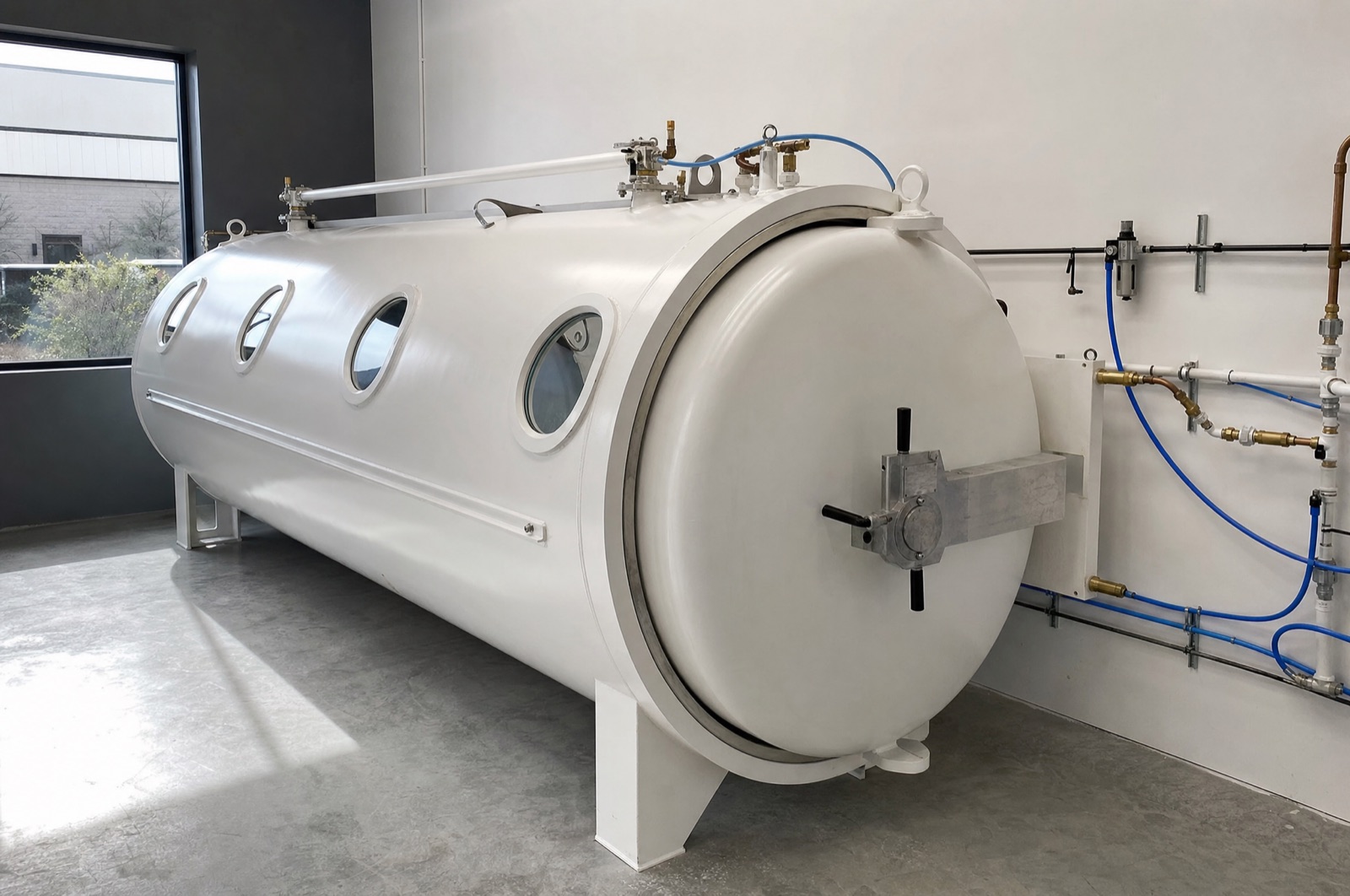
[ Clinic chamber ] Reference imagery; final photography in production
This page answers one question: what does it take to run a hyperbaric chamber in Germany or France, beyond the CE mark. It uses German federal law, decisions of the body that sets what German statutory insurance pays for, forms from the doctors' associations that grant billing approval, French regional health agency pages and a French labour order. Most sources are in German or French; the translations are ours. We do not say whether any treatment works.
Banned or not: the answer for each country
Neither country bans hyperbaric chambers. Both treat a medical chamber as a medical device under EU law, and each adds its own layer for the people who run one. Germany puts duties on the operator through a federal regulation and limits what statutory insurance pays for. France goes further at the front door: a medical caisson hyperbare is on the short list of heavy equipment that needs a regional health agency authorisation before it is installed.
The two systems also regulate the staff. In Germany, the outpatient billing rules name the qualifications of everyone at the chamber. In France, a 2024 labour order sets the team that must be present when staff work under pressure in a hyperbaric medicine centre. The sections below take each country in turn.
What the EU layer already covers
Both countries sit under the same EU device rules, so a chamber sold in either one needs the same CE marking route. Our CE marking guide covers that route: the device class, the notified body number and how to read a declaration of conformity. This page does not repeat it. The German operator regulation itself points back to that layer: its section 4 cites Regulation (EU) 2017/745, the EU Medical Device Regulation, when it sets out when a device may be used without an instruction manual. For the same question in other countries, see hyperbaric chamber rules in Australia, Canada and the UK.
Germany: operator duties under the MPBetreibV
In Germany the main extra layer is the Medizinprodukte-Betreiberverordnung, the regulation on operating and using medical devices, known as the MPBetreibV. Its Annex 1 (in German) lists a short set of non-implantable active devices that carry extra duties. Item 1.7 is Therapie mit Druckkammern, therapy with pressure chambers. It sits in the same list as defibrillators, ventilators and MRI scanners.
Three duties follow from that listing. Under section 11, the operator may let a listed device be used only after the maker, or a person authorised by the maker, has run a function test at the site and instructed a person the operator names. Only staff instructed in the device may then use it, and the test and the instruction must be documented. Under section 12, the operator must have safety checks carried out at least every two years, sooner if defects are to be expected, and the checker must write a report and label the device with the month of the next check. Under section 13, the operator keeps a device logbook, the Medizinproduktebuch. It records the instruction, the checks, maintenance, malfunctions and any incident reports, and must be kept for five years after the device leaves service.
Who counts as the operator matters. The definitions in section 2 make the operator whoever is responsible for the health facility where staff use the device, and add that anyone who keeps devices ready for use outside a health facility also counts as an operator. Section 1 excludes devices bought and used solely on one's own responsibility for personal purposes, and leaves workplace safety law untouched. Section 4 adds a general rule: devices may only be operated or used by people with the training, or the knowledge and experience, the task needs.
Germany: what statutory insurance pays for
Statutory health insurance in Germany covers hyperbaric oxygen in outpatient care for one condition only. The Federal Joint Committee, the G-BA, decides which methods the statutory funds pay for. Its decision of 21 September 2017 (in German) added hyperbaric oxygen as an add-on treatment of diabetic foot syndrome to the list of recognised outpatient methods. It moved every other outpatient use onto the list of methods that may not be billed to the statutory funds, which now reads hyperbaric oxygen therapy with the exception of the recognised indication. The G-BA procedure page gives 11 January 2018 as the date it took effect.
The decision sets conditions. The lesion must reach the joint capsule or tendons. Wound care that follows the guidelines must already have been given in a facility qualified for diabetic foot treatment, without signs of healing. Treatment needs a referral from a specialist in endocrinology and diabetology, or an internist or general practitioner with diabetology training. Before 2017, outpatient hyperbaric oxygen was not covered at all: a decision of 10 April 2000 by the G-BA's predecessor confirmed a 1994 refusal to recognise it for outpatient care.
Hospital care follows a separate track. A G-BA press release of 14 March 2008 says that for diabetic foot syndrome in hospital, hyperbaric oxygen could be billed to statutory insurance only in certain cases from then on: in Wagner stages III and IV, after standard therapy is exhausted and where standard therapy offers no reasonable prospect of healing. The procedure page lists a series of other hospital reviews by condition, all marked closed. We did not open each one, so we do not state their outcomes here.
Germany: who may treat, and the GTÜM lists
To bill the covered treatment, a doctor needs approval from the regional association of statutory health insurance physicians, the Kassenärztliche Vereinigung or KV. The KV Hessen application form (in German, dated January 2019) sets out what is checked. The doctor must be a specialist in one of six named fields, such as internal medicine or anaesthesiology, and hold the Druckkammerarzt diploma of the GTÜM, the German society for diving and hyperbaric medicine, or an equivalent. The chamber centre must have a minimum team on hand: that doctor, an anaesthesia, theatre or intensive care nurse with the GTÜM hyperbaric assistant training or an equivalent, and a lock attendant or a person with the GTÜM chamber operator diploma. At least one doctor and one other person must be certified fit for pressure, renewed at most every 12 months. The form says billing is allowed only after approval and that approval cannot be backdated. The KV Baden-Württemberg page runs the same approval through its own application service.
The GTÜM also publishes its own staffing guidance. Its training rules for assistant staff (in German) say every person working at a therapeutic chamber must be certified for the tasks they carry out, and that when a doctor and an assistant are both inside the chamber, a second operator is needed outside, citing the accident insurers' DGUV Information 207-001 on safe work with therapeutic pressure chambers. The DGUV describes that 2023 booklet as a summary of the main legal requirements for running such chambers, and says work under pressure counts as dangerous work under its accident prevention rules.
For finding a centre, the GTÜM keeps a directory of treatment chambers in three lists. List 1 covers emergency centres that meet the criteria of a diving accident alliance, including 24 hour readiness within 60 minutes and chamber technology to EN 14931; it names seven locations. List 2 covers chambers with 24 hour service and intensive care in the chamber; List 3 covers chambers with limited service hours. The GTÜM says being on a list is not a statement about quality, and that the lists rest on what the centres themselves report. They are a society's directory, not a state licence register.
France: the caisson hyperbare as heavy equipment
In France a medical hyperbaric chamber needs a state authorisation before it is installed. French law groups a short list of costly machines as équipements matériels lourds, heavy medical equipment. The regional health agency for La Réunion (in French) sets out the list in article R6122-26 of the public health code: item 2 is MRI and CT scanners, item 4 is the caisson hyperbare, and item 5 is the medical cyclotron. Items 1 and 3 are repealed. The same page says care activities and heavy equipment are subject to authorisation by the director general of the ARS, the regional health agency.
The list is planned at regional level. The Nouvelle-Aquitaine ARS says its zoning order of 25 October 2023 puts the caisson hyperbare in a single region-wide planning zone, alongside the treatment of severe burns and the cyclotron. Other activities, such as surgery or psychiatry, are planned in smaller zones. A 2016 staff paper for the HCAAM, the French advisory council on the future of health insurance, described the test then in force. The ARS granted an installation when the project met the health needs in the regional plan, fitted its aims and met siting and technical operating conditions. The authorisation could go to one or more doctors, a health establishment or a legal entity set up to run one. The paper says the authorisation usually also counts as permission to provide care reimbursed to people covered by social security. The secretariat that wrote it notes that it does not bind the council, and the 2023 reform may have changed some of these details.
France: how the ARS authorisation works
The ARS for Provence-Alpes-Côte d'Azur (in French) gives the working detail. Requests are filed online through the national SI-Autorisations portal, during windows the agency opens. It publishes a separate form for a new authorisation for a heavy equipment item, cyclotron or caisson hyperbare, and another for renewal. A renewal file must reach the agency at least 14 months before the authorisation expires. Its most recent caisson and cyclotron window on the page ran from 20 February to 20 April 2025.
The caisson is in a holding pattern under the national reform of authorisations. The same page lists the caisson hyperbare among the activities and equipment whose rules were not revised on 1 June 2023. Their authorisations were extended while the law known as the loi Valletoux, of 27 December 2023, was awaited. The page says article 9 of that law affects the law on health authorisations and that a decree was still to come. We did not find that decree, so we cannot say what it changes for the caisson.
France: rules for staff who work under pressure
The French labour code covers staff who go inside the chamber with patients. An order of 29 May 2024 deals with hyperbaric work without immersion in health care, mention C of article R4461-28 of the labour code. We read it through the article by article reproduction published by the OPPBTP, the construction sector's prevention body. Article 2 defines the setting as any dry hyperbaric exposure where a health professional or rescuer assists, assesses, rescues or gives care, in a hyperbaric medicine centre, an emergency recompression chamber or another professional pressure enclosure.
Article 17 sets the team in a hyperbaric medicine centre: an operator, a standby operator, a supervisor and a head of hyperbaric operations. All four must hold a hyperbaric fitness certificate, mention C, at class I, which covers work up to at least 3,000 hectopascals of relative pressure. The head of operations may also act as supervisor. Article 2 defines the supervisor as the person who runs and controls the chamber from outside, at local atmospheric pressure, and handles communication with the operator. These rules protect workers. They do not by themselves say who may prescribe a treatment.
The two countries side by side
The table sets the sourced answers next to each other. For staffing roles in general, see our guide to clinic staffing and certification; for the fire code side of a clinic install, see NFPA 99 and hyperbaric fire safety.
| Question | Germany | France |
|---|---|---|
| Banned? | No | No |
| Device rules | EU MDR and CE marking | EU MDR and CE marking |
| Permission before installing a medical chamber | No state licence found; operator duties apply from first use | Yes. Heavy equipment item 4 under article R6122-26, authorised by the ARS |
| Operator duties | MPBetreibV Annex 1 item 1.7: function test and instruction, safety check at least every two years, device logbook | Not checked beyond the authorisation |
| Staff rules | KV approval for billing: specialist with GTÜM Druckkammerarzt diploma, trained nurse, chamber operator | Labour order of 29 May 2024: operator, standby operator, supervisor, head of operations, all with a mention C certificate |
| Public insurance cover | Outpatient: diabetic foot syndrome only, under conditions, since 11 January 2018 | Not verified from an official source |
| Private home use | Operator regulation excludes devices bought and used only for personal purposes | No official text found |
Sources: MPBetreibV on gesetze-im-internet.de; G-BA decisions, procedure page and press release; KV Hessen and KV Baden-Württemberg; GTÜM; DGUV; ARS La Réunion, Nouvelle-Aquitaine and PACA; HCAAM; OPPBTP reproduction of the order of 29 May 2024. All linked above, read 26 October 2026.
Whether a prescription is needed is a separate question; our prescription guide covers the US and EU position. For how pressure and setting differ between wellness and hospital chambers, see mild vs medical hyperbaric. For the chambers we track and what we can verify about each, see the scorecard.
What we have not verified
Légifrance, has-sante.fr, ameli.fr and EUR-Lex did not load for us this run. So we read article R6122-26 and the labour order through ARS pages and the OPPBTP reproduction, not the official consolidated text. We did not read any HAS assessment of hyperbaric oxygen or the French procedure codes and tariffs, so we make no claim about what the French national insurer pays for, beyond the 2016 HCAAM remark on authorisations. We did not find the decree the PACA agency was waiting for, or the current length of a caisson authorisation. In Germany, we did not open the G-BA's other hospital reviews, read the full DGUV booklet, or check the rules of each of the 16 states, such as building or pressure equipment approvals. We found no German or French text that addresses low pressure soft chambers sold for wellness, and we do not know whether the French heavy equipment rule or the German Annex 1 duties apply to them. If you hold a regulator document that settles any of these, send it and we will check it.
Frequently asked
Are hyperbaric chambers legal in Germany?
Yes. We found no German ban. A chamber is a medical device under EU rules, and Germany adds duties for whoever runs one. Its operator regulation, the MPBetreibV, lists therapy with pressure chambers in its Annex 1. That means a function test and staff instruction before first use, safety checks at least every two years, and a device logbook. The regulation does not apply to a device bought and used only for personal purposes.
Does German public health insurance pay for hyperbaric oxygen?
Only in narrow cases. Since January 2018 the G-BA guideline for outpatient care recognises hyperbaric oxygen only as an add-on treatment for diabetic foot syndrome, under listed conditions and on referral from a diabetes specialist. Every other outpatient use stays on the guideline's list of methods that may not be billed to the statutory funds. The doctor also needs approval from the regional association of statutory health insurance physicians.
Do you need permission to open a hyperbaric centre in France?
Yes, for a medical centre. French regional health agencies list the caisson hyperbare as item 4 of the heavy medical equipment in article R6122-26 of the public health code, and say that this equipment needs authorisation from the director general of the regional health agency, the ARS. Applications go through the national SI-Autorisations portal during set filing windows.
Who may work inside a hyperbaric chamber in France?
Staff who go under pressure in a hyperbaric medicine centre fall under French labour law. A 2024 order on hyperbaric work in health care sets a minimum team of four roles: an operator, a standby operator, a supervisor and a head of hyperbaric operations. Each must hold a hyperbaric fitness certificate, mention C, at a class covering at least 3,000 hectopascals of relative pressure.
Does this page cover home or wellness chambers?
Only in part. The German operator regulation excludes devices bought and used only for personal purposes, and the French heavy equipment list names the caisson hyperbare without saying whether low pressure soft chambers count. We did not find an official German or French text that deals with wellness chambers by name, so we list that as an open question.

Alex tests the machines himself, in clinics and studios on three continents. Every score comes from the same 27 public criteria, and no manufacturer has a say in them.
Six questions, and we'll match chamber, options, and install to your space and budget.