Are Hyperbaric Chambers Legal in Australia, Canada and the UK? The Rules Compared
Researched and scored by Alex Evans. Last reviewed August 2026. Corrections are dated and public. See corrections
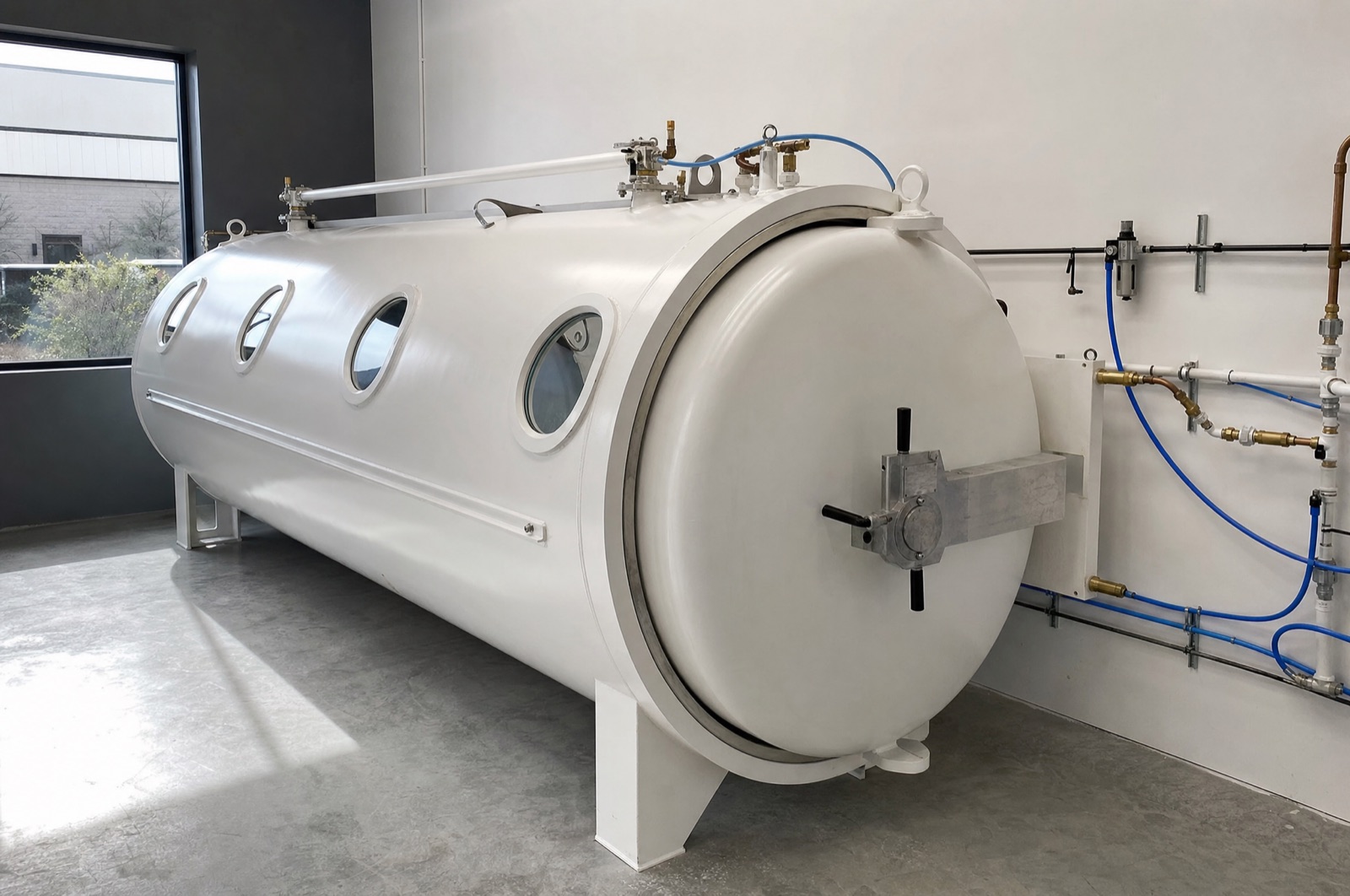
[ Clinic chamber ] Reference imagery; final photography in production
This page answers one question: can you legally buy, sell or run a hyperbaric chamber in Australia, Canada and the UK, and who decides. It uses the regulators' own pages, the Australian Act, Health Canada's licence data and public advisories, MHRA guidance and CQC records. Where a regulator talks about claims, we report what it says about the claims. We do not say whether any treatment works.
Banned or not: the answer for each country
None of the three countries bans hyperbaric chambers as such. Each one regulates them as medical devices and controls who may supply them and what may be said in ads. The closest thing to a ban is in Canada, where Health Canada says it has authorized no soft-shelled chamber and that importing, selling or advertising one is illegal.
In Australia the rule turns on the national register. A chamber that is in the Australian Register of Therapeutic Goods, the ARTG, can be supplied; one that is not, and has no exemption or approval, cannot. In the UK the rule turns on registration with the MHRA and a conformity mark, plus registration of the service with the CQC in England when it falls within a regulated activity. The sections below take each country in turn.
Australia: the TGA and the ARTG
In Australia a chamber must be in the ARTG before it is supplied. The Therapeutic Goods Act 1989, section 41MI, makes it an offence to import, export, supply or manufacture a medical device in Australia unless the device is of a kind included in the Register for that person, or is exempt, or is covered by an approval or authority under the Act. Where use of the device has caused or is likely to cause harm or injury, the penalty listed is imprisonment for 5 years or 4,000 penalty units, or both. Section 41MIB adds a civil penalty for the same conduct.
The TGA publishes a public summary for each ARTG entry. We read seven on the TGA eBusiness Services site. The four active entries for a patient chamber that can be supplied in Australia are all Class IIb. Each uses the device term GMDN 12061, Chamber, patient, hyperbaric:
- ARTG 147088: Class IIb, start date 7 November 2007, a monoplace system with an operating pressure of 303.9 kPa.
- ARTG 511953: Class IIb, start date 16 September 2025, the same monoplace description.
- ARTG 402307: Class IIb, start date 17 January 2023, a modular rectangular chamber family rated to a pressure of up to 3 atmospheres.
- ARTG 182494: Class IIb, start date 27 April 2011, a range of chambers.
Two more entries, ARTG 196615 and ARTG 394091, use the same device term but are marked Medical Device Included (Export Only) Class 1. If a seller quotes a Class 1 chamber entry, check whether it carries that export only label. A seventh, ARTG 407157, is a different device: a powered extremity hyperbaric chamber for a limb, GMDN 47189, included as Class IIa.
To check a chamber, ask the seller for its ARTG number and open the public summary. Read the class, the status, the start date and the intended purpose. Each summary we read says it is not an ARTG certificate document, and that the reader must check the information is still current. We found no state or territory rule specific to hyperbaric chambers; the gaps section says what we did not check.
Australia: advertising rules and a court case
Australia limits what a chamber ad may say, and has fined a seller for it. Section 42DD of the Act makes a reference in an ad to a serious form of a disease, condition, ailment or defect, as named in the Therapeutic Goods Advertising Code, a restricted representation. Section 42DL makes it an offence to advertise therapeutic goods with a restricted representation that has no approval or permission, or with a prohibited representation. The same section covers an ad that suggests the goods have been recommended or approved by a government or government authority, with limited exceptions.
The leading case involved hyperbaric devices. A Clayton Utz summary of December 2021 describes the Federal Court case the TGA brought against Oxymed, a Victorian clinic, and its director. It says the clinic advertised devices intended to administer hyperbaric oxygen therapy that were not on the ARTG and had no exemption. The TGA alleged 1,851 contraventions, which the court treated as three courses of conduct: advertising unregistered devices, restricted representations and prohibited representations.
The court ordered the company to pay $2 million and the director $1 million, more than the TGA had sought against him. It also made injunctions, one for seven years, that restrain both from advertising hyperbaric oxygen therapy devices not listed on the ARTG. The summary says the TGA had earlier sent five infringement notices of $12,600 each. We could not load the TGA's own media release or the judgment this run, so these figures rest on the law firm's summary.
Canada: Health Canada and the device licence
In Canada a chamber needs a licence. Health Canada's hyperbaric oxygen therapy page says hyperbaric chambers are medical devices and require a licence from Health Canada. It says licences have been issued only for a list of 14 recognized conditions, and that no device licences have been issued for chambers to treat other conditions. It tells readers to be skeptical of anyone who advertises or offers hyperbaric oxygen therapy, to check that a chamber is licensed, and to report problems to the Medical Devices Hotline at 1-800-267-9675.
Licences are listed in the Medical Devices Active Licence Listing, or MDALL. Health Canada says it holds all licensed Class II, III and IV devices offered for sale in Canada. Class I devices need no licence and do not appear in it. You can search by company, licence name, licence number, device name or device identifier.
We queried the MDALL licence data for the word hyperbaric on 23 October 2026. Every whole-chamber licence it returned is risk Class III, the second highest of Canada's four classes. Three chamber licences had no end date: two for monoplace chambers and one for a chamber family that includes multiplace systems. Thirteen other licences for chambers or chamber systems had end dates between 2004 and 2021. One topical extremity chamber was Class II and ended in 2010. A search by name can miss a licence filed under another word, so treat the counts as a floor, not a census.
Canada: soft-shelled chambers
Health Canada has authorized no soft-shelled chamber, and says selling one is illegal. Its public advisory of 16 June 2026 says it has received several complaints about unauthorized soft-shelled chambers and that they are increasingly found in wellness centres in Canada. It says they are regulated as medical devices under the Food and Drugs Act and the Medical Devices Regulations. It says Health Canada has not authorized any for sale because it has not received the evidence needed to confirm they meet its safety, effectiveness or quality requirements, and that as a result it is illegal to import, sell and advertise them in Canada.
The advisory lists the risks Health Canada names: fire, especially with an oxygen concentration device, suffocation, spread of infectious disease between users, damage to ears, eyes, sinuses, lungs and teeth, and changes in blood sugar. It tells the public not to use soft-shelled chambers, to use only licensed devices, to check MDALL, and to report complaints, including the sale of unlicensed devices.
This is the third notice on the subject. The first advisory, from October 2019, said Health Canada had licensed five hard-shelled chambers for sale and no soft-shelled ones, and that it had not received evidence supporting the benefits of the soft-shelled version. It said Health Canada was asking sellers to stop selling and to recall, and was contacting provincial and territorial authorities and clinics. The 2020 update said Health Canada seized six unlicensed units from distributors in Quebec in early 2020 and three more from a distributor in Alberta that September, and was working with the Canada Border Services Agency to stop further imports. For how soft and hard chambers differ in build, see hard shell vs soft shell.
The UK: MHRA registration and the UKCA or CE mark
In Great Britain a chamber must be registered with the MHRA before it is placed on the market. The MHRA guidance on registering medical devices says all medical devices must be registered before they can be placed on the market in England, Wales and Scotland, and must conform to the Medical Devices Regulations 2002. A maker based outside the UK must appoint a single UK Responsible Person to register and act for it.
The same page says registration does not represent any form of accreditation, certification, approval or endorsement by the MHRA, and that makers may not claim it does or use MHRA logos in marketing or on packaging. Once a maker is registered, its name, address and registered device types appear on the Public Access Registration Database, PARD, listed by GMDN term and by brand or trade name.
The mark is a separate step. The MHRA's overview of UK device regulation says the UKCA mark is the Great Britain route to market, and that its rules derive from the EU device directives. CE marked devices are still accepted: those under the old EU directive until the sooner of certificate expiry or 30 June 2028, and those under the EU regulation until 30 June 2030. The EU device regulation applies in Northern Ireland. The registration page says that since 28 May 2026 most devices for the EU and Northern Ireland markets go into EUDAMED, the EU database, instead of MHRA registration. Our CE marking guide covers what that mark means and how to read a declaration.
The UK: CQC registration for providers
A service offering hyperbaric treatment in England often has to register with the CQC, which describes itself as the independent regulator of health and adult social care in England. Its guidance on the regulated activity treatment of disease, disorder or injury, updated 27 August 2026, says the activity covers treatment by or under the supervision of a listed healthcare professional, in any setting. It lists hyperbaric oxygen therapy provided to workers in connection with their work, or governed by the Diving at Work Regulations 1997 or the Work in Compressed Air Regulations 1996, as outside the activity.
The regulations close one door for doctors. Schedule 2 of the Health and Social Care Act 2008 (Regulated Activities) Regulations 2014 exempts some doctors working in their own consulting rooms, but paragraph 4(g) says the exemption does not apply to hyperbaric therapy carried out by or under the supervision or direction of a medical practitioner. The CQC page on medical practitioners in independent practice repeats it.
Wellness use sits in a grey area. A 2023 CQC inspection summary for a London clinic offering low level hyperbaric oxygen for general wellbeing said the CQC did not then regulate or inspect hyperbaric services used for general wellbeing, and rated the clinic's other regulated activities. A CQC register entry for another London provider lists its type of service as Hyperbaric chamber services, registered for treatment of disease, disorder or injury. To check a provider, look it up on the CQC's find care services search and read the registration details. For the staffing side, see our guide to clinic staffing and certification.
The UK: what the advertising regulator says about claims
The UK advertising regulator expects clinical evidence behind any treatment claim. The CAP Executive's advice on oxygen therapy, dated 6 February 2024, says the ASA and CAP have yet to see convincing evidence that oxygen used as an alternative therapy in hyperbaric chambers is efficacious in the treatment of health conditions. It says marketers should hold robust documentary evidence in the form of clinical trials before claiming their therapy treats any health or medical condition, and that ads should avoid conditions for which medical supervision should be sought unless a suitably qualified health professional supervises the treatment. The advice notes it does not bind the ASA.
The ASA has ruled on this. In its ruling of 15 November 2023 on a hyperbaric oxygen provider, part of a wider piece of work on long COVID claims, it upheld a complaint that website and social posts claiming the therapy could treat long COVID were misleading, because it had not seen evidence of the standard it expected.
The three countries side by side
The table sets the sourced answers next to each other. For the US rules, see our guide to FDA cleared vs FDA registered, which says US chambers are Class II under 21 CFR 868.5470.
| Question | Australia | Canada | United Kingdom |
|---|---|---|---|
| Device regulator | TGA | Health Canada | MHRA |
| Banned? | No. Supply without an ARTG entry, exemption or approval is an offence | No for licensed chambers. No soft-shelled chamber is authorized; importing, selling or advertising one is illegal | No. Registration with the MHRA is required before a device is placed on the GB market |
| Chamber class found | Class IIb in the four active supply entries we read | Class III in every whole-chamber licence in MDALL | No MHRA source we read names a class |
| How to check | ARTG number and public summary; watch for Export Only | MDALL search by name or licence number | PARD by maker or GMDN term; UKCA or CE mark and declaration |
| Advertising rules | Restricted and prohibited representations, no implied government approval (Act s42DD, s42DL) | Illegal to advertise an unlicensed device for sale | ASA and CAP expect clinical trial evidence for treatment claims; no claim that MHRA registration is approval |
| Provider registration | Not checked | Not checked | CQC in England for treatment of disease, disorder or injury |
Sources: Therapeutic Goods Act 1989; TGA ARTG public summaries; Health Canada advisories, hyperbaric oxygen therapy page and MDALL data; MHRA guidance on GOV.UK; CQC guidance and register; ASA and CAP. All linked above, read 23 October 2026.
Whether a prescription is needed is a separate national question; our prescription guide covers the US and EU position. For how pressure and setting differ between wellness and hospital chambers, see mild vs medical hyperbaric. For the chambers we track and what we can verify about each, see the scorecard.
What we have not verified
The main tga.gov.au site would not load for us this run, so we did not read any TGA safety alert, the TGA's own release on the Oxymed case, the judgment, or the Therapeutic Goods Advertising Code itself. The court figures come from a law firm summary. We read seven ARTG public summaries, not a full search of the register, so there may be other chamber entries, including soft chambers, that we did not see. We found no Australian state or territory rule specific to hyperbaric chambers, but we did not search each state. We found no Canadian provincial rule and did not search each province. We found no MHRA document that names a device class for hyperbaric chambers, and the PARD search tool did not load for us, so we cannot say how many chambers are registered in Great Britain. We did not check the care regulators for Scotland, Wales or Northern Ireland. The CQC wellbeing statement comes from a single 2023 inspection summary and may not reflect the CQC's current position after its August 2026 guidance update. If you hold a regulator document that settles any of these, send it and we will check it.
Frequently asked
Are hyperbaric chambers banned in Australia?
We found no ban. Under the Therapeutic Goods Act 1989, supplying a medical device in Australia that is not included in the Australian Register of Therapeutic Goods, and not otherwise exempt or approved, is an offence. Chambers can be and are included: the four active patient chamber entries we opened on the TGA public summary service are all Class IIb. What the Act restricts is supply without an ARTG entry and certain kinds of advertising.
Are soft hyperbaric chambers legal in Canada?
Health Canada says no soft-shelled chamber is authorized for sale in Canada. Its public advisory of 16 June 2026 says that, as a result, it is illegal to import, sell and advertise soft-shelled hyperbaric chambers in Canada, and it tells the public not to use them. Hard-shelled chambers can be licensed, and the chamber licences we found in Health Canada's licence data are Class III.
How do I check whether a chamber is licensed in Canada?
Search the Medical Devices Active Licence Listing, known as MDALL. Health Canada says it holds all licensed Class II, III and IV devices offered for sale in Canada, and that you can search by company name, licence name, licence number, device name or device identifier. Class I devices need no licence and are not in it. Each of Health Canada's soft-shelled chamber advisories points readers to MDALL.
Does MHRA registration mean a chamber is approved in the UK?
No. The MHRA says registration of a device with it does not represent any form of accreditation, certification, approval or endorsement by the MHRA, and that makers may not claim it does or use MHRA logos in marketing. Registration is a legal step before a device is placed on the Great Britain market. Conformity is shown by a UKCA mark or, for now, an accepted CE mark.
Does a hyperbaric clinic in England need to register with the CQC?
Often, yes. The CQC regulated activity called treatment of disease, disorder or injury covers treatment by listed healthcare professionals, and the regulations do not let a doctor in solo private practice skip registration for hyperbaric therapy. Hyperbaric oxygen given to workers under the diving and compressed air regulations is excluded. A 2023 CQC inspection summary said the CQC did not then regulate or inspect hyperbaric services used for general wellbeing.
Can a seller advertise that a chamber treats a disease in these countries?
Each country limits it. Australia restricts advertising that refers to serious forms of a disease named in the Therapeutic Goods Advertising Code unless approved or permitted. Health Canada says it has issued no licences for chambers to treat conditions outside a recognized list. The UK advertising regulator's guidance says it has yet to see convincing evidence for hyperbaric oxygen as an alternative therapy and expects robust clinical evidence behind treatment claims.

Alex tests the machines himself, in clinics and studios on three continents. Every score comes from the same 27 public criteria, and no manufacturer has a say in them.
Six questions, and we'll match chamber, options, and install to your space and budget.