Hyperbaric Chamber vs Cryotherapy Chamber: Two Different Machines
Researched and scored by Alex Evans. Last reviewed August 2026. Corrections are dated and public. See corrections
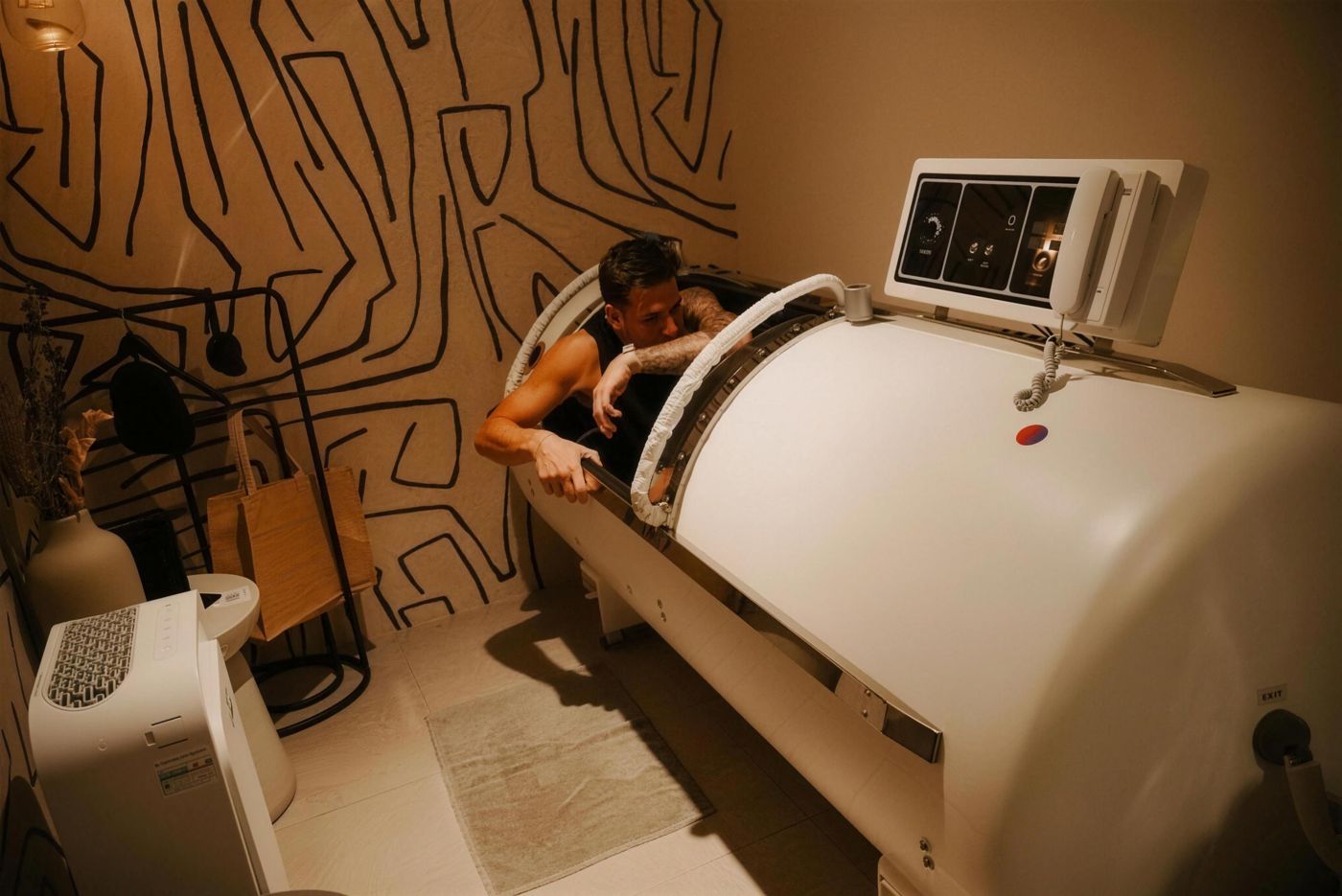
[ Hard-shell chambers ] Reference imagery; final photography in production
Both machines get sold as a wellness chamber, and both are capsules you step or lie into. That is where the overlap ends. This page describes what each one does physically, how US regulators treat it, and which hazards public bodies have named for each. It makes no claim that either one does anything for your health, and it does not compare brands.
What a hyperbaric chamber does
A hyperbaric chamber raises the air pressure around your whole body. The federal rule, 21 CFR 868.5470, identifies it as a device intended to increase the environmental oxygen pressure by pressurization greater than atmospheric pressure, and places it in Class II. The FDA's August 25, 2025 letter to health care providers describes hyperbaric oxygen therapy as breathing 100% oxygen in a special chamber where the air pressure is raised above normal.
The session is long and the temperature is not the point. Cleveland Clinic says sessions usually last one to two hours, often on an outpatient basis, and that the chamber delivers oxygen at two to three times normal air pressure. In a one-person monoplace chamber you lie on a table that slides in. In a multiplace chamber you breathe oxygen through a mask. Home chambers run lower: soft shells near 1.3 ATA and hard shells near 1.5 ATA, as our pressure guide explains.
What a cryotherapy chamber does
A cryotherapy chamber exposes the body to extreme cold for a few minutes. The clearest regulator description we found comes from Bahrain's National Health Regulatory Authority, in Annex 49 to its Resolution No. 2 of 2019, which covers whole-body cryochambers and cryosaunas. It puts cryotherapy temperatures in a range of minus 40 to minus 160 degrees Celsius, depending on the use.
The classic design, which the annex calls the Wroclaw type, has two rooms. You spend 30 seconds in a pre-chamber at about minus 60 degrees Celsius, then up to 3 minutes in the main chamber at about minus 120. The annex says a session should last 3.5 minutes at most. The whole body, head included, is in cold breathable air. Up to six people can use it at once.
Reporting on the FDA's consumer update, HealthDay (republished by Medical Xpress, March 2017) described the treatment as placing people in an enclosed space with vapors at minus 200 to minus 300 degrees Fahrenheit, typically for two to four minutes. That is roughly minus 130 to minus 185 degrees Celsius.
The difference from a hyperbaric session is plain. One holds you for an hour or two at raised pressure. The other holds you for about three minutes at well below minus 100 degrees Celsius. None of the cryotherapy sources we read describes raising the pressure inside the unit.
Cryochamber or cryosauna: the name matters
Cryotherapy is two kinds of machine, and the Bahrain annex says the names are often swapped, which misleads users. In its terms, a cryochamber cools the entire body including the head. A cryosauna is a single-person, can-shaped enclosure open at the top. Your torso and legs are inside, your head stays out at room temperature, and the operating temperature can be set between minus 100 and minus 160 degrees Celsius.
The cooling works differently. In a classic cryochamber, liquid nitrogen evaporates inside heat exchangers, and the annex says there is never direct contact between the user and the nitrogen. In a cryosauna, cold nitrogen vapor is injected into the enclosure itself. The annex says this creates an atmosphere of near 0 percent oxygen around the user for the whole session.
A 2023 scoping review in the European Journal of Medical Research, by an international consortium led by Fabien Legrand (we read the copy in the Victoria University repository), draws the same line with different labels. It calls the cryochamber whole-body cryotherapy, with air at minus 50 to minus 150 degrees Celsius, usually cooled by refrigerated air rather than nitrogen. The Bahrain annex, by contrast, describes both types as supplied with liquid nitrogen. The review calls the cryosauna partial-body cryotherapy, with a mist of air and liquid nitrogen at about minus 190. It says the cryosauna imposes both cold and low oxygen at once. The authors argue that some safety concerns raised by public bodies, the FDA among them, mixed the two machines together. So when a seller says cryotherapy chamber, ask which one they mean.
The two machines side by side
The table puts the sourced facts on the same rows. Every cell comes from a source linked on this page.
| Question | Hyperbaric chamber | Cryotherapy chamber |
|---|---|---|
| What it does physically | Raises the pressure around the body above atmospheric | Surrounds the body with air or nitrogen vapor far below freezing |
| Temperature | Not a defining feature | Classic chamber about minus 120 to minus 160 degrees Celsius; cryosauna minus 100 to minus 160 (Bahrain annex) |
| Session length | Usually one to two hours (Cleveland Clinic) | Up to 3 minutes in the main chamber, 3.5 minutes in all (Bahrain annex) |
| Gas around you | Air, or oxygen in some designs | Cold breathable air in a classic chamber; cold nitrogen vapor in a cryosauna, near 0 percent oxygen inside |
| Head inside? | Yes | Yes in a cryochamber; no in a cryosauna |
| US federal device status | Class II, 21 CFR 868.5470, cleared by 510(k), product code CBF | FDA officials said not cleared or approved as safe and effective for medical conditions; no product code found |
| Main hazard named by regulators | Fire, with oxygen at high concentration (FDA, 2025) | Oxygen deficiency from nitrogen; frostbite, burns and eye injury from cold (FDA via HealthDay; Bahrain annex) |
| Who runs it | A provider in the room throughout (Cleveland Clinic); supervision for the whole treatment (FDA) | Trained staff supervising every session (Bahrain annex) |
Sources: 21 CFR 868.5470; FDA letter to health care providers, August 25, 2025; Cleveland Clinic; Bahrain National Health Regulatory Authority, Annex 49 (2019); HealthDay via Medical Xpress (2017); Legrand et al., European Journal of Medical Research (2023); openFDA, queried 23 October 2026.
How the FDA treats each one
The hyperbaric side has a clear federal home. The 2025 FDA letter says hyperbaric devices are Class II medical devices cleared through the 510(k) process, and that cleared devices can be found by searching product code CBF in the 510(k) database. When we queried the FDA classification data through openFDA on 23 October 2026, CBF was listed as Chamber, Hyperbaric, regulation 868.5470, Class 2, with 69 510(k) records on file. What a clearance does and does not cover is set out in our guide to FDA cleared vs FDA registered, including the FDA's statement that zippered soft chambers are cleared for altitude sickness only.
The cryotherapy side has no such entry that we could find. The same openFDA search found no 510(k) record with whole body cryotherapy, cryochamber, cryosauna or cryo chamber in the device name. Five records carried the word cryotherapy, filed under product codes the FDA names as cryosurgical accessories, a vapocoolant device, and a water-circulating hot or cold pack. No classification name we found covers a whole-body cold chamber.
One trace does sit in FDA files. A physician's voluntary report in the FDA's MAUDE adverse event database, received in February 2018, describes a skin reaction after eight sessions in a cold chamber. It was logged under product code ILJ, which the classification data names Bath, Hydro-Massage. The report is the reporter's account, not an FDA finding.
What the FDA has said about cryotherapy claims
The FDA published a consumer update on whole body cryotherapy under the title Whole Body Cryotherapy (WBC): A Cool Trend that Lacks Evidence, Poses Risks. The fda.gov address for it returned a not-found page when we tried it on 23 October 2026, and we could not reach an archived copy. We report its content from the HealthDay article linked above, which quotes FDA staff by name.
According to that report, Dr. Aron Yustein, a medical officer in the FDA's Center for Devices and Radiological Health, said consumers may wrongly believe the FDA has cleared or approved whole body cryotherapy devices as safe and effective to treat medical conditions, and that this is not the case. He said the FDA had informally reviewed the medical literature and found very little evidence about the treatment's safety or effectiveness for the conditions it is promoted for. His advice to anyone considering it or already using it was to discuss it with a doctor.
We give that as the FDA's position, not ours. This page does not weigh the research on either machine. For what home hyperbaric chambers can and cannot claim, see our hyperbaric chamber benefits guide.
The main hazard in each machine
For hyperbaric chambers, the named hazard is fire. The 2025 FDA letter says there is a heightened risk of fire with oxygen at high concentration, that the FDA knew of recent fires with these devices that caused serious injuries and deaths, and that the root cause was not known. It also says the FDA believes serious adverse events are rare. Cleveland Clinic tells patients that metal objects and electronics stay outside, because sparks could start a fire in the high-oxygen space. Our hyperbaric chamber safety guide covers grounding, clothing, the prohibited list and the fires the FDA letter refers to.
For cryotherapy, the named hazards are cold and lost oxygen. The FDA, as HealthDay reported, listed frostbite, burns and eye injury from the extreme cold. Dr. Anna Ghambaryan, an FDA scientific reviewer, named asphyxiation as another hazard, especially when liquid nitrogen is used for cooling, because nitrogen vapor in a closed room lowers the oxygen and can lead to loss of consciousness.
The Bahrain annex puts numbers on it. One liter of liquid nitrogen evaporates into about 700 liters of gas. The annex counts an oxygen deficiency event as oxygen below 18 percent. If a heat exchanger leaked inside a classic chamber, it estimates the oxygen would fall to 11.5 percent, so those chambers carry an oxygen monitor that sounds an alarm and shuts the nitrogen valves below 18.5 percent. In a cryosauna the low-oxygen atmosphere is there by design. The annex names human errors such as breathing in the vapor, which it says causes immediate loss of consciousness, or bending into the enclosure to pick something up.
The US Chemical Safety Board's 2003 safety bulletin on nitrogen asphyxiation explains why this gives no warning. It is written for industry, not cryotherapy. It says nitrogen cannot be detected by smell, that a nitrogen-enriched space can be detected only with special instruments, and that an oxygen-deficient atmosphere can cause unconsciousness after one or two breaths. It notes that OSHA requires workplaces to keep oxygen between 19.5 and 23.5 percent, and that 4 to 6 percent oxygen causes coma in less than 40 seconds. It counted 85 workplace nitrogen asphyxiation incidents in the US from 1992 to 2002, with 80 deaths.
So the two machines fail in opposite directions. In a hyperbaric chamber the worry is too much oxygen near a spark. In a nitrogen-cooled cryotherapy unit it is too little oxygen to breathe.
The Henderson, Nevada death and the guidelines that followed
A cryotherapy chamber death in Nevada in October 2015 led the state to issue guidelines a month later. The Associated Press, carried by NBC News, reported that the 24-year-old manager of a cryotherapy salon in Henderson was found dead inside a treatment chamber chilled by liquid nitrogen. The state said it was widening its inquiry from worker safety and equipment to whether the treatment was safe for the public.
Fox News reported that the coroner ruled the death a suffocation, and cited Fox 5 Vegas as reporting that oxygen levels dipped to nearly 5 percent. It said she reportedly used the chamber without assistance and was found the next day, and that regulators closed the business's two locations over a lack of workers' compensation coverage.
A month later, the AP reported that Nevada's health department had issued voluntary guidelines. The state called them expected standards with no penalties, not law. They asked for nitrogen monitors in treatment rooms, emergency kits and defibrillators on site, staff trained to run the machine, spot problems and perform CPR, and one session a day of no more than three minutes. They also asked centers not to promote outcomes that had not been scientifically evaluated. We could not find the guidelines on a Nevada state website, and we do not know whether they are still in use.
Who runs the session, and where
Hyperbaric sessions in hospitals have staff in the room. Cleveland Clinic says a healthcare provider is in the room throughout. The FDA letter asks providers to train staff and make sure the patient is monitored and supervised for the whole treatment. Our clinic staffing and certification guide covers the technologist credential and what the UHMS expects of the attending provider. Home chambers are a different setting; our home chamber pros and cons page covers the trade-offs of owning one.
For cryotherapy, the Bahrain annex is the most detailed staffing rule we found. It allows the devices only in medical centers, medical spa centers, hospitals, physiotherapy and rehabilitation centers, and professional sports clubs. It says every session must be supervised by trained staff. It requires written policies on informed consent, emergencies and incident reporting, plus contracts with a nearby hospital, an ambulance service and the maker for yearly maintenance.
The room matters as much as the person. The annex sets a minimum room of 9 square meters, or 6 if the nitrogen tanks sit in a separate room, with an oxygen sensor wherever the tanks are stored. It says a cryosauna room needs mechanical ventilation and an oxygen sensor, and that an exhaust fan should not sit directly above the unit, since it would pull nitrogen up into the user's face. A cryosauna door opens under the weight of a person leaning on it, so a user who passes out is not trapped.
What to ask before you book either one
Start with what the machine does. A pressure gauge and a sealed door mean hyperbaric. A cold cabin fed from a nitrogen tank means cryotherapy. Then ask for the paperwork that fits.
- Hyperbaric: what is the 510(k) number, and what uses does the clearance cover?
- Hyperbaric: what pressure does it run at, is oxygen used, and is the chamber grounded?
- Hyperbaric: who stays with the chamber for the whole session?
- Cryotherapy: is it a cryochamber with the head inside, or a cryosauna with the head out?
- Cryotherapy: is it cooled by liquid nitrogen, and is there an oxygen sensor with an alarm in the room?
- Cryotherapy: what temperature and time are set, and who watches the session?
- Either: if the seller says FDA approved or cleared, ask for the number and check it.
If you are shopping for a chamber to own, our hyperbaric chamber scorecard covers the models we track on the points we can verify. We do not review cryotherapy equipment.
What we have not verified
We could not read the FDA's cryotherapy consumer update on fda.gov, and we have not confirmed its publication date, so the FDA position on this page comes from HealthDay's 2017 report of it. Our openFDA search used device names and classification names; a device sold under another name could be missed. The Bahrain annex is one country's rule, and its figures for temperatures, oxygen levels and failure odds are its own. We found no US federal rule and no current US state law on cryotherapy staffing or equipment, and we did not survey every state. The Nevada guidelines and the Henderson facts come from 2015 news coverage, not from state or coroner documents. We give no session prices for either machine. If you hold a source that settles any of these points, send it and we will check it.
Frequently asked
Is a cryotherapy chamber a type of hyperbaric chamber?
No. A hyperbaric chamber is defined by pressure: the FDA rule describes a device that pressurizes above atmospheric pressure. A cryotherapy chamber is defined by cold. Bahrain's National Health Regulatory Authority describes classic cryochambers at about minus 120 to minus 160 degrees Celsius in the main room and cryosaunas at minus 100 to minus 160, with sessions of about three minutes. None of the cryotherapy sources we read describes pressurizing the unit.
Are whole body cryotherapy devices FDA cleared?
In a 2017 HealthDay report on the FDA's consumer update, an FDA medical officer said consumers may wrongly believe the FDA has cleared or approved these devices as safe and effective to treat medical conditions, and that this is not the case. When we searched the FDA's 510(k) and classification data through openFDA on 23 October 2026, we found no record or product code named for a whole body cryotherapy chamber, cryosauna or cryochamber.
Why is liquid nitrogen a hazard in a cryotherapy chamber?
Because it turns into a lot of gas. The Bahrain annex says one liter of liquid nitrogen evaporates into about 700 liters of gas, which can push oxygen out of a closed space. The US Chemical Safety Board says nitrogen cannot be smelled, can be detected only with instruments, and that an oxygen-deficient atmosphere can cause unconsciousness after one or two breaths.
What is the difference between a cryochamber and a cryosauna?
In the Bahrain annex, a cryochamber exposes the whole body, head included, to cold breathable air, and the liquid nitrogen stays inside heat exchangers away from the user. A cryosauna is a single-person enclosure open at the top: the head stays out, and the body sits in cold nitrogen vapor that the annex says creates near 0 percent oxygen inside the enclosure.
What is the main hazard in a hyperbaric chamber?
Fire. The FDA told health care providers in August 2025 that there is a heightened risk of fire with oxygen at high concentration, and that it was aware of recent reports of fires with hyperbaric devices that resulted in serious injuries and deaths. It also said it believes serious adverse events with these devices are rare.
Does anyone have to supervise a cryotherapy session?
The Bahrain annex says sessions in both cryochambers and cryosaunas must be supervised by trained staff, which it gives as the manufacturer's recommendation. Nevada's 2015 voluntary guidelines, as reported by the Associated Press, asked for staff trained to run the machine, recognize problems and perform CPR. We did not find a US federal rule on cryotherapy staffing.

Alex tests the machines himself, in clinics and studios on three continents. Every score comes from the same 27 public criteria, and no manufacturer has a say in them.
Six questions, and we'll match chamber, options, and install to your space and budget.