Claustrophobia and Hyperbaric Chambers: Bore Sizes Compared
Researched and scored by Alex Evans. Last reviewed August 2026. Corrections are dated and public. See corrections
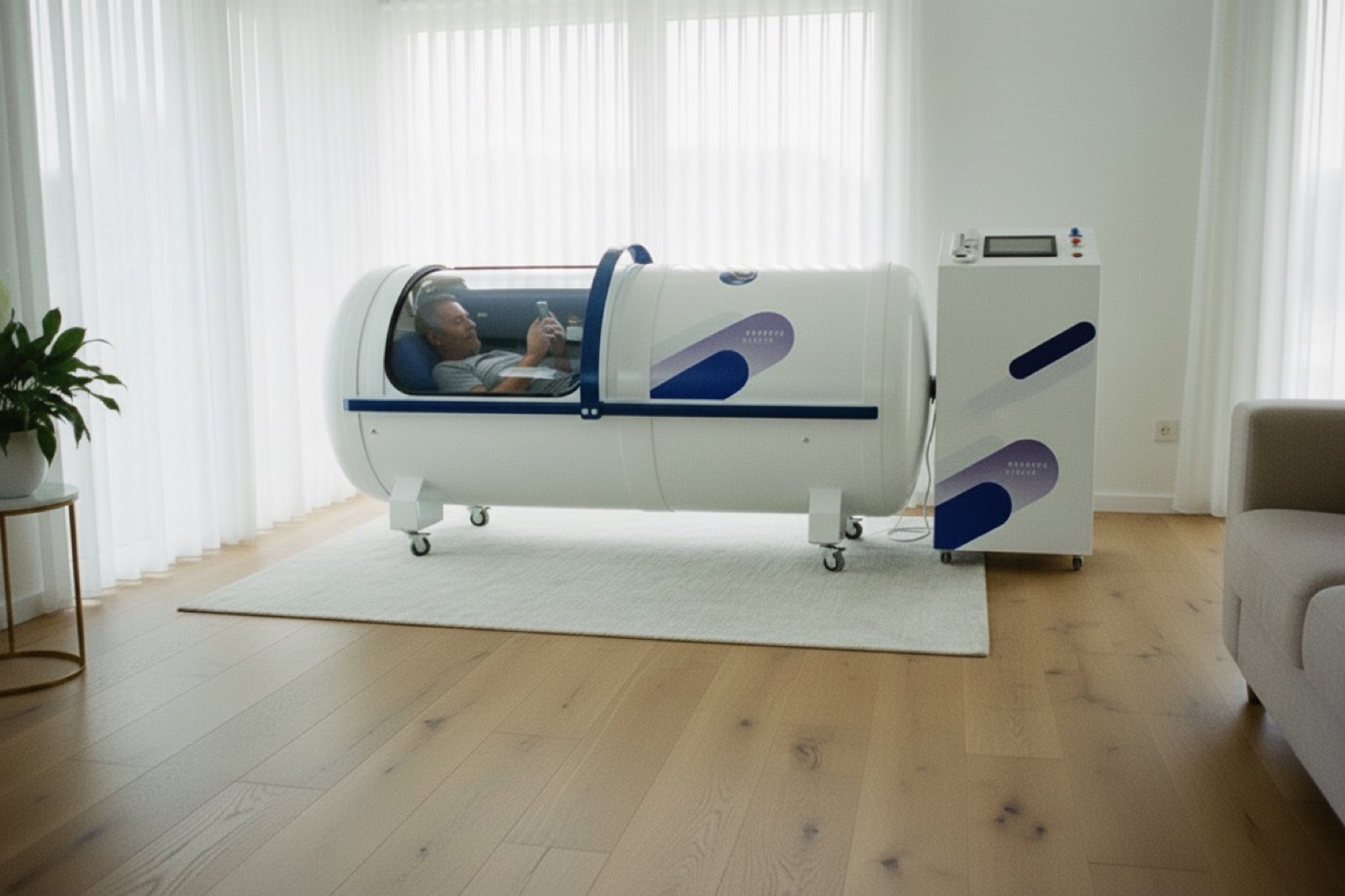
[ Capsule with a viewing window ] Reference imagery; final photography in production
What bore means
Bore is the inside diameter of a tube. For a lying chamber it is the space around your body, from the mattress to the curve above your face. A wider bore means more room for your shoulders and more distance between your eyes and the wall.
The spec sheets we read do not use the word bore. Hospital chamber makers say internal diameter. The K140559 510(k) summary for the Sechrist 3300H/HR and 3600H/HR has a column headed Internal Diameter. Perry Baromedical's spec tables list Internal Diameter next to Width. Soft chamber records say width or diameter, and leave the side unstated.
This page sets out the published figures by chamber type. It does not rank chambers or say which suits a person who feels closed in. Size is one input. The hospitals we read also talk about windows, company, TV and how they handle worry, and we cover those below.
Inside diameter and outside diameter
Two numbers describe a tube. The inside diameter is the space you lie in. The outside diameter, or the overall width, includes the wall and anything bolted to it. The gap between them can be large on a hard chamber.
The Sechrist summary shows this. It lists an internal diameter of 32.50 inches (83 cm) for the 3300H/HR and 35.50 inches (90 cm) for the 3600H/HR. It lists the external width of both at 44.50 inches (113 cm). The outside width is a figure for the whole machine, including its frame, so it does not tell you the wall thickness.
Perry Baromedical publishes both numbers for each model it sells. Its Sigma Icon 30 page lists an internal diameter of 30.0 inches and an overall width of 40 inches. The same page says its clear acrylic tube is 1.25 inches thick. The wall is only part of the gap. The rest is frame and fittings.
A soft chamber is harder to read. The K072757 summary for the Summit to Sea Dive chambers says all dimensions are with the devices inflated. It does not say whether the 27 inch width is measured inside or outside. When a source does not say, we do not guess, and the table below marks it.
Our portable chambers guide uses outside widths for a different job: getting a chamber through a door. For comfort inside, the inside figure is the one to ask for.
Published sizes by chamber type
Each figure below is in the unit its source used. Where a source gave two units, both appear. The last two columns say whether the source states inside or outside, and where the figure comes from. Model names identify a source. They are not picks.
| Chamber type | Model named in source | Published size | Inside or outside? | Source |
|---|---|---|---|---|
| Soft, lying | Gamow bag (predicate) | 7 ft x 21 in, length x inflated diameter | Not stated | FDA K051759 |
| Soft, lying | The Dive / Shallow Dive | 7 ft long, 27 in wide, inflated | Not stated | FDA K072757 |
| Soft, lying | Flexi-Lite | 8 ft x 30 in, length x inflated diameter | Not stated | FDA K051759 |
| Soft, lying | Revitalair 430F | 900 mm diameter, 1850 mm long | Not stated | FDA K171899 |
| Soft, lying | Grand Dive | 9 ft long, 40 in wide, inflated | Not stated | FDA K072757 |
| Hard home capsule | OxyLife I 80 / I 90 | Diameters of 80 and 90 cm in the model text; 2322 x 889 x 889 mm and 2322 x 985 x 985 mm, L x W x H | Not stated for the 80 and 90 cm figures | OxyHelp monoplace page |
| Hard home capsule | HERO LifeCare chamber | 35.4 in D (90 cm) x 90.6 in L (230 cm) | Not stated | HERO LifeCare product page |
| Soft, seated | L1 | 150 x 105 x 170 cm, L x W x H | Overall size; no inside diameter published | Macy-Pan spec page |
| Hospital monoplace, acrylic | Sigma Icon 30 | 30.0 in internal diameter; 40 in overall width | Both stated | Perry Baromedical page |
| Hospital monoplace, acrylic | Sechrist 3300H/HR / 3600H/HR | 32.50 in (83 cm) / 35.50 in (90 cm) internal diameter; 44.50 in (113 cm) external width | Both stated | FDA K140559 |
| Hospital monoplace, acrylic | Sigma 34 / 36 / 40 | 33.5 / 36 / 40.5 in internal diameter; 40 / 42 / 46 in width | Both stated | Perry Baromedical pages |
| Hospital monoplace, steel and acrylic | Presidential HA-34 / HA-38 | 33.5 / 38 in internal diameter; 92 in overall external length | Inside stated | FDA K081506 |
| Hospital monoplace, aluminum alloy and acrylic | BLKS-307 | 42.1 in (1080 mm) internal diameter; 90.4 in (2300 mm) long | Inside stated | FDA K060739 |
| Hospital monoplace, as a hospital describes it | Not named | About 7 ft long and about 32 in wide | Not stated | Sparrow patient guide |
| Multiplace, steel | Gulf Coast rectangular | 9.3 ft W x 8.3 ft H x 32 ft L; 12 seated patients | Not stated | FDA K082455 |
Sources by row: FDA 510(k) summaries K051759 (Gamow bag, Flexi-Lite), K072757 (Dive, Shallow Dive, Grand Dive), K171899 (Revitalair 430F), K140559 (Sechrist), K081506 (Presidential), K060739 (BLKS-307) and K082455 (Gulf Coast) at accessdata.fda.gov; the OxyHelp monoplace page at oxyhelp.com; the HERO LifeCare product page; the Macy-Pan L1 page, as cited in our sitting vs lying guide; the Perry Baromedical Sigma Icon 30, Sigma 34, Sigma 36 and Sigma 40 pages; the Sparrow Hyperbaric Unit patient guide. Read 22 October 2026 except the Macy-Pan page, read 12 October 2026. We did not convert any figure. This is a list of published sizes, not a ranking.
Two notes. The Sechrist summary gives the centimetre figures one way in its device description and swaps them in two later comparison tables. We show the description, where 32.50 inches sits with 83 cm. The Gamow bag is the altitude rescue bag the Flexi-Lite summary compares itself against. It is in the table because the record gives its size.
Soft lying chambers
A soft lying chamber is a fabric tube held open by air pressure. In the FDA records we read, the widths run from 21 inches to 40 inches. Most are given inflated, and none says inside or outside.
The K072757 summary lists the Shallow Dive and the Dive at 7 feet long and 27 inches wide, and the Grand Dive at 9 feet long and 40 inches wide. It says the bags are urethane coated nylon. The K051759 summary lists the Flexi-Lite at 8 ft x 30 in inflated diameter, and the Gamow bag it compares against at 7 ft x 21 in. The K171899 summary describes the Revitalair 430F as a cylinder 900 mm in diameter and 1850 mm long. Its own comparison table gives 900 mm x 1900 mm, so the summary disagrees with itself on length.
Fabric has one more catch. A soft chamber is sized when it is full of air. Our hard vs soft shell guide explains why a soft shell runs at low pressure, and the records we read do not give a size for a chamber that is only partly inflated.
Hard home capsules
Hard home capsules are rigid tubes sold for home or wellness use. Their makers publish sizes in different ways, and the two pages we read both leave the side unstated.
OxyHelp's monoplace page says the OxyLife I comes as single-seat capsules in two diameters, 80 and 90 cm. Its model table lists the I 80 at 2322 x 889 x 889 mm and the I 90 at 2322 x 985 x 985 mm, length by width by height, with internal volumes of 1060 L and 1350 L. The listed width is larger than the diameter in the text. The page does not say whether 80 and 90 cm are inside figures.
The HERO LifeCare product page lists dimensions of 35.4 inches D (90 cm) by 90.6 inches L (230 cm) and a lightweight composite material. It does not say whether D is inside or outside. The same page lists an extra large transparent viewing window, a 9 inch internal screen and two walkie talkies.
Volume is a third way to describe space. OxyHelp gives it. Most soft chamber records do not. Volume alone does not tell you how close the wall is to your face, because a long narrow tube and a short wide one can hold the same air.
Seated soft chambers
A seated chamber puts you upright in a chair. It is a different shape, so bore is a less useful number. Makers list an overall box: length, width and height. Our sitting vs lying guide sets out those figures in full. It cites Macy-Pan's L1 at 150 x 105 x 170 cm, length by width by height, and notes that no source we read gives the inside diameter of a seated soft chamber with its chair in place, or the seat height.
That guide also quotes a US patent for an upright chamber. The patent says confinement in a chamber can cause or worsen claustrophobia, and presents the seated design as its answer. That is the inventor's stated aim. We have no data that compares how people feel in a seated chamber against a lying one.
Hospital monoplace chambers
A hospital monoplace chamber holds one person lying down. In the records and maker pages we read, every one states its internal diameter. They run from 28.7 inches to 42.1 inches.
The Sechrist summary describes a horizontal seamless acrylic cylinder with a door at one end and a two-way intercom between patient and attendant. Perry Baromedical's Sigma 34, Sigma 36 and Sigma 40 pages list internal diameters of 33.5, 36 and 40.5 inches, and internal lengths of 90, 93 and 93 inches. The K081506 summary for the Presidential HA-34 and HA-38 lists 33.5 and 38 inches. The K060739 summary lists 42.1 inches (1080 mm) for the BLKS-307, and 28.7 inches (730 mm) for the older BLKS-303MK it compares against.
Hospitals do not always name the model. The Sparrow patient guide says its unit uses a single person chamber about seven feet long and about 32 inches wide. It does not say whether that is inside or outside. If you are booked into a monoplace chamber, the unit can tell you the model, and the model gives you the figure.
Our monoplace vs multiplace guide covers how the two kinds of chamber differ in cost and use.
Multiplace rooms
A multiplace chamber is a room, so bore does not apply. The K082455 summary for the Gulf Coast Hyperbarics rectangular chamber lists 9.3 feet wide, 8.3 feet high and 32 feet long, with three doors of 48 by 76 inches and room for 12 seated patients. It says the chamber is fitted out to look like any other clinical room in a hospital to reduce patient anxiety.
Hospitals describe their rooms in plain terms. DDRC Healthcare says its multiplace chamber seats up to eight patients, with an attendant inside at all times. Willis Knighton Health says its multiplace chamber is like an airliner cabin, though much more spacious, and is designed for people who have trouble with confined spaces. In a multiplace room you breathe oxygen through a mask or a hood. Cleveland Clinic says some facilities use a lightweight, see-through oxygen hood.
Clear acrylic, steel and portholes
What you can see may matter as much as the diameter. Chambers come in three broad builds.
- Clear acrylic tube. The Royal Brisbane and Women's Hospital booklet describes its monoplace chamber as cylindrical and made of a clear specialised acrylic. Mayo Clinic content on its care network calls a monoplace chamber a clear tube. The Sechrist and Perry chambers in the table are this type.
- Part steel, part acrylic. The K081506 summary says the Presidential chamber is built from a half-steel and half-acrylic tube. The K060739 summary lists aluminum alloy and acrylic for the BLKS-307.
- Steel with portholes. Royal Brisbane says its multiplace chamber is steel with porthole windows. The Gulf Coast summary lists nine 18 inch viewports per chamber and an 8 inch viewport in each of three doors.
Soft chambers have windows set in the fabric. The FDA records list 2 to 3 windows on the Dive, 2 to 4 on the Grand Dive, 4 on the Flexi-Lite and 10 on the Revitalair 430F, which its summary says give 360 degree viewing. The K102831 summary for the RSI 4200 says its windows are placed and sized to give the patient a feeling of comfort and spaciousness.
Clear acrylic has a cost in care. It has a design life and an inspection regime, and makers name the cleaners it can take. Our chamber maintenance guide covers that.
What hospitals tell claustrophobic patients
Hospitals name claustrophobia openly. Cleveland Clinic lists it among the risks. It says monoplace chambers are small and confined, which can trigger claustrophobia, and that side effects may include anxiety attacks or panic attacks. UC San Diego Health lists claustrophobia among possible side effects. The Mayo Clinic content says some people may feel anxiety in an enclosed space. Here is what the pages we read say they do about it.
Raise it early. The Prince of Wales Hospital patient guide in Sydney asks the question directly: what if I get claustrophobic? It says some people may feel claustrophobic but most find they can cope well, and asks patients to raise any concerns at the initial assessment. Royal Brisbane asks patients to arrive 30 minutes early for a pre-treatment check, where they can talk to the doctor or nurses.
Someone can see and hear you. Royal Brisbane says the nurse runs its monoplace chamber from outside and can hear, see and talk to you during treatment. It says the chamber supervisor watches through video monitors and microphones in the chambers. DDRC says its monoplace attendant stays outside but in continual communication. Prince of Wales says a registered nurse is always present with you in its chamber.
Something to look at. Cleveland Clinic says monoplace patients may pass the time watching television or a movie, sleeping, or listening to music, a podcast or an audiobook. Royal Brisbane allows a movie in its monoplace chamber but no reading material. Dartmouth Health's guide for nurses says patients can watch cable TV or Netflix or listen to a music CD. Conemaugh Health System says its sessions take place in a room with clear sides so you can see your surroundings, and a TV.
Medication, only as the hospital says. Cleveland Clinic says your provider may prescribe a mild sedative to help you remain calm. The Mayo content says that if you are anxious about an enclosed space, you may be given a drug to help you relax. Dartmouth tells ward nurses that if a patient has serious concerns about claustrophobia, they should discuss anxiolytic medication with the covering provider. These are the hospitals' words. Whether it applies to you is for your own care team.
Stopping. The pages we read describe stopping pressurization for ear trouble. The University of Maryland Medical Center says pressurization will be stopped until your ears clear. The Dartmouth Health patient page says staff can stop the compression to give you more time. On the device side, the K060739 summary says its pressurization and depressurization rates are variable for the patient's comfort in a confined space, and that an emergency decompression button allows fast termination of a session in an emergency. None of the patient pages we read says how a session is ended early for claustrophobia, or how long it takes to get out. Ask. Our guide to what a session feels like covers the phases and why the way down takes time.
Questions to ask before a session
These come from the gaps in the sources above. They work for a hospital booking or a home chamber.
- What is the internal diameter, and is the figure on the sheet inside or outside?
- For a soft chamber, is the size given inflated, and at what pressure?
- Where do the windows sit relative to your face, and how many are there?
- Can you talk to someone at all times? Is there an intercom, a handset or a radio?
- Is there a screen or TV, and who controls it?
- How is a session ended early if you ask, and how long does that take at the pressure used?
- Can the chamber be opened or worked from inside? The Revitalair 430F summary says it can be operated from the inside as well as the outside.
- At home, who stays outside? The Grand Dive manual says never to take a treatment alone.
Size is one line on a spec sheet. It does not tell you which chamber to buy. For how the chambers we track compare on what we can verify, see the scorecard.
What we have not verified
We found no study that measures claustrophobia against chamber diameter, window area or chamber type, so we make no claim about which size or build helps. Two makers link size to feeling closed in. OxyHelp says its wider shell is there for people who feel closed in, and Perry Baromedical's Sigma 36 page says confinement anxiety will be reduced in larger chambers. We have not seen data behind either statement. We did not find whether the soft chamber widths in the FDA records, the OxyHelp 80 and 90 cm figures or the HERO 35.4 inch figure are inside or outside measurements. An earlier OxyHelp spec sheet gave the I 80 as 841 mm wide; the current page says 889 mm, and we use the current figure. We could not reopen the Macy-Pan L1 page on 22 October 2026 and rely on our 12 October reading. None of the hospital pages we read explains how a session is ended early for claustrophobia, and we did not check what any hospital charges or does when a session stops. We have not measured any chamber. If you hold a drawing or a spec sheet that settles one of these points, send it and we will check it.
Frequently asked
How wide is the inside of a hospital monoplace chamber?
In the FDA records and maker pages we read, internal diameters run from 28.7 inches to 42.1 inches. The Sechrist 3300H and 3600H summary lists 32.50 and 35.50 inches. Perry Baromedical lists 30.0 inches for the Sigma Icon 30 and 40.5 inches for the Sigma 40. The BLKS-307 summary lists 42.1 inches (1080 mm), and the older BLKS-303MK it compares against 28.7 inches (730 mm).
Is the width on a soft chamber spec sheet the inside or the outside?
The records we read do not say. The K072757 summary gives the Dive as 27 inches wide and the Grand Dive as 40 inches wide, and says all dimensions are with the chambers inflated. The Flexi-Lite and Revitalair summaries give a diameter. None of them says whether the figure is measured inside or outside the fabric.
What do hospitals do for patients who feel claustrophobic?
The pages we read describe a few steps. Prince of Wales Hospital asks patients to raise concerns at the first assessment. Royal Brisbane says the monoplace nurse can hear, see and talk to you. Cleveland Clinic says a provider may prescribe a mild sedative, and Mayo Clinic content says you may be given a drug to help you relax. The decision belongs to your own care team.
Can you see out of a hyperbaric chamber?
It depends on the build. Royal Brisbane describes its monoplace chamber as cylindrical and made of clear acrylic, and its multiplace chamber as steel with porthole windows. Soft chamber records list from 2 to 10 windows. The Gulf Coast multiplace summary lists nine 18 inch viewports per chamber and an 8 inch viewport in each of three doors.
Can you watch TV during a hyperbaric session?
At many hospitals, yes. Cleveland Clinic says monoplace patients may watch television or a movie. Royal Brisbane allows a movie in its monoplace chamber but no reading material. Dartmouth Health tells nurses that patients can watch cable TV or Netflix. Your own phone or tablet does not go in.

Alex tests the machines himself, in clinics and studios on three continents. Every score comes from the same 27 public criteria, and no manufacturer has a say in them.
Six questions, and we'll match chamber, options, and install to your space and budget.