How Long Is a Hyperbaric Session? Protocols Explained
Researched and scored by Alex Evans. Last reviewed August 2026. Corrections are dated and public. See corrections
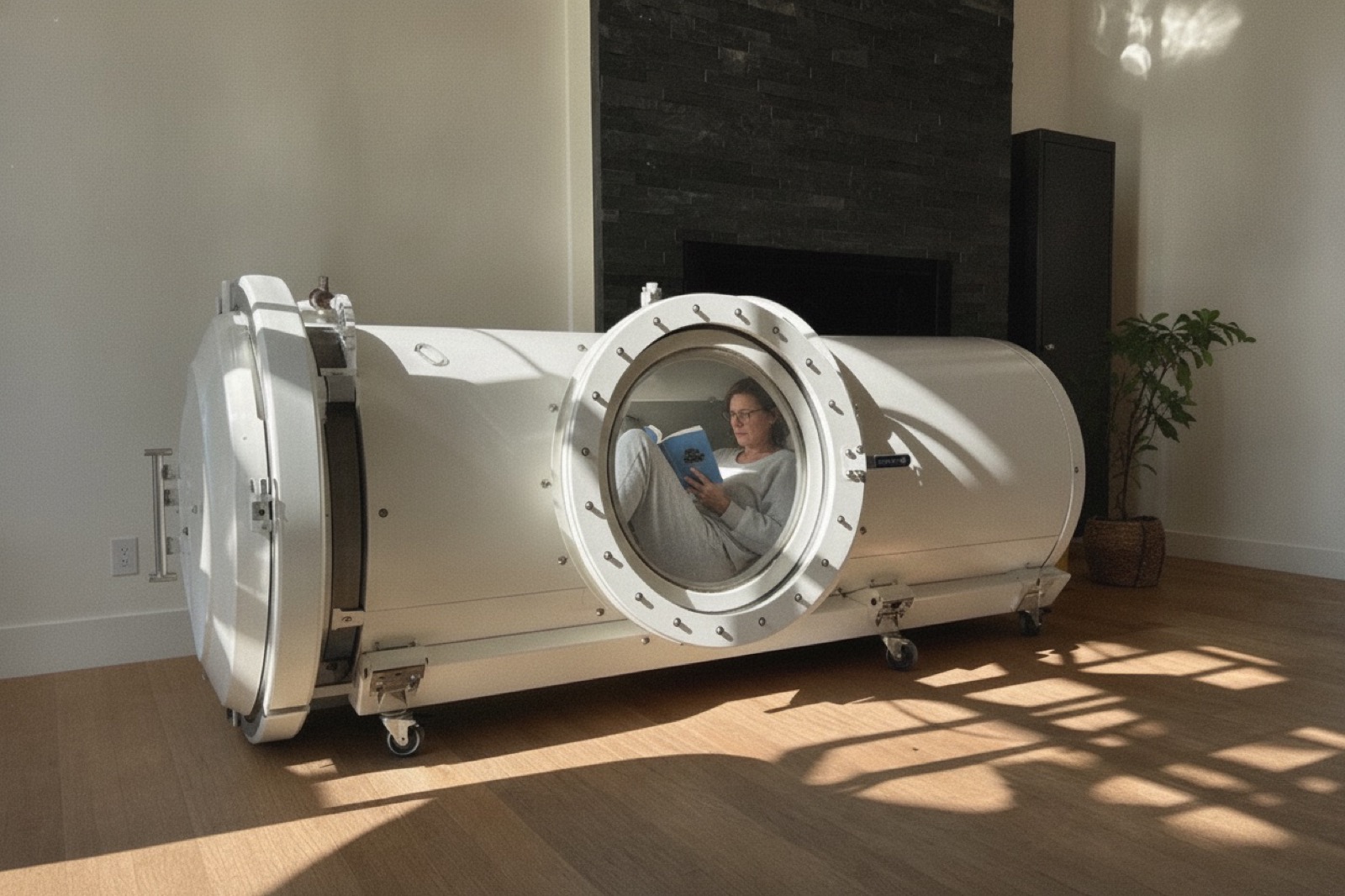
[ A timed session ] Reference imagery; final photography in production
This page is about the clock: how long a session runs, what fills that time, and how many sessions a course takes. It uses hospital patient leaflets, the U.S. Navy Diving Manual, the Undersea and Hyperbaric Medical Society (UHMS) and Medicare documents. It does not say what any session does for any condition. For what the same two hours feel like from inside, see what a hyperbaric session feels like.
Total time versus time at pressure
Two numbers get mixed up. The first is total time in the chamber. The second is time at treatment pressure breathing oxygen. A two hour session holds less than two hours of oxygen at pressure, because the chamber has to go up and come down.
Hospitals quote the total. The UHMS indications page defines hyperbaric oxygen as the whole body in a hard sided chamber at not less than 2.0 ATA, breathing physician prescribed medical grade oxygen, for an amount of time that is typically between 90 and 120 minutes per treatment. It adds that treatments are usually delivered at 1.9 to 3.0 ATA. Our pressure guide explains ATA.
Doctors order the oxygen time. A CMS transmittal of 6 January 2005 says a physician order for a 90 minute treatment typically means the patient is to be under 100% oxygen for 90 minutes, and that additional time may be needed for descent, air breaks and ascent. So the order and the clock are two different numbers by design.
The four parts of a session
Every hospital schedule we read has the same parts in the same order. Names vary, so the table gives the common ones.
| Part | Also called | What happens | Who states a time |
|---|---|---|---|
| Compression | Pressurization, descent | Air or oxygen flows in until the chamber reaches treatment pressure | Royal Brisbane: about 15 minutes. Prince of Wales: first 10 minutes. Navy tables: 20 feet per minute |
| Oxygen periods | Time at depth, treatment pressure | Oxygen by hood or mask in a multiplace chamber, or chamber oxygen in a monoplace | Royal Brisbane: 75 minutes in its routine session. Navy Table 9: three periods of 30 minutes |
| Air breaks | Air periods | The hood or mask comes off and the patient breathes chamber air at pressure | Prince of Wales and University of Maryland: 5 minutes. Navy Table 9: two breaks of 5 minutes |
| Decompression | Depressurization, ascent | Pressure is released back to normal | Royal Brisbane: generally 20 minutes. Prince of Wales: last 20 minutes |
Sources: Royal Brisbane and Women's Hospital patient booklet; Prince of Wales Hospital patient information; University of Maryland Medical Center; U.S. Navy Diving Manual, Volume 5, chapter 17. All linked below.
The air break is the part people do not expect. The University of Maryland Medical Center says oxygen is given in two segments with a five minute air break. Divers Alert Network says the scheduled air periods on the Navy table are there to reduce the risk of oxygen toxicity. The break is spent at pressure, so it counts toward time in the chamber.
Session lengths hospitals publish
The hospital figures cluster near two hours. The table uses only what each hospital or body states for its own service.
| Source | Total session | Breakdown given |
|---|---|---|
| UHMS indications page | Typically 90 to 120 minutes per treatment | Not broken down |
| Cleveland Clinic | One to two hours | Not broken down |
| Mayo Clinic content | 1 1/2 to 2 hours for most conditions | Not broken down |
| UC San Diego Health | About 2 hours | Not broken down |
| Royal Brisbane and Women's Hospital | Almost 2 hours | About 15 minutes compression, 75 minutes oxygen, about 20 minutes decompression |
| Prince of Wales Hospital, Sydney | 2 hours | First 10 minutes pressurizing, one 5 minute air break, last 20 minutes depressurizing |
| The Townsville Hospital | About two hours | Three phases; the hood is removed twice for a break |
Sources, read 22 October 2026: Cleveland Clinic; Mayo Clinic content via Mosaic Life Care; UC San Diego Health; Royal Brisbane booklet; Prince of Wales patient information; Townsville leaflet.
Royal Brisbane gives the clearest split. Its booklet says there are a few different treatment profiles and that the one used depends on the condition. For its most routine treatment, the oxygen phase is 75 minutes. For decompression illness, it says that phase can be several hours. Prince of Wales says its standard treatment pressurizes the chamber to the equivalent of 14 metres underwater, and that its monoplace chamber offers more flexibility with timing.
The clock also runs before the door closes. Royal Brisbane asks patients to arrive 30 minutes before the treatment start time. Changing into unit clothing and the safety check happen in that window, so a visit takes longer than a session.
Treatment tables: the named schedules
A treatment table is a fixed schedule of depth, time and gas. The best known set comes from the U.S. Navy Diving Manual, Volume 5, chapter 17, hosted by the UHMS. Depth is given in feet of seawater (fsw), not ATA. Divers Alert Network equates 60 feet of seawater with 2.8 ATA. Our decompression chamber guide explains why the Navy calls these recompression chambers.
| Navy table | Treatment depth | Total elapsed time stated | Listed uses include |
|---|---|---|---|
| Treatment Table 9 | 45 fsw | 102 minutes 15 seconds, not including descent | Residual symptoms after first treatment; selected carbon monoxide or cyanide cases; smoke inhalation; non-diving HBO2 schedules in Table 17-4 |
| Treatment Table 5 | 60 fsw, then 30 fsw | 135 minutes (2 hours 15 minutes), not including descent | Type I decompression sickness after a normal neurological exam; carbon monoxide poisoning; gas gangrene |
| Treatment Table 6 | 60 fsw, then 30 fsw | 285 minutes (4 hours 45 minutes), not including descent | Arterial gas embolism; Type II decompression sickness; severe carbon monoxide or cyanide poisoning |
Source: U.S. Navy Diving Manual, Volume 5, chapter 17, figures 17-4, 17-5 and 17-10 and sections 17-6.2, 17-6.3 and 17-6.8. Uses shortened; the manual lists more.
Table 9, the 90 minute oxygen table
Table 9 is the one that looks most like a routine hospital session. The manual calls it a hyperbaric oxygen treatment table providing 90 minutes of oxygen breathing at 45 feet, used only on the recommendation of a Diving Medical Officer.
- Descent: 20 feet per minute. The clock for time at depth starts on arrival at 45 feet.
- At depth: 30 minutes on oxygen, 5 minutes on air, 30 minutes on oxygen, 5 minutes on air, 30 minutes on oxygen.
- Ascent: 20 feet per minute, which the manual says may be slowed to 1 foot per minute depending on the patient's condition.
- Total: 102 minutes 15 seconds, not including descent.
The manual allows two changes. If the patient cannot tolerate oxygen at 45 feet, the table can be modified to a depth of 30 feet. The oxygen time can then be extended to a maximum of 3 to 4 hours. The tender inside breathes oxygen for the last 15 minutes at 45 feet and during ascent.
Section 17-7 lists Table 9 against most of the non-diving conditions in its Table 17-4, which it says is taken from the UHMS Hyperbaric Oxygen Therapy Committee Report of 2014. That list is a schedule guide for Navy chambers, not a statement about results.
Tables 5 and 6, the dive tables
Tables 5 and 6 start deeper and run longer. Both begin at 60 feet, and on both the time on oxygen starts on arrival at 60 feet. Descent is 20 feet per minute. Ascent is not to exceed 1 foot per minute, so the climb from 60 to 30 feet takes 30 minutes on the figure.
On Table 5, the patient breathes oxygen in 20 minute periods with 5 minute air breaks at 60 feet, then at 30 feet, for a total of 135 minutes. Table 6 adds more oxygen periods at both depths, including two 60 minute oxygen periods at 30 feet, for a total of 285 minutes. The manual says Table 6 can be lengthened by up to two extra 25 minute periods at 60 feet, two extra 75 minute periods at 30 feet, or both. Divers Alert Network gives the usual duration of Table 6 as just under five hours, with extensions added as required.
This is why an emergency session can last more than twice as long as a routine one. Our monoplace vs multiplace guide covers the chambers these tables run in.
How Medicare counts the minutes
Medicare bills chamber time in 30 minute units. The CMS Claims Processing Manual, chapter 32, section 30.1, lists two codes. HCPCS G0277 is hyperbaric oxygen under pressure, full body chamber, per 30-minute interval. CPT 99183 is physician attendance and supervision of hyperbaric oxygen therapy, per session. The manual says G0277 is not available for use other than in a hospital outpatient department.
The counting rule we found is older. The 2005 transmittal covers C1300, a hospital code with the same description, per 30 minute interval. It says that from 1 January 2005, hospitals may count four things toward the intervals: time under 100% oxygen, descent, air breaks and ascent. It says additional units may be billed for sessions requiring at least 16 minutes of the next 30 minute interval.
| Session length counted | Units of C1300 in the 2005 transmittal |
|---|---|
| 46 to 75 minutes | 2 |
| 76 to 105 minutes | 3 |
| 106 to 135 minutes | 4 |
| Worked example: 90 minutes oxygen, 10 descent, 10 air breaks, 10 ascent | 4 |
Source: CMS Pub. 100-04 Transmittal 423, Change Request 3632, 6 January 2005. The current manual lists G0277 with the same per 30-minute wording; it does not restate these bands.
The transmittal also says HBO is typically prescribed for an average of 90 minutes, and that CMS does not expect a 90 minute order to exceed 4 billed units. Our insurance and CPT codes guide covers coverage, settings and supervision. This page gives no payment amounts.
How many sessions a course runs
A course is the set of sessions a doctor plans for one condition. Hospitals publish ranges, and every one says the count depends on the condition being treated.
| Source | How often | How many |
|---|---|---|
| Royal Brisbane and Women's Hospital | 5 days a week, usually one treatment per patient per day | On average most conditions require 30 to 40 |
| Prince of Wales Hospital | Monday to Friday | A period of 4 to 6 weeks |
| The Townsville Hospital | Usually daily, 6 to 7 days a week | 1 to 60; some emergency conditions need one or two |
| Cleveland Clinic | Once a week up to five days a week | Up to 30 or more |
| Mayo Clinic content | Not stated | A few for carbon monoxide poisoning; 40 or more for nonhealing wounds |
| UC San Diego Health | Not stated | A few for some emergencies; more than 30 for others |
| UHMS indications page | Daily | A series of treatments for several weeks for most disorders |
Sources as linked in the session length table above, read 22 October 2026.
The Navy Table 17-4 gives minimums and maximums by condition, from 1 to 3 treatments for acute carbon monoxide poisoning up to 60 for some wound and radiation injury entries. Some entries run twice a day. Medicare adds a review point for one condition: our insurance guide quotes NCD 20.29 as requiring diabetic wounds to be evaluated at least every 30 days during HBO therapy. A course at five sessions a week for six weeks is 30 visits of about two hours each, plus travel.
How a mild home session differs
We found no regulator or medical society source that sets a session length for a home chamber. What the sources do describe is the device, and the device sets the outline of the session.
The UHMS position statement on low-pressure fabric chambers says they operate at less than 1.4 ATA, are designed to be compressed only with air, and hold FDA 510(k) clearance for acute mountain sickness only. It says exposure below 1.4 ATA while breathing air does not meet its definition of hyperbaric oxygen therapy. So the hospital pattern of oxygen periods and air breaks has no counterpart in a soft chamber used as cleared. The whole session is air.
One fabric chamber's FDA 510(k) summary, K171899, lists an operating pressure of 4 psi, or 1.3 ATA, the same as its two predicates. It is inflated with atmospheric air by an electric compressor and is indicated to treat acute mountain sickness under the prescription of a health professional. The summary does not give a session length, a compression time or a decompression time.
The Medicare clock does not carry over either. The CMS manual limits G0277 to hospital outpatient departments. Our mild vs medical guide sets the two tiers side by side, and our home chamber pros and cons page covers running sessions at home. For the models we track and what we can verify about each, see the scorecard.
What we have not verified
We did not find a current CMS or contractor document that restates the 2005 counting rule for G0277, and we did not confirm in a CMS source that G0277 replaced C1300; the two share a description, and that is all we state. We could not load the StatPearls chapter on hyperbaric therapy. We found no hospital page that gives compression and decompression times for a monoplace session. Prince of Wales gives depth in metres, and we have not converted it to ATA from a source. We found no regulator, UHMS or maker manual that sets a session length, a compression time or a weekly schedule for a mild home chamber; the times on retail and brochure pages are sales copy, and we left them out. We have not timed a session ourselves. If you hold a manual or a clinical protocol that settles one of these points, send it and we will check it.
Frequently asked
How long is a hyperbaric oxygen session?
At the hospitals we checked, about two hours from closing the door to opening it. Cleveland Clinic says one to two hours, Mayo Clinic content says 1 1/2 to 2 hours, and UC San Diego Health says about 2 hours. The UHMS says treatment typically lasts 90 to 120 minutes.
How much of a session is spent at full pressure?
Less than the total. Royal Brisbane and Women's Hospital spends about 15 minutes pressurizing, 75 minutes breathing oxygen and about 20 minutes depressurizing in its routine session. The U.S. Navy Treatment Table 9 holds 90 minutes of oxygen at 45 feet, split into three 30 minute periods with two 5 minute air breaks.
What is the Medicare billing unit for a hyperbaric session?
The CMS Claims Processing Manual lists HCPCS G0277 as hyperbaric oxygen under pressure, full body chamber, per 30-minute interval, and CPT 99183 as physician attendance and supervision, per session. A 2005 CMS transmittal for the earlier code C1300 counted oxygen time, descent, air breaks and ascent toward the 30 minute intervals.
How many hyperbaric sessions are in a course?
It depends on the condition, and hospitals publish ranges, not one number. Royal Brisbane says most conditions need 30 to 40 treatments, five days a week. Prince of Wales Hospital in Sydney says 4 to 6 weeks. Townsville says 1 to 60. Mayo Clinic content says some conditions need 40 sessions or more.
How long is a session in a home soft chamber?
We found no regulator or medical society source that sets one. The FDA clearance summary we read for a 1.3 ATA fabric chamber gives the operating pressure and the indication, acute mountain sickness, but no session length. The times on retail pages are sales copy, and we have not used them.
Why does a dive injury session take longer?
Because it runs on a different table. The U.S. Navy Diving Manual gives Treatment Table 6 a total elapsed time of 4 hours 45 minutes, not counting descent, starting at 60 feet. Royal Brisbane says oxygen breathing for decompression illness can be several hours, against 75 minutes in its routine session.

Alex tests the machines himself, in clinics and studios on three continents. Every score comes from the same 27 public criteria, and no manufacturer has a say in them.
Six questions, and we'll match chamber, options, and install to your space and budget.