Can You Sleep in a Hyperbaric Chamber? What Hospitals and Manuals Say
Researched and scored by Alex Evans. Last reviewed August 2026. Corrections are dated and public. See corrections
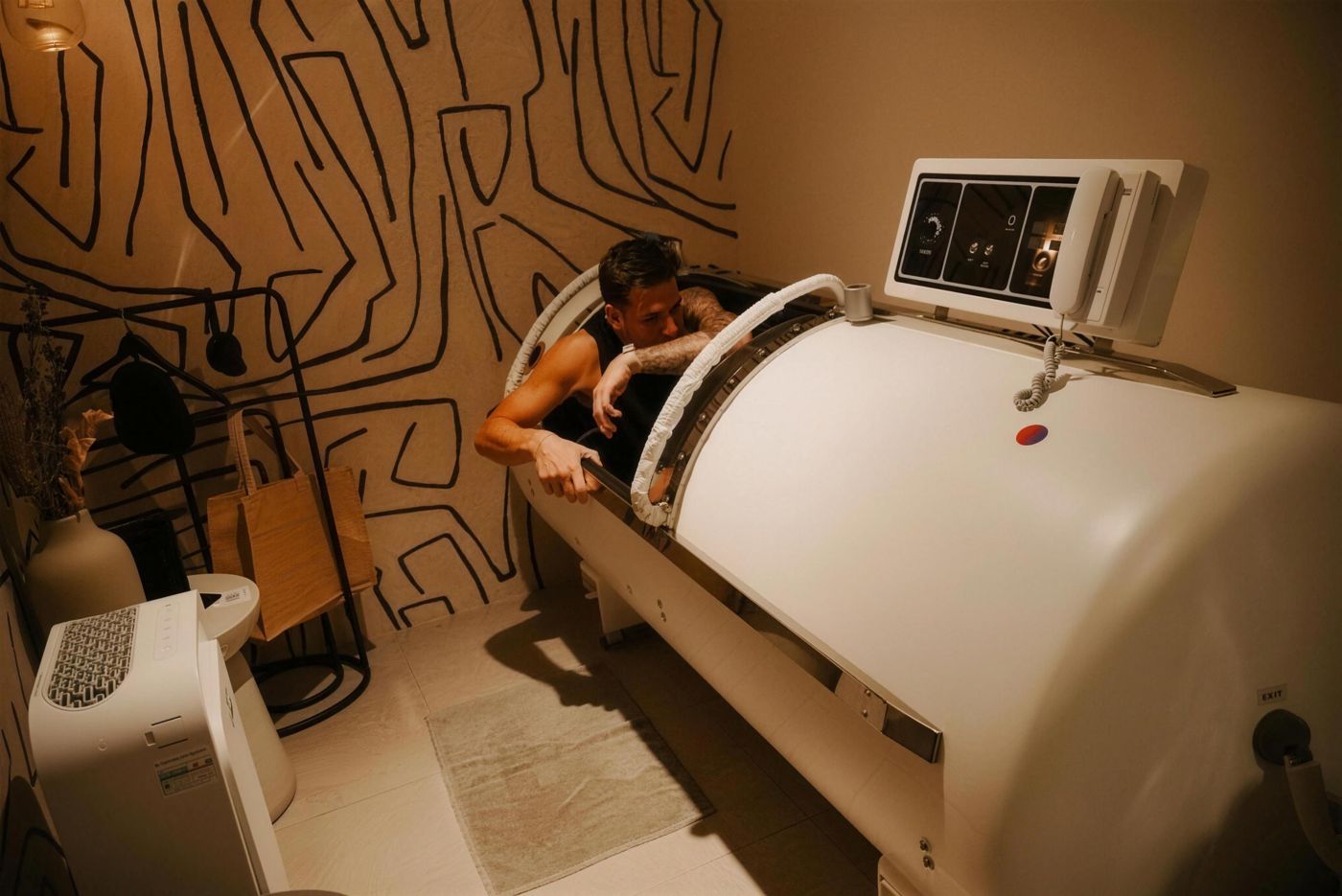
[ Hard-shell chambers ] Reference imagery; final photography in production
This page answers one question with what sources say. It uses hospital patient guides, two home chamber manuals, FDA clearance summaries, the FDA's 2025 letter to providers and papers from the NFPA fire code committee. It does not say whether sleep in a chamber does anything for you. It says what you are allowed to do, who is watching, and how the machine behaves while you are not paying attention.
What hospitals tell patients about sleeping
Hospitals allow it, and some say it in plain words. The Sparrow Wound and Hyperbaric Clinic patient guide says that when you reach the prescribed pressure, the fullness in your ears will stop and you may rest or sleep during the remainder of the treatment. You can also watch TV or listen to music. It puts that part of the session at about 1.5 to 2 hours. Sparrow uses a single person monoplace chamber about seven feet long and 32 inches wide.
The Royal Brisbane and Women's Hospital booklet answers the question under the heading of what you can do during treatment. In its multiplace chamber you can read, rest, sleep, watch a movie or listen through the audio system. In its monoplace chamber no reading material is allowed, but you can watch a movie, rest or sleep. Your own electronic equipment cannot come in.
Cleveland Clinic lists sleeping among the things monoplace patients do, along with watching television or a movie and listening to music. It says many people spend the time on relaxing activities or even sleeping. It also says you may feel sleepy after the session. That is a note about how people feel, not a claim about sleep, and we leave it there.
So the hospital answer is yes, inside a session of about two hours, with staff present. For how that time is split, see our guide to how long a hyperbaric session lasts.
Who watches while you sleep
Every hospital source that allows sleep also says someone is watching. Sparrow says a nurse or technician will remain with you during the treatment. Cleveland Clinic says a healthcare provider will be in the room throughout. The GBMC hyperbaric FAQ says you will be continuously monitored by the hyperbaric team.
Royal Brisbane describes the most layers. A registered nurse trained in the specialty is with you throughout the treatment. In the monoplace, that nurse operates the chamber from the outside and is able to hear, see and talk to you. Two full time chamber supervisors look after the technical side. The booklet says a supervisor can observe everything through video monitors and microphones in the chambers. A hyperbaric doctor is always available during a treatment.
The hardware is built around that operator. The FDA 510(k) summary K140559 for two Sechrist monoplace chambers lists a two-way intercom between the patient and an attendant outside. The door cannot be unlocked while there is more than about 1 psig in the chamber. An emergency vent, worked by the operator with a pneumatic push button, takes the chamber from 30 psig to 0 in 119 seconds at most. A covered emergency shutoff switch cuts the gas supply and depressurizes the chamber. Each of these is a control for the person outside, not the person lying inside.
The part you stay awake for: your ears
Ear clearing happens at the start. Sparrow says the nurse or technician sets the rate of compression to your tolerance and coaches you through the full feeling in your ears. Compression generally lasts 7 to 10 minutes, depending on how well you clear. Royal Brisbane says that with a good technique you should not feel discomfort, and that you should tell the nurse at once if you do.
Cleveland Clinic suggests yawning or a sip of water, or holding your nose and swallowing. Our page on what a hyperbaric session feels like collects the techniques hospitals teach, and what staff do when ears will not clear.
The end of the session asks less of you. Royal Brisbane says that during decompression your ears should pop on their own, and you should not have to actively equalize. Sparrow says the nurse or technician lowers the pressure near the end. So in a hospital, the part that needs your attention comes first, and staff run the rest.
Breathing and the way back up
One instruction appears in hospital and home sources alike. GBMC says that holding your breath during treatment could result in lung collapse, which it names as pneumothorax. The OxyHealth operating and reference guide for its portable mild chambers says everyone treated must be told that, in the unlikely event of a rapid decompression, they must exhale. It adds that breath holding is not a usual response, because expanding air tends to make people breathe out.
None of the sources we read discusses whether a sleeping person would follow that instruction. We list it under what we have not verified.
What home chamber manuals say
Home chambers have no nurse by default, so the manual is the closest thing to a rule. We read two in full. Both describe soft, zippered chambers pressurized by an air compressor.
The OxyHealth guide is Revision 5, dated September 2005. It says to consult the prescribing doctor for protocols, and that in most cases each session will be 60 minutes long. It tells the operator to set a clock or timer for the prescribed treatment period. The guide does not mention sleep.
The Oxynova user manual, dated 2021 and hosted by a retailer, says a session usually lasts 45 to 90 minutes, depending on the protocol you were advised to use. Under what to do during a session, it suggests a calm activity such as sleeping, reading a book, meditating or listening to music. It is the only maker document we found that names sleep. It describes a session of up to 90 minutes, not a night.
Neither manual gives a maximum time in so many words. Neither describes an automatic shutoff or a built-in timer. OxyHealth puts the timer in the attendant's hands.
Attendants, timers and getting out alone
The two manuals take different lines on being alone. OxyHealth is direct. Its treatment chapter says: we recommend that an attendant be present during the entire time someone is inside the chamber, because of any unforeseen emergency involving the patient's condition that is unrelated to the treatment. Its operating steps tell the attendant to reassure the person that they will stay for the whole treatment and check on them regularly.
Oxynova describes both setups. One section covers a single user operating the chamber from the inside. Another covers use with an attendant, who checks the user's comfort at all times and stays close to the chamber throughout depressurization. The manual says the user can talk with an attendant outside when the attendant comes to a window.
Both manuals say the person inside can get out. OxyHealth says the pressure valve turns from the inside as well as the outside, and that each zipper has an inner and outer pull, so the person can exit at any time without help. It says depressurizing should take no less than 3 minutes, guided by the comfort of the person inside. Oxynova says to depressurize over 15 minutes or more, and never to open the zippers under pressure.
The FDA files point the same way. The 510(k) summary K171899 for a fabric chamber says it can be operated from the inside as well as the outside, and its ten windows allow the patient's comfort to be checked from outside. Its comparison table lists the skills of the person to leave the chamber as a feature of the cleared device and both predicates. Being able to leave depends on being awake to do it. No source we read says how a chamber wakes a sleeping user.
If the power fails
A soft chamber stays up because the compressor keeps running. The Oxynova manual says what happens when it stops: in a power failure the compressor no longer works, the chamber depressurizes gently by itself, and the person inside can get out. It says that even without air circulating, there is more than enough oxygen in the chamber to depressurize and get out.
A consultant letter filed with an NFPA proposal in 2023 says the same of the soft chambers it reviewed. The letter says that if electricity is interrupted the compressors stop, the chambers deflate on their own, and the occupant can leave once the pressure is back to ambient. That is one expert's view in a submission, not code text. The OxyHealth guide does not describe a power failure. Neither manual says how long the slow deflation takes.
Air, carbon dioxide and heat in a soft chamber
A closed bag with a person in it collects exhaled carbon dioxide. The OxyHealth guide explains how its chambers handle that. Two stainless steel relief valves, one a regulator and one a backup, start releasing air at about 4 PSI. Fresh air is pumped in constantly while old air leaves through those valves, which the guide says prevents carbon dioxide buildup. It says the compressor should be on at all times during a session.
The guide then gives a short exposure table. It lists 3 percent carbon dioxide as acceptable for 1 hour and 1 percent for 24 hours. It says that while the compressor runs, the level inside stays below 1 percent. The FDA summary K171899 lists excessive carbon dioxide exposure among the contraindications for the cleared chamber and both predicates. Its compressor has an extra safety valve for a blocked supply hose.
Heat is the other variable. OxyHealth says the inside runs a little warmer than the room, that a person may sweat heavily and fog the window, and that the chamber can then be depressurized so they can get out. It suggests setting up near an air conditioning vent. Our hyperbaric chamber safety guide covers the wider list of what goes wrong.
Oxygen concentrators and their alarms
Soft chambers are cleared for air. The UHMS position statement on low-pressure fabric chambers says they are designed to be compressed only with air, and that the FDA prohibits their use with supplemental oxygen. The OxyHealth guide says its chambers are not to be inflated with enriched oxygen. The Oxynova manual says not to inflate its chamber with pure oxygen or an oxygen concentrator.
Some setups still pair a chamber with a concentrator; the 2023 NFPA filing described below covers one. So concentrator alarms belong in this question. The 510(k) summary K030233 for one portable concentrator says an alarm warns of low oxygen concentration, lack of current, high internal temperature and a blocked air inlet filter. That is one cleared unit, not a standard for all of them. We found no manual that says an alarm on a concentrator will wake a sleeping chamber user, or that links the two machines. Our oxygen concentrator guide and BIBS and oxygen delivery guide explain how oxygen reaches the person in each chamber type.
What the FDA and the fire code papers say
The FDA did not write about sleep. Its letter to health care providers of August 25, 2025 asks them to follow the maker's instructions for use, train staff, follow fire prevention measures, and ensure the patient is properly monitored and supervised for the duration of the treatment. It does not mention home use, overnight use or unattended use in those words. Duration of the treatment is the closest it comes.
The UHMS statement says the society does not endorse the concept of in-home therapy at any time. It recommends that physicians, or trained and supervised non-physician providers, be available immediately throughout hyperbaric oxygen therapy.
The fire code question was argued in 2023. Proposed NFPA 99 TIA 1735 would have created a lighter category for mild chambers, with an annex note that the zippers can be forced open in an emergency. The committee ballot recorded 0 votes in favour and 17 against, so it was not issued. An egress analysis filed with it said the intent and standard practice is to always have the exit guided and assisted, and then tested a worst case with no attendant. In self-exit videos at the locations studied, the average time to depressurize and get out was 2 minutes 25 seconds, and none took more than 3 minutes. The filing does not describe a user who starts the exit asleep.
The Minnesota State Fire Marshal says mild chambers typically run between 2 and 4.5 psi and appear to fall within NFPA 99 Chapter 14. It notes that the annex now says the Chapter 14 safeguards apply regardless of location. Our NFPA 99 fire safety guide walks through what that chapter asks for. We found no code text that speaks to sleeping in a chamber.
Hospital and home sessions side by side
The table puts the sourced answers next to each other. Blank answers are left as not stated, not guessed.
| Question | Hospital chamber | Soft home chamber manuals |
|---|---|---|
| Is sleep allowed? | Yes: Sparrow, Royal Brisbane, Cleveland Clinic | Oxynova lists sleeping; OxyHealth does not mention it |
| Session length stated | Sparrow: about 1.5 to 2 hours at pressure | OxyHealth: 60 minutes in most cases. Oxynova: usually 45 to 90 minutes |
| Who watches | Nurse or technician throughout; Royal Brisbane adds video monitoring | OxyHealth recommends an attendant the entire time. Oxynova covers solo and attended use |
| Timer | Run by staff | OxyHealth: set a clock or timer. No built-in timer or auto shutoff described |
| Ear clearing | Coached during compression; Sparrow: 7 to 10 minutes | Valsalva named in both manuals |
| Power failure | Not stated in the hospital sources we read | Oxynova: compressor stops, chamber deflates by itself |
| Getting out | Door locked above about 1 psig; operator emergency vent (K140559) | Valve and zippers work from inside; OxyHealth: no less than 3 minutes |
| Overnight use | Not addressed | Not addressed |
Sources: Sparrow patient guide; Royal Brisbane and Women's Hospital booklet; Cleveland Clinic; FDA 510(k) summary K140559; OxyHealth guide, Revision 5, 2005; Oxynova user manual, 2021. All linked above, read 22 October 2026.
For the models we track and what we can verify about each, see the scorecard. For the trade-offs of running sessions at home, see home chamber pros and cons.
What we have not verified
We found no regulator, medical society, maker or fire code source that says whether overnight use of any hyperbaric chamber is safe, and we do not say it is or is not. We found no study of sleep inside a chamber that we could cite, and this page makes no claim about sleep quality or any health effect. The OxyHealth guide we read dates from 2005 and may have been replaced; the Oxynova manual is hosted by a retailer, not the maker. We did not find a home chamber with a built-in session timer or automatic shutoff described in a manual or an FDA summary. We did not find a source that says how long a soft chamber takes to deflate after a power cut, or whether a sleeping person would notice. We did not read a hard-shell home chamber manual. Concentrator alarms come from one 2003 summary for a portable unit. The NFPA egress times come from a filing with a failed proposal, not from code text. If you hold a current manual that sets a maximum session or speaks to sleep, send it and we will check it.
Frequently asked
Can you fall asleep during hyperbaric oxygen therapy?
The hospitals we checked say yes. Sparrow Wound and Hyperbaric Clinic says that once you reach the prescribed pressure you may rest or sleep for the rest of the treatment. Royal Brisbane and Women's Hospital lists sleep as allowed in both its multiplace and monoplace chambers. Cleveland Clinic names sleeping among the ways to pass the time in a monoplace chamber.
Does someone watch you while you sleep in a hospital chamber?
In every hospital source we read, yes. Sparrow says a nurse or technician remains with you during the treatment. Royal Brisbane says its monoplace nurse operates the chamber from outside and can hear, see and talk to you, and a chamber supervisor watches through video monitors. Cleveland Clinic says a provider is in the room throughout. GBMC says patients are continuously monitored.
Can you sleep overnight in a home hyperbaric chamber?
We found no source that says so. The two home chamber manuals we read describe sessions of about 60 minutes (OxyHealth) and 45 to 90 minutes (Oxynova). OxyHealth recommends an attendant for the entire time someone is inside. The FDA asks providers to monitor and supervise the patient for the duration of the treatment. No regulator, maker or fire code document we read addresses an overnight session.
What happens if the power goes out while you are in a soft chamber?
The Oxynova manual says the compressor stops, the chamber depressurizes gently by itself and the person inside can get out. A consultant letter filed with a 2023 NFPA proposal said the same of the soft chambers it reviewed. The OxyHealth manual says the person inside can release the pressure from the inside and unzip both zippers without help.
Do you have to be awake to clear your ears?
Ear clearing is needed while the chamber pressurizes. Sparrow says compression generally lasts 7 to 10 minutes and staff coach you through it, and that the fullness stops once you reach pressure. Royal Brisbane says that during decompression your ears should pop on their own and you should not have to actively equalize.

Alex tests the machines himself, in clinics and studios on three continents. Every score comes from the same 27 public criteria, and no manufacturer has a say in them.
Six questions, and we'll match chamber, options, and install to your space and budget.