Liability Insurance for Hyperbaric Operators Explained
Researched and scored by Alex Evans. Last reviewed August 2026. Corrections are dated and public. See corrections
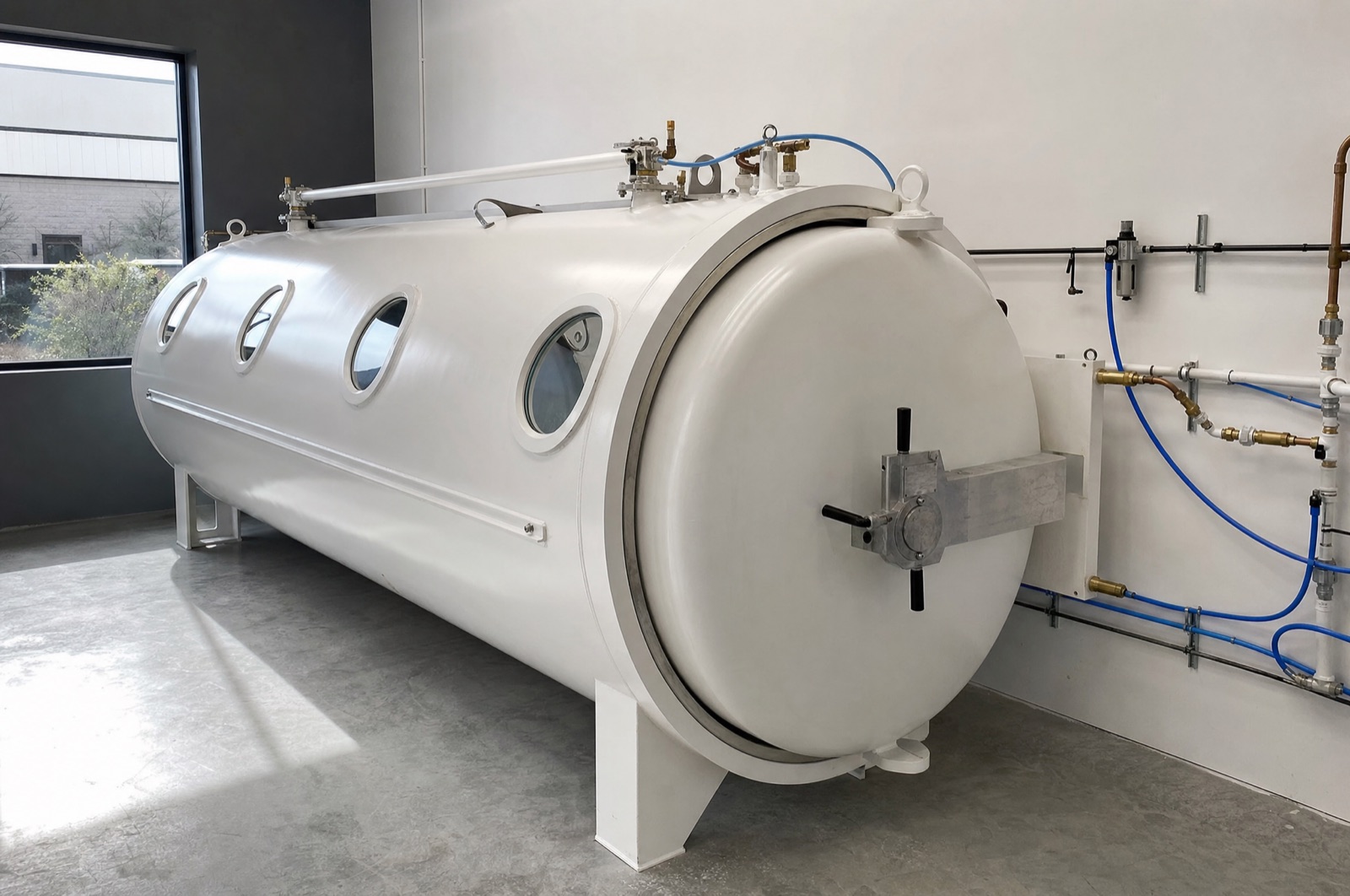
[ Clinic install ] Reference imagery; final photography in production
The policies a chamber operator deals with
A business that adds a chamber usually needs several policies working together. No single form covers a slip in the lobby, a claim about how a session was run, a faulty valve and a dead compressor. This page is about insurance that protects the operator. It is not about whether a health plan pays for treatment; that is covered in our insurance and CPT codes guide.
The SBA's business insurance page lists the main types. General liability protects against financial loss from bodily injury, property damage, medical expenses, libel, slander, defending lawsuits, and settlements or judgments. Product liability is for businesses that make, wholesale, distribute or sell a product. Professional liability covers loss from malpractice, errors and negligence. Commercial property covers loss or damage to company property from events such as fire and vandalism. The SBA also says the federal government requires every business with employees to carry workers' compensation, unemployment and disability insurance, and that some states require more.
| Policy | What it is built for | Chamber example | Source |
|---|---|---|---|
| Commercial general liability | Bodily injury, property damage, personal and advertising injury | A client trips on a hose on the way to the chamber | Texas DOI; NAIC |
| Professional liability or malpractice | Wrongful practices by professional service providers | A claim that staff ran a session badly or screened a client poorly | NAIC; SBA |
| Product liability | Injury caused by a defective product you make or sell | Usually the maker's policy; yours if you resell or rent units | SBA; Insureon |
| Commercial property | Damage to your property from outside causes such as fire or theft | The chamber and room after a building fire | SBA; Westfield |
| Equipment breakdown | Sudden internal failure such as arcing or motor burnout | A compressor motor burns out | Westfield |
| Excess or umbrella | Covered losses above the primary policy's limit | A large injury claim that exceeds the liability limit | Texas DOI; NAIC |
| Workers' compensation | Injuries to your own employees | A technician is hurt moving a chamber | SBA; Texas DOI |
Sources: SBA, Texas Department of Insurance, NAIC, Insureon and Westfield pages linked in this guide, read October 2026. The chamber examples are ours, for illustration. Whether any policy pays a given claim depends on its wording.
A business owner's policy, or BOP, bundles some of these. The NAIC's small business insurance page calls a BOP a package that typically includes property, business interruption and liability cover. It says a BOP usually excludes commercial auto, workers' compensation, health, disability and professional liability. That last exclusion matters most for a chamber.
General liability and what it leaves out
The Texas Department of Insurance publishes a plain guide to commercial general liability. It says a CGL policy protects business owners against claims for bodily injury, property damage, and personal and advertising injury. Premises and operations cover pays for injury or damage on your premises or caused by your operations. Products and completed operations cover pays for injury or damage away from your premises caused by your products or completed work.
The same guide lists common CGL exclusions. Several apply to a chamber business:
- Damage to your product. CGL does not pay for damage to your own product arising out of that product. A failed part may be covered elsewhere, but not here.
- Contractual liability. CGL excludes liability you take on in a contract, with exceptions, including an "insured contract" as the policy defines it. A lease or a supplier agreement with an indemnity clause should be read against that wording.
- Recall. CGL will not pay to recall faulty products, though TDI says this can be added by endorsement.
- Employee injuries. CGL is not meant to cover workers' compensation or employer's liability.
General liability also stops short of the treatment itself. The NAIC says standard CGL does not cover claims of wrongful practices by professional service providers, and gives health care providers as an example. Latent Insurance Services, a broker, says in its med spa guide that general liability does not cover treatment-related claims. The TDI guide adds that most CGL policies are auditable, so the premium paid at the start is a deposit based on estimated payroll or sales and can change after an audit.
Professional liability and malpractice
Professional liability is the cover for the session itself. The NAIC defines it as coverage for wrongful practices by professional service providers. The Insurance Information Institute's professional liability page says it is also known as errors and omissions insurance and that most policies are claims-made. Insureon's med spa page describes professional liability, which it also calls medical malpractice, as paying legal costs related to your work.
The key risk is a policy that does not name hyperbaric sessions. Insureon says coverage can vary by insurer and some treatments may be excluded or need endorsements. World Insurance's med spa page lists treatment endorsements for services such as IV therapy, laser treatments and injectables, and describes endorsements as a way to customize exclusions, limits or conditions for specific procedures. Hyperbaric therapy is not on that list. Bay Legal, a California law firm, writes in an article on hyperbaric businesses that general medical malpractice policies may not cover hyperbaric-specific incidents.
The second risk is who the policy covers. Latent says an entity-level malpractice policy may or may not extend to independent contractors, and that every practitioner who touches patients should have individual cover as well as the entity policy. World Insurance lists automatic coverage for medical directors but does not set out its terms. The people who run sessions, and their training, are covered in our staffing and certification guide. Map each person to a named policy before the first client.
Records matter to this cover. Bay Legal writes that a business without a documented safety program may have a documentation gap that professional liability insurance may not cover retroactively. The FDA's August 2025 letter to health care providers tells facilities to follow the maker's instructions for use, keep staff training current, monitor the patient for the whole session, and follow the maker's cleaning, maintenance and safety check schedule. Written logs of each of those are the records a claim will turn on.
Claims-made, occurrence and tail cover
How a policy is triggered decides whether an old incident is covered. The TDI guide says an occurrence policy covers claims arising from injury or damage while the policy is in force, regardless of when the claim is first made. A claims-made policy covers injury or damage during the policy period that is also reported to the insurer during the policy period. The III puts it the same way: the policy must be in effect both when the event took place and when the suit is filed. The Texas Medical Liability Trust's explainer says a claims-made policy protects you during the current policy period, usually one year.
TDI describes the two add-ons that close the gaps. Prior acts, or "nose," cover reaches injury that happened before the policy began but is reported after, back to a retroactive date shown on the declarations page. It does not cover claims known when the policy began. Run-off, or "tail," cover pays for claims made after the policy ends. TDI says a typical claims-made policy gives 30 or 60 days after expiry to report, and that tail then runs for one, three or five years, or unlimited, for an extra premium. Insureon says professional liability is typically claims-made and recommends tail cover.
This matters when a clinic changes carrier, sells, or stops offering sessions. TDI says that if a claims-made policy ends, you should buy tail from the old insurer or prior acts cover from the new one. Bay Legal describes tail cover as one tool for past services when a hyperbaric business restructures.
Product liability and the chamber maker
Product liability belongs mainly to whoever makes or sells the chamber. The SBA says it is for businesses that manufacture, wholesale, distribute or retail a product, and covers loss from a defective product that causes injury. Insureon says it covers illness or injury from products you make or sell. A clinic that only uses a chamber is not in that position. A clinic that resells chambers, rents them for home use, or sells branded accessories may be. Latent says product liability is often included in general liability policies but tells buyers to check.
The TDI guide says products and completed operations cover is part of a CGL policy, and that CGL excludes damage to your own product. So if a client is hurt by a part, the claim and the repair can fall under different policies held by different companies. Ask the seller who made each component, which company carries product liability for it, and whether its contracts give your clinic any protection. Ask for those answers in writing. Build standards that bear on hard chambers are in our ASME PVHO-1 guide, and the FDA letter says HBOT devices are Class II medical devices cleared through the 510(k) process. Warranty terms, which are separate from insurance, are in our warranty guide.
Property and equipment breakdown
Commercial property cover pays when something outside the machine damages it. Westfield, an insurer, says on its equipment breakdown page that commercial property insurance helps protect against external factors like fire, theft and wind. Equipment breakdown covers the inside failures. Westfield lists short circuit, electrical arcing, power surges, mechanical breakdown and motor burnout, plus microelectronic failure even where physical damage is not detectable. It says the cover can include lost business income and extra expense, and that it can be added to a property policy or a BOP. It excludes external forces like fire, wind or hail, and normal wear and tear.
A chamber system has compressors, coolers, controls and often an oxygen concentrator, so this line is worth a direct question. Latent lists equipment breakdown as sometimes optional in a BOP. Insureon says expensive equipment can raise property insurance costs. Tell the insurer the replacement value of each unit, and check whether a leased chamber is your property to insure or the lessor's.
Excess cover and who the insurer is
A single serious injury can exceed a primary limit. TDI says excess liability pays covered losses above the CGL policy's dollar limit, and that an umbrella policy sits above auto and CGL limits and may also cover some exposures the primary policy does not. The NAIC says umbrella limits typically run from $1 million to $5 million. Whether an umbrella sits above professional liability depends on its wording.
The type of insurer also matters. TDI says cover that licensed insurers will not write may be placed with eligible surplus lines insurers. In Texas, it says, those insurers do not file rates and forms with the regulator, their forms may be more restrictive, defense costs could sit inside the limit, prior acts or run-off cover may not be available, and policyholders are not protected by the state guaranty association if the insurer fails. Other states have their own rules, so ask your broker whether a quote is from a licensed or surplus lines insurer.
When an insurer disputes a claim
A policy being in force does not settle whether it responds to a given claim. Chamber fires have already led to court cases over insurance coverage, and the outcome turns on the policy wording, which is rarely public. Holmes Murphy, a broker, wrote after a 2025 chamber fire that facilities should ensure that insurance policies cover fire-related incidents, equipment failures, and potential liability claims, and that claims may concern negligence, equipment maintenance and staff training. The fire code side is in our NFPA 99 guide, and wider safety points are in our chamber safety guide.
Oversight is uneven, which puts more weight on your own records. NBC reported in a 2025 story on chamber oversight that Michigan's health, workplace safety and licensing agencies said they lack oversight of chambers. It reported that the Undersea and Hyperbaric Medical Society accredits about 150 facilities, and that accreditation costs about $10,000 and lasts three to four years. We did not find any insurer that publishes a rule linking accreditation to premium or eligibility.
What insurers publish on price
No insurer or broker we read publishes a premium for hyperbaric operations. One publishes med spa figures. Insureon gives monthly averages for its med spa customers: $52 for general liability, $208 for professional liability or malpractice, and $102 for a BOP. It says most of those customers have fewer than five employees and five years or less in business, and that premiums depend on services, revenue, location, limits, deductibles, claims history and staff.
Those figures do not cover chambers. A business adding hyperbaric sessions changes the risk being priced, and the type of chamber changes it again. Our mild vs medical guide explains the difference in pressure and oxygen that an underwriter is likely to ask about. Treat any figure as a reason to get a written quote, not a budget line.
Questions to put to a broker
Get each answer in writing, ideally as a policy endorsement or schedule:
- Is hyperbaric therapy a named covered service, with the chamber type, pressure and oxygen use stated?
- Which people are covered: the entity, the medical director, employees, and any independent contractors?
- Is each liability policy claims-made or occurrence, what is the retroactive date, and what does tail cover cost?
- Are there exclusions for fire, oxygen, pressure vessels or specific procedures?
- Does the property policy cover the chamber at replacement value, and is equipment breakdown included?
- Are defense costs inside or outside the limit, and does the umbrella sit above professional liability?
- Is the insurer licensed in your state or a surplus lines carrier?
- Which company carries product liability for the chamber and concentrator, and what do its contracts give your clinic?
The wider build-out of a clinic room is in our chambers for clinics guide. For how the brands we track score on what we can verify, see the scorecard.
What we have not verified
We read published pages from regulators, insurers, brokers, a law firm and court and news sources. We did not read any actual policy form for a hyperbaric business. Open questions:
- What any insurer charges to cover hyperbaric sessions. We found no published premium.
- Whether common malpractice forms exclude hyperbaric therapy by name, or simply do not list it.
- Whether insurers treat mild soft chambers and medical hard chambers differently in underwriting.
- Whether UHMS accreditation or NFPA 99 compliance affects price or eligibility with any carrier.
- What policy language insurers have relied on when disputing chamber fire claims.
- Whether any state requires a minimum liability limit for a business that runs a chamber.
This page explains policy types. It is not insurance or legal advice. If you hold a policy or an endorsement that settles one of these points, the corrections page says how to send it.
Frequently asked
Does general liability insurance cover a hyperbaric session that goes wrong?
Not on its own. The NAIC says professional liability covers wrongful practices by professional service providers such as health care providers, and that standard commercial general liability does not cover those claims. Bay Legal, a California law firm, writes that general liability policies do not cover malpractice at all. A claim tied to how a session was run is usually a professional liability question.
Will my existing med spa malpractice policy cover a new chamber?
Only if the policy says so. Insureon says some treatments may be excluded or need endorsements. Latent Insurance Services says adding services later without updating your policy can create gaps. Bay Legal writes that general medical malpractice policies may not cover hyperbaric-specific incidents. Ask the insurer to confirm in writing that hyperbaric sessions are a covered service.
What is tail coverage and do I need it?
The Texas Department of Insurance calls it run-off or tail coverage, also called an extended reporting period. It pays for claims made after a claims-made policy expires. TDI says the period may be one, three or five years, or unlimited, and is bought for an additional premium. If you switch carriers or close, you need either tail from the old insurer or prior acts cover from the new one.
Does the chamber manufacturer's insurance protect my clinic?
Not automatically. The SBA describes product liability as cover for businesses that make, distribute or sell a product, against loss from a defective product that causes injury. That policy belongs to the maker. Whether your clinic gets any protection from it depends on the maker's contracts and endorsements, which you should ask to see. It does not replace your own general and professional liability.
How much does liability insurance for a hyperbaric clinic cost?
We did not find any insurer that publishes a premium for hyperbaric operations. Insureon publishes monthly averages for its med spa customers, but those figures are not for chambers. A quote depends on your services, staff, location and limits, so treat any number you hear as a starting point for a written quote.

Alex tests the machines himself, in clinics and studios on three continents. Every score comes from the same 27 public criteria, and no manufacturer has a say in them.
Six questions, and we'll match chamber, options, and install to your space and budget.