Hyperbaric Chamber vs Red Light Therapy Bed: Two Different Machines
Researched and scored by Alex Evans. Last reviewed August 2026. Corrections are dated and public. See corrections
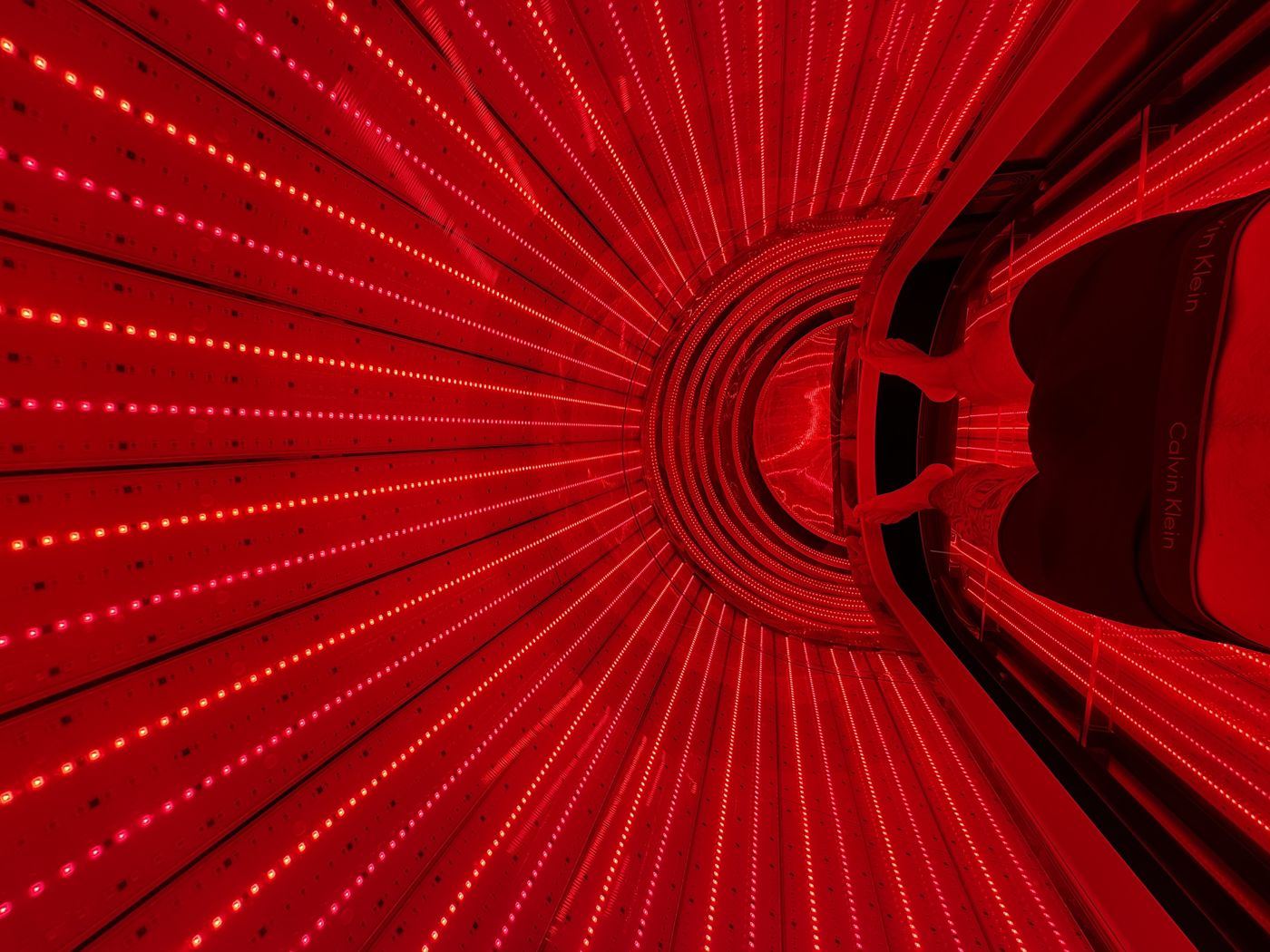
[ LED bed interior ] Reference imagery; final photography in production
A hyperbaric chamber and a red light therapy bed are two different machines. The chamber is a sealed vessel that raises the air pressure around your whole body. The bed is an open frame of light-emitting diodes, or LEDs, that shines red and near infrared light on your skin at normal room pressure. They share a sales shelf, not a mechanism. This page sets out what each machine physically does, how the US Food and Drug Administration files it, what each needs in space and power, and the hazards regulators have named. It makes no claim that either one does anything for your health, and it names no brands.
Our page on what a wellness chamber is puts both machines next to cryotherapy cabins, float tanks, infrared saunas and oxygen bars. This page goes deeper on the pair.
What a hyperbaric chamber physically does
A hyperbaric chamber changes the pressure of the gas around you. The federal rule, 21 CFR 868.5470, identifies it as a device intended to increase the environmental oxygen pressure by means of pressurization greater than atmospheric pressure. The FDA's August 25, 2025 letter to health care providers describes hyperbaric oxygen therapy as breathing 100% oxygen in a special chamber.
Cleveland Clinic says a hospital chamber delivers oxygen at two to three times normal air pressure, and that sessions usually last one to two hours. In a monoplace chamber you lie on a table that slides into the chamber. In a multiplace chamber several people sit inside and breathe oxygen through a mask or a clear hood. Your ears may feel clogged or pop, as on a plane.
Home units run lower. The Undersea and Hyperbaric Medical Society's position statement on low-pressure fabric chambers (revised July 10, 2018) says fabric chambers operate below 1.4 ATA, are designed to be compressed with air only, and are cleared by the FDA for acute mountain sickness only. Our guides to chamber pressure and mild vs medical hyperbaric cover the ranges. Whatever the pressure, the defining part is the sealed shell. Light and heat play no part in how it works.
What a red light bed physically does
A red light bed changes the light falling on your skin. Nothing is sealed and the air pressure stays where it was. The clearest physical descriptions we found are in the FDA 510(k) summaries for two cleared beds.
The summary for K153399, cleared on July 5, 2016, says the bed is similar in design to the bottom half of a tanning bed. It is about 6.5 feet long and 3 feet wide and has 18,240 LEDs. Its switch turns off after 30 minutes, and it runs from an AC to DC power supply. The summary says only a person trained by the company should operate it.
The summary for K252786, cleared on December 1, 2025, describes a red and infrared LED system with two LED panels, a software control console, a power adapter and cables. The panels adjust to roughly fit the person lying in it. The summary says professional operators control it and that the console has an emergency stop button. Its treatment time is 30 minutes.
Cleveland Clinic's page on red light therapy says the light can come from LEDs or from low-level lasers, and that red light therapy does not use ultraviolet light, unlike tanning booths. It says the wavelength affects how deeply the light goes into the skin.
Wavelengths: what the bed paperwork states
Light is described by its wavelength in nanometers, nm. Visible red light sits below about 700 nm. The FDA's infrared lamp rule, 21 CFR 890.5500, defines infrared as approximately 700 to 50,000 nm.
The K252786 summary gives the numbers we could check. One mode uses 630 nm at an irradiance of 4.1 mW per square centimeter. A second mode uses 630, 660, 855 and 940 nm at 58 to 60 mW per square centimeter. The summary says those four wavelengths match its predicate, K153399, which it lists at 60 mW per square centimeter. So a single bed can mix visible red at 630 and 660 nm with near infrared at 855 and 940 nm.
The K153399 summary itself describes the output only as visible and infrared energy. Its performance test measured skin temperature at six body sites over 30 minutes and recorded readings between 40 and 41.3 degrees Celsius. We quote those figures as test conditions in a clearance file, not as a result for users.
A hyperbaric chamber has no wavelength figure because it emits nothing. Its key numbers are pressure, in atmospheres absolute, and the oxygen percentage of the gas you breathe.
The two machines side by side
Every cell below comes from a source linked on this page.
| Point | Hyperbaric chamber | Red light bed |
|---|---|---|
| What it changes | Pressure of the gas around you | Light on your skin, at room pressure |
| Key figure | Two to three times normal air pressure in hospital units (Cleveland Clinic); fabric units below 1.4 ATA (UHMS) | 630, 660, 855 and 940 nm in one cleared bed (K252786) |
| Enclosure | Sealed vessel | Open frame or panels; one is described as like the bottom half of a tanning bed (K153399) |
| Typical session | One to two hours (Cleveland Clinic) | 30 minutes in both cleared beds we read |
| Federal rule | 21 CFR 868.5470, Class II, product code CBF | No bed rule; cleared beds sit under codes such as ILY (890.5500) or OLI (878.5400), Class II |
| Main hazard named | Fire with oxygen at high concentration (FDA, 2025) | Eyes: FDA names eye burns as a laser risk; one voluntary report of eye flash burns from an LED mask |
| Who runs it, per the paperwork | A provider in the room throughout (Cleveland Clinic) | A trained person (K153399) or professional operators (K252786) |
Sources: 21 CFR 868.5470, 890.5500 and 878.5400 (eCFR); FDA letter to health care providers, August 25, 2025; Cleveland Clinic; UHMS position statement, revised 2018; FDA 510(k) summaries K153399 and K252786; FDA general wellness guidance, January 2026; FDA MAUDE.
How the FDA files a hyperbaric chamber
The chamber has its own rule. 21 CFR 868.5470 places it in Class II. In the FDA's device classification data, which we read through openFDA on 29 October 2026, product code CBF is named Chamber, Hyperbaric. It sits under the anesthesiology panel and is flagged as a life sustaining or life supporting device. openFDA held 69 510(k) records under CBF that day.
The FDA's 2025 letter tells buyers to use product code CBF to find cleared chambers in the 510(k) database. Our guide to FDA cleared vs FDA registered explains what a clearance does and does not prove. The UHMS statement adds that chamber construction falls under ASME PVHO-1, which applies to a vessel holding a person above 2 psig, and that the room must meet NFPA 99. See our pages on ASME PVHO-1 and NFPA 99.
How the FDA files a red light bed
There is no rule for red light beds. Light devices are filed by the use the maker claims, so the same hardware can land under different codes. These are the codes that came up, with their openFDA classification records as read on 29 October 2026.
- ILY, Lamp, Infrared, Therapeutic Heating, under 21 CFR 890.5500. Class II. The rule says an infrared therapeutic heating lamp is exempt from 510(k) within the limits of 21 CFR 890.9, which still requires a 510(k) for a different intended use or a different technology. openFDA held 229 510(k) records under ILY.
- OLI, Fat Reducing Low Level Laser, under 21 CFR 878.5400, the rule for a low level laser system for aesthetic use. Class II with special controls.
- OHS, Light Based Over The Counter Wrinkle Reduction, and OLP, Over-The-Counter Powered Light Based Laser For Acne. openFDA places both under 21 CFR 878.4810. The text of that rule names carbon dioxide and argon surgical lasers, so the link comes from FDA's classification data, not the rule's wording.
- 21 CFR 878.4860, a light based energy source device for topical application. Its scope is narrow: near infrared light applied to cold sore lesions on or around the lips. Its special controls require testing of ocular safety. It does not describe a bed.
When we searched openFDA's 510(k) data on 29 October 2026 for device names containing the word bed under ILY, OLI, OHS, OLP and NHN, it returned three records: K153399 under ILY, and K220519 and K252786 under OLI. The K252786 letter itself lists both OLI and ILY. Each one covers the indications written in its own file. K252786 lists two separate indications, one aesthetic and one for topical heating. K153399 is marked for over-the-counter use.
Both bed files also note other rules. The K153399 letter reminds the maker of the electronic product radiation control provisions, 21 CFR 1000 to 1050, where they apply. The K252786 summary says the bed was tested to IEC 62471, the photobiological safety standard for lamps, and to the IEC 60601 electrical safety series.
Is a red light bed a tanning bed?
Not under federal rules. A tanning bed is a sunlamp product. Both 21 CFR 1040.20 and 21 CFR 878.4635 define a sunlamp product by ultraviolet radiation between 200 and 400 nm, intended to induce skin tanning. Section 878.4635 says this includes tanning beds and booths, and requires a warning that the product should not be used on persons under 18.
The beds we read use 630 to 940 nm, well above that ultraviolet band, and Cleveland Clinic says red light therapy does not use ultraviolet light. The shape is where the overlap ends. One summary compares its bed to the bottom half of a tanning bed, so the two can look alike in a studio. Check the wavelength on the label, not the shape.
Space, power and setting
The beds we read are about the size of a single bed. K153399 gives 6.5 by 3 feet. The K252786 summary lists a 220 to 240 V AC supply at 4,000 VA and 50 to 60 Hz. That is the maker's rating for one bed, not a figure for every bed. Ask any seller for the voltage and circuit before delivery.
A hyperbaric chamber brings a different list. A hard chamber needs floor area, a path through the doors, and a supply for whatever pressurizes it. Our guides to hyperbaric chamber space and power and delivery and installation give footprints, floor loads and power figures for the chambers we track. For a business, the UHMS statement says the room must meet NFPA 99.
The setting differs too. Cleveland Clinic says a provider stays in the room through a hyperbaric session. The two bed summaries describe a trained operator or professional operators. Cleveland Clinic also says at-home red light products may be less powerful than devices dermatologists use.
The hazards regulators name
Each machine fails in its own way.
- Hyperbaric chamber: the 2025 FDA letter says there is a heightened risk of fire with oxygen at high concentration, and that the FDA believes serious adverse events are rare but can and do occur. It asks for cotton clothing, grounding and supervision for the full session. Cleveland Clinic lists claustrophobia, middle ear injury, sinus congestion, temporary nearsightedness, oxygen poisoning and seizures as risks. Our hyperbaric chamber safety guide covers the rules.
- Red light bed, eyes: we found no FDA statement written for LED beds. The FDA's general wellness guidance, issued January 6, 2026, says a product is not low risk if it involves risks from lasers or radiation exposure, and that laser technology presents risks of skin and eye burns. It does not mention LED beds. Cleveland Clinic tells users to shield their eyes. A voluntary MAUDE report received March 4, 2020 describes eye flash burns, confirmed by an ophthalmologist, from an LED face mask sold without goggles. It is one person's report about a mask, not an FDA finding.
- Light devices, batteries: an FDA Class 2 recall, posted June 17, 2026, covers a portable near infrared device under code ILY whose lithium-ion battery may catch fire. It is not a bed.
What the FDA and FTC have said about light device claims
Both agencies have acted on what sellers say, not on the light itself.
In a warning letter dated December 26, 2019, the FDA wrote to a Colorado seller of low-level LED devices, including a bed. The letter says one device held 510(k) clearances, K172111 and K162763, but was marketed for neuropathy and inflammation, which it calls different intended uses from the cleared ones. It found the devices adulterated and misbranded, and objected to the phrase FDA Approved on the website. The bed, it said, had no 510(k) at all.
On June 25, 2020 the Federal Trade Commission announced a settlement with the Michigan marketers of a low-level light therapy device that emits infrared and invisible light. The FTC alleged they claimed the device treated chronic, severe pain and inflammation without scientific evidence, and falsely said it was FDA approved. The order imposed a $22 million judgment, partly suspended.
The FTC's Health Products Compliance Guidance, dated December 2022, says health claims need competent and reliable scientific evidence, generally randomized, controlled human clinical testing. It says the same principles apply to any health-related product. One of its examples finds an ad deceptive where FDA Approved sat beside claims for a cleared Class II device, because it implied the FDA endorsed those effects. The same rules apply to anyone selling a hyperbaric chamber.
Questions to ask about either machine
- What does it change around my body: pressure, or light? If light, at which wavelengths in nm?
- What is the K number, and which product code and indications does that clearance list? Look it up in the FDA database yourself.
- Does the use the seller describes match the indications in the clearance?
- Who runs it while I am inside, and what training do they have?
- For a light bed: what eye protection does the maker specify?
- For a chamber: what fire rules does the room follow, and what may I wear inside? See what to wear in a hyperbaric chamber.
- What voltage and circuit does it need, and how much floor space?
Other comparisons may fit what you are looking at: hyperbaric chamber vs infrared sauna for heat, and hyperbaric chamber vs cryotherapy chamber for cold. If you are shopping for a pressure chamber, our scorecard covers the models we track on the points we can verify. We do not review light beds.
What we have not verified
We read two LED bed 510(k) files, so the wavelengths, sizes and power figures here come from those two beds only. Other beds may differ. Our openFDA search matched device names, so a bed listed under another name or code could be missed. We found no FDA page written for full body LED beds and no eyewear rule for them. We did not check whether either bed falls under specific radiation control rules in 21 CFR 1000 to 1050. A query of the CPSC recall service on 29 October 2026 for product names containing red light and light therapy returned no recalls, but the service was unreliable that day, so we do not rely on it. We have not seen IEC 62471 itself. We do not weigh any research on either machine. If you hold a source that settles one of these points, send it and we will check it.
Frequently asked
Is a red light therapy bed a type of hyperbaric chamber?
No. A hyperbaric chamber is defined by pressure: 21 CFR 868.5470 describes a device that works by pressurization greater than atmospheric pressure. A red light bed is defined by light. The 510(k) summaries we read describe LED panels that you lie on or under, at normal room pressure. Neither summary describes sealing or pressurizing anything.
Are red light therapy beds FDA cleared?
Some are, for the uses in their own paperwork. When we searched openFDA on 29 October 2026, three 510(k) records with the word bed in the device name sat under the light codes we checked. K153399 was cleared in 2016 under product code ILY, the infrared lamp rule. K252786 was cleared in 2025 under OLI and ILY. A clearance covers only the indications written in it.
What wavelengths does a red light bed use?
It depends on the bed. The 510(k) summary for K252786 lists 630 nm for one mode and 630, 660, 855 and 940 nm for another. The first two are visible red light. The infrared lamp rule, 21 CFR 890.5500, puts infrared at about 700 to 50,000 nm, so 855 and 940 nm fall in its range.
Do I need eye protection in a red light bed?
Follow the maker's instructions. We found no FDA rule that sets eyewear for LED beds. Cleveland Clinic tells red light users to shield their eyes. The FDA's January 2026 general wellness guidance says laser technology presents risks of skin and eye burns. A 2020 voluntary MAUDE report describes flash burns to the eyes from an LED face mask used without goggles.
Which one needs more space and power?
It depends on the models. One cleared LED bed is about 6.5 feet long and 3 feet wide, per its 510(k) summary. Another lists a 220 to 240 V supply at 4,000 VA. A hyperbaric chamber needs room for the vessel and, for clinic units, a room that meets NFPA 99. Our space and power guide gives chamber footprints and power figures.
Can a seller say a red light bed treats a disease?
Not without FDA clearance or approval for that use. In a December 2019 warning letter, the FDA told a Colorado seller of cleared LED devices that marketing them for neuropathy and inflammation was a different intended use from the cleared one. In 2020 the FTC settled with the marketers of a light therapy device over pain claims and false FDA approval claims.

Alex tests the machines himself, in clinics and studios on three continents. Every score comes from the same 27 public criteria, and no manufacturer has a say in them.
Six questions, and we'll match chamber, options, and install to your space and budget.