Hyperbaric Chamber Rules in the UAE: Dubai and Abu Dhabi
Researched and scored by Alex Evans. Last reviewed August 2026. Corrections are dated and public. See corrections
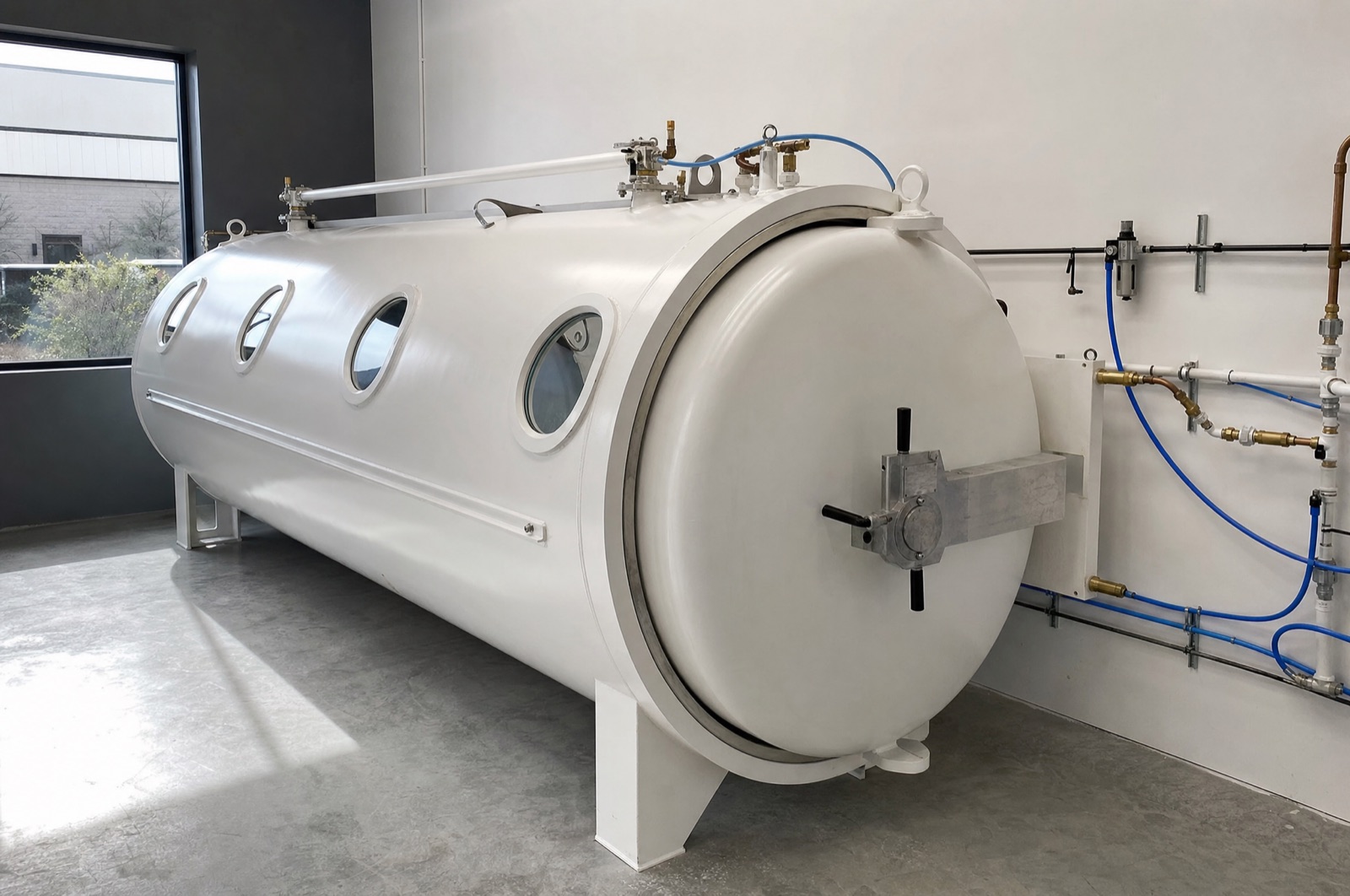
[ Clinic install ] Reference imagery; final photography in production
In the United Arab Emirates, hyperbaric oxygen therapy is treated as a medical service that only a licensed health facility may offer. Dubai and Abu Dhabi each have a written standard for it. Both ban inflatable chambers in health facilities, keep chambers out of malls and industrial areas, require chambers approved by two foreign regulators, and set staffing and fire rules. This page sets out what those standards say, plus the federal rules on device registration and health advertising. It uses the regulators' own PDFs, read on 29 October 2026. We do not say whether any treatment works.
Who regulates what
Health care in the UAE has more than one regulator. Dubai's social media advertising standard defines the authorities by area: the Ministry of Health and Prevention (MOHAP), the Department of Health Abu Dhabi (DOH), the Dubai Healthcare City Regulatory Authority and the Dubai Health Authority (DHA). Facility licensing is local. A clinic in Dubai answers to DHA; a clinic in Abu Dhabi answers to DOH.
Medical products are federal. Federal Decree-Law No. 38 of 2024 replaced Federal Law No. 8 of 2019, took effect on 2 January 2025 and covers medical devices, per a Simmons & Simmons summary. It names the Emirates Drug Establishment (EDE) as the regulator that takes over from MOHAP. The two emirate standards we read were written before that law, so they name MOHAP or the Ministry of Health.
Dubai: the DHA standard
The DHA publishes the Standards for Hyperbaric Oxygen Therapy (HBOT) Services, code DHA/HRS/HPSD/ST-17. The copy we read is version 2.1, issued and effective on 28 April 2022, with a revision date of 28 April 2027. It runs to 57 pages. Its scope is HBOT services in DHA licensed health facilities. It applies to the facilities and to the licensed professionals in them.
The standard sorts chambers by occupancy. Class A is a multiplace chamber for more than one person. Class B is a monoplace chamber for one person. Class C is for animals. It defines HBOT as a treatment in which the patient breathes oxygen in a chamber at higher than local atmospheric pressure.
The licensing steps in Standard One:
- A licensed facility that wants to add HBOT must inform the Health Regulation Sector and apply for permission (5.3).
- It must employ a consultant or specialist physician in undersea hyperbaric oxygen medicine (5.3.1).
- It must keep 14 written policies, signed off by all staff, from an emergency action plan to staffing (5.4).
- It must show contracts for a nearby hospital if it is not in one, lab services, equipment maintenance with the maker or an authorised dealer, housekeeping, laundry and medical waste (5.5).
- Moving a chamber needs DHA approval (5.9).
DHA checks these points with written checklists. Its final inspection checklist (issue 1, 14 November 2022) and random inspection checklist (issue 2, 12 December 2023) turn the standard's clauses into yes or no items. The final checklist includes the mall rule and the ban on inflatable chambers.
Dubai: rooms, chambers and gas
Standard Two sets out where a chamber may go. An HBOT facility shall not be in a mall or an industrial area (6.1). Multiplace chambers may be used only in DHA licensed hospitals and standalone specialised HBOT centres, on the ground floor (6.2). Monoplace chambers may be used in approved DHA licensed health facilities (6.3). The service area must include a reception, consultation room, holding area, changing area, treatment room, gas storage room and compressor room, among others (6.7).
The treatment room must conform to NFPA 99, Chapter 14, and to Dubai Civil Defence requirements (6.8.1). Its floor must be antistatic, fireproof and joint free, with no carpet or wood. It needs sprinklers, a smoke evacuator and no smoking signs. A metal detector at the door is preferred. For more on the US fire code it cites, see our NFPA 99 guide.
For a monoplace room, the numbers are specific:
- At least 18 square meters for one monoplace chamber and a patient transfer gurney (6.10.4).
- Exit doorways at least 1 meter wide, and 0.9 meters of clear space around any exit path (6.10.3, 6.10.5).
- An oxygen shut off valve for each chamber that the operator can reach (6.10.9).
- Power outlets within 3 meters of the chamber entrance mounted at least 0.9 meters above the floor (6.10.10).
- No direct sunlight on the chamber, and screens between chambers for privacy (6.10.13, 6.10.14).
The chamber itself must have audible and visual alarms, an external breathing air source for emergency exit, a quick release door and a dedicated vent line for oxygen. Its acrylic windows need certification such as an ASME stamp with PVHO-1 or an equivalent (6.11.10). The hull must be grounded, with resistance to ground of no more than 1 ohm, and not through a wall outlet (6.11.17). Our ASME PVHO-1 page explains that standard.
The gas store must hold at least six medical oxygen tanks and at least one 400 liter liquid oxygen tank with a vaporizer (6.12.2, 6.12.3). It needs explosion proof fittings, outside exhaust, an alarmed automatic manifold and a vented door. The facility keeps installation, assessment, operation, cleaning and maintenance checklists and a log of chamber use (6.14).
Dubai: staff and supervision
Only a DHA licensed consultant or specialist physician in undersea hyperbaric oxygen medicine can provide the service (7.1). That physician must be on the premises and immediately available at all times when the chamber is occupied (7.3.14). The other roles are the chamber operator, inside and outside attendants for multiplace chambers, a registered nurse, a safety officer, a patient coordinator and a fire marshal.
| DHA rule | What it says | Clause |
|---|---|---|
| Chamber operator training | A registered nurse with recognised training, or a professional with at least 40 hours of face to face certified training and 6 months as a hyperbaric technician | 7.4.1 |
| Operators for monoplace chambers | 1 operator for every 2 monoplace chambers during working hours | 7.4.4 |
| Operators for multiplace chambers | 2 operators for every multiplace chamber during working hours | 7.4.7 |
| Second person | At least one more staff member, preferably the physician, present during treatment | 7.4.5 |
| Inside attendants | 8 stable patients per attendant; 4 for complicated patients; 1 for critical care | 7.5.1 |
| Nurse to physician | 1 to 1 | 7.7.1 |
| Safety officer | Formal training from NEBOSH or OSHA | 7.8.2 |
| Fire marshal | At least 1 on the premises in working hours; drills 2 to 3 times a year | 7.9.2, 7.9.5 |
| Life support | All professionals trained in HBOT, with BLS and ACLS | 7.10 |
Source: DHA Standards for Hyperbaric Oxygen Therapy (HBOT) Services, version 2.1, linked above. Wording shortened.
Before treatment, the physician assesses each patient, and every patient, or a guardian, signs an informed consent form in Arabic, English or another language (8.5). A new form is needed for a new condition (8.6). Staff run a Safety Time Out and Pause before every session, signed by two staff members. The patient showers to remove makeup and lotions and wears pocketless cotton scrubs from the facility (9.1). Critically ill or unstable patients are treated only in a hospital (8.1). Appendix 1 lists 19 indications. For how other countries handle staffing, see hyperbaric clinic staffing and certification.
Abu Dhabi: the DOH standard
The Department of Health Abu Dhabi publishes the DoH Standard for Hyperbaric Oxygen Therapy, reference DOH/SD/HLME/0.9. The copy we read is version 0.9, approved in April 2019 and effective on 16 April 2019. It applies to DOH licensed providers in the Emirate of Abu Dhabi, to facilities seeking a licence for HBOT, to the professionals involved, and to payers and third party administrators. Its stated aim is safe operation of medically required HBOT.
Its definition is more precise than Dubai's. HBOT is breathing 100% oxygen, or oxygen and other gas mixtures, inside a chamber pressurized above atmospheric pressure, 1.4 atm abs or higher (3.1). A monoplace chamber is pressurized with 100% oxygen. A multiplace chamber is pressurized with air while patients breathe 100% oxygen through masks, hoods or tubes (3.3, 3.4).
The main facility rules:
- DOH approves multiplace and monoplace chambers. Inflatable chambers shall not be used in any health facility (5.1, 5.2).
- A qualified service representative installs and assesses each chamber, with records kept (5.3).
- HBOT may run in hospitals and in centres, including medical centres and day care surgery centres, licensed for HBOT or for two of six listed specialties (6.1.2.1).
- DOH approval is needed to move a chamber or stop the service (6.1.3).
- No HBOT in active areas such as malls or industrial areas (6.4.2). Multiplace chambers go on the ground floor (6.4.6).
- Separate male and female reception and changing areas (6.4.8).
- Room design follows NFPA, ASME, the Compressed Gas Association and the UHMS committee report (6.4.1).
Abu Dhabi: staff, access and insurance
Each facility names a director or chair of HBOT services and staffs HBOT physicians, chamber operators and registered nurses as chamber attendants (6.2.1). At least two people must be outside the chamber, inside the facility, whenever a patient is under pressure (6.2.5). Each multiplace chamber needs two chamber operators, or one operator and one supervisor. Each two monoplace chambers need one operator (6.2.7, 6.2.8). Staff have a yearly fitness check at a third party facility (6.2.4).
Appendix B sets training. A physician is first privileged after a 40 hour course approved by a recognised international body and two months, at least 240 hours, of practical training. The physician stays in the facility for a patient's first session and is present whenever the chamber is occupied. A chamber operator must be licensed as a registered nurse, respiratory therapist or podiatrist and complete a 40 hour course. A nurse attendant spends no more than 90 minutes of treatment time a day in the chamber, with at least 12 hours between sessions.
Access is tied to a list. Patients need a referral from a physician or dentist (7.3). Appendix A lists 14 accepted indications, and a facility needs DOH approval to treat any other condition (7.2). Section 9 tells payers and third party administrators to complete insurance authorisation for covered services within no more than 4 weeks. Section 10 says DOH may impose sanctions for breaches under its Healthcare Regulator Manual.
Fire rules in both emirates
Dubai's Standard Eight opens with the reason: ignition is more likely in a hyperbaric setting, and burning is faster with a raised share or raised partial pressure of oxygen. It requires a strictly enforced contraband policy, 100% cotton clothing and linen, a fire plan that includes alerting Dubai Civil Defence, fire equipment kept to Civil Defence requirements, and drills at least twice a year. Alcohol based hand sanitizer is flagged as a risk with oxygen and to chamber acrylics (13.1.12). Appendix 3 is a poster listing 20 prohibited items, from aerosols and lighters to newspaper and non-diving watches.
Abu Dhabi's section 6.5 is close to Dubai's. It names Abu Dhabi Civil Defense, NFPA 99 and a fire alarm at the control panel. It also lists specifics Dubai does not: humidity above 40%, a ban on mercury and on magnesium, beryllium or cadmium alloys, no alcohol cleaners, and a fire safety checklist shared with the patient before each pressurization. For what goes wrong and why, see hyperbaric chamber safety.
Device approval and registration
Both standards use the same two step test for equipment. The chamber must be approved by at least two of a list of foreign authorities, and registered in the UAE.
- Dubai (11.1, 11.2): two of the FDA, Health Canada, CE, Australia's ARTG, Korea's MFDS, Taiwan's TFDA and Japan's MITI, and registration with MOHAP.
- Abu Dhabi (6.3.1, 6.3.2): two of the FDA, Health Canada, CE, ARTG and MITI, and registration with the Ministry of Health.
Dubai adds that inflatable, collapsible or portable chambers shall not be used in any health facility, because the standard says the FDA does not recognise them as medical devices for hyperbaric oxygen treatment and no supporting studies validate them (11.3). For what those foreign approvals mean, see FDA cleared vs FDA registered and CE marking for hyperbaric chambers. On the soft chambers this rule shuts out, see portable hyperbaric chambers.
Advertising health services
Dubai's Standards for Medical Advertisement Content on Social Media (code DHA/HRS/HPSD/ST-21, version 1.1, effective 3 October 2022) apply to all DHA licensed facilities and professionals. The official facility account must show its medical advertisement licence number from MOHAP (5.2). The medical director approves posts that name the facility (5.3). All advertising must be substantiated, above all on outcomes, and include the risks (6.6). Section 6.11 bans words such as unique, the best, safest, magic, miraculous, has no side effects, 100%, and immediate results. Section 6.8 says facilities should avoid promoting products not supported by clinical evidence.
In Abu Dhabi, DOH circular 26 of 2023 (23 February 2023) told every licensed facility to send two staff to training on its Healthcare Guidelines for Health Media and Advertising. After training, facilities can log their advertising material on DOH systems and publish it under the guidelines.
At federal level, the CMS expert guide (updated 8 May 2024) names Cabinet Resolution No. 7 of 2007 on health advertisements and Ministerial Resolution No. 430 of 2007 as the main rules. It says advertisements must be approved by MOHAP before publication, and that the words safe or effective may not be used without restriction. It was written before the 2024 medical products law took effect.
Dubai and Abu Dhabi side by side
| Question | Dubai (DHA) | Abu Dhabi (DOH) |
|---|---|---|
| Document | DHA/HRS/HPSD/ST-17, version 2.1, effective 28 April 2022 | DOH/SD/HLME/0.9, version 0.9, effective 16 April 2019 |
| Pressure in the definition | Higher than local atmospheric pressure | 1.4 atm abs or higher |
| Inflatable chambers in health facilities | Not allowed, nor collapsible or portable | Not allowed |
| Malls and industrial areas | Not allowed | Not allowed |
| Multiplace chambers | Hospitals and standalone HBOT centres only, ground floor | Ground floor |
| Equipment approval | 2 of 7 listed authorities, plus MOHAP registration | 2 of 5 listed authorities, plus Ministry registration |
| Physician | Consultant or specialist in undersea hyperbaric oxygen medicine, on premises when occupied | Licensed physician with 40 hour course and 240 hours of practice, present when occupied |
| Operators | 1 per 2 monoplace; 2 per multiplace | 1 per 2 monoplace; 2 per multiplace, or 1 plus a supervisor |
| Indications list | 19 items, Appendix 1 | 14 items, Appendix A; others need DOH approval |
| Fire code named | NFPA 99 and Dubai Civil Defence | NFPA 99 and Abu Dhabi Civil Defense |
Sources: DHA HBOT standard version 2.1 and DOH Abu Dhabi HBOT standard version 0.9, both linked above and read 29 October 2026.
What this means for a wellness centre
Both standards are written for licensed health facilities. Neither text we read sets rules for a chamber run outside one, such as in a spa or gym, and we found no DHA or DOH document that does. Inside a licensed facility, the two standards leave little room for a wellness setup: no inflatable chambers, no mall sites, foreign approval plus UAE registration, and a hyperbaric physician present while the chamber is in use. Abu Dhabi's 1.4 atm abs line sits above the 1.3 ATA listed in the FDA fabric chamber clearance covered in our mild vs medical hyperbaric guide. We found no DOH text on what applies below that line.
For the same question elsewhere, see chamber rules in Australia, Canada and the UK, Germany and France and Japan. For the chambers we track and what we can verify about each, see the scorecard.
What we have not verified
Search results point to a DHA circular dated 29 January 2026 that announces version 2.2 of the HBOT standard. The circular page returned an error when we fetched it, and we did not find the version 2.2 PDF, so the Dubai figures above are from version 2.1. We do not know what changed. We found no newer DOH standard than version 0.9, but we did not confirm that none exists. The MOHAP and EDE websites did not load for us, so we could not read their current device registration or advertising licence pages, fees or forms; the transfer of device work to the EDE comes from a law firm summary. We could not open the official text of Federal Decree-Law No. 38 of 2024. We did not find Dubai Civil Defence or Abu Dhabi Civil Defense rules written for hyperbaric rooms, nor any rule from the Dubai Healthcare City Regulatory Authority or the northern emirates. We found no enforcement case naming a hyperbaric provider in the UAE.
Frequently asked
Can a spa or wellness centre in Dubai offer hyperbaric oxygen therapy?
The DHA standard applies to HBOT services in DHA licensed health facilities. It says a facility adding HBOT must apply to the Health Regulation Sector, employ a consultant or specialist physician in undersea hyperbaric oxygen medicine, and stay out of malls and industrial areas. It also says inflatable, collapsible or portable chambers shall not be used in any health facility. We found no DHA text on chambers used outside licensed health facilities.
Are inflatable or soft hyperbaric chambers allowed in UAE clinics?
No, by both emirate standards we read. The DHA standard, section 11.3, says inflatable, collapsible or portable chambers shall not be used in any health facility. The DOH Abu Dhabi standard, section 5.2, says inflatable chambers shall not be used in any health facility as they are not recognised medical devices for hyperbaric oxygen treatment.
What approvals does a hyperbaric chamber need in the UAE?
Both emirate standards ask for approval by at least two listed foreign regulators. Dubai lists the FDA, Health Canada, CE, the Australian ARTG, Korea's MFDS, Taiwan's TFDA and Japan's MITI. Abu Dhabi lists five of those. Both also require UAE registration: Dubai names the Ministry of Health and Prevention, MOHAP. A federal law in force since 2 January 2025 moved product regulation to the Emirates Drug Establishment.
What pressure counts as hyperbaric oxygen therapy in Abu Dhabi?
The DOH Abu Dhabi standard defines HBOT as breathing 100% oxygen, or oxygen and other gas mixtures, inside a chamber pressurized above atmospheric pressure, at 1.4 atm abs or higher. The Dubai standard defines HBOT as breathing oxygen at higher than local atmospheric pressure and gives no number.
Do hyperbaric clinics in Dubai need approval to advertise?
Dubai's standard for medical advertisement content on social media applies to all DHA licensed facilities and professionals. It says a facility's official account must state its medical advertisement licence number from MOHAP, that claims must be substantiated and include risks, and it bans words such as safest, 100%, has no side effects and immediate results.

Alex tests the machines himself, in clinics and studios on three continents. Every score comes from the same 27 public criteria, and no manufacturer has a say in them.
Six questions, and we'll match chamber, options, and install to your space and budget.