Hyperbaric vs Hypobaric (Altitude) Chamber: The Opposite Machines
Researched and scored by Alex Evans. Last reviewed August 2026. Corrections are dated and public. See corrections
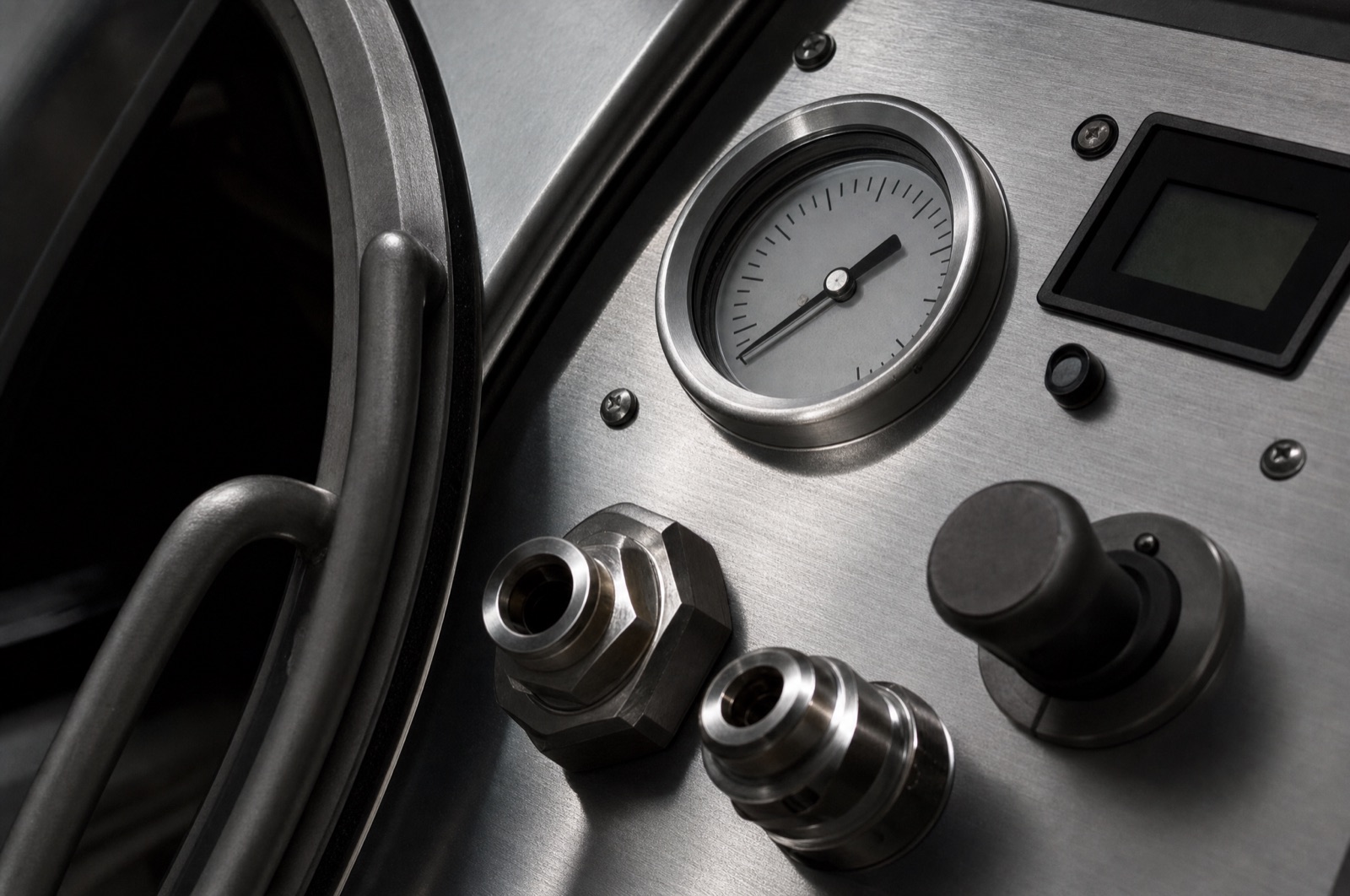
[ Hyperbaric chamber gauge ] Reference imagery; final photography in production
The names differ by two letters and the machines do opposite things. A hyperbaric chamber adds pressure. A hypobaric chamber takes it away. A third group of products, the altitude tents, generators and masks sold to athletes, changes the air you breathe without changing the pressure at all. This page sets out what each one is, the pressure numbers, how each is regulated and who runs it. It makes no claim that any of these machines does anything for health or performance, and it does not compare brands.
Two machines, opposite directions
The federal rule for the hyperbaric chamber, 21 CFR 868.5470, identifies it as a device intended to increase the environmental oxygen pressure by means of pressurization greater than atmospheric pressure. The FDA's August 25, 2025 letter to health care providers describes hyperbaric oxygen therapy as breathing 100% oxygen in a special chamber where the air pressure is raised above normal. A hypobaric chamber runs the other way. It lowers the pressure below sea level to copy the air at altitude.
Our earlier guide to decompression vs hyperbaric chambers gave the altitude chamber a short note. This page goes further: how the chamber works, how aviation training has changed, and the low oxygen products that borrow the word altitude.
What a hypobaric chamber is
The clearest description we found is in a December 2010 FAA report, Physiological Equivalence of Normobaric and Hypobaric Exposures of Humans to 25,000 Feet (DOT/FAA/AM-10/20). It describes the Civil Aerospace Medical Institute, or CAMI, altitude training chamber as a computer controlled, man-rated, low pressure (hypobaric) chamber. It normally holds 20 students and two inside safety observers. A vacuum pump removes air from the chamber, and as the pressure drops it matches the pressure of a chosen altitude under the U.S. 1976 Standard Atmosphere.
The air inside keeps its normal mix. The FAA's hypoxia brochure says the percentage of oxygen at 18,000 feet is the same as at sea level, a little over 20%, but that sea level pressure is twice the pressure at 18,000 feet, so each breath holds half the oxygen. That is the condition the chamber copies: the same air, spread thinner.
How the FAA has used the altitude chamber
The 2010 report says the FAA began altitude training for civilian pilots and crew in 1962, and calls hypobaric chamber training the traditional method of demonstrating hypoxia to aviators. It sets out the standard chamber flight profile used in the FAA course:
- A 30 minute denitrogenation period, breathing 100% oxygen through an aviator's mask.
- A climb at 3,000 feet per minute.
- A hypoxia demonstration at flight level 250, about 25,000 feet.
- A rapid decompression from 8,000 to 18,000 feet, and a visual acuity demonstration.
The FAA advisory circular AC 61-107B, dated March 2013, described the same course: a one day class with rapid decompression from 8,000 to 18,000 feet and hypoxia at 25,000 feet in a hypobaric chamber. It said trainees had to be at least 18, hold a current FAA medical certificate, and have no cold or other significant health problem. Non-pilots could attend, but needed at least a Class III medical certificate for the chamber.
The course has since changed. The FAA's current aerospace physiology training page, last updated May 21, 2024, describes a half day course in Oklahoma City with a hypoxia demonstration at the physiological equivalent of 25,000 feet in a normobaric chamber, and lists hypoxia familiarization in the Permanent Reduced Oxygen Training Enclosure. It says the course does not yield a high altitude endorsement, though a flight instructor can accept it toward that qualification.
Military altitude training
The 2010 FAA report says the U.S. Navy and Air Force physiological training programs had recently added ground level hypoxia training. The Navy then went further. A December 2019 article by NAS Jacksonville Public Affairs, reprinted by DC Military, reported that Aviation Survival Training Center Jacksonville had started training with a Normobaric Hypoxia Trainer. The article said the trainer replaced the low pressure chamber decommissioned in February 2017, and that it simulates the reduced oxygen levels of a depressurized aircraft at altitude.
The same article said the Navy runs eight Aviation Survival Training Centers, that aircrew take a refresher every four years, and that the other seven centers were scheduled to have the trainer running by summer 2020. We have not confirmed that they did.
As of 2022 the Air Force still ran altitude chambers. A June 2022 KSAT report from San Antonio described a new altitude chamber at the Air Force Career Enlisted Aviator Center of Excellence that holds up to 18 people and is one of 10 nationwide. That is a local news report. Our requests to af.mil and navy.mil pages were blocked, so we could not check either service's current figures at the source.
The move to low oxygen at ground level
There are two ways to copy the oxygen pressure at altitude. One lowers the total pressure, as the chamber does. The other keeps room pressure and lowers the share of oxygen, which the 2010 FAA report calls normobaric. The report says newer devices make hypoxic air at ground level by altering the fraction of oxygen, avoiding some of the risk factors of altitude chamber training. The enclosure it tested adjusted the mix of nitrogen-rich air inside to reach the target. Students walked in, sat down and removed their oxygen masks.
The two are not identical. The FAA team gave 20 subjects five minutes at a simulated 25,000 feet in each, at the same oxygen partial pressure of 58.9 mm Hg. Mean blood oxygen saturation at four minutes was 62.3% in the hypobaric chamber and 69.5% in the normobaric enclosure, and the number of hypoxia symptoms differed at one minute but not at three and four. For scale, AC 61-107B puts the oxygen partial pressure at sea level at about 152 mm Hg.
Altitude tents and hypoxic generators
The altitude products sold to athletes are normobaric. A 2005 research communication in High Altitude Medicine & Biology by Pedlar and colleagues, indexed by the German sports science database SPOLIT, said technology to deliver normobaric hypoxic gas by nitrogen dilution was widely available. The units it tested were designed to deliver 100 liters a minute of gas at 14.5% oxygen, and their measured output fell on average 30.4% short of that figure.
A 2024 technical note in Sports Engineering by Willmott and colleagues, held in the University of Essex repository, said altitude generators reduce the oxygen in air through a filtration mechanism, for use with masks or with tents for rest and sleep. It listed one maker's settings as 17.9% oxygen for about 1,200 meters up to 13.7% for about 3,400 meters, and noted a claim of 9.6%, about 6,000 meters, that had not been studied. It found the units it tested consistent, with small gaps from the maker's reference values at two settings.
Wikipedia's altitude tent article, a weaker source, says most tents are normobaric, can drop to as little as 12% oxygen, and that most athletes use settings between 8,000 and 15,000 feet. Several of those statements carry citation needed tags.
IHHT, and the EWOT vs IHHT search
IHHT stands for intermittent hypoxic-hyperoxic training. A 2022 systematic review in Sports Medicine Open by Behrendt and colleagues, on PubMed Central, describes the setup. Low oxygen and high oxygen periods alternate. Done at rest it is called IHHE, for exposure; done during exercise it is IHHT. In the studies it reviewed, the gas was given through face masks connected to hypoxia generators, all at normal pressure.
- Low oxygen phases: an oxygen fraction of 0.10 to 0.12, lasting 2 to 7 minutes.
- High oxygen phases: 0.30 to 0.40, lasting 1 to 6 minutes.
- Five studies reported 4 to 8 cycles a session; four reported sessions of about 35 to 50 minutes.
EWOT, exercise with oxygen therapy, uses only the high oxygen half. A 2019 review of hyperoxic training by Zinner and Sperlich in the German Journal of Sports Medicine reported oxygen fractions of 0.60 to 1.00 in the studies it covered. Our HBOT vs EWOT guide covers the EWOT kit. Neither EWOT nor IHHT is a hypobaric or hyperbaric machine. Both are masks at room pressure.
The pressure numbers side by side
Pressure in this field is written in atmospheres absolute, or ATA, where sea level is 1 ATA. Our pressure guide explains the unit. Every cell below comes from a source linked on this page.
| Machine | Pressure | Oxygen in the gas |
|---|---|---|
| Hospital hyperbaric chamber | Two to three times normal air pressure (Cleveland Clinic); UHMS indications need at least 2 ATA | 100% oxygen (FDA, Cleveland Clinic) |
| Soft fabric chamber | Below 1.4 ATA (UHMS) | Air only; not designed for supplemental oxygen (UHMS) |
| Hypobaric chamber, 18,000 feet | Half of sea level pressure (FAA) | Same percentage as sea level (FAA) |
| Hypobaric chamber, 25,000 feet | Oxygen partial pressure 58.9 mm Hg, against about 152 mm Hg at sea level (FAA) | Normal air, pressure lowered by vacuum pump (FAA) |
| Altitude tent or generator | Room pressure (Pedlar 2005, Willmott 2024) | 13.7% to 17.9% on the settings tested in 2024; 14.5% design figure in 2005 |
| IHHT mask | Room pressure (Behrendt 2022) | 10% to 12%, alternating with 30% to 40% |
Sources: Cleveland Clinic; FDA letter, August 25, 2025; UHMS position statement on low pressure fabric chambers, revised 2018; FAA hypoxia brochure, 2024; FAA report DOT/FAA/AM-10/20, 2010; FAA AC 61-107B, 2013; Pedlar et al. 2005; Willmott et al. 2024; Behrendt et al. 2022.
The Cleveland Clinic figure and the UHMS position statement on low pressure fabric chambers set the hyperbaric range. The UHMS says soft chambers run below 1.4 ATA and are cleared by the FDA for acute mountain sickness only. Our guide to mild vs medical hyperbaric covers that split.
How each one is regulated
Hyperbaric chambers. The FDA letter says hyperbaric devices are Class II medical devices cleared through the 510(k) process, listed under product code CBF. The UHMS statement says chamber construction must meet ASME PVHO-1, and that NFPA 99 and the NFPA 101 Life Safety Code set the rules for hyperbaric facilities.
Hypobaric chambers. The same pressure vessel standard reaches them. The FDA's recognized standards entry for PVHO-1-2023 lists high altitude chambers alongside hyperbaric and decompression chambers as pressure vessels for human occupancy. On the aviation side, AC 61-107B says 14 CFR 61.31(g) requires high altitude training, and that parts 121 and 135 require physiology training for crews above 25,000 feet, but that none of the regulations include altitude chamber training.
Tents, generators and IHHT kits. We found no FDA classification for them. A search of the FDA device classification data through openFDA on 28 October 2026 for the terms hypoxic, altitude and hypobaric returned no matches. That does not prove no rule applies; it means we found none by name. The 2024 Willmott note said regulations are necessary as these generators grow in popularity. In sport, the Canadian Centre for Ethics in Sport said in October 2006 that the World Anti-Doping Agency had decided hypoxic devices should not be added to the 2007 Prohibited List.
Who runs each one
Hyperbaric chambers in hospitals run with clinical staff. Cleveland Clinic says a healthcare provider is in the room throughout, and that treatment should come from an experienced provider in an accredited medical facility.
Hypobaric chambers are run by aviation training bodies: the FAA at CAMI in Oklahoma City, and military physiology units. The 2010 FAA report describes two inside safety observers on each chamber flight and one inside observer in the normobaric enclosure.
Tents and generators are mostly run by their owners. The 2024 Willmott note said elite athletes are likely to be supervised during this training and amateur athletes are not. The authors recommended supervision for all users, an accurate room oxygen sensor, and continuous pulse oximetry with an alarm, and named hypercapnia, a build up of carbon dioxide, while sleeping in tents as one danger to rule out. The 2005 Pedlar paper also raised the question of clearing carbon dioxide from enclosed tents.
Where the two machines meet
The two machines connect through one hazard. AC 61-107B says most cases of altitude decompression sickness occur at 25,000 feet or higher, and cites a U.S. Air Force study in which only 13 percent of cases occurred below that height. It tells pilots to allow at least 24 hours between scuba diving or hypobaric chamber exposure and flying.
It then points to the other machine. It tells pilots to learn where hyperbaric chambers are in their area, and warns that not every hyperbaric facility has staff qualified to handle an altitude decompression emergency. The 2010 FAA report adds that the team ran the hypobaric exposure first each day because moving from a high nitrogen environment into a hypobaric one could raise the risk of decompression sickness.
If you are comparing hyperbaric chambers to own, our hyperbaric chamber scorecard covers the models we track on the points we can verify. We do not review altitude tents, generators or IHHT kits.
What we have not verified
The af.mil and navy.mil pages we tried returned access errors, so the Air Force figures come from a local news report and the Navy figures from a reprinted Navy article. We could not open the 2005 Pedlar paper in full and relied on its indexed summary. FAA sources disagree on course length: the 2024 brochure says one day with an altitude chamber, and the 2024 course page says half a day with a normobaric chamber. We did not convert altitudes into ATA ourselves, and we did not survey other countries' rules on tents or generators, or check WADA lists after 2007. If you hold a source that settles any of these points, send it and we will check it.
Frequently asked
Is a hypobaric chamber the opposite of a hyperbaric chamber?
Yes, in the direction of pressure. A hyperbaric chamber is defined in 21 CFR 868.5470 by pressurization greater than atmospheric pressure. The FAA describes its training chamber as a low pressure, or hypobaric, chamber that uses a vacuum pump to remove air until the pressure matches a chosen altitude.
Is an altitude tent a hypobaric chamber?
Not in the sources we read. The tents and generators studied in the research we cite work at normal room pressure and lower the share of oxygen in the air, which researchers call normobaric hypoxia. A hypobaric chamber lowers the pressure itself. A 2010 FAA report compared the two at a simulated 25,000 feet and found measurable differences between them.
What is the difference between EWOT and IHHT?
Both are mask setups at room pressure. EWOT means breathing oxygen-enriched gas during exercise; a 2019 review of hyperoxic training reported oxygen fractions of 0.60 to 1.00 in the studies it covered. IHHT alternates low oxygen and high oxygen gas through a face mask connected to a hypoxia generator; a 2022 systematic review reported 0.10 to 0.12 for the low phases and 0.30 to 0.40 for the high phases. Neither one changes the pressure around the body.
Can anyone take the FAA altitude chamber course?
The FAA advisory circular on high altitude operations, AC 61-107B from 2013, said anyone could attend whether or not they were a pilot, but that trainees needed at least a Class III medical certificate to take part in the altitude chamber training, and had to be 18 or older. The current FAA course page describes a hypoxia demonstration in a normobaric chamber rather than the hypobaric one.
Are altitude tents banned in sport?
Not as of the decision we could source. The Canadian Centre for Ethics in Sport said in October 2006 that the World Anti-Doping Agency had decided hypoxic devices, also called oxygen or altitude tents, should not be added to the 2007 Prohibited List. We have not checked every later WADA list.
Does this page recommend a chamber, tent or generator?
No. It describes what each machine is and who regulates it, and makes no claim about what any of them does for health or performance. For hyperbaric chambers sold for home use, our scorecard covers the models we track on points we can verify.

Alex tests the machines himself, in clinics and studios on three continents. Every score comes from the same 27 public criteria, and no manufacturer has a say in them.
Six questions, and we'll match chamber, options, and install to your space and budget.