Hyperbaric Chamber Rules in Japan: Medical Chambers and Oxygen Capsules
Researched and scored by Alex Evans. Last reviewed August 2026. Corrections are dated and public. See corrections
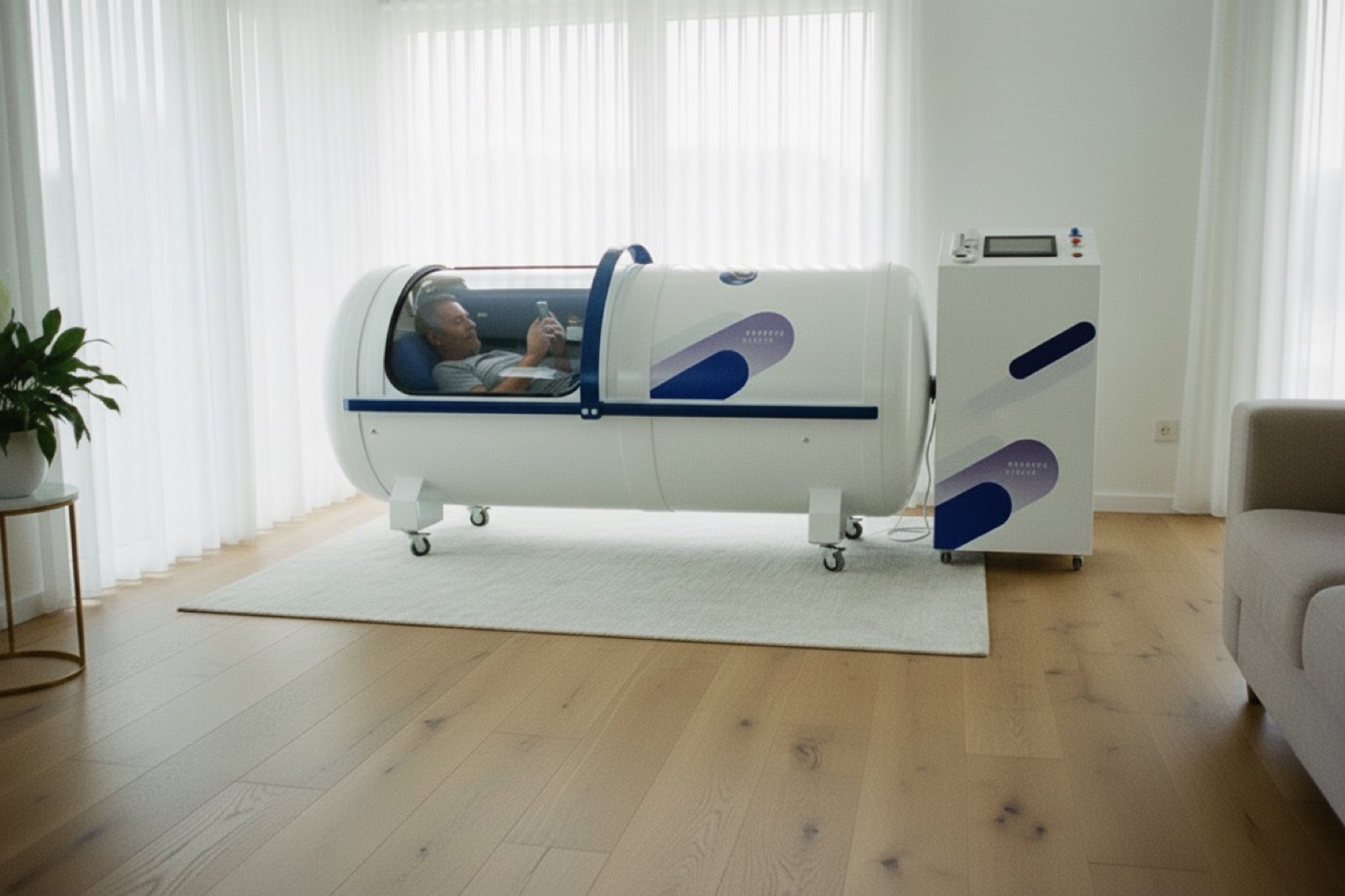
[ Wellness room ] Reference imagery; final photography in production
This page answers one question: what rules apply to a hyperbaric chamber in Japan, for the medical chambers in hospitals and for the oxygen capsules, 酸素カプセル, found in salons and gyms. It uses the Japanese device law on the government e-Gov law site, the PMDA list of device names, the 2026 medical fee schedule from the Ministry of Health, Labour and Welfare, and documents from Japan's hyperbaric medicine society and its predecessors. Almost all sources are in Japanese; the translations are ours. We do not say whether any treatment works.
Two tracks: medical chambers and oxygen capsules
Japan does not ban hyperbaric chambers. It runs two tracks that rarely meet. The first is the medical chamber: a regulated device, sold under a ministry approval, installed in a hospital that follows a detailed society safety standard and bills public insurance under a set fee code. The second is the oxygen capsule, which the Japanese specialist society calls a health care chamber, or HCC. These run on air at modest pressure, sit outside hospitals, and are not covered by the medical standard.
JACHOD, one of the two societies that later merged, said in 2023 that this second track has no official safety rules of its own, and published a proposal to fill the gap. The sections below take the medical track first, then the capsules, then the advertising rules that apply to both.
The medical chamber as a regulated device
Japan's device law is the Act on Securing Quality, Efficacy and Safety of Products Including Pharmaceuticals and Medical Devices, often shortened to the PMD Act or, in Japanese, 薬機法. The text on e-Gov (in Japanese) defines a medical device in article 2 by its purpose: a machine or tool meant for diagnosing, treating or preventing disease, or for affecting the structure or function of the body, and named by cabinet order. The same article defines a specified maintenance device as one whose upkeep and repair need expert knowledge, so that poor upkeep could seriously affect diagnosis or treatment.
The PMDA, Japan's device and drug agency, publishes a list of generic device names (in Japanese; the copy we read says it was checked at the end of September 2026). The medical chamber appears as 高圧酸素患者治療装置, a hyperbaric oxygen patient treatment device, code 12061000. The list gives it Class III, and marks it as both a specified maintenance device and a device that needs installation management. Its definition is a vessel in which air or gas pressure is higher than standard pressure, giving 2 to 3 ATM as an example, used for gas gangrene, decompression illness, anaerobic infections and other cases that call for high oxygen levels. The older name was a one person hyperbaric oxygen device, classed II or III.
The law sets who may sell such a device. Article 23-2 of the Act reserves the Type 1 marketing licence for highly controlled medical devices, and article 23-2-5 requires a ministry approval for each product, apart from listed exceptions. The society's safety standard, covered next, applies those two articles to chambers directly: only a holder of a Type 1 marketing licence may market one, each product needs ministerial approval, and an imported chamber goes through the foreign maker approval route.
The society and its safety standard
Japan now has one specialist society for hyperbaric medicine. Its president's welcome message (in Japanese) says that on 1 April 2024 the Japanese Society of Hyperbaric and Undersea Medicine (JSHUM) and the Japanese Association for Clinical Hyperbaric Oxygen and Diving Medicine (JACHOD) merged into the Japan Undersea and Hyperbaric Medical Society, JUHMS. Older documents carry one of the two earlier names.
The society publishes the safety standard for hyperbaric oxygen therapy (in Japanese, revised 4 June 2026) through its HBO Safety Association. Article 3 says anyone who makes, sells or installs a chamber, and anyone who treats with one, must follow it. Article 7 says chambers must be built with reference to JIS T 7321, the Japanese industrial standard for hyperbaric oxygen chambers. Article 10 bars makers from selling chambers that fail the approval rules, and says that bar does not apply to devices meant for non-clinical use.
The standard sorts chambers into two kinds under article 11. A Type 1 chamber holds one patient. A Type 2 chamber holds two or more patients, or staff with a patient, and must be pressurized with air while patients breathe oxygen; the standard says it must never be pressurized with oxygen for any reason. The other main duties are these:
- The room must be fire resistant under the Building Standards Act (article 12), with sprinkler heads at least every 2.3 meters horizontally and an indoor hydrant within 25 meters, with some exceptions by chamber type (article 14).
- A hospital that uses a chamber must employ a full time JUHMS specialist physician (article 18) and a full time specialist technician (article 20), and must join the HBO Safety Association (article 21).
- Pressure must rise and fall no faster than 0.078 MPa per minute; decompression may go faster only to evacuate or rescue someone after an accident (article 28).
- Staff check the chamber before each use and after the last use of the day (article 32), log every session and keep the log for 5 years (article 33), and inspect the gauges, safety valve and other parts at least once a year (article 34). A special inspection is due when the chamber reaches 10 years from manufacture.
- Before treatment, the doctor checks the patient's general, lung, heart and ear condition and takes written consent (article 35).
Fire: the reason the standard is strict
Article 36 of the standard lists what patients may not take inside: matches, lighters, tobacco, disposable hand warmers and other heating items, watches, radios, mobile phones and other electrical items, oils and greases, rubbing alcohol, benzine and other flammable items. Wool and synthetic fabrics are banned. Patients wear cotton or clothing with anti-static treatment. The article starts from one fact: oxygen strongly supports burning, so a tiny ignition source can set fire to anything combustible.
The society has issued two warnings about hand warmers in recent years. A notice of 22 February 2024 (in Japanese) reports that on 15 January 2024 a patient complained of heat during treatment; staff found a disposable warmer, decompressed quickly, and the patient had a burn where it was stuck. It did not ignite. A second notice of 30 April 2025 reports another warmer found three minutes into a session, after a metal detector check and a verbal check. That notice gives the history: Japan had five chamber fires between 1967 and 1996, four caused by warmers, and a 1996 chamber explosion in Yamanashi Prefecture killed three people. Both notices tell hospitals to follow articles 35 and 36.
What public insurance pays for
Japan's public insurance pays for hyperbaric oxygen through the national fee schedule. The Ministry of Health, Labour and Welfare posts the 2026 fee revision (in Japanese) with the medical fee table and its billing notice, dated 5 March 2026. The notice states that the cost of care is the total points times 10 yen. Code J027, hyperbaric oxygen therapy, is paid per day:
| J027 item | Points per day | Session limit per course |
|---|---|---|
| 1. Decompression illness or air embolism | 5,000, plus 500 for each extra 30 minutes past 5 hours, up to 3,000 extra | 7, when started within 1 month of onset |
| 2. Acute conditions such as carbon monoxide and other gas poisoning, severe soft tissue infection, acute peripheral vascular injury, cerebral infarction, severe hypoxic brain injury and bowel obstruction | 3,000 | 10 |
| 2. Conditions such as retinal artery occlusion, sudden hearing loss, cancer treated with radiation or anticancer drugs, ulcers with poor circulation, skin grafts, spinal nerve disease, osteomyelitis or radiation injury | 3,000 | 30, with up to 10 more for two of the listed conditions when justified on the claim |
Source: MHLW medical fee table and billing notice for the 2026 revision, linked above. The condition names are shortened from the notice; it lists more detail under each.
Two notes in the billing notice matter for the line between medical and other chambers. Note 5 says that when treatment at 2 atmospheres absolute or more lasts under 1 hour, it is billed per day as oxygen inhalation, code J024, not as J027. Note 6 says doctors should refer to the points of care issued by the relevant societies.
Oxygen capsules: what the society has said
The specialist societies have written about capsules for two decades. Minutes posted by JACHOD of a meeting on 11 December 2004 (in Japanese) record that the Japan International Hyperbaric Association told the society that two imported inflatable chamber products were pressurized with air, not oxygen. The association said buyers had to take two days of training, at least 8 hours, and that a safety standard was being drafted.
In an October 2005 statement (in Japanese), JACHOD's then head, Hiroshi Yagi, described the capsules as inflatable chambers of nylon fabric, run on ordinary 21% oxygen air at about 1.3 atmospheres. He wrote that at this level, with air and no physician, they reportedly do not conflict with the Medical Practitioners' Act or the pharmaceutical law of the time. His concern was the claim that the capsules raise oxygen in the body, and the chance that some operators were quietly adding oxygen, which would raise fire risk. He put the number in use in Japan at several hundred, all outside medical institutions, and said no reliable statistics existed.
The merged society keeps the topic open. The president's message says a working group on health care chambers was set up because these devices, with 1.3 atmosphere air pressurization, have recently become a problem. The HCC working group page (in Japanese) describes an HCC as a pressure device used for fatigue recovery and health maintenance that usually exposes the body to about 1.2 to 1.5 times atmospheric pressure, and says the society will study the safety of the devices and their users.
The 2023 proposal for health care chambers
The most detailed document is a JACHOD proposal of 26 December 2023 (in Japanese) on the safe use of health care chambers. It says the standard HCC session is air breathing at 1.3 atmospheres without oxygen, and that this is clearly distinct from hyperbaric oxygen therapy in how the device is used and in medical evidence. It says no maintenance conditions or user safety standards exist for HCCs, and that a fire or injury in one could damage trust in hospital treatment. The society says HCCs are outside its remit but should still be safe, so it set out its own recommendations.
The main points of the proposal:
- A one person HCC should have an inside volume of no more than 2.0 cubic meters, and the base case is a product certified or recommended by the Japan Health Atmospheric Pressure Association (日本健康気圧協会). The proposal notes that this association has set no clear safety standard.
- Working pressure should be 1.2 to 1.5 atmospheres, never above 1.5. Soft chambers use flame resistant flexible material; hard chambers are metal and fixed in place.
- Medical oxygen in an HCC needs a doctor's prescription. The proposal says giving it without the right qualification would breach the Medical Practitioners' Act and the PMD Act.
- Running an HCC needs no medical licence, but the proposal recommends an instructor trained through the association.
- Check before and after each day's use, log every session, inspect at least once a year and keep records for 5 years.
- No matches, lighters, tobacco including e-cigarettes, warmers, hot water bottles, watches, radios or lithium battery devices. No wool or synthetic clothing; cotton is recommended.
- Pressure changes no faster than 0.078 MPa per minute, with about 60 minutes as a guide for session length.
The proposal also explains the fire point in numbers. Oxygen stays at 21% inside, but its partial pressure rises with total pressure. At 1.3 atmospheres it reaches 207.5 mmHg, the same as air with 27.3% oxygen at sea level, and the proposal says this makes fire easier to start from any ignition source. It also lists ear and sinus barotrauma as possible at HCC pressures.
Advertising: what the law says about claims
Two articles of the PMD Act set the limits. Article 66 bars anyone, not only makers, from advertising, describing or spreading false or exaggerated statements about the name, efficacy, effects or performance of a medical device, whether stated outright or implied. It adds that wording which could be read as a doctor or other person vouching for the effects counts as the same breach. Article 68 bars anyone from advertising the name, efficacy, effects or performance of a medical device that has not yet received its approval or certification.
The link to oxygen capsules runs through the definition in article 2. A device counts as a medical device by its intended purpose: diagnosis, treatment or prevention of disease, or an effect on the body's structure or function. We found no ministry ruling on any specific capsule, so we cannot say where a given sales claim crosses that line. For the US version of the same question, see FDA cleared vs FDA registered; for Europe, see CE marking for hyperbaric chambers.
Medical chamber and oxygen capsule side by side
The table puts the sourced answers next to each other. For how pressure and setting differ in general, see mild vs medical hyperbaric.
| Question | Medical chamber | Oxygen capsule (HCC) |
|---|---|---|
| Banned? | No | No ban found |
| Device status | Class III on the PMDA list, code 12061000, specified maintenance and installation management | No ministry ruling found; the society calls it outside its remit |
| Who may sell it | Type 1 marketing licence holder, with ministerial approval per product | Not set out in any official text we found |
| Pressure | PMDA definition gives 2 to 3 ATM as an example | About 1.3 atmospheres of air; 2023 proposal caps it at 1.5 |
| Breathing gas | High concentration oxygen; Type 2 chambers pressurized with air only | Air; the 2023 proposal says medical oxygen needs a prescription |
| Safety rules | JUHMS safety standard, revised 4 June 2026 | No official standard; JACHOD proposal of 26 December 2023 |
| Staff | Full time JUHMS specialist physician and specialist technician | No licence needed; trained instructor recommended |
| Public insurance | J027: 5,000 or 3,000 points a day for listed conditions | No fee code |
Sources: PMD Act on e-Gov; PMDA list of generic device names; JUHMS safety standard, notices and working group page; JACHOD minutes, 2005 statement and 2023 proposal; MHLW 2026 fee table and billing notice. All linked above, read 28 October 2026.
For the same question in other countries, see hyperbaric chamber rules in Australia, Canada and the UK and chamber rules in Germany and France. For the chambers we track and what we can verify about each, see the scorecard.
What we have not verified
We found no warning, test report or case on oxygen capsules from the Consumer Affairs Agency (消費者庁) or the National Consumer Affairs Center; searches of both sites returned nothing on capsules. We found no enforcement action under the PMD Act or the premiums and representations law naming a capsule seller. We found no ministry or PMDA text saying whether a capsule is or is not a medical device. A 2021 report in the Hokkaido Medical Association bulletin, summarizing a society talk, said the ministry treats breathing 100% oxygen at 2.0 atmospheres or more as hyperbaric treatment that needs a doctor present; we did not find that statement in a ministry document, so we do not rely on it. We did not read JIS T 7321 itself or the Japan Health Atmospheric Pressure Association's draft standard, and we did not check whether the Medical Care Act adds maintenance plan duties for chambers. The fee figures above are from the 2026 revision; we did not compare them with earlier years.
Frequently asked
Are hyperbaric chambers legal in Japan?
Yes. We found no ban. A medical hyperbaric chamber is a medical device under the Act on Securing Quality, Efficacy and Safety of Products Including Pharmaceuticals and Medical Devices. The PMDA list of device names gives it as a Class III device with specified maintenance and installation duties. Non-medical oxygen capsules are also sold and used; a 2023 proposal from JACHOD, one of the two societies that merged into JUHMS, says no safety standard covers them.
Is an oxygen capsule the same as hyperbaric oxygen therapy in Japan?
No. A 2023 proposal from the Japanese Association for Clinical Hyperbaric Oxygen and Diving Medicine says the standard use of what it calls a health care chamber is breathing ordinary air at 1.3 atmospheres, without added oxygen, and that this is clearly distinct from hyperbaric oxygen therapy, which is medical treatment. The PMDA definition of the medical device gives 2 to 3 atmospheres as its example range.
Can an oxygen capsule salon give extra oxygen inside the capsule?
The society says no. Its 2023 proposal states that medical oxygen inhalation in a health care chamber needs a doctor's prescription, and that giving it without the right qualification would breach the Medical Practitioners' Act and the pharmaceutical and medical device law. The same proposal says operating the chamber itself needs no medical licence, though it recommends a trained instructor.
Does Japanese public insurance pay for hyperbaric oxygen?
Yes, for listed conditions. Fee code J027 in the 2026 medical fee schedule pays 5,000 points a day for decompression illness or air embolism, up to 7 sessions per course when started within a month of onset, and 3,000 points a day for other listed conditions, with caps of 10 or 30 sessions by condition. A session under 1 hour at 2 atmospheres absolute or more is billed as oxygen inhalation instead.
Who sets the safety rules for hospital hyperbaric chambers in Japan?
The main detailed rules come from the Japan Undersea and Hyperbaric Medical Society, JUHMS, formed in April 2024 when the two earlier Japanese hyperbaric societies merged. Its safety standard, last revised on 4 June 2026, covers device approval, building and fire protection, staffing, inspections, records and what patients may wear and carry. The fee schedule notice tells doctors to refer to the relevant society guidance.

Alex tests the machines himself, in clinics and studios on three continents. Every score comes from the same 27 public criteria, and no manufacturer has a say in them.
Six questions, and we'll match chamber, options, and install to your space and budget.