Hyperbaric Chamber vs Oxygen Bar: Two Different Ways to Breathe Oxygen
Researched and scored by Alex Evans. Last reviewed August 2026. Corrections are dated and public. See corrections
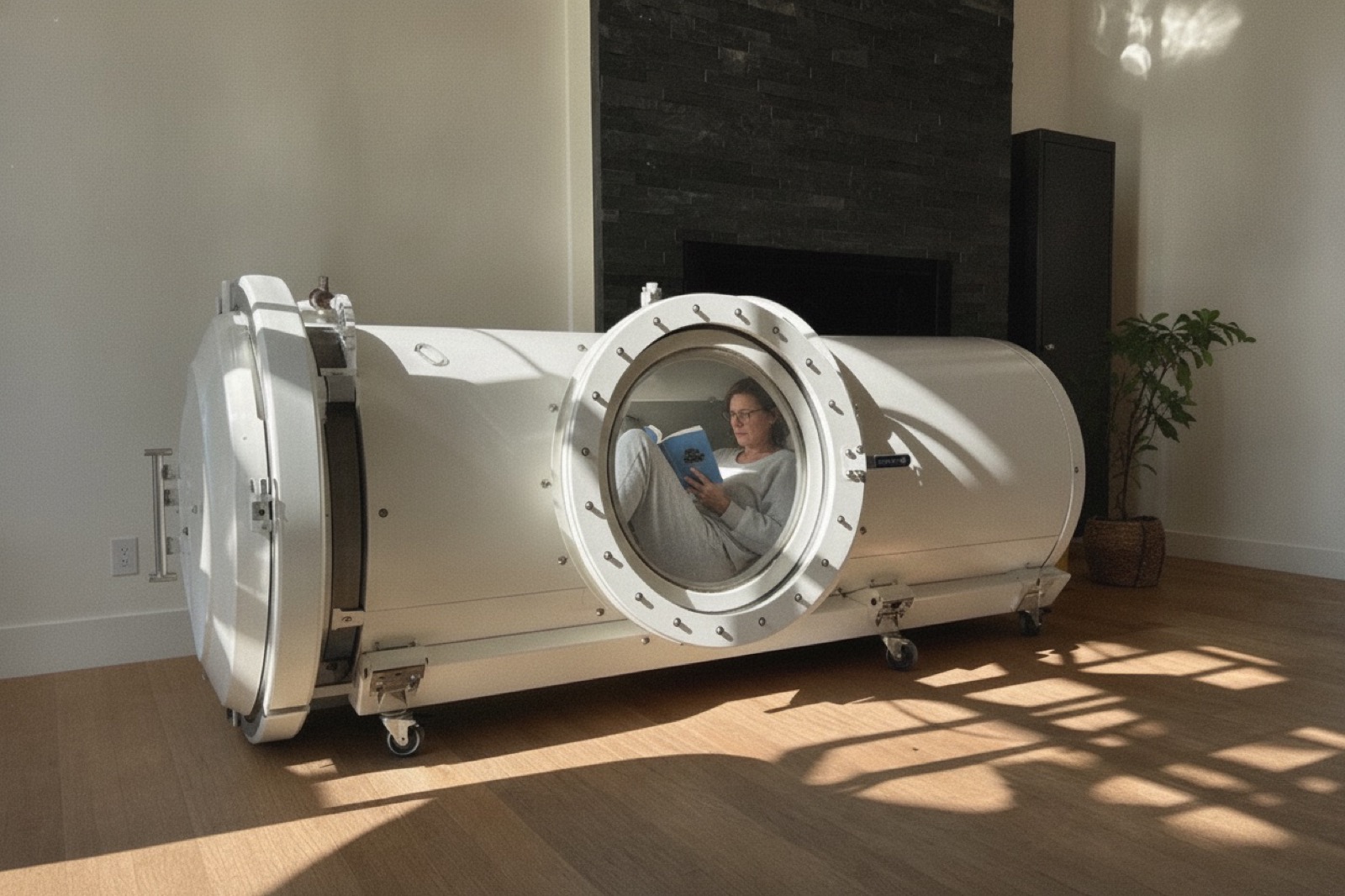
[ Hyperbaric session ] Reference imagery; final photography in production
Both get described as a way to breathe more oxygen, and both often appear on the same wellness menu. They are different things. One is a sealed vessel that raises the pressure around your body. The other is a tube under your nose in a normal room. This page sets out what each one is, how US regulators treat it, and which hazards public bodies have named. It makes no claim that either one does anything for your health, and it does not compare brands.
What a hyperbaric chamber is
A hyperbaric chamber is a pressure vessel. The federal rule, 21 CFR 868.5470, identifies it as a device intended to increase the environmental oxygen pressure by means of pressurization greater than atmospheric pressure. It places the device in Class II. The FDA's August 25, 2025 letter to health care providers describes hyperbaric oxygen therapy as breathing 100% oxygen in a special chamber.
Cleveland Clinic says the chamber is pressurized to two to three times higher than normal air pressure, and that sessions usually last one to two hours as an outpatient visit. A monoplace chamber treats one person. A multiplace chamber treats several people at once. Home chambers are a separate group that runs at lower pressure; our guide to mild vs medical hyperbaric explains the split.
What an oxygen bar is
An oxygen bar sells short sessions of oxygen-enriched air through a nasal tube. The FDA described them in a November 2002 FDA Consumer article, reprinted on Quackwatch. It said many bars use a concentrator that filters nitrogen and other gases out of room air and sends a continuous flow through a hose into the nose. The customer sits at a counter or in a chair. Nothing is sealed.
Scent is often part of the sale. The FDA Consumer article said flavored oxygen is made by bubbling oxygen through aromatic solutions and pumping the vapor into the nose. A 2003 HealthDay report listed flavors ranging from eucalyptus to raspberry to mint. A 2019 Healthline article, medically reviewed, said most scents are fruit flavors or essential oils, and described the tube as a cannula: a flexible tube that splits into two small prongs that rest inside the nostrils.
Pressure: the core difference
Pressure is what separates the two. Pressure in this field is often written in atmospheres absolute, or ATA, where normal air pressure at sea level is 1 ATA. Cleveland Clinic's figure of two to three times normal air pressure puts a hospital chamber at about 2 to 3 ATA. A 2013 HealthDay report on an FDA consumer warning described the chamber as one where atmospheric pressure is raised up to three times higher than normal.
An oxygen bar works at room pressure. None of the three oxygen bar sources we read describes raising the pressure around the customer. Our pressure guide covers what ATA means and how home chambers compare with hospital ones. A related normal-pressure method, oxygen breathed by mask during exercise, is covered in HBOT vs EWOT.
How much oxygen each one delivers
Room air is about 21 percent oxygen, as the HealthDay and Healthline articles both note. A hyperbaric oxygen session uses 100 percent oxygen, per the FDA letter and Cleveland Clinic. The figure at an oxygen bar is less clear, and the sources give different numbers.
- FDA Consumer, 2002: concentrators at bars deliver oxygen about 95 percent pure, but customers also breathe the room air around them, which lowers it. Adding aroma lowers it further. One bar supplier said customers get less than 50 percent pure oxygen.
- HealthDay, 2003: Dr. Ron Balkissoon, a pulmonologist at National Jewish Medical and Research Center in Denver, said a person will probably breathe 50 to 75 percent oxygen.
- Healthline, 2019: bar oxygen is often advertised as 95 percent, but this can vary greatly, partly because room air dilutes it at low flow rates.
So 95 percent is a figure for what leaves the machine. What reaches the lungs is lower, and none of these sources measured it.
Where the oxygen comes from
Oxygen bars mostly use concentrators. The 2002 FDA Consumer article said many bars run a concentrator, while others use aviator's breathing oxygen. It said aviator's oxygen, at least 99.0 percent pure, is meant for aircraft and should not be used on people for recreation or medicine. It also mentioned a canister that holds about 20 minutes of oxygen.
The FDA classes medical oxygen generators as devices. Under 21 CFR 868.5440, a portable oxygen generator is a device intended to release oxygen for respiratory therapy by a chemical reaction or by physical means such as a molecular sieve, and it is Class II. In a 2020 consumer update, reprinted by MedWrench, the FDA said oxygen concentrators take in air from the room and filter out nitrogen, are medical devices required to be sold and used only with a prescription, and that it had not approved or cleared any to be sold or used without one. We have not seen the FDA say how that applies to the units bars use.
Hyperbaric centers supply oxygen in several ways, and home chambers that add oxygen usually pair with a concentrator. Our guide to oxygen concentrators for hyperbaric chambers covers that setup.
The two side by side
The table puts the sourced facts on the same rows. Every cell comes from a source linked on this page.
| Question | Hyperbaric chamber | Oxygen bar |
|---|---|---|
| What it is | A sealed vessel pressurized above atmospheric pressure (21 CFR 868.5470) | A nasal tube fed by a concentrator or oxygen supply, in an open room (FDA Consumer) |
| Pressure | Two to three times normal air pressure in a hospital chamber (Cleveland Clinic); home chambers run lower | Room pressure; no source describes pressurizing |
| Oxygen | 100% oxygen (FDA, Cleveland Clinic) | About 95 percent from the machine; less than 50 to 75 percent breathed, by source (FDA Consumer, HealthDay) |
| Scents | Not part of treatment; oils and petroleum products banned from the chamber (UI Health Care) | Often offered, by bubbling oxygen through aromatic solutions (FDA Consumer) |
| Session length | Usually one to two hours (Cleveland Clinic) | A few minutes to about 20 minutes (FDA Consumer); up to 30 to 45 minutes (Healthline) |
| Federal status | Class II device, cleared through 510(k), product code CBF (FDA) | Oxygen given by another person for breathing is a prescription drug; enforcement left to states (FDA Consumer) |
| Main hazard named | Fire, with oxygen at high concentration (FDA, 2025) | Lipoid pneumonia from oily scents (FDA Consumer); fire near smoking |
| Where found | Outpatient, in an accredited medical facility (Cleveland Clinic); also home chambers | Malls and nightclubs (Healthline); nightclubs and casinos (FDA Consumer) |
Sources: 21 CFR 868.5470; FDA letter to health care providers, August 25, 2025; Cleveland Clinic; FDA Consumer, November 2002, via Quackwatch; HealthDay, May 2003; Healthline, March 2019; University of Iowa Health Care.
How the FDA treats oxygen at a bar
The FDA treats breathing oxygen as a drug. The 2002 FDA Consumer article said that under the Federal Food, Drug and Cosmetic Act, any oxygen administered to a person for breathing by another person is a prescription drug. It quoted Melvin Szymanski, a consumer safety officer at the FDA's Center for Drug Evaluation and Research: "It doesn't matter what they label it."
The same article said oxygen bars that dispense without a prescription technically violate FDA regulations. It also said the FDA uses regulatory discretion and leaves enforcement of dispensing rules to state licensing boards. It added that the FDA would investigate serious health claims, such as curing cancer or AIDS.
The federal labeling rule for medical gases, 21 CFR 201.161, lets oxygen be provided without a prescription only in narrow cases: depressurization or other environmental oxygen deficiency, and emergency use by properly trained personnel. The required label says that for all other medical applications a prescription is required. It also requires a No Smoking and No Vaping warning.
Not every source agrees on the framing. Healthline wrote in 2019 that oxygen bars aren't regulated by the FDA. That fits the enforcement picture the FDA described, but it reads differently from the FDA's own statement that bars dispensing without a prescription violate its rules. We report the FDA's words.
How the FDA treats a hyperbaric chamber
The chamber is a device, not a drug. The 2025 FDA letter says hyperbaric devices are Class II medical devices cleared through the 510(k) process, and that cleared devices can be found by searching product code CBF. What a clearance covers, and how it differs from a registration, is set out in our guide to FDA cleared vs FDA registered.
The FDA has also warned about claims. The 2013 HealthDay report quoted the agency as saying there is no evidence that hyperbaric oxygen therapy cures or is an effective treatment for diseases such as cancer, autism or diabetes. It said the FDA approves the therapy for certain uses, including decompression sickness in divers, carbon monoxide poisoning and burns from heat or fire. We report this as the FDA's position, not as a review of the research.
State rules on selling oxygen
Because the FDA leaves oxygen dispensing to states, the rules vary. The FDA Consumer article said many states allow oxygen bars, and others discourage them by requiring strict compliance with the law. HealthDay said in 2003 that oxygen bars cannot claim to treat or cure illness in any state.
Ohio is one example of a written rule. Ohio Administrative Code 4729:5-17-02, effective September 1, 2019, requires a license for anyone who conducts retail sales of medical oxygen in the state, and requires a prescriber's order before the first sale to a patient. Emergency oxygen units that meet a set flow rate may be sold without a prescription. The rule does not mention oxygen bars by name, and we have not seen how Ohio applies it to them.
Massachusetts publishes a policy on oxygen bars on mass.gov. Our requests to that page were blocked, so we do not quote it here.
The hazards regulators and hospitals name
Fire is the hazard both share. The 2025 FDA letter says there is a heightened risk of fire with oxygen at high concentration. The NFPA Educational Messages Desk Reference, 2026 edition, says medical oxygen creates an oxygen-enriched environment that can cause fires to ignite more easily and burn faster and hotter. It says body oil, hand lotion and items containing oil and grease can easily burn, and should be kept away from areas where oxygen is in use. It says to keep cylinders at least 5 feet from a heat source, open flames or electrical devices.
For the chamber, hospitals control what goes inside. University of Iowa Health Care bans grease, oil and other petroleum products, cosmetics and hair sprays, and requires 100% cotton garments. Cleveland Clinic tells patients to leave metal objects and electronics outside because they could spark. The 2013 HealthDay report listed risks the FDA named: sinus pain, ear pressure and painful joints, and serious problems such as paralysis and air embolisms. Our NFPA 99 fire safety guide covers the code chambers are built to.
For the oxygen bar, the FDA Consumer article named these hazards:
- Oily scents: inhaling oily substances can lead to lipoid pneumonia, a serious inflammation of the lungs. The FDA called flavoring its biggest concern.
- Aroma purity: even oil-free aromas cannot be guaranteed sterile, so allergens, irritants or germs may be inhaled.
- Fire: smoking near oxygen is extremely dangerous, even in the same room, and adding oils to an oxygen-enriched space is a further fire risk.
- Equipment: clay filters in some concentrators can grow germs if not changed, and cylinders are hazardous if stored on their sides or in poorly ventilated areas.
- Health conditions: people with some heart diseases, asthma, congestive heart failure, pulmonary hypertension or COPD, and people taking the chemotherapy drug bleomycin, face risk from extra oxygen.
Healthline added that poorly cleaned tubing can carry bacteria and mold, and that tubing should be changed after each user. In the 2003 HealthDay report, Dr. Norman Edelman, then a consultant for scientific affairs at the American Lung Association, said that breathing pure oxygen for long periods can cause respiratory problems.
Session length and price
A chamber session is far longer. Cleveland Clinic puts it at one to two hours. The FDA Consumer article said oxygen bar sessions last from a few minutes to about 20 minutes. Healthline said bars usually sell oxygen in five minute blocks, up to 30 to 45 minutes.
Two sources give an oxygen bar price. The FDA Consumer article in 2002 said about a dollar a minute. Healthline in 2019 said $1 to $2 per minute, depending on location and scent. Both figures are years old. We found no price for a hyperbaric session in the sources we fetched, so we give none.
Who runs each one
Hospital chambers run with clinical staff. Cleveland Clinic says a healthcare provider is in the room throughout, and that treatment should come from an experienced provider in an accredited medical facility. The FDA letter asks providers to make sure the patient is monitored and supervised for the whole treatment.
Oxygen bars are retail businesses. Healthline placed them in malls and nightclubs. The FDA Consumer article mentioned nightclubs and casinos. HealthDay interviewed the owner of an oxygen bar and organic cafe in San Francisco. We found no federal rule on who must staff an oxygen bar.
What to ask before you book either one
Start with what you are being sold. A sealed door and a pressure gauge mean a chamber. A tube under your nose in an open room means a bar. Then ask the questions that fit.
- Chamber: what is the 510(k) number, and what uses does the clearance cover?
- Chamber: what pressure does it run at, and who stays with you for the session?
- Bar: is the scent made with oil? The FDA named oily scents as its biggest concern.
- Bar: is the cannula new for each customer?
- Bar: is anyone smoking or vaping nearby?
- Either: if you have a heart or lung condition, or take bleomycin, ask your doctor first. The FDA named these groups.
- Either: if a seller says it treats a disease, ask what FDA clearance or approval covers that claim.
If you are shopping for a chamber to own, our hyperbaric chamber scorecard covers the models we track on the points we can verify. We do not review oxygen bars. For other comparisons, see hyperbaric vs infrared sauna and hyperbaric vs cryotherapy.
What we have not verified
The most detailed FDA source on oxygen bars is a 2002 magazine article, read through a reprint, and we have not found a newer FDA page on bars. We could not open the FDA's 2020 concentrator update on fda.gov and used a reprint. We could not open the Massachusetts oxygen bar policy, and we did not survey the other states. No source we read measured the oxygen a bar customer actually breathes; the figures are estimates. We found no current federal rule on scented oxygen, on cleaning shared cannulas, or on staff at a bar. We found no hyperbaric session price in a source we could check. If you hold a source that settles any of these points, send it and we will check it.
Frequently asked
Is an oxygen bar a type of hyperbaric chamber?
No. A hyperbaric chamber is defined by pressure: the federal rule, 21 CFR 868.5470, describes a device that raises the oxygen pressure around a patient by pressurization greater than atmospheric pressure. An oxygen bar feeds oxygen through a nasal tube, called a cannula, while you sit in an ordinary room. None of the oxygen bar sources we read describes raising the pressure.
How much oxygen do you breathe at an oxygen bar?
Less than the machine puts out. A 2002 FDA Consumer article said concentrators at oxygen bars deliver oxygen about 95 percent pure, but that customers also breathe room air, and that one bar supplier said customers get less than 50 percent pure oxygen. In a 2003 HealthDay report, a pulmonologist estimated 50 to 75 percent. Cleveland Clinic and the FDA both describe hyperbaric oxygen therapy as breathing 100% oxygen.
Is oxygen at an oxygen bar legal without a prescription?
The FDA's own magazine said in 2002 that oxygen given to a person for breathing by another person is a prescription drug, so a bar that dispenses it without a prescription technically breaks FDA rules. The same article said the FDA leaves enforcement of dispensing rules to state licensing boards, and that many states allow oxygen bars. We did not survey all 50 states.
Why does the FDA worry about scented oxygen?
The 2002 FDA Consumer article named flavoring as the agency's biggest concern. It said some bars bubble oxygen through aroma oils, and that breathing oily substances can cause a serious inflammation of the lungs called lipoid pneumonia. It added that even oil-free aromas cannot be guaranteed sterile.
What is the main fire hazard with each one?
Both put extra oxygen near people. The FDA told health care providers in August 2025 that there is a heightened risk of fire with oxygen at high concentration, in a letter about hyperbaric devices. The 2002 FDA Consumer article said smoking near an oxygen bar is extremely dangerous, and that some bars sit in nightclubs or casinos where smoking is common. NFPA says medical oxygen makes fires ignite more easily and burn faster and hotter.
How long is a session in each one?
Cleveland Clinic says hyperbaric oxygen sessions usually last one to two hours. The 2002 FDA Consumer article put oxygen bar sessions at a few minutes to about 20 minutes. Healthline, in a 2019 article, said bars usually sell oxygen in five minute blocks up to 30 to 45 minutes.

Alex tests the machines himself, in clinics and studios on three continents. Every score comes from the same 27 public criteria, and no manufacturer has a say in them.
Six questions, and we'll match chamber, options, and install to your space and budget.