Hyperbaric Chamber Rules in Saudi Arabia: SFDA Marketing Authorization, Licences and Ad Approval
Researched and scored by Alex Evans. Last reviewed August 2026. Corrections are dated and public. See corrections
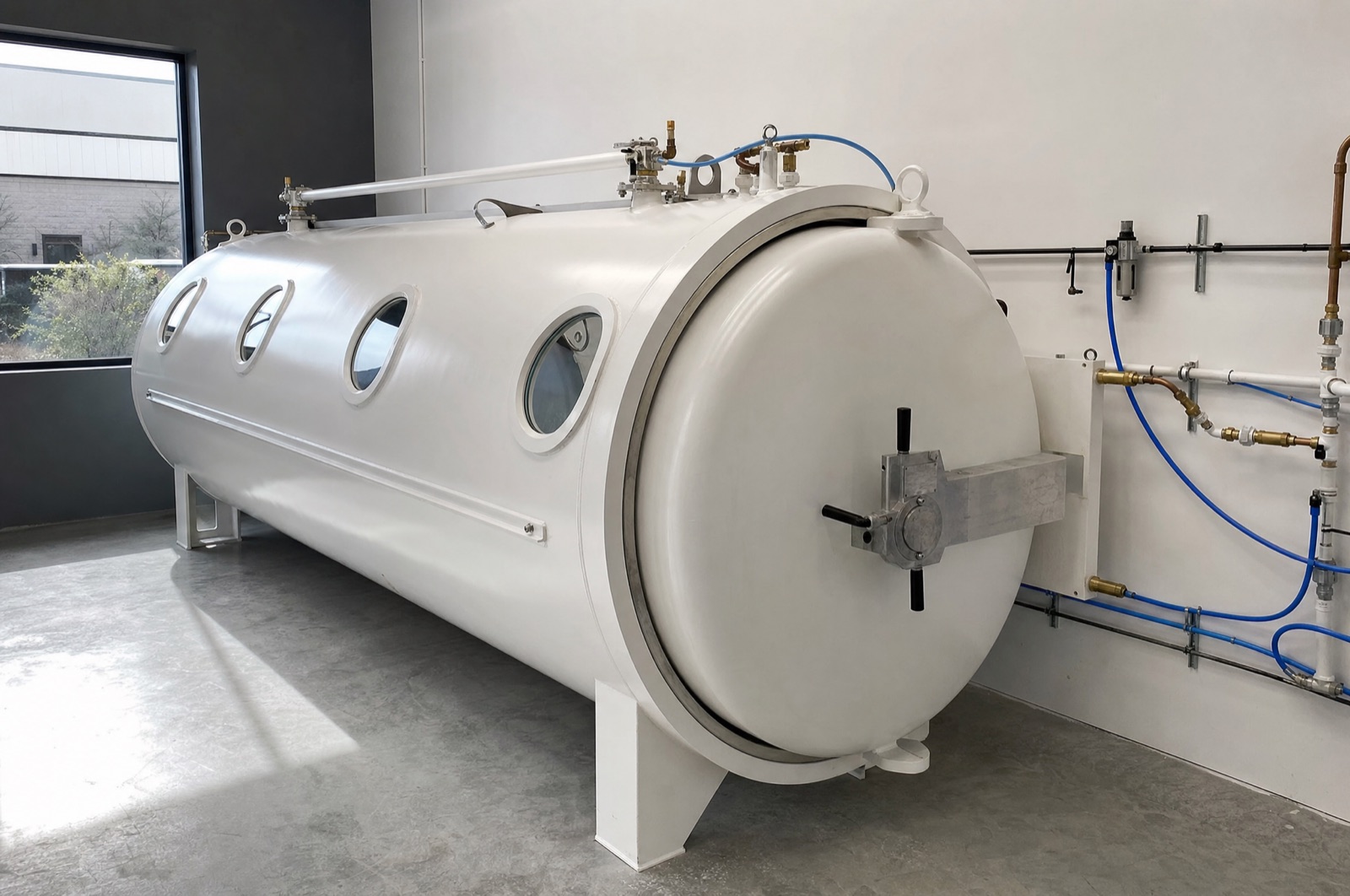
[ Clinic install ] Reference imagery; final photography in production
Hyperbaric chambers are legal in Saudi Arabia, and a chamber sold for a medical purpose is a medical device. The Saudi Food and Drug Authority (SFDA) runs the system under the Law of Medical Devices and Supplies of 2021. A device needs an SFDA marketing authorization before it can be sold. The firms that make, import, distribute or represent it need an SFDA establishment licence. Every ad needs SFDA approval before it runs. A private clinic needs a licence from the Ministry of Health. This page covers each rule for hospital units and for home or wellness chambers. It uses the 2021 law in the official translation, the SFDA implementing regulation, three SFDA requirement documents, the 2008 interim regulation, an SFDA FAQ, the Ministry of Health's private health institutions law and one news report. We do not say whether any treatment works.
Legal, and regulated as a medical device
The base law is the Law of Medical Devices and Supplies, Royal Decree No. M/54 of 18 February 2021. We read the official translation by the Bureau of Experts at the Council of Ministers, hosted by the Ministry of Investment. Article 1 defines a medical device as any instrument, apparatus or similar article intended for diagnosis, prevention, monitoring, treatment or alleviation of disease or injury, or for support of the anatomy or of a physiological process, among other purposes. It must not act mainly by pharmacological, immunological or metabolic means.
The same article defines a medical supply to include medical gases. Article 3 says accessories count as devices. Article 8 says devices may not be circulated unless they are registered and have a marketing authorization. Article 6 says no establishment may carry out a covered activity unless it is registered and licensed. Covered activities, under Article 2, include making, importing, marketing, distributing, storing and maintaining devices, and representing a maker based outside the Kingdom.
From the 2008 interim regulation to the 2021 law
Before the law, the SFDA used the Medical Devices Interim Regulation, issued by SFDA board decree 1-8-1429 of 27 December 2008 and amended on 27 December 2017. Article 6 tied marketing authorization to the rules of at least one of Australia, Canada, Japan, the USA and the EU/EFTA, plus Saudi labelling rules. Article 41 banned ads for any device without a marketing authorization and required SFDA approval of all ad material.
The SFDA regulations page now lists the Implementing Regulation of the Law of Medical Devices, issued by SFDA board decision 3-29-1443 of 19/02/1443 AH, with a page date of 27 September 2021. The current SFDA requirement documents cite the 2021 law and this regulation, not the interim text. We did not find the text that formally retired the interim regulation.
Marketing authorization for a chamber
Article 8.1 of the implementing regulation says no device may be circulated without a scientific assessment by the SFDA under its marketing authorization requirements. Article 8.2 says the device is then listed in the national registry. The details sit in MDS-REQ 1, Requirements for Medical Devices Marketing Authorization, version 6.0 of 19 December 2021. Its main points:
- The device must meet the Essential Principles of Safety and Performance in its Annex 1. Principle 14.3 asks makers to minimise the risk of fire or explosion in normal use and in single fault condition.
- The maker must keep technical documentation and run a quality management system to ISO 13485:2016.
- A local maker, a foreign maker, or the foreign maker's authorized representative applies through the SFDA GHAD system, after getting its own SFDA licence.
- Significant changes must be reported within 10 days. A renewal request can be filed 90 days before the certificate expires.
- The certificate is issued in Arabic and English and lists the device listing numbers and its validity period.
For devices meant for lay users, Principle 22.1 says the user interface must be in Arabic and English. Fees are set by SFDA circulars, which we did not read. For how the US and Europe handle the same step, see FDA cleared vs FDA registered and CE marking for hyperbaric chambers.
How a chamber would be classified
Saudi Arabia uses four risk classes, A to D, set out in Annex 5 of MDS-REQ 1. The SFDA classification FAQ says the manufacturer is responsible for classifying its device under SFDA rules. It must consider all applicable rules, pick the highest class, and justify its choice. Annex 5 says classification is governed by the intended purpose.
Two rules in Annex 5 cover active therapeutic devices. Rule 9 puts devices that administer or exchange energy in class B, or class C if they do so in a potentially hazardous way. Rule 12 puts devices that administer substances to the body in class B, or class C if the manner is potentially hazardous. We found no SFDA list, notice or ruling that applies either rule to a hyperbaric chamber, so we do not state a Saudi class. India, by contrast, lists the chamber as Class C; see chamber rules in India.
The class matters for one more rule. Article 23 of the law says devices classed as high risk may not be dispensed for use outside a healthcare facility without a prescription, and the SFDA must publish a list of them. We did not find that list.
Licences for importers, distributors and representatives
A maker based outside the Kingdom must appoint an authorized representative under Article 15 of the law. The licence rules are in MDS-REQ 9, Requirements for Licensing Medical Device Establishments, version 2.0 of 15 January 2025. It covers local makers, authorized representatives, importers, distributors, warehouses and maintenance providers. Its general rules include:
- Open an account on the SFDA GHAD system and apply there or through the Saudi Business Center platform.
- Hold a quality management certificate or inspection report against SFDA.MD/GSO ISO 13485:2017, depending on the establishment category.
- Circulate no device that lacks a valid marketing authorization.
- Advertise no device without prior SFDA approval under MDS-REQ 8.
- Keep records for at least five years and report changes within 10 days.
The SFDA issues the licence for one year, renewable, and a renewal request can be filed 60 days before expiry. Article 18 of the law says a healthcare provider must not deal with an establishment that is not registered and licensed.
When a wellness or home chamber counts as a medical device
The maker's intended purpose decides. The law's definition includes support of a physiological process, which is broad. A soft chamber sold with wording about oxygen in the body or recovery may fall inside it. We found no SFDA ruling, alert or notice on soft or mild chambers. For the pressure and gas differences, see mild vs medical hyperbaric.
Personal imports have their own route. Article 13 of the law lets the SFDA admit personal use devices in limited quantities, based on a medical report, if they are not used for business. Implementing regulation Article 13.1 says SFDA approval is needed before the import. Article 13.2 counts home devices for lay use, imported infrequently, as personal use. Article 13.5 says the maker of a home use device must give Arabic and English labels and local support contacts.
The SFDA site also lists a page titled Safe Use Guidelines for Hyperbaric Oxygen Therapy (HBOT) Devices, dated 17 September 2026. We could load the title and date, but not the body or any attached file.
Advertising needs SFDA approval first
Article 24 of the law bars any ad or promotion of a medical device without SFDA approval. The current rules are in MDS-REQ 8, version 4.0 of 20 July 2026. It applies to makers, representatives, importers, distributors, healthcare providers, media, ad agencies and individual advertisers. Its rules include:
- The device must hold a valid marketing authorization.
- Ads may not contain claims the SFDA has not approved, or mislead a layperson.
- Ads may not compare the device with other firms' products, or use the SFDA logo.
- Ads aimed at the public must be in Arabic.
- Ads must show the device name, the maker, and the MDMA number or the approval number and QR code.
- The SFDA may suspend approval if an ad mentions uses beyond the device's primary intended use.
The rules reach online ads aimed at the public in the Kingdom, wherever the site is registered. A social media content creator must hold a Mawthooq licence and the SFDA must approve the material. The fee for a separate approval is SAR 3,000 for ads to laypersons and SAR 6,000 for ads to health practitioners, and approval lasts one year.
Awareness and charity campaigns that use or display devices need their own approval. The device may be used on attendees only with written consent, and free samples are banned.
Clinics and the Ministry of Health
The SFDA regulates the device. The Ministry of Health licenses private facilities under the Private Health Institutions Law, Royal Decree No. M/40 of 3/11/1423 AH. We read the Arabic text with the third edition of its implementing rules, 2019, linked from the ministry's licences page.
Article 1 covers any privately owned facility set up for treatment, diagnosis, nursing or rehabilitation, including clinics and support service centres. Article 4 says no private health institution may open or operate until it meets all the conditions and holds the required licences, and that the licence runs for five years and can be renewed. Rule 1/3 says the medical devices in the building must meet SFDA specifications.
The law does not name hyperbaric oxygen. We found no Ministry of Health or CBAHI standard for hyperbaric units, unlike the Dubai and Abu Dhabi standards on our chamber rules in the UAE page. For the fire code most chamber makers cite, see NFPA 99 and hyperbaric fire safety, and for the vessel standard, see the ASME PVHO-1 guide. We found no Saudi rule that names either one.
Penalties
Article 42 of the law sets the penalties for breaking the law or its regulation:
- a fine of up to five million riyals;
- closure of the establishment for up to 180 days;
- suspension of the marketing authorization for up to one year, or its revocation;
- a ban on device activity for up to 180 days, or loss of the licence.
Some acts carry heavier penalties under Article 42(2), including fraud and bringing unregistered or unauthorized devices into the Kingdom. These carry up to ten years in prison, a fine of up to ten million riyals, or both. Article 41 also lists putting false information on a device or using it in promotion. Article 14 says anyone who sells an unregistered device must tell the SFDA once they know, and refund the buyer.
Public hospital units
We found no Ministry of Health or university hospital page on a hyperbaric unit that we could load. Arab News reported on 2 January 2013 that King Khaled University Hospital in Riyadh had acquired what it called the largest and first rectangular hyperbaric chamber, for treatment and research use. We did not find a later report on that unit.
We searched for a hyperbaric line in the Council of Health Insurance benefit documents and could not load them. For how US payers code the treatment, see hyperbaric insurance and CPT codes.
Hospital unit and wellness chamber side by side
| Question | Hospital unit | Home or wellness chamber |
|---|---|---|
| Banned? | No | No ban found |
| Medical device? | Yes, under the 2021 law | Depends on the maker's intended purpose; no SFDA ruling found |
| Before sale | SFDA marketing authorization (MDMA) | Same, if it is a medical device |
| Risk class | Set by the maker under Annex 5; none published that we found | Same |
| Importer or distributor | SFDA establishment licence, one year | Same, if it is a medical device |
| Personal import | Not applicable | SFDA approval first, limited quantities, no business use |
| Facility licence | Ministry of Health, five years for private facilities | Not confirmed for wellness centres |
| Ads | Prior SFDA approval under MDS-REQ 8 | Same, if it is a medical device |
| Lay user labelling | Not applicable | Arabic and English, per MDS-REQ 1 and Article 13.5 |
| Hyperbaric unit standard | None found | None found |
Sources: Law of Medical Devices and Supplies, Royal Decree M/54; SFDA implementing regulation 3-29-1443; SFDA MDS-REQ 1 version 6.0, MDS-REQ 8 version 4.0 and MDS-REQ 9 version 2.0; SFDA classification FAQ; Medical Devices Interim Regulation; Private Health Institutions Law, Royal Decree M/40. All linked above, read 2 November 2026.
For the same question in other countries, see chamber rules in the UAE and chamber rules in India. For fire and other hazards, see hyperbaric chamber safety, and for oxygen supply, see oxygen concentrators for hyperbaric chambers. For the chambers we track and what we can verify about each, see the scorecard.
What we have not verified
We could not read the body of the SFDA Safe Use Guidelines for HBOT Devices page of 17 September 2026, so we cannot say what it requires of facilities or users. We found no SFDA document that names a risk class for hyperbaric chambers, and no copy of the Article 23 list of high risk devices that need a prescription. We did not read the SFDA fee circulars for marketing authorization or the fee annex of MDS-REQ 9. We did not find the date the 2021 law entered into force, or the text that retired the interim regulation. We do not know whether version 6.0 of MDS-REQ 1 is still current. We did not read MDS-REQ 11 on post-market surveillance, which the implementing regulation says sets safe use rules inside healthcare facilities. We read the Private Health Institutions Law in Arabic and did not check whether a wellness centre offering chamber sessions needs a Ministry of Health licence. We found no CBAHI standard for hyperbaric units, could not load the Council of Health Insurance benefit documents, and could not load a King Faisal Specialist Hospital page or a 2014 WHO EMRO file on hyperbaric medicine in Saudi Arabia. We found no SFDA alert or recall on chambers, and no SFDA decision against a chamber seller.
Frequently asked
Are hyperbaric chambers legal in Saudi Arabia?
Yes. We found no ban. The Law of Medical Devices and Supplies, Royal Decree No. M/54 of 18 February 2021, covers any apparatus intended for treatment or alleviation of disease or injury, or for support of a physiological process. Article 8 says a medical device may not be circulated unless it is registered and has a marketing authorization from the Saudi Food and Drug Authority (SFDA).
Who approves a hyperbaric chamber for sale in Saudi Arabia?
The SFDA. Its MDS-REQ 1 requirements, version 6.0 of 19 December 2021, say a device may be supplied only if it is registered at the SFDA and holds a medical devices marketing authorization (MDMA). A local maker, or the authorized representative of a foreign maker, applies through the SFDA GHAD system after getting its own SFDA licence.
What risk class is a hyperbaric chamber in Saudi Arabia?
We could not confirm one. The SFDA says the manufacturer must classify its device under the SFDA rules and pick the highest class that applies. Annex 5 of MDS-REQ 1 has four classes, A to D. Rule 9 puts active therapeutic devices that administer energy in class B, or class C if they do so in a potentially hazardous way. We found no SFDA text that applies any rule to a chamber.
Is a soft or mild hyperbaric chamber a medical device in Saudi Arabia?
It depends on what the maker says it is for. The 2021 law defines a medical device by its intended use, and the list includes treatment, alleviation of disease, and support of a physiological process. MDS-REQ 1 says classification is governed by the intended purpose. We found no SFDA ruling or notice on soft or mild chambers.
Can a clinic or influencer advertise a hyperbaric chamber in Saudi Arabia?
Only with SFDA approval first. Article 24 of the law bars any ad or promotion of a medical device without it. The SFDA advertising requirements, MDS-REQ 8 version 4.0 of 20 July 2026, apply to healthcare providers, agencies and individual advertisers. A social media content creator must also hold a Mawthooq licence. The device must have a valid MDMA, and the ad may not carry claims the SFDA has not approved.
Can I import a hyperbaric chamber into Saudi Arabia for home use?
Article 13 of the law lets the SFDA permit personal use devices in limited quantities, based on a medical report, if they are not used for business. The implementing regulation says SFDA approval is needed before the import, and that home devices for lay use imported infrequently count as personal use. We found nothing that addresses chambers by name.

Alex tests the machines himself, in clinics and studios on three continents. Every score comes from the same 27 public criteria, and no manufacturer has a say in them.
Six questions, and we'll match chamber, options, and install to your space and budget.