Hyperbaric Chamber Rules in South Africa: SAHPRA Class C, Licences, Pressure Rules and Advertising
Researched and scored by Alex Evans. Last reviewed August 2026. Corrections are dated and public. See corrections
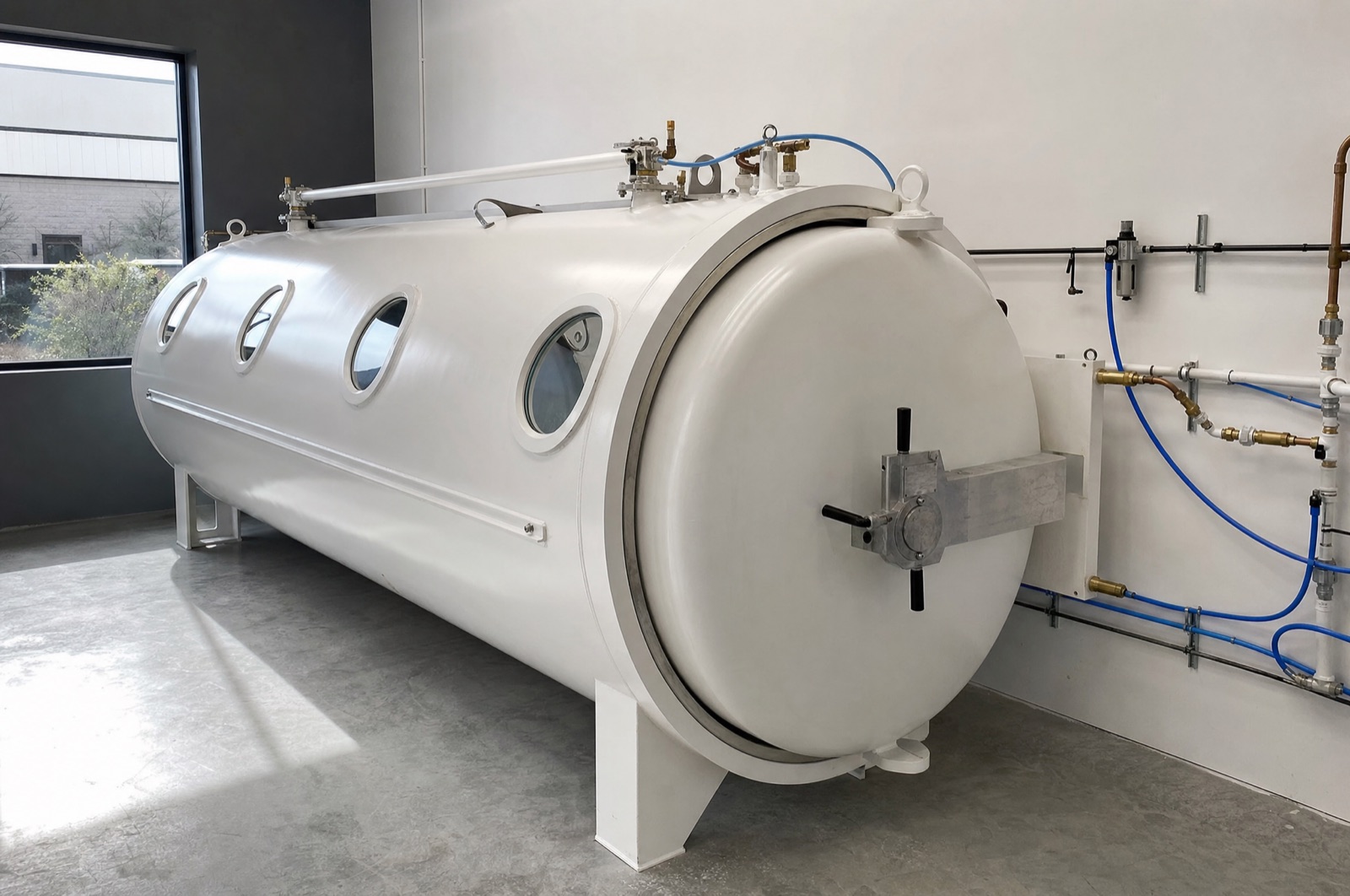
[ Clinic install ] Reference imagery; final photography in production
Hyperbaric chambers are legal in South Africa, and the law treats them as medical devices. The regulator, the South African Health Products Regulatory Authority (SAHPRA), names hyperbaric chambers as an example of a Class C device, the second highest of four risk classes. A maker, importer or distributor needs a medical device establishment licence. The medical device regulations bar public advertising of Class C devices. The Department of Labour's Pressure Equipment Regulations also name hyperbaric chambers. This page covers each rule for hospital units and for home or wellness chambers. It uses the Act, two SAHPRA guidelines and a SAHPRA notice, the gazette text of the pressure rules, the advertising regulation, the ARB code preface, two SAUHMA pages, a medical scheme annexure, a hospital group article and a tender listing. We do not say whether any treatment works.
Legal, and regulated as a medical device
The base law is the Medicines and Related Substances Act 101 of 1965. SAHPRA hosts a consolidated copy of the Act published in Government Gazette 40869 of 26 May 2017. Section 1 defines a medical device as any instrument, apparatus, machine or appliance intended by the manufacturer for one or more listed purposes. These include:
- diagnosis, prevention, monitoring, treatment or alleviation of disease;
- diagnosis, monitoring, treatment, alleviation of or compensation for an injury;
- investigation, replacement, modification or support of the anatomy or of a physiological process;
- supporting or sustaining life.
The device must not achieve its main intended action by pharmacological, immunological or metabolic means.
The detailed rules sit in the Regulations relating to Medical Devices and IVDs, Government Notice No. 1515 in Government Gazette No. 40480 of 9 December 2016. The Acts Online index lists 29 regulations, among them licences in regulation 5, licence validity in regulation 6, classification in regulation 11, advertising in regulation 21 and transitional rules in regulations 27 and 28. The full text there sits behind a subscription, and the gazette copy on gov.za did not load for us.
Where the hyperbaric chamber sits in SAHPRA's classes
South Africa sorts devices into four classes. SAHPRA's licence guideline gives them as Class A low risk, Class B low to moderate risk, Class C moderate to high risk and Class D high risk, where risk relates to the patient, the user or public health.
The classification guideline is SAHPGL-MD-04, version 5, dated 27 February 2025. Rule 11 covers active devices that administer or remove medicines, body liquids or other substances. Rule 11(a) puts such devices in Class B. Rule 11(b) puts them in Class C when they do so in a way that is potentially hazardous to the patient. Its listed examples include ventilators, hyperbaric chambers and pressure regulators for medical gases.
The guideline sets out how the rules work:
- Classification is based on the maker's intended purpose, taken from the instructions for use, the label, the maker's advertising and the technical documents.
- If more than one rule applies, the higher class applies.
- For a system, the class of the whole is the highest class of any device in it.
- In a dispute over classification, SAHPRA decides.
For how the US files the same device, see FDA cleared vs FDA registered, and for Europe, see CE marking for hyperbaric chambers.
Licences to make, import and distribute a chamber
Section 22C(1)(b) of the Act lets SAHPRA issue a licence to a medical device establishment, manufacturer, wholesaler or distributor to manufacture, import, export, act as a wholesaler of or distribute a device. SAHPRA's licence guideline, SAHPGL-MD-06, version 3, dated 8 March 2023, sets out what that means for devices.
- The maker, importer, distributor or exporter of a Class B, C or D device must be licensed with SAHPRA. A person who deals only in Class A devices is exempt until further notice.
- The application lists every device by name, Global Medical Device Nomenclature code and risk class, and names a South African resident Authorised Representative.
- For a Class C or Class D device, the applicant must show premarket approval or registration from at least one of these: the Australian TGA, Brazil's ANVISA, Health Canada, an EU CE certificate, Japan's MAH licence, or US FDA premarket approval or 510(k) clearance.
- Class B, C and D devices also need a certificate of free sale from the country of manufacture or final assembly.
- The applicant must have a quality management system in place.
- A licence is valid until the guideline is revised or for five years, whichever comes first.
- A change to a Class C device, or to the foreign approval relied on, must be reported to SAHPRA within 30 days. A recall of that device must be reported at once.
SAHPRA has added an ISO 13485 step. Its communication MD01-2025/2026_v2, dated 18 September 2025, says that from 1 June 2025 a licence holder applying for renewal must provide a valid ISO 13485:2016 certificate from a conformity assessment body SAHPRA recognises. From 1 April 2028, an applicant for a new licence must do the same.
Registration and ordering from abroad
A licence covers the business. Registration covers the product. Section 14 of the Act bars the sale of a device that is subject to registration unless it is registered. A device becomes subject to registration only when SAHPRA publishes a declaration in the Gazette naming it, or its class or category. We did not find a declaration that calls up hyperbaric chambers or Class C devices for registration.
The licence guideline also covers personal imports. It says no person shall order an unregistered Class B, C or D device from abroad for personal use unless SAHPRA has authorised the import. On that wording, a buyer who orders a Class C chamber from an overseas website for home use needs that authorisation.
When a wellness chamber counts as a medical device
In South Africa, the maker's intended purpose decides. The Act's definition includes support or modification of a physiological process, which is broad. A soft chamber sold with wording about oxygen in the body or recovery may fall inside it.
The classification guideline adds one point that matters here. If the intended purpose is not clear, SAHPRA will ask the maker or Authorised Representative. If the answer does not come in time, or is unclear, SAHPRA will assume an intended purpose consistent with the purpose generally accepted in current clinical practice. The guideline also counts the maker's advertising as one source of intended purpose.
We found no SAHPRA ruling, alert or classification decision on soft or mild chambers. SAUHMA's position statement, covered below, draws a line by pressure and gas. For the pressure and gas differences between the two kinds of chamber, see mild vs medical hyperbaric.
Advertising: regulation 21
Regulation 21 of Notice 1515 sets the advertising rules for devices. We read it on the Acts Online page for regulation 21. It says:
- Only Class A and Class B medical devices and IVDs may be advertised to the public or a lay person. Male and female condoms are an exception.
- An ad may not contain a statement that deviates from, conflicts with or goes beyond the evidence on safety, quality or performance accepted by the regulator and included in the approved instructions for use.
- A written ad must give the name of the device and, if it is registered, its registration number.
- When a Class C or Class D device is advertised for the first time to a prospective user, written information under regulation 23 must go with it. Later ads must make that information available on request.
On the plain text, a seller may not advertise a Class C hyperbaric chamber to the public. The rule speaks of ads for a device. We found no ruling on whether it reaches an ad for sessions in a chamber at a clinic or spa.
Advertising: the ARB code
The Advertising Regulatory Board runs the industry's self regulatory code. Its code preface, version 2021.1, says the ARB is an independent body set up and paid for by the marketing communication industry. It says the Code of Advertising Practice is based on the International Chamber of Commerce code.
The preface sets limits on its reach. The ARB has no jurisdiction over a person or entity that is not a member, and may not sanction a non-member. It may still rule for its members on any ad, to decide whether members should accept or withdraw it. The preface says that under the Electronic Communications Act No. 36 of 2005, all electronic broadcasters must adhere to the Code.
Pressure equipment rules
The Department of Labour made the Pressure Equipment Regulations, 2009 under section 43 of the Occupational Health and Safety Act, 1993. We read the gazette text, Government Notice R. 734 in Government Gazette No. 32395 of 15 July 2009, hosted by the University of Cape Town.
- Regulation 1 defines pressure equipment to include, but not be limited to, an accumulator, a hot water geyser and hyperbaric chambers. Regulation 2 applies the rules to pressure equipment with a design pressure of 50 kPa or more.
- Regulation 3 says anyone who makes, imports, sells or supplies pressure equipment for use in South Africa must ensure it complies, and that all pressure equipment must be categorised and assessed under SANS 347.
- Regulation 4 says imported equipment stamped by an ASME authorised maker in line with the full ASME Code of Construction is deemed to comply.
- Regulation 11 requires most pressure vessels to be inspected and tested by an approved inspection authority at intervals of no more than 36 months.
- Regulation 20 makes breaches an offence, with a fine or up to 12 months in prison.
The rules took effect on 1 October 2009. Government Notice R. 735 of the same date incorporated a list of standards, led by SANS 347. That 2009 list does not name a hyperbaric standard. We did not read later amendments. Many makers cite ASME PVHO-1; see our ASME PVHO-1 guide. We did not check the design pressure of any soft chamber against the 50 kPa line.
SAUHMA accreditation and position statement
The Southern African Underwater and Hyperbaric Medical Association is a medical association, not a regulator. Its accreditation policy says it assesses facilities on equipment safety and compliance with national requirements, on the Health Professions Council of South Africa registration and competence of all staff, and on fire and oxygen system hazards. It says accreditation is valid for four years from the date of issue. SAUHMA says it regularly forwards its list of accredited facilities to medical reimbursement organisations and to the Department of Labour.
Its position statement on low pressure fabric chambers was created on 25 April 2017. It makes these points:
- It defines hyperbaric oxygen therapy as breathing near 100% oxygen while enclosed in a chamber at a pressure equal to or greater than 1.4 ATA.
- It says SAUHMA approved indications start at 2 ATA or more.
- It says air below 2.0 ATA does not meet the SAUHMA definition of therapeutic hyperbaric oxygen therapy.
- It says low pressure fabric chambers hold an FDA 510(k) clearance for acute mountain sickness only, and are designed to be compressed only with air.
- It says SAUHMA does not endorse in home therapy.
- It cites SANS 347, ASME PVHO-1, NFPA 99 and NFPA 101 for chamber design and facility safety.
These are the views of a professional body. We found no law that adopts them. For the fire code it cites, see NFPA 99 and hyperbaric fire safety. For oxygen supply set ups, see oxygen concentrators for hyperbaric chambers.
Hospital units and medical scheme cover
Netcare, a private hospital group, wrote on 19 February 2018 that Netcare St Augustine's Hospital in Durban runs a chamber that can treat up to 10 patients at once, and called it the only hospital based facility of its kind in KwaZulu-Natal. It named units at Netcare Milpark Hospital in Johannesburg and Netcare Pretoria East Hospital, and a single patient chamber at Medicross Tokai in Cape Town. It said treatment at St Augustine's follows SAUHMA protocols.
On the public side, a Tenderflow listing shows Free State Health tender DOH(FS)15/2026/2027 for the supply, delivery, installation and commissioning of a hyperbaric oxygen chamber at the Oncology Annex of Universitas Academic Hospital in Bloemfontein. It was advertised on 28 August 2026 and closed on 18 September 2026. We did not find an award notice.
For scheme cover, we read Bestmed Medical Scheme's 2026 annexure on prescribed minimum benefits. It lists hyperbaric oxygen therapy among the interventions excluded from the generic medical and surgical management categories unless otherwise specified. That is one scheme's rules. For how US payers code the treatment, see hyperbaric insurance and CPT codes.
Hospital unit and wellness chamber side by side
| Question | Hospital unit | Home or wellness chamber |
|---|---|---|
| Banned? | No | No ban found |
| Medical device? | Yes; named as a Class C example under Rule 11(b) | Depends on the maker's intended purpose; no SAHPRA ruling found |
| Making, importing or distributing it | Section 22C establishment licence | Same, if it is a medical device |
| Foreign approval for the licence | Proof from at least one listed regulator | Same, if it is a Class C device |
| Ordering one from abroad for personal use | Not applicable | SAHPRA authorisation needed if Class C and unregistered |
| Ads to the public | Not allowed for Class C under regulation 21 | Same, if it is a Class C device |
| Pressure Equipment Regulations | Named in the definition; 50 kPa design pressure threshold | Named in the definition; we did not check soft chamber ratings |
| SAUHMA view | Accreditation for facilities | Does not endorse in home therapy |
| Scheme cover | Excluded from generic PMB categories in Bestmed's rules unless specified | No scheme rule found |
Sources: Medicines and Related Substances Act 101 of 1965 as published by SAHPRA; SAHPGL-MD-04 v5 of 27 February 2025; SAHPGL-MD-06 v3 of 8 March 2023; SAHPRA communication MD01-2025/2026_v2; regulation 21 of Notice 1515 of 2016; Pressure Equipment Regulations, 2009; SAUHMA accreditation policy and position statement; Bestmed 2026 PMB annexure. All linked above, read 2 November 2026.
For the same question in other countries, see hyperbaric chamber rules in Australia, Canada and the UK, chamber rules in the UAE and chamber rules in India. For fire and other hazards, see hyperbaric chamber safety. For the chambers we track and what we can verify about each, see the scorecard.
What we have not verified
The gazette copy of Notice 1515 of 2016 on gov.za did not load, and the Acts Online full text needs a subscription, so we read regulation 21 only and could not read regulations 5, 11, 19 or 27. We found no Gazette declaration under section 14 that calls up hyperbaric chambers or Class C devices for registration, so we cannot say whether a chamber must be registered before sale. We found no SAHPRA ruling on soft or mild chambers, and no SAHPRA alert or recall on hyperbaric chambers. We did not read the ARB Code clauses on substantiation or its health appendices. We read the 2009 Pressure Equipment Regulations as first published and did not read later amendments, including a 2017 notice that search results say added a hyperbaric chamber standard. We did not check whether any HPCSA or provincial rule sets who may run a chamber or licenses a clinic that runs one. We did not read the Council for Medical Schemes list of diagnosis and treatment pairs, so the Bestmed text may or may not match other schemes. We did not confirm whether the Free State tender was awarded or how many public hospitals run a chamber.
Frequently asked
Are hyperbaric chambers legal in South Africa?
Yes. We found no ban. The Medicines and Related Substances Act 101 of 1965 covers medical devices, and SAHPRA's classification guideline SAHPGL-MD-04, version 5 of 27 February 2025, names hyperbaric chambers as an example of a Class C device under Rule 11. The Pressure Equipment Regulations, 2009 also name hyperbaric chambers in their definition of pressure equipment.
What risk class is a hyperbaric chamber in South Africa?
Class C, which SAHPRA calls moderate to high risk. Rule 11(b) of the classification guideline covers active devices that administer substances to a patient in a way that is potentially hazardous. Its list of examples includes hyperbaric chambers, alongside ventilators and pressure regulators for medical gases. The guideline says classification rests on the maker's intended purpose, and that SAHPRA decides any dispute.
Who needs a licence to sell a hyperbaric chamber in South Africa?
The maker, importer, distributor or exporter of a Class B, C or D device. SAHPRA guideline SAHPGL-MD-06, version 3 of 8 March 2023, says they must be licensed under section 22C(1)(b) of the Act. For a Class C device, the applicant must show approval from at least one listed regulator, such as the US FDA, Health Canada, the Australian TGA or an EU CE certificate. The guideline says a licence is valid for up to five years.
Is a soft or mild hyperbaric chamber a medical device in South Africa?
It depends on what the maker says it is for. The Act defines a medical device by the maker's intended use, including support of a physiological process. SAHPRA's guideline says it will assume a purpose consistent with current clinical practice if the maker's purpose is unclear. We found no SAHPRA ruling on soft chambers. SAUHMA, a medical association, says air below 2.0 ATA does not meet its definition of hyperbaric oxygen therapy.
Can a clinic in South Africa advertise a hyperbaric chamber to the public?
Regulation 21 of the medical device regulations, Notice 1515 of 2016, says only Class A and Class B devices may be advertised to the public or a lay person. A hyperbaric chamber is listed as a Class C example. The rule covers ads for the device. We found no ruling on whether it covers an ad for a treatment session. The ARB code also asks advertisers to hold evidence for their claims, but the ARB says it has no jurisdiction over non-members.
Do medical schemes in South Africa pay for hyperbaric oxygen therapy?
We could not confirm a general rule. Bestmed Medical Scheme's 2026 annexure on prescribed minimum benefits lists hyperbaric oxygen therapy among the interventions excluded from its generic medical and surgical management categories unless otherwise specified. That is one scheme's rules. We did not read the Council for Medical Schemes list of diagnosis and treatment pairs.

Alex tests the machines himself, in clinics and studios on three continents. Every score comes from the same 27 public criteria, and no manufacturer has a say in them.
Six questions, and we'll match chamber, options, and install to your space and budget.