Hyperbaric Chamber Rules in Singapore: HSA, Dealer Licences, MOM and MediSave
Researched and scored by Alex Evans. Last reviewed August 2026. Corrections are dated and public. See corrections
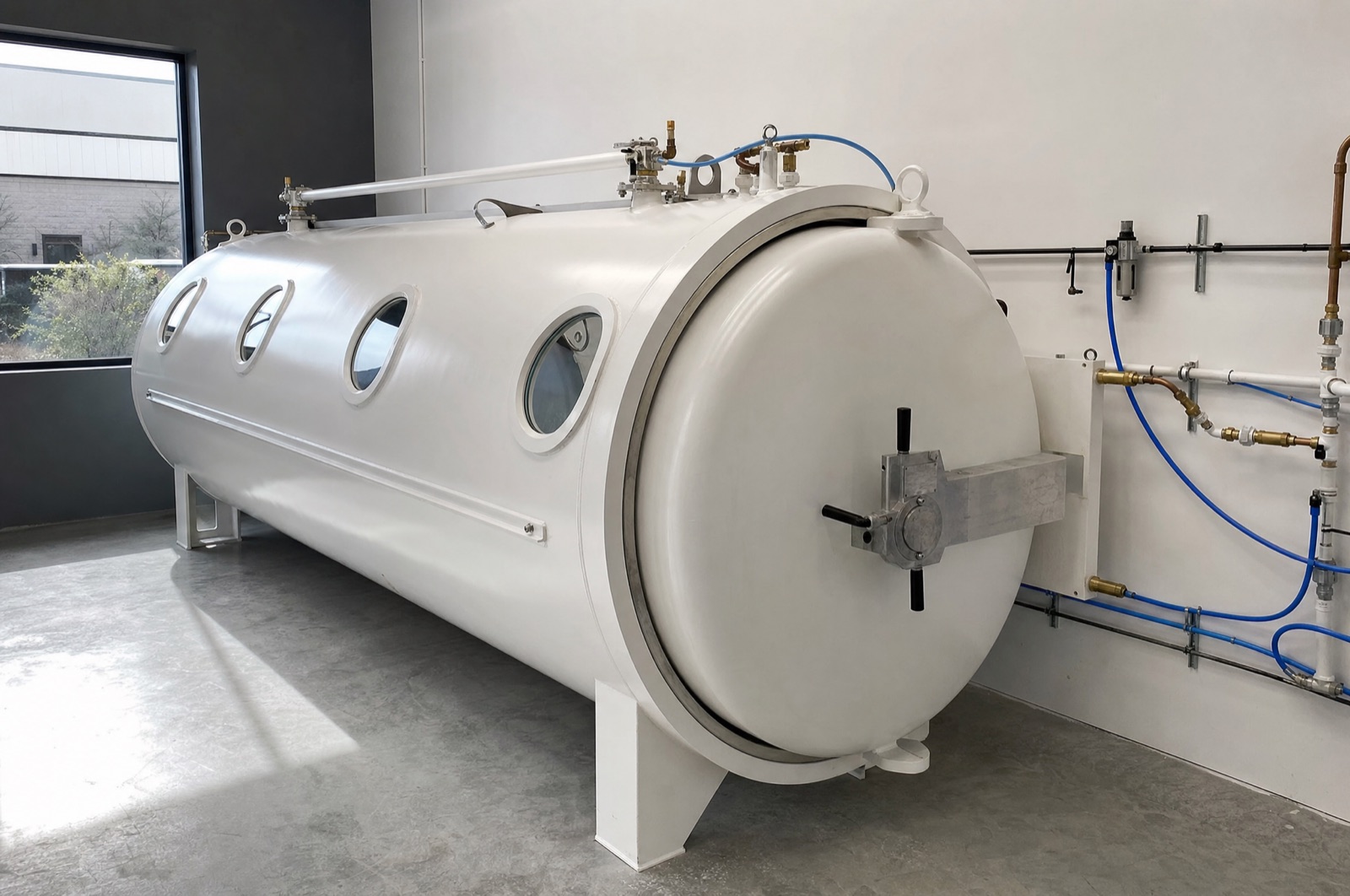
[ Clinic install ] Reference imagery; final photography in production
Hyperbaric chambers are legal in Singapore. A chamber sold for a medical purpose is a medical device under the Health Products Act, so it must be registered with the Health Sciences Authority (HSA) unless it is in the lowest risk class, and the firms that import and sell it need a dealer's licence. A chamber sold only for general well-being, with no medical claims, may sit outside those rules. Claims rules, clinic licensing under the Healthcare Services Act and the Ministry of Manpower's pressure vessel rules add further layers. This page covers each one. It uses HSA, MOH, MOM, CPF, Singapore General Hospital and Navy pages, read on 30 October 2026. We do not say whether any treatment works.
Legal, and regulated when it is a medical device
HSA regulates the import, manufacture, export and supply of medical devices. Its regulatory overview names the legal basis: the Health Products Act and the Health Products (Medical Devices) Regulations 2010. It sets out four duties that matter for a chamber:
- All medical devices need registration with HSA before they can be supplied in Singapore, except Class A low risk devices or devices under conditions HSA approves.
- Companies need a dealer's licence before they make, import or supply medical devices.
- Importers, manufacturers, suppliers and registrants must report adverse events.
- A firm whose device poses a health risk must tell HSA, take corrective action and notify users.
We found no rule that bans hyperbaric chambers or limits them to hospitals. The question for any given chamber is whether it is a medical device at all. That turns on what its maker and seller say it is for.
What HSA counts as a medical device
HSA's overview says medical devices are health products with a physical or mechanical effect on the human body, used to diagnose, treat or monitor medical conditions or body functions. An HSA explainer of 28 May 2026, How medical devices are regulated by HSA, uses the same wording and adds that devices may measure or monitor body functions.
Both pages draw a line for wellness products. The overview says products used to maintain or support general well-being without specific medical claims are not medical devices. Its examples are body toning equipment, magnetic accessories and massagers. Hyperbaric chambers are not on that list, and we found no HSA ruling on mild or soft chambers.
So the sales pitch matters. A chamber offered to treat a medical condition looks like a medical device under HSA's definition. A chamber offered only for relaxation, with no medical claims, may fall under the well-being exclusion. HSA runs an online Is it a medical device questionnaire of 15 questions for sellers who are unsure. For how the US draws a similar line, see FDA cleared vs FDA registered.
Risk classes and product registration
HSA sorts medical devices into four risk classes. The May 2026 explainer says the class depends on the device's intended purpose, how it works, the user and the technology. Its examples:
- Class A, low risk: bandages, wheelchairs, surgical masks.
- Class B, low to mid risk: contact lenses, dental crowns, hearing aids.
- Class C, mid to high risk: X-ray machines, lung ventilators, hip implants.
- Class D, high risk: pacemakers, heart stents, breast implants.
HSA's registration overview explains what each class needs. Class A devices are exempt from registration, but the maker or importer must file a product notification in HSA's SHARE system. Class B, C and D devices go through an evaluation route. Which route depends on the class, on prior approvals from HSA's overseas reference agencies and on the device's safety record.
A device with no prior approval from any reference agency needs a full evaluation. The reference agencies are Australia's TGA, EU Notified Bodies, Health Canada, Japan's MHLW and the US FDA. For the FDA, HSA counts 510(k) clearance, De Novo or PMA. The overview adds a catch: a device approved abroad as Class I, or as Class II exempt, cannot use those approvals for the faster abridged, expedited or immediate routes. FDA registration on its own is not on HSA's list. See our guides to CE marking and FDA clearance for what those approvals mean. We could not confirm which class HSA gives a hyperbaric chamber.
Dealer licences for importers and sellers
Registration covers the product. Licensing covers the firm. HSA's page on how to apply for a medical device dealer's licence lists three kinds:
- An importer's licence lets a dealer bring a medical device into Singapore. An importer that also sells wholesale needs a wholesaler's licence too.
- A wholesaler's licence covers wholesale supply, including export, supply for re-supply and supply as a commercial sample.
- A manufacturer's licence covers making a device and packing and labelling it before supply.
Each application needs evidence of a quality system. Importers and wholesalers can show an MDSAP certificate, an ISO 13485 certificate or a GDPMDS certificate, with the audit report. The certificate must come from a body accredited by the Singapore Accreditation Council. A dealer handling only Class A devices can file a declaration of conformity instead. The same page says a wholesaler's licence is not needed to supply end users, such as in a retail store.
For a buyer, the explainer gives plain advice: do not buy from dubious sources such as unknown websites or makeshift stalls, and do not risk your health with unregistered devices.
Advertising rules for medical devices
HSA's page on advertisements and promotions of medical devices says the advertiser is responsible for compliance. It treats any information published to promote a health product as an advertisement under the Health Products Act. That includes social media, testimonials, competitions and trials offered to the public.
The rules most likely to reach a chamber seller or clinic:
- No ads to the public for devices meant for professional use only, except in material for qualified practitioners.
- No claim that a device will prevent, alleviate or cure a listed condition. The list includes cancer, diabetes, hypertension, kidney diseases, paralysis and infertility.
- No claim that a device is 100% safe, has no side effects or cannot cause harm.
- No claim that a device is a guaranteed or sure cure, and nothing that discourages people from seeing a doctor.
- All claims must be backed by scientific studies. No unqualified superlatives.
- No testimonials or recommendations from healthcare professionals. User testimonials must reflect a typical user and the device's intended purpose.
- No use of HSA's name or logo.
The same page says every medical device ad must also follow the Singapore Code of Advertising Practice, which the Advertising Standards Authority of Singapore runs. HSA points to its guidance document GN-08 for detail and for acceptable claims for Class A devices. That PDF did not load for us. For how mild and medical chambers differ, see mild vs medical hyperbaric.
Licensing the clinic: the Healthcare Services Act
The device rules cover the chamber. A separate law covers the service. A Ministry of Health press release of 18 May 2023 says the Healthcare Services Act was enacted in 2020 to replace the Private Hospitals and Medical Clinics Act. It licenses services rather than premises and came in over three phases. Phase 2 began on 26 June 2023 and covered outpatient medical services, among others.
The Outpatient Medical Service page lists what needs that licence. It includes examining an outpatient's body or mind, assessing their health, treating them for any condition, disease, disorder or injury, and providing medical care. A clinic that gives hyperbaric oxygen to treat a condition fits that wording.
The page does not mention wellness centres or spas. We found no MOH text on whether a centre that offers chamber sessions with no medical claims needs a licence. For who may order a session in other countries, see do you need a prescription.
The pressure vessel side
A chamber holds air above room pressure. In Singapore, the Ministry of Manpower regulates pressure vessels under the Workplace Safety and Health Act. MOM's page on how to register a pressure vessel says an owner must register it with MOM and hire an Authorised Examiner to inspect and register it. The vessels named are air receivers, steam receivers, refrigerating plant receivers, steam boilers, economisers and superheaters. Registration conditions are in Regulation 27 of the Workplace Safety and Health (General Provisions) Regulations.
Some vessels are exempt. Air receivers with a safe working pressure of 0.5 bar or less, or where pressure times volume is 100 bar litres or less, need no registration. MOM says exempt vessels must still be built to recognised codes and kept in good repair under Regulation 33. MOM's regular inspections page says air receivers need a visual examination and running tests every 2 years, and a hydrostatic test and thickness gauging at least every 10 years. Since 5 August 2023 MOM no longer sends reminders.
MOM's pages do not mention hyperbaric chambers. We do not know whether MOM treats a chamber as an air receiver. SGH says its treatment pressure is usually 2 to 3 ATA, well above the 0.5 bar exemption. The design standard most chamber makers cite is covered in our ASME PVHO-1 guide.
The public units: SGH and the Navy
Singapore General Hospital runs the Hyperbaric and Diving Medicine Centre, which it calls the first comprehensive and integrated facility in Singapore serving the civilian community. It is at Block 4 Level 1, Green Zone. Its listed services are diving and hyperbaric consultation, hyperbaric oxygen therapy, problem wound management and a 24 hour service for diving emergencies on 6222 3322. The clinic runs Monday to Friday, 8.00am to 5.00pm. The page says treatment pressure is usually 2 to 3 ATA, which it compares to 10 to 20 metres under water. It lists ear pain, sinus pain and oxygen toxicity among possible side effects.
The Navy is a partner. A Republic of Singapore Navy feature, Navy Medical Service: Doctors, Sailors, Singaporeans, says the centre is jointly run by Navy Medical Service and SGH staff. It says the centre's multiplace chamber can treat over 20 patients at once and handles two to three emergency cases a month. The Navy keeps a hyperbaric medicine team on 24 hour standby with SGH. The same feature says the Navy's portable hyperbaric chambers have been used at MRT worksites to treat workers with decompression sickness.
What MediSave pays
MediSave is Singapore's medical savings scheme. MOH's MediSave outpatient care page, last updated 15 October 2026, lists Outpatient Hyperbaric Oxygen Therapy under other outpatient uses, at up to $80 per treatment session.
An older CPF list of outpatient treatments under MediSave, marked correct as at 1 September 2022, gives $100 per treatment. We use the MOH figure as the current one. Neither page lists the conditions that qualify or says whether a session at a wellness centre counts. For how US insurers code the same service, see hyperbaric insurance and CPT codes.
Hospital unit and wellness chamber side by side
| Question | Hospital or clinic unit | Home or wellness chamber |
|---|---|---|
| Banned? | No | No ban found |
| Medical device? | Yes, by its medical purpose | Not if sold for general well-being without medical claims, per HSA |
| Product registration | Required unless Class A; class not confirmed | Required only if it is a medical device |
| Dealer's licence | Importer and wholesaler licences | Required only if it is a medical device |
| Service licence | Outpatient Medical Service licence fits treatment of a condition | No MOH text found |
| Pressure | Usually 2 to 3 ATA at SGH | Not set by any rule we found |
| MOM registration | Not confirmed; MOM does not name chambers | Not confirmed; air receivers at 0.5 bar or less are exempt |
| Advertising | HSA device ad rules and the ASAS code | Same rules if it is a medical device; ASAS code in any case |
| MediSave | Up to $80 per outpatient session | Not confirmed |
Sources: HSA regulatory overview, registration overview, dealer licence and advertising pages; HSA explainer of 28 May 2026; MOH and HCSA pages; MOM pressure vessel pages; SGH and Navy pages; MOH MediSave page. All linked above, read 30 October 2026.
For the same question in other countries, see hyperbaric chamber rules in Australia, Canada and the UK, chamber rules in New Zealand and chamber rules in the UAE. For fire and other hazards, see hyperbaric chamber safety. For the chambers we track and what we can verify about each, see the scorecard.
What we have not verified
Singapore Statutes Online blocked our requests, so we did not read the Health Products Act, the 2010 Medical Devices Regulations, the Healthcare Services Act or the Workplace Safety and Health (General Provisions) Regulations. The rules above come from the HSA, MOH and MOM pages that summarise them. HSA's risk classification guidance and its GN-08 advertising guidance did not load, so we cannot say which class a hyperbaric chamber falls in or what claims HSA accepts for Class A devices. We found no HSA ruling, recall or warning on hyperbaric chambers, and no list of registered chambers. We did not confirm whether MOM treats a chamber as an air receiver, whether a wellness centre offering chamber sessions needs a licence under the Healthcare Services Act, or whether any rule limits who may give oxygen in such a centre. We did not find SGH's charges or a list of private clinics that take MediSave for hyperbaric oxygen. We did not read the current Singapore Code of Advertising Practice itself.
Frequently asked
Are hyperbaric chambers legal in Singapore?
Yes. We found no ban. HSA regulates medical devices under the Health Products Act and the Health Products (Medical Devices) Regulations 2010. Its regulatory overview says all medical devices need registration with HSA before they can be supplied in Singapore, except Class A low risk devices, and that companies need a dealer's licence before they make, import or supply medical devices.
Is a mild or soft hyperbaric chamber a medical device in Singapore?
It depends on what the seller claims. HSA's regulatory overview says products used to maintain or support general well-being without specific medical claims are not medical devices, and gives body toning equipment, magnetic accessories and massagers as examples. A chamber sold to treat a condition would fall on the other side. We found no HSA ruling on mild or soft chambers as a class.
Which HSA risk class is a hyperbaric chamber?
We could not confirm it. HSA sorts devices into Class A, the lowest risk, to Class D, the highest, based on intended purpose, how the device works, the user and the technology. Its 2026 explainer gives X-ray machines and lung ventilators as Class C examples. HSA's risk classification guidance did not load for us, so we have not seen how it would place a hyperbaric chamber.
Do I need a licence to import a hyperbaric chamber into Singapore?
If it is a medical device, yes. HSA's dealer licence page says an importer's licence allows a dealer to bring a medical device into Singapore, and that importers who also sell wholesale need a wholesaler's licence. A quality system certificate, such as ISO 13485 or GDPMDS from a body accredited by the Singapore Accreditation Council, is part of the application. HSA says a wholesaler's licence is not needed to supply end users, such as in a retail store.
Does MediSave pay for hyperbaric oxygen therapy?
For outpatient treatment, MOH's MediSave outpatient care page lists Outpatient Hyperbaric Oxygen Therapy at up to $80 per treatment session. An older CPF list, marked correct as at 1 September 2022, gave $100 per treatment. Neither page we read says whether a wellness centre session qualifies.
Does a hyperbaric chamber need to be registered with MOM?
We could not confirm it. MOM says owners must register air receivers, steam receivers and some other pressure vessels through an Authorised Examiner under the Workplace Safety and Health (General Provisions) Regulations. Air receivers at a safe working pressure of 0.5 bar or less are exempt. MOM's pages do not name hyperbaric chambers, so we do not know if MOM treats one as an air receiver.

Alex tests the machines himself, in clinics and studios on three continents. Every score comes from the same 27 public criteria, and no manufacturer has a say in them.
Six questions, and we'll match chamber, options, and install to your space and budget.