Hyperbaric Chamber Rules in Ireland: HPRA, EU MDR, Pressure Law and the Galway Unit
Researched and scored by Alex Evans. Last reviewed August 2026. Corrections are dated and public. See corrections
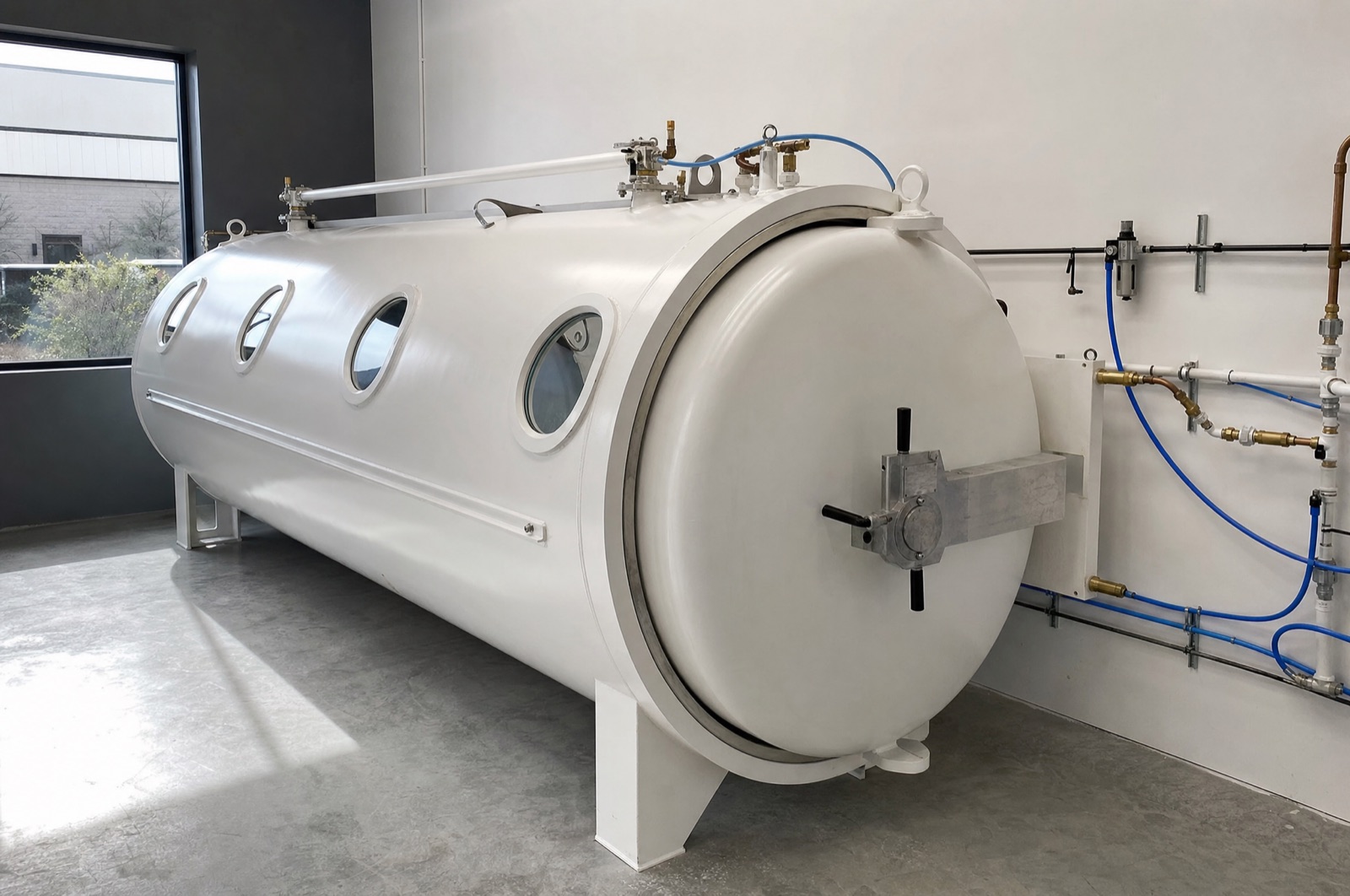
[ Clinic install ] Reference imagery; final photography in production
Hyperbaric chambers are legal in Ireland. A chamber sold for a medical purpose is a medical device under the EU Medical Devices Regulation, which applies directly in Ireland, and the Health Products Regulatory Authority (HPRA) enforces it. EU guidance places hyperbaric chambers in class IIb, so an independent notified body checks them before the CE mark goes on. Irish distributors must register with the HPRA. Advertising must match the device's intended purpose. The Health and Safety Authority (HSA) covers the pressure vessel side. This page sets out each rule, plus the public unit in Galway and how divers reach recompression. It uses the Irish Statute Book, HPRA pages, EU guidance, the ASAI code, HSA guidance and a HSE hospital page, all read on 30 October 2026. We do not say whether any treatment works.
Legal, and regulated under EU law
Ireland has no separate approval system for medical devices. It applies Regulation (EU) 2017/745, the Medical Devices Regulation, known as the MDR. An EU regulation applies in each member state without being copied into national law. Ireland adds its own rules on top to name the regulator, set offences and give inspectors powers.
Those rules are the Medical Devices Regulations 2021, S.I. 261/2021. The Minister for Health made them, and they came into operation on 26 May 2021. Regulation 4 says the HPRA performs the functions the MDR gives to national authorities, and designates the HPRA as the market surveillance authority for medical devices.
The 2021 regulations define a device as a medical device, an accessory for one, or a product listed in Annex XVI to the MDR. Annex XVI covers certain products with no medical purpose that the EU still regulates like devices. We did not confirm whether any hyperbaric chamber falls under Annex XVI, so this page treats a chamber as a medical device only when it is sold for a medical purpose. For the EU picture in more depth, see our guide to CE marking for hyperbaric chambers.
How the EU classifies a hyperbaric chamber
The MDR sorts devices into four classes: I, IIa, IIb and III. Class depends on the intended purpose and the risk. The Medical Device Coordination Group, made up of member state representatives, publishes guidance on how to apply the rules. Its MDCG 2021-24 Rev.1 guidance on classification, dated April 2026, names hyperbaric chambers directly.
They appear as an example under Rule 12. That rule covers active devices that give medicinal products, body liquids or other substances to the body, or remove them. Such devices are class IIa, unless they do it in a potentially hazardous way, which makes them class IIb. The guidance lists hyperbaric chambers among the class IIb examples, next to ventilators, anaesthesia machines and medical gas mixers.
Class matters because it decides who checks the device. The same guidance says the manufacturer is first responsible for showing conformity, and that for most classes a notified body then assesses it. The higher the class, the greater the notified body's role. The guidance adds that every device, whatever its class, must meet the general safety and performance requirements in Annex I of the MDR and falls under the vigilance reporting system. The guidance itself says it is not legally binding; only the Court of Justice of the EU can give binding readings of EU law.
Registering with the HPRA
Registration depends on the company's role in the supply chain. The HPRA's page for manufacturers established in Ireland sets out the split:
- Irish manufacturers, authorised representatives, importers and system or procedure pack producers register on Eudamed, the EU device database. The HPRA validates the application, and Eudamed issues a single registration number.
- Irish distributors and manufacturing facilities register nationally with the HPRA and receive an HPRA registration number.
- Manufacturers in other EU states that have registered on Eudamed do not need to register with the HPRA to sell in Ireland.
- Applications are processed within 10 working days.
- All registered operators pay an annual maintenance fee, invoiced in the second quarter of each year. Operators that register directly with the HPRA also pay an administration fee before registration is confirmed.
The HPRA's distributor page defines a distributor as an EU entity in the supply chain, other than the manufacturer or importer, that makes a device available on the market. It says a company that fits more than one role must register for each role separately. Both pages give the legal basis as Chapter III of the MDR and the Medical Devices (Registration) Regulations 2021, S.I. 691/2021. A clinic that buys a chamber from an Irish distributor and uses it on clients would not, on these pages, be a distributor; the pages do not address that case directly.
Offences and HPRA powers
S.I. 261/2021 turns many MDR duties into criminal offences. The ones most relevant to a chamber business are these:
- A distributor that makes available a device, other than a custom made or investigational one, without a CE marking under Article 20 of the MDR (Regulation 18).
- A distributor that makes available a device without an EU declaration of conformity (Regulation 18).
- An importer that places on the market a device without a CE marking or a declaration of conformity (Regulation 19).
- Any person who makes available or puts into service a device that fails a general safety and performance requirement in Annex I (Regulation 24).
- Any person who uses text, names, trademarks or pictures in labelling, instructions or advertising that may mislead the user or patient, contrary to Article 7 of the MDR (Regulation 24).
- Any person who uses a non compliant device in a commercial activity to provide a diagnostic or therapeutic service, including online (Regulation 24).
The HPRA can appoint authorised officers under Regulation 28, with powers to enter premises and inspect. Under Regulation 32 an officer who finds non compliance may serve a compliance notice that names the breach and the corrective action. Regulation 26 lets the HPRA bring and prosecute summary offences. On conviction, a court may order the goods forfeited to the HPRA for destruction. The text we read does not state fine amounts.
The HPRA's page on monitoring device safety describes its wider work as market surveillance. It gathers reports from manufacturers, users and other regulators, ranks issues by public health risk and how widely a device is used in Ireland, and checks that the manufacturer has a plan to fix a problem.
Anyone who has a problem with a medical device can report it to the HPRA. Its page for patients and members of the public says to tell your healthcare provider first, then report to the HPRA and the manufacturer by online form, by email to devicesafety@hpra.ie, by post or by phone. The HPRA's page for industry says Irish importers and distributors must notify the HPRA immediately if they suspect a device poses a serious risk or is falsified.
When a wellness chamber counts as a medical device
The line is the intended purpose. A chamber sold to treat or prevent disease is a medical device. A chamber sold only for relaxation is harder to place. We found no HPRA statement on mild or soft chambers as a group, and no HPRA warning or recall naming a hyperbaric chamber.
The advertising code shows why the label matters. The ASAI code section on health and beauty says, in rule 11.1, that medicinal or medical claims may be made for a medicine authorised by the HPRA or the European Medicines Agency, or for a CE marked medical device. It defines a medicinal claim as a claim that a product can be used to diagnose, treat or prevent disease, including an injury, ailment or adverse condition. A seller of a chamber with no CE marking as a medical device therefore has no route under that rule to make medical claims.
The MDCG guidance adds that the same classification rules apply to Annex XVI products, read alongside any implementing acts for them. For how the US draws a similar line, see FDA cleared vs FDA registered. For the pressure gap between the two kinds of chamber, see mild vs medical hyperbaric.
Claims and advertising
Three layers apply to chamber advertising in Ireland. The first is the MDR itself. The law firm Mason Hayes & Curran, in a September 2025 note on device marketing, says device advertising is governed mainly by Article 7 of the MDR, which bars presenting or advertising a device in a way that may mislead the user or patient about its intended purpose. S.I. 261/2021 makes that an offence, as listed above. The same note says the HPRA can order companies to withdraw misleading advertisements and issue corrective statements, though it makes that point in a general discussion rather than for devices alone.
The second layer is the ASAI code, a self regulatory code. Its health and beauty section says it governs the advertising, not the products, which health regulators such as the HPRA oversee. Rules that bear on a chamber clinic:
- Claims about health products and treatments should be backed by substantiation, which where relevant should include robust and reputable trials on human subjects (11.1).
- No reference to tests, trials or endorsements by a college, hospital, clinic or laboratory unless the establishment is genuine and under proper professional supervision (11.3).
- Advertisers should not discourage essential treatment for conditions that need medical supervision (11.5).
- Advertisers should hold substantiation before saying a product is guaranteed to work or is absolutely safe (11.8).
- Unqualified claims such as cure and rejuvenation are not generally acceptable (11.9).
- No suggestion that a product will work in every case (11.10).
- Marketing for a medical device should be consistent with its intended purpose (11.31).
The third layer is general consumer law. The Competition and Consumer Protection Commission's page on misleading advertising says an advertisement is misleading under Irish consumer law if it contains false or deceptive information or leaves out important information. It says the CCPC is responsible for enforcing advertising rules in Ireland and can take action against businesses that mislead consumers.
The pressure equipment side
A chamber is also a pressure vessel, and two sets of rules can apply. The first covers equipment placed on the market. The European Union (Pressure Equipment) Regulations 2017, S.I. 233/2017, give effect to the Pressure Equipment Directive 2014/68/EU. Regulation 3 designates the HSA as the market surveillance authority. Regulation 4 says the rules apply to pressure equipment with a maximum allowable pressure above 0.5 bar, and do not apply to the items excluded by Article 1(2) of the directive. We did not read that article, so we cannot say whether a chamber that is CE marked as a medical device is also inside these rules.
The second covers equipment used at work. The HSA's guide to the pressure systems regulations explains S.I. 445 of 2012, which added Part 10 to the General Application Regulations of 2007 and came into operation on 1 January 2013. The guide says the rules apply to pressure systems and equipment at pressures above 0.5 bar in any place of work, subject to the exceptions in Schedule 12. Pressure vessels must be examined by a competent person at set intervals, and after any repair or change that could affect safe operation. The employer must keep the reports.
The Schedule 12 exceptions include pressure equipment with a flexible casing, such as tyres, air cushions and inflatable craft. They also include systems whose vessels each hold less than 250 bar litres, and pressure equipment used for diving operations. We found no HSA statement on whether a soft chamber falls under the flexible casing exception. The guide adds that excepted equipment may still be work equipment that needs a scheme of inspections. For the US vessel standard many chamber makers cite, see our ASME PVHO-1 guide.
The national unit in Galway
The National Hyperbaric Medicine Unit at University Hospital Galway is on the ground floor of the hospital, according to its HSE West North West page. The page describes a 10 person chamber. It says patients breathe medical grade oxygen in a sealed chamber pressurised to 2.4 to 4.0 times normal atmospheric pressure.
The page lists the staff as a multidisciplinary team of intensive care nurses, advanced paramedics, anaesthetic doctors and the Galway sub aqua club. It names gas emboli, carbon monoxide poisoning and necrotising fasciitis as medical emergencies it sees, along with decompression illness after diving. For emergencies it says to call the hospital switchboard on 091 524222 and ask for the third on call anaesthetist. The page does not describe a referral process or opening hours.
A Galway Advertiser article of September 2022 described the hospital unit as the emergency hyperbaric unit for the west of Ireland and mentioned a private, non emergency chamber in the city. We did not check that private chamber's device class or status.
Diving emergencies and recompression
Diving at work has its own rule on access to a chamber. The HSA's page on compression chambers says that where a project falls under the Code of Practice for Inland Diving and Inshore Diving, the diving contractor must make sure a diver can be recompressed in an emergency. The contractor must find the nearest available chamber, agree arrangements and record them in the emergency plan.
The HSA lists points the contractor should check:
- the location of the nearest chamber and the travel time at different times of day;
- that the chamber is certified, in date, operational and available for the whole project;
- that a competent chamber operator is available;
- suitable transport, drivers and vehicles.
The same page says the Irish Coast Guard helicopter will only take a diver to the nearest available chamber within the Irish Search and Rescue Region. If a diver needs treatment outside it, for example in the UK, the contractor must arrange other transport. Offshore projects under the Code of Practice for Offshore Diving must have a two person, two compartment chamber at the worksite. For general hazards of chambers, see hyperbaric chamber safety.
Hospital unit and wellness chamber side by side
| Question | Hospital unit or medical chamber | Wellness or home chamber |
|---|---|---|
| Banned? | No | No ban found |
| Law that applies | EU MDR and S.I. 261/2021 | The same, if sold for a medical purpose; no HPRA ruling on mild chambers found |
| Device class | IIb, per MDCG 2021-24 Rev.1 | IIb if it is a medical device; not confirmed otherwise |
| Who checks it | A notified body, then CE marking | Not confirmed for chambers with no medical purpose |
| Seller registration | Eudamed or HPRA, by role | The same, if it is a medical device |
| Pressure | 2.4 to 4.0 times atmospheric at the Galway unit | Not set by any Irish rule we found |
| Workplace pressure rules | Above 0.5 bar, with Schedule 12 exceptions | Same at a workplace; flexible casing exception may matter; not confirmed |
| Medical claims in ads | Allowed for a CE marked device, within its intended purpose | No route under ASAI rule 11.1 without CE marking as a device |
| Who enforces | HPRA, HSA, ASAI, CCPC | HPRA, HSA, ASAI, CCPC |
Sources: S.I. 261/2021 and S.I. 233/2017 on the Irish Statute Book; MDCG 2021-24 Rev.1; HPRA registration, distributor and safety pages; ASAI code section 11; HSA pressure systems guide; HSE West North West Galway unit page. All linked above, read 30 October 2026.
For the same question in other countries, see hyperbaric chamber rules in Australia, Canada and the UK, chamber rules in Germany and France and chamber rules in New Zealand. For the chambers we track and what we can verify about each, see the scorecard.
What we have not verified
EUR-Lex blocked our requests, so we did not read the MDR text itself. The points on Article 7, Article 20, Annex I and Annex XVI come from S.I. 261/2021, the MDCG guidance and the Mason Hayes & Curran note, which cite them. We did not read Article 1(2) of the Pressure Equipment Directive, so we cannot say whether a CE marked medical chamber is also inside S.I. 233/2017. The fine amounts for offences under S.I. 261/2021 are not in the text we read; they appear to sit in the parent Act, which we did not read. We found no HPRA guidance, warning or recall on hyperbaric chambers, no HPRA view on whether a mild or soft chamber is a medical device, and no ASAI or CCPC decision naming a chamber seller. We did not confirm whether the HSA treats a soft chamber as flexible casing under Schedule 12. We did not check who may give medical oxygen in a wellness setting in Ireland, whether the HSE funds any elective hyperbaric treatment, or the Galway unit's referral rules and hours. We did not confirm which Irish notified body, if any, certifies hyperbaric chambers.
Frequently asked
Are hyperbaric chambers legal in Ireland?
Yes. We found no ban. A chamber placed on the market for a medical purpose is a medical device under Regulation (EU) 2017/745, the EU Medical Devices Regulation. The Medical Devices Regulations 2021, S.I. 261/2021, give the Health Products Regulatory Authority (HPRA) its functions under that regulation and make it the market surveillance authority for medical devices in Ireland.
What class of medical device is a hyperbaric chamber in the EU?
Class IIb, in the examples of the EU classification guidance MDCG 2021-24 Rev.1, dated April 2026. It lists hyperbaric chambers under Rule 12, which covers active devices that give substances to the body in a potentially hazardous way. The same guidance says the higher the class, the greater the role of a notified body in checking conformity. The guidance is not legally binding.
Does a chamber seller in Ireland need to register with the HPRA?
It depends on the role. The HPRA says distributors established in Ireland must register their organisation details and device types nationally with the HPRA. Irish manufacturers, importers and authorised representatives register on Eudamed, and the HPRA validates the application. Manufacturers already registered on Eudamed in another EU state do not need to register with the HPRA. The national rules are in S.I. 691/2021.
Can a wellness centre in Ireland advertise hyperbaric oxygen as a treatment?
The ASAI code says medicinal or medical claims may be made for a medicine authorised by the HPRA or EMA, or for a CE marked medical device, and that marketing for a device should be consistent with its intended purpose (rule 11.31). Claims must be substantiated, and unqualified cure claims are not generally acceptable (rule 11.9). Misleading device advertising contrary to Article 7 of the EU regulation is also an offence under S.I. 261/2021.
Where is the public hyperbaric chamber in Ireland?
The National Hyperbaric Medicine Unit is on the ground floor of University Hospital Galway. Its HSE West North West page describes a 10 person chamber pressurised to 2.4 to 4.0 times normal atmospheric pressure, staffed by intensive care nurses, advanced paramedics, anaesthetic doctors and the Galway sub aqua club. In an emergency the page says to call the hospital switchboard on 091 524222 and ask for the third on call anaesthetist.
Do pressure equipment rules apply to a hyperbaric chamber in Ireland?
At work, they can. The Health and Safety Authority guide to S.I. 445 of 2012 says the workplace pressure systems rules apply to equipment above 0.5 bar, with exceptions listed in Schedule 12, and require examination by a competent person. Separately, S.I. 233/2017 makes the HSA the market surveillance authority for pressure equipment placed on the market. We did not confirm how either applies to a given chamber.

Alex tests the machines himself, in clinics and studios on three continents. Every score comes from the same 27 public criteria, and no manufacturer has a say in them.
Six questions, and we'll match chamber, options, and install to your space and budget.