Hyperbaric Chamber Rules in Malaysia: MDA Class C, Registration, Licences and Advertising Law
Researched and scored by Alex Evans. Last reviewed August 2026. Corrections are dated and public. See corrections
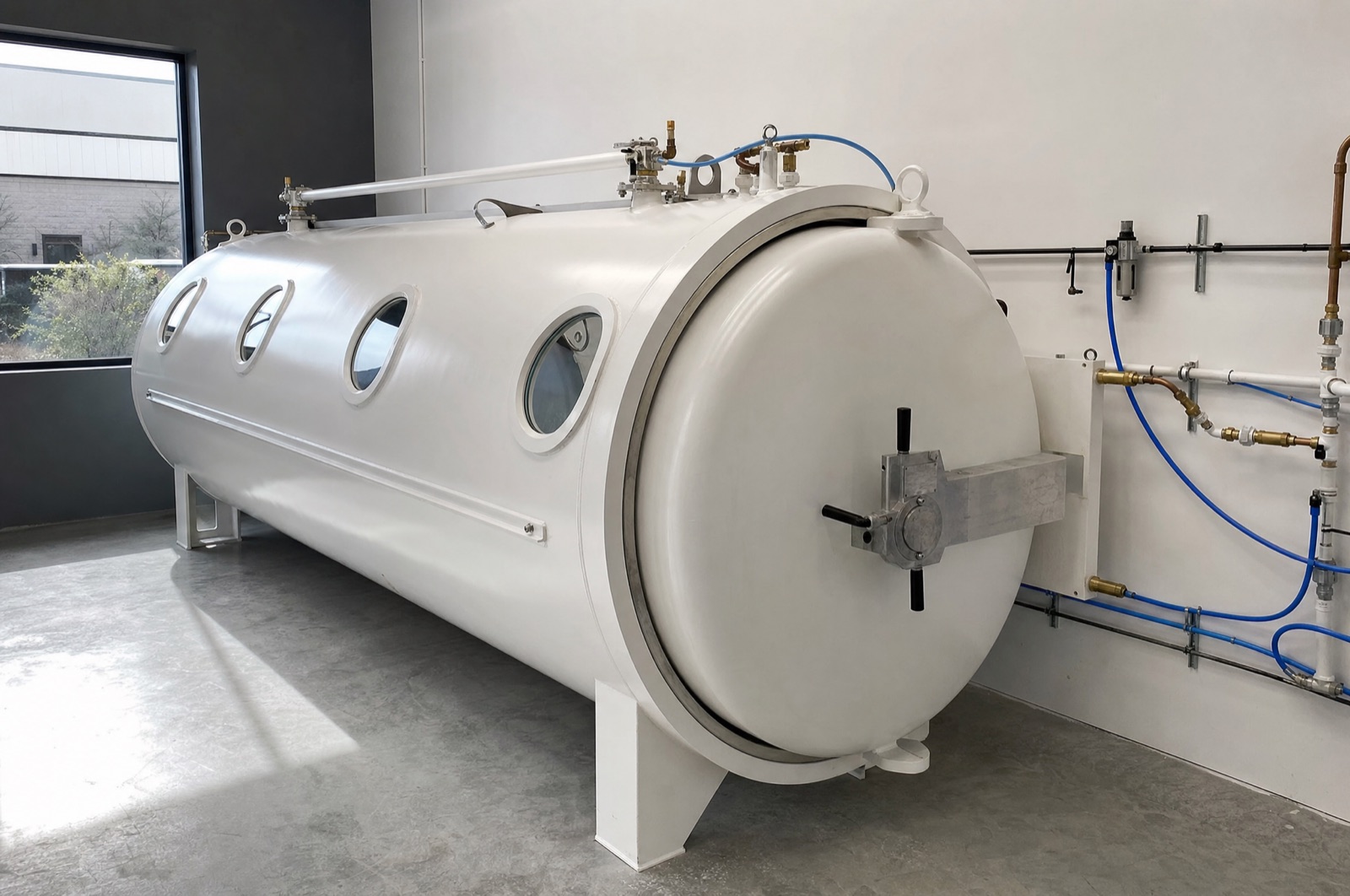
[ Clinic install ] Reference imagery; final photography in production
Hyperbaric chambers are legal in Malaysia. A chamber sold for a medical purpose is a medical device under the Medical Device Act 2012 (Act 737). It must be registered with the Medical Device Authority (MDA), and the firm that imports or supplies it needs an establishment licence. MDA guidance gives the hyperbaric chamber as an example of a Class C device. Ads need MDA approval and must follow an MDA code. A 1956 law on medical advertising, clinic licensing and pressure vessel rules add further layers. This page covers each one for hospital units and for home or wellness chambers. It uses MDA web pages and guidance documents, the text of three Acts on the Lawplayer database, a law firm alert, DOSH pages and guides, a business chamber note, a 2006 journal article and two news reports. We do not say whether any treatment works.
Legal, and regulated as a medical device
MDA's background page says Act 737 and the Medical Device Authority Act 2012 (Act 738) were published in the Gazette on 9 February 2012, and that MDA has been fully in operation since 16 June 2012.
We read the Act on Lawplayer, which shows the text as at 1 March 2017 and notes that later amendments may be missing. Two sections set the base rules:
- Section 5(1): no medical device shall be imported, exported or placed in the market unless it is registered under the Act.
- Section 15(1): no establishment shall import, export or place in the market a registered device unless it holds an establishment licence.
On the Lawplayer text, breach of either section is an offence with a fine of up to RM200,000, prison of up to three years, or both. We found no rule that bans hyperbaric chambers or limits them to hospitals.
Where the hyperbaric chamber sits in the risk classes
Malaysia sorts general medical devices into four classes. MDA's classification guidance, MDA/GD/0009, second edition, dated 1 April 2022, gives them as Class A, low risk; Class B, low-moderate risk; Class C, moderate-high risk; and Class D, high risk. Its examples for Class C are a lung ventilator and orthopedic implants.
Rule 11 covers active devices that give or remove medicines, body liquids or other substances. They are Class B, unless this is done in a way that is potentially hazardous, given the substance, the part of the body and the route. In that case they are Class C. The examples the guidance lists for Class C under this rule are infusion pumps, anesthesia equipment, dialysis equipment, hyperbaric chambers and some nebulizers. The first edition of March 2014 gives the same example under the same rule.
Two points limit this. The guidance says its examples are for illustration only, and that the manufacturer must apply the rules to each device by its intended purpose. Section 3 of Act 737 also says the establishment classifies the device by its risk. If an establishment and a conformity assessment body disagree, the guidance says the establishment may ask MDA in writing, within thirty days of the dispute, to decide. For how the US files the same device, see FDA cleared vs FDA registered, and for Europe, see CE marking for hyperbaric chambers.
Registration and the establishment licence
MDA's registration page cites section 5(1) and names the online system, MeDC@St 2.0. It links separate process flows for Class B, C and D devices. It says a holder should apply to re-register one year before the certificate expires, but does not state how long a registration lasts.
The licence side sits on MDA's establishment licence page. It says an establishment is a manufacturer, importer or distributor, but not a retailer, or an authorised representative appointed by a maker whose main place of business is outside Malaysia. A 2019 alert by the law firm Skrine quotes the full definition from the Act. The person or representative must be resident in Malaysia or a Malaysian firm, and must carry on business mainly in Malaysia.
The same alert summarises the Medical Device (Duties and Obligations of Establishments) Regulations 2019. It says they were gazetted on 15 November 2019 and took effect on 1 July 2020. An establishment must:
- keep distribution records and complaint records;
- report incidents to MDA, and send an investigation report within 30 days of a mandatory report;
- notify MDA before a field corrective or preventive action, and follow the rules on voluntary and mandatory recalls.
When a wellness chamber counts as a medical device
In Malaysia, the maker's intended purpose decides. MDA's definition guidance, MDA/GD/0006, first edition, March 2014, says the definition is legally binding and sets the scope of control. It covers any instrument, apparatus, machine or similar article intended by the manufacturer for human use for seven purposes. They include diagnosis, prevention, monitoring, treatment or alleviation of disease, and investigation, replacement, modification or support of the anatomy or of a physiological process. The device must not achieve its main action by pharmacological, immunological or metabolic means.
The Act adds a second limb, which the Skrine alert quotes. The Minister may declare an article used on the human body to be a medical device by order in the Gazette, after weighing public safety, public health or public risk. We found no such order for hyperbaric chambers.
Many soft chambers run on air at lower pressures, and the MDA documents we read do not address them. A soft chamber sold with wording about a physiological process may fall inside the definition. We found no MDA ruling or guidance on soft or mild chambers. For the pressure and gas differences between the two kinds of chamber, see mild vs medical hyperbaric.
Using a chamber on clients
Act 737 also reaches the people who run a device. Section 43, on the Lawplayer text, says a person who uses or operates a medical device on a third party must make sure it is safe and efficacious and used for its intended purpose. It must be used to the maker's instructions and be properly installed, tested, commissioned and maintained. Those who use, install, test, maintain or dispose of a device must have the qualifications and competency the Minister prescribes. A device that is no longer safe and effective must be taken out of use and disposed of safely.
Breach of these duties carries a fine of up to RM100,000, prison of up to one year, or both. We did not find the regulations that set the qualifications. For the hazards these duties aim at, see hyperbaric chamber safety and NFPA 99 and hyperbaric fire safety.
Advertising: section 44 and the 2019 regulations
Section 44 of Act 737 sets two rules. No person shall advertise a medical device unless it has been registered. No person shall make misleading or fraudulent claims about a device in an ad. On the Lawplayer text, breach carries a fine of up to RM300,000, prison of up to three years, or both.
The Skrine alert says the Medical Device (Advertising) Regulations 2019 were gazetted on 15 November 2019 and took effect on 1 July 2020. Per the alert, they:
- bar anyone from advertising a registered medical device without MDA approval;
- set out the documents and fees for an application;
- require the ad to state that the device is registered under the Act and to show its registration number.
Advertising: the MDA Code of Advertisement
MDA's Code of Advertisement, MDA/GD/0032, second edition, March 2021, says it applies to ads for all medical devices, whether they need approval or not. Its rules for a chamber seller or clinic include:
- Claims must match the intended use registered with MDA, and must not be stronger than scientific evidence warrants.
- No words or images may claim or imply the cure of any of 26 diseases and conditions in Annex A. The list includes cancer, diabetes, hypertension, heart disease, paralysis and kidney disease, and the code says it is not exhaustive.
- Ads may not suggest a device will control, slow or reverse ageing, enhance brain or memory function, give immunity against specific diseases, reduce the stress of modern living, or improve performance in sports and studies.
- In ads to the general public, no statement or image of a healthcare professional may give the impression of professional endorsement, and white coats and stethoscopes are not allowed for that purpose.
- Testimonials must be genuine, refer only to the approved intended purpose and be backed by a consent letter.
Advertising: the Medicines (Advertisement and Sale) Act 1956
A separate law controls medical advertising. We read the Medicines (Advertisement and Sale) Act 1956 on Lawplayer, as at 1 January 2006. Section 3(1) bars ads for any article in terms that lead to its use as a medicine, an appliance or a remedy to prevent or treat a disease in the Schedule. The Schedule begins with diseases of the kidney and heart, diabetes, epilepsy, paralysis, tuberculosis and asthma.
Section 4A goes further for services. It bars ads that refer to any skill or service for the treatment, prevention or diagnosis of any ailment, disease, injury, infirmity or condition of the body. Exceptions cover ads by professional medical bodies with the Minister's approval, and ads by private hospitals and certain clinics with the approval of the Medicine Advertisements Board. We found no ruling that applies the Act to a hyperbaric session.
Licensing the clinic
The Private Healthcare Facilities and Services Act 1998 (Act 586) licenses private premises. We read it on Lawplayer, as at 1 May 2006. Section 3 says no person shall set up or keep listed facilities without approval, or run them without a licence. The list includes private hospitals, private ambulatory care centres, private haemodialysis centres and other facilities the Minister names in the Gazette.
A private medical clinic is premises used for the practice of medicine on an outpatient basis. That includes curing or easing any abnormal condition of the body by the application of any apparatus, equipment, instrument or device. Healthcare services include services for preventive or promotive health purposes, and any health-related services. The Act does not name hyperbaric therapy, and we found no MOH notice on which class a chamber centre falls into.
The pressure vessel side
Malaysia changed its pressure vessel law in 2024. An AmCham Malaysia note says the Occupational Safety and Health (Amendment) Act 2022 came into force on 1 June 2024, under P.U.(B) 128/2024. It says the Factories and Machinery Act 1967 is repealed and its rules folded into the Occupational Safety and Health Act 1994. DOSH's list of repealed regulations includes the Factories and Machinery (Steam Boilers and Unfired Pressure Vessels) Regulations 1970.
The new rules are the Occupational Safety and Health (Plant Requiring Certificate of Fitness) Regulations 2024. A DOSH guide for imported pressure vessels says they were made under section 27B of the 1994 Act and took effect on 1 June 2024. The guide defines a pressure vessel as an enclosed vessel with pressure greater or less than atmospheric pressure. It says any pressure vessel must get design verification before it enters Malaysia, through the MySKUD system, and must meet a design code listed in the Fourth Schedule. Vessels in the Second Schedule are outside its scope.
A rigid chamber is an enclosed vessel above atmospheric pressure, so it may fit the plain words. No DOSH page we read names hyperbaric chambers or vessels for human occupancy. We did not read the Second Schedule. Many chamber makers cite ASME PVHO-1; see our ASME PVHO-1 guide. We do not know if it appears in the Fourth Schedule.
Military, university and public hospital units
The armed forces built Malaysia's first hospital units. A 2006 article in the Medical Journal of Malaysia says the Navy installed recompression chambers at its bases in Lumut, Kuantan and Labuan in 1982. It says the Armed Forces Hospital in Lumut began operating in 1996 with a three-compartment multiplace chamber for up to 14 people, the first hospital-based chamber of its kind in Malaysia. At the time of writing, the article said, there was no hyperbaric facility in any Ministry of Health hospital. Hospital Universiti Sains Malaysia had a monoplace chamber from 2004, and four private clinics and one private hospital were registered with chambers.
Two recent reports show the field in 2026. USM reported on 8 May 2026 that a team from its specialist hospital visited the Underwater and Hyperbaric Medicine Institute at 96 Armed Forces Hospital, Lumut, to discuss work in hyperbaric medicine. Kosmo reported on 20 April 2026 that the Universiti Sultan Zainal Abidin hospital (HoSZA) began running a multiplace chamber on 15 March, for up to seven patients per session. It called the unit the first and only one at a university teaching hospital in Malaysia.
We found no MOH fee schedule or insurance rule for the treatment. For how US payers code it, see hyperbaric insurance and CPT codes.
Hospital unit and wellness chamber side by side
| Question | Hospital unit | Home or wellness chamber |
|---|---|---|
| Banned? | No | No ban found |
| Medical device? | Yes, under the Act 737 definition | Depends on the maker's intended purpose; no MDA ruling found |
| Risk class | Class C example under Rule 11 of MDA/GD/0009 | Not addressed in the MDA documents we read |
| Registration | Required under section 5, via MeDC@St 2.0 | Same, if it is a medical device |
| Firm that imports or supplies it | Establishment licence under section 15 | Same, if it is a medical device; retailers are not establishments |
| Duties of the operator | Section 43: safe use, maintenance, competency | Same, if it is a medical device used on others |
| Ads | MDA approval, Code of Advertisement, 1956 Act | Same for a device; the 1956 Act may reach services |
| Premises licence | Act 586 for private facilities | Not confirmed for wellness centres |
| Pressure vessel rules | 2024 certificate of fitness rules; chamber status not confirmed | Same; soft chambers not addressed |
Sources: Medical Device Act 2012, Medicines (Advertisement and Sale) Act 1956 and Private Healthcare Facilities and Services Act 1998 on Lawplayer; MDA/GD/0009 second edition, 1 April 2022; MDA/GD/0006; MDA/GD/0032; MDA registration and establishment licence pages; Skrine alert of 19 November 2019; DOSH imported pressure vessel guide and repealed regulations list; AmCham Malaysia note. All linked above, read 2 November 2026.
For the same question nearby, see chamber rules in Singapore and chamber rules in India. For how a concentrator fits a chamber setup, see oxygen concentrators for hyperbaric chambers. For the chambers we track and what we can verify about each, see the scorecard.
What we have not verified
We read Acts 737, 290 and 586 on Lawplayer, a private database, with texts as at 2017, 2006 and 2006. The official Laws of Malaysia site was not checked, so later amendments, including to the fines quoted, are possible. We did not read the Medical Device Regulations 2012 or the 2019 advertising and establishment regulations themselves; those points come from the Skrine alert. A 2026 second edition of the MDA definition guidance exists, and we read only the 2014 first edition. We did not search the MDA register for any registered chamber. We could not load DOSH's older design approval page or the 2024 regulations, so we do not know whether the Second Schedule exempts chambers, or whether ASME PVHO-1 is a recognised code. We did not check rules on oxygen storage or medical gas. We could not open a tender notice for hyperbaric works at Hospital Kuala Lumpur, so we do not know whether that unit is in use. We found no MOH notice on which Act 586 class covers a chamber centre, and no MDA or Medicine Advertisements Board decision naming a chamber seller.
Frequently asked
Are hyperbaric chambers legal in Malaysia?
Yes. We found no ban. The Medical Device Act 2012 (Act 737) says no medical device may be imported, exported or placed in the market unless it is registered under the Act, and no establishment may do those things without an establishment licence. A chamber sold for a medical purpose falls under those rules. We found no rule that limits chambers to hospitals.
What risk class is a hyperbaric chamber in Malaysia?
MDA guidance points to Class C, which it calls moderate-high risk. The second edition of MDA/GD/0009, dated 1 April 2022, lists hyperbaric chambers as an example under Rule 11, for active devices that give substances to the body in a potentially hazardous way. The guidance says examples are for illustration only. Under section 3 of Act 737, the establishment classifies the device.
Who registers a hyperbaric chamber with the Medical Device Authority?
Act 737 makes registration a condition for import, export and placing on the market. The Act defines an establishment as a manufacturer, importer or distributor that places a device on the market, not a retailer, or an authorised representative appointed by a maker based outside Malaysia. That representative must be resident in Malaysia or a Malaysian firm. MDA runs registration through its MeDC@St 2.0 system.
Is a mild or soft hyperbaric chamber a medical device in Malaysia?
It depends on what the maker says it is for. The Act 737 definition covers articles intended by the manufacturer for listed purposes, including modification or support of the anatomy or of a physiological process. The Minister may also declare an article to be a medical device by order in the Gazette. We found no MDA ruling on soft or mild chambers as a group.
Can a clinic in Malaysia advertise hyperbaric treatment?
Several rules apply. Section 44 of Act 737 bars ads for an unregistered device and bars misleading or fraudulent claims. The 2019 advertising regulations require MDA approval to advertise a registered device. MDA's Code of Advertisement bars claims of curing 26 listed diseases and conditions, and claims about ageing, stress, immunity and sports performance. The Medicines (Advertisement and Sale) Act 1956 also controls ads for services that treat a condition.
Does a hyperbaric chamber need a DOSH certificate of fitness?
We could not confirm it. DOSH says the Occupational Safety and Health (Plant Requiring Certificate of Fitness) Regulations 2024 took effect on 1 June 2024, and its guide defines a pressure vessel as an enclosed vessel with pressure greater or less than atmospheric pressure. The guide excludes vessels listed in the Second Schedule. We did not read that schedule, and no DOSH page we read names hyperbaric chambers.

Alex tests the machines himself, in clinics and studios on three continents. Every score comes from the same 27 public criteria, and no manufacturer has a say in them.
Six questions, and we'll match chamber, options, and install to your space and budget.