Are Hyperbaric Chambers Legal in Israel? Special Device Licences, the Medical Equipment Register and Coverage
Researched and scored by Alex Evans. Last reviewed August 2026. Corrections are dated and public. See corrections
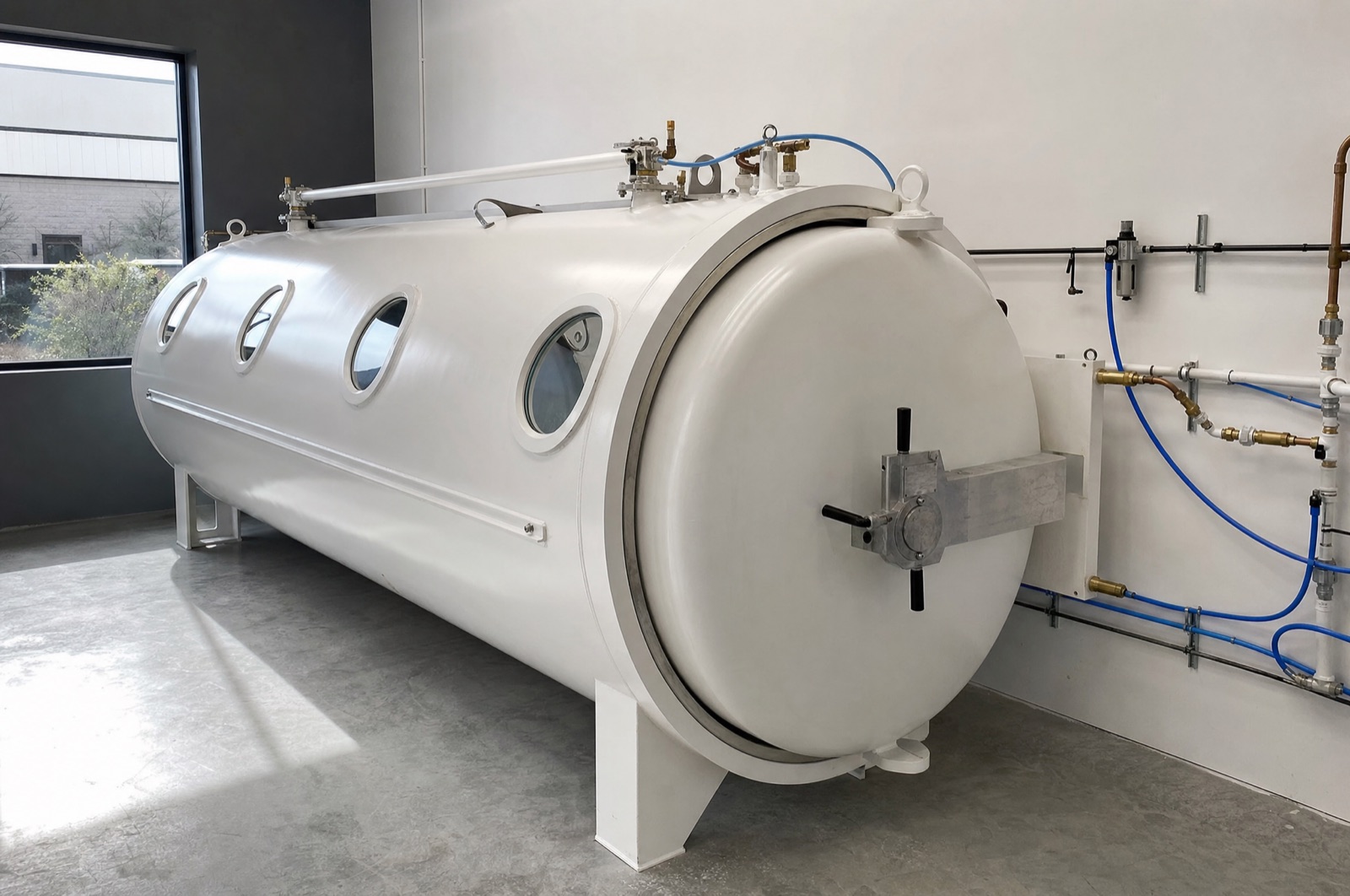
[ Clinic install ] Reference imagery; final photography in production
Hyperbaric chambers are legal in Israel, but only under licence. The Public Health Regulations (Special Medical Devices) 1994 list a chamber for hyperbaric oxygen treatment as a special medical device. No one may buy or use one without a written licence from the director general of the Ministry of Health. Since July 2022 the quota is ten fixed chambers and two mobile ones, and a licence goes only to a large public general hospital. New chambers must also be on the medical equipment register kept under the Medical Equipment Law 5772-2012. This page covers each rule for hospital units and for home or wellness chambers. It uses the law and a 2023 bill on the Knesset site, a 2022 amendment in the official gazette, a Ministry of Health freedom of information answer, a Knesset research paper, an ombudsman position paper and a public hospital consent form. Most sources are in Hebrew, and the translations are ours. We do not say whether any treatment works, and we do not name or rate any clinic.
Legal, but only under licence
We found no ban on hyperbaric chambers. We found a licence duty and a fixed national quota. In a freedom of information answer dated 12 February 2020, the Ministry of Health said the chamber quota set in the 1994 regulations was full, for both multiplace and one-person chambers. A Knesset Research and Information Center paper of 5 July 2022 quotes a ministry letter of May 2022: all chambers operating outside hospitals were operating without a licence, because their activity breaches the regulations (our translation). The same paper says the ministry had found 10 to 15 unlicensed chambers.
Two sets of rules
Two separate regimes apply, and a chamber must satisfy both. The first is the Medical Equipment Law, which governs whether a device may be made, sold or used at all. It works through a register. The second is the Public Health Ordinance 1940 and the special device regulations made under its section 65B. They govern whether a given institution may buy and run a high-cost device, and how many such devices the country may have. The ministry's 2020 answer ties the two together. It says some licensed chambers are not on the medical equipment register, because that duty was not in force when their licences were issued. It adds that applications examined today must meet the register requirement, among other conditions.
The Medical Equipment Law and the register
We read the Medical Equipment Law as published in Sefer HaHukim 2357 on 14 May 2012, on the Knesset site. The Knesset passed it on 8 May 2012. Section 1 defines medical equipment to include a device used for medical treatment, and a device or software needed to run it. Section 2(a) says medical equipment shall be made and marketed only if it is registered and in line with its registration terms, unless it is listed in the Second Schedule as not needing registration. It also limits medical use to registered equipment.
- Section 4 lets the minister set rules under which the director may allow unregistered equipment for essential treatment, research, development, emergencies or export only.
- Section 15 sets a penalty of one year in prison or a fine for making or marketing unregistered equipment, other than for personal use, and for using it in medical treatment. A company faces double the fine.
- Section 24 says the law takes effect 60 days after regulations under sections 3, 4, 6 and 8 take effect, and that sections 2(a), 15 and 16 start one year after that.
- Section 25 treats devices on the older register of medical accessories and devices as registered under the new law until their registration expires.
The law does not name hyperbaric chambers. It also does not sort devices into risk classes, and we found no official page that gives a chamber's class. For how other systems class the same device, see FDA cleared vs FDA registered and CE marking for hyperbaric chambers.
Recognised countries
Section 6(b) is the reliance route. A government bill published on 27 February 2023 quotes the section as it stood. If the director is satisfied that the equipment is registered or allowed for sale in a recognised country and sold there, the director shall register it. The Israeli registration may not run longer than the period it may be sold in that country, and conditions set there carry over. The bill's notes say the premise is that such equipment can be assumed to be safe, effective and of good quality.
The First Schedule of the 2012 law lists 21 recognised countries: Austria, Australia, Italy, Iceland, Ireland, the United States, Belgium, the United Kingdom, Germany, Denmark, the Netherlands, Greece, Norway, New Zealand, Spain, Portugal, Finland, France, Canada, Sweden and Switzerland. Japan is not on the 2012 list. The 2023 bill proposed two changes. Equipment approved in one recognised country could be registered if sold in another. And equipment approved under EU Regulation 2017/745 in an EU state not on the list could be registered too. The bill says it was first published in May 2022. We did not confirm that it became law.
The special medical device licence
The 1994 regulations were made under sections 33 and 65B of the Public Health Ordinance. We read the consolidated text on Hebrew Wikisource, a volunteer transcription that links each amendment to its gazette scan. We checked the chamber item against the gazette itself, below.
- Regulation 1 defines a special device as a medical device or system of a type listed in the Schedule. A licence means a licence to buy and operate one. Buying includes receiving a device from another person by any form of transfer.
- Regulation 2(a) says no one may buy or use a special device without a written licence from the director general. A licence may carry conditions.
- Regulation 3 lists what the director weighs: public health effect, the device rate per head set in the Schedule, public access, the share of publicly funded use, running costs, and the device's safety and effectiveness for its purpose.
- Regulation 6 says the licence names the medical institution where the device sits. For a mobile device, it names the districts and institutions where it may run.
The regulations also require licence holders to report each year. The Knesset paper says the 2021 reporting form asked for the number of chambers and seats, patients and treatments, the split by indication and by public or private funding, and the average wait.
What counts as a chamber
Item 11 of the Schedule covers the chamber. We read the amending regulations in Kovetz HaTakanot 10252 of 10 July 2022, a gazette scan hosted by the Open Law project. The health minister signed them on 6 July 2022, with the finance minister's consent and the approval of the Knesset Health Committee. They renamed the item a chamber for hyperbaric oxygen treatment in which the pressure exceeds 1 atmosphere absolute (our translation).
The Knesset paper explains the change. The old item named only a chamber for hyperbaric oxygen treatment, with no pressure level. At committee hearings in June 2022, a private clinic argued that no licence was needed below 1.4 atmospheres. The ministry said the rules already covered all chambers, and that the new wording aimed to end public confusion after services between 1 and 1.4 atmospheres were offered privately. The paper notes that circular 37/99 defines hyperbaric treatment as 100% oxygen in a chamber at 1.4 atmospheres absolute or more. The ministry's 2020 answer gave the same reading: the Schedule means any device used for oxygen treatment above one atmosphere.
The quota and where chambers may sit
The 2022 amendment set new licence conditions. A chamber may sit in a public general hospital, as defined in section 54 of the Economic Efficiency Law 2016, that has:
- at least 900 inpatient beds;
- a general emergency room;
- an intensive care department, a general surgery department and an orthopaedics department;
- a chamber treatment unit approved by the director;
- departments or units with beds approved for vascular and plastic surgery.
In the northern district the director may license one chamber in a smaller public general hospital. The device must be able to reach at least 2 atmospheres absolute. The quota column now reads ten: three in the north, three in the south and four in the centre, and the director may approve two mobile chambers. The Knesset paper says the earlier limit was six fixed chambers, two per region, and that the ministry counts Jerusalem as part of the south. It says that at the end of 2021 only four public hospitals met the 900 bed test on their own, rising to six if two merged campuses are counted.
The licence duty also binds public hospitals. A private member bill tabled on 5 June 2023 proposed to remove the minister's power to require a special device licence in public general hospitals. Its notes argue the duty causes shortages and long waits. We did not find that it passed, and it would not reach private clinics.
Licensed units
The Knesset paper lists six institutions licensed in 2022, from a ministry letter. Five are public or military:
- the Institute for Maritime Medicine of the Israel Defense Forces, in Haifa;
- Hadassah Ein Kerem Medical Center, in Jerusalem;
- Shamir Medical Center (Assaf Harofeh), in Be'er Ya'akov;
- Tel Aviv Sourasky Medical Center (Ichilov);
- Yoseftal Medical Center, in Eilat.
The sixth is a private hospital in Haifa. The paper says the ministry had only partial data on use. Those data show 1,312 patients and 54,614 treatments in hospitals in 2018, 1,071 and 42,763 in 2019, and 1,123 and 39,783 in 2020. The 2020 answer said licences for the Tel Aviv and Hadassah chambers had not yet been issued, as both units were still being built. We did not find which hospitals, if any, received the four extra fixed places created in 2022.
Mild and home chambers
On the ministry's reading, a chamber above one atmosphere used for oxygen treatment is a special device, and a licence goes only to a qualifying hospital. We found no separate route for a soft chamber, a home unit or a wellness centre. The Knesset paper says the ministry's September 2020 warning noted that some firms rent chambers for home use, and that use at home without medical supervision carries a risk of fire or explosion and a medical risk to the user. It also says inflatable bags were sold in Israel as chamber treatment, and that the ministry warned against them in November 2017.
Item 11 names a chamber for hyperbaric oxygen treatment. We found no ruling on a chamber that runs on room air, with no added oxygen. For the pressure and gas differences between the two kinds of chamber, see mild vs medical hyperbaric, and for fire and oxygen hazards, see hyperbaric chamber safety and NFPA 99 and hyperbaric fire safety.
Advertising and public warnings
The Medical Equipment Law defines advertising as publication of medical equipment aimed at the public, orally, in writing or by any other means, except in scientific literature. It lets the director attach conditions to a registration, and the listed conditions include limits on how the equipment may be advertised and what an ad may say. It also lets the director limit the advertising of equipment that is harmful or may harm public health. We found no separate advance approval duty for device ads in the text we read.
The Knesset paper cites a ministry warning of 14 September 2020 about chamber treatments that the ministry has not approved. It says the ministry told the research centre that it follows the opening of unlicensed private chambers, runs surprise inspections and works to close them where suitable. A ministry representative told the Health Committee in June 2022 that many closure orders had been issued to clinics running devices without a licence. We could not load the ministry's news pages, so we rely on the paper's account of these warnings.
Health basket coverage
An ombudsman position paper for the National Health Insurance Law, published on gov.il and undated on its face, quotes the Second Schedule to that law. Item 6(c)(6), under intensive care, lists hyperbaric treatment among the services health funds must provide. The paper says the circular of indications reflects medical knowledge at the time it was issued, and that coverage is not frozen at the 1994 base date. It ruled one complaint against a health fund justified.
The Knesset paper says circular 37/99, dated 23 August 1999, lists 15 indications in the basket, 11 urgent and four elective. It says draft updates were written but no new circular was issued, which the ministry put down to objections from various parties. It adds that hospital units also offer treatment for indications outside the basket. The Tel Aviv Sourasky consent form has the patient mark whether their indication is in the basket or not. The 2020 answer says the ministry itself does not fund chamber treatments. For how US payers code the same service, see hyperbaric insurance and CPT codes.
Importing a chamber
We found no rule written for chamber imports. Three general points apply. The special device licence covers buying and using, and buying includes any transfer, so an institution needs the licence before it acquires a chamber. Marketing a device that needs registration requires it to be on the register, and the recognised country route can support that filing. Section 23 of the 2012 law amended the Standards Law 1953. It lets the minister exempt imported medical equipment from conformity testing against an official Israeli standard, and ask instead for documents showing it meets an international standard. For a chamber shipped into the US instead, see importing a hyperbaric chamber into the US.
Hospital unit and home chamber side by side
| Question | Hospital unit | Home or wellness chamber |
|---|---|---|
| Banned? | No | No ban as such, but no licence route found |
| Special medical device? | Yes, item 11 of the 1994 Schedule | Yes if above 1 ATA and used for oxygen treatment; air only not addressed |
| Licence to buy and use | Required under regulation 2 | Required; ministry says units outside hospitals are unlicensed |
| Where allowed | Public general hospital with 900 beds and listed departments | Not allowed under the 2022 conditions, on our reading |
| Quota | Ten fixed (3 north, 3 south, 4 centre) plus 2 mobile | Counts against the same quota |
| Minimum capability | At least 2 ATA | Same condition |
| Medical equipment register | Required for new chambers | Required to market a registrable device |
| Foreign approval | Supports registration via section 6(b) | Same; does not replace the licence |
| Risk class | Not found | Not found |
| Basket coverage | For listed indications under circular 37/99 | None found |
Sources: Medical Equipment Law 5772-2012 and government bill of 27 February 2023 on fs.knesset.gov.il; Kovetz HaTakanot 10252, 10 July 2022; consolidated 1994 regulations on Hebrew Wikisource; Ministry of Health freedom of information answer, 12 February 2020; Knesset Research and Information Center paper, 5 July 2022; National Health Insurance ombudsman position paper on gov.il; Tel Aviv Sourasky consent form. All linked above, read 5 November 2026.
For the same question elsewhere, see chamber rules in the UAE, chamber rules in Saudi Arabia and chamber rules in Germany and France. For the chambers we track and what we can verify about each, see the scorecard.
What we have not verified
We could not load the Ministry of Health pages on gov.il for the Medical Devices Division (AMAR), so we did not read its own guidance on registration, reliance or fees. We did not read the registration regulations of 2013 or confirm the date the Medical Equipment Law took full effect. We read the 2012 text as a scan with overlapping layers on some pages, so we cite only sections we could read cleanly. We did not confirm whether the 2023 bill on EU approvals became law, whether the recognised country list has changed since 2012, or whether Japan has been added. We found no official risk class for a chamber. We did not read circular 37/99 itself or the ministry warnings of 2017 and 2020, and rely on the Knesset paper for them. We did not read the 1994 regulations in their original gazette form, only the 2022 amendment. We did not confirm whether the old limit of one chamber seat per 70,000 people survived the 2022 amendment. We found no ruling on air-only chambers, and no rule on personal import of a chamber for home use. We did not find which hospitals hold licences today.
Frequently asked
Are hyperbaric chambers legal in Israel?
Yes, under licence. The Public Health Regulations (Special Medical Devices) 1994 list the hyperbaric chamber as a special medical device. Regulation 2 says no one may buy or use one without a written licence from the Ministry of Health director general. In May 2022 the ministry told the Knesset research centre that all chambers operating outside hospitals were operating without a licence.
How many hyperbaric chambers does Israel allow?
Ten fixed chambers, plus up to two mobile chambers that the director general may approve. A July 2022 amendment set the quota at three in the north, three in the south and four in the centre. Before that the limit was six fixed chambers. In February 2020 the ministry said the old quota was full for both multiplace and one-person chambers.
Can a private clinic get a chamber licence in Israel?
We found no route for one. Since July 2022 the licence conditions for a chamber name a public general hospital with at least 900 beds, a general emergency room, intensive care and other listed departments. The director general may approve one chamber in the northern district in a smaller public general hospital. A private member bill from June 2023 on special devices addressed public hospitals, not clinics, and we did not find that it passed.
Does an FDA clearance or CE mark let a chamber be sold in Israel?
It can support registration, but it is not a licence to operate. Section 6(b) of the Medical Equipment Law lets the director register equipment that is registered or allowed for sale in a recognised country and sold there. The 2012 list of 21 recognised countries includes the United States, the United Kingdom, Canada, Australia and many European states. The chamber still needs a special device licence before anyone buys or uses it.
Does the Israeli health basket cover hyperbaric oxygen therapy?
For some indications. The Second Schedule to the National Health Insurance Law lists hyperbaric treatment among the services health funds must provide. A Ministry of Health circular from August 1999, 37/99, lists 15 indications, 11 urgent and four elective. A 2022 Knesset research paper says the circular had not been updated. The ministry itself said in 2020 that it does not fund chamber treatments directly.

Alex tests the machines himself, in clinics and studios on three continents. Every score comes from the same 27 public criteria, and no manufacturer has a say in them.
Six questions, and we'll match chamber, options, and install to your space and budget.