Hyperbaric Chamber Rules in Thailand: Thai FDA Risk Classes, Notification Routes, Ad Licences and Clinic Law
Researched and scored by Alex Evans. Last reviewed August 2026. Corrections are dated and public. See corrections
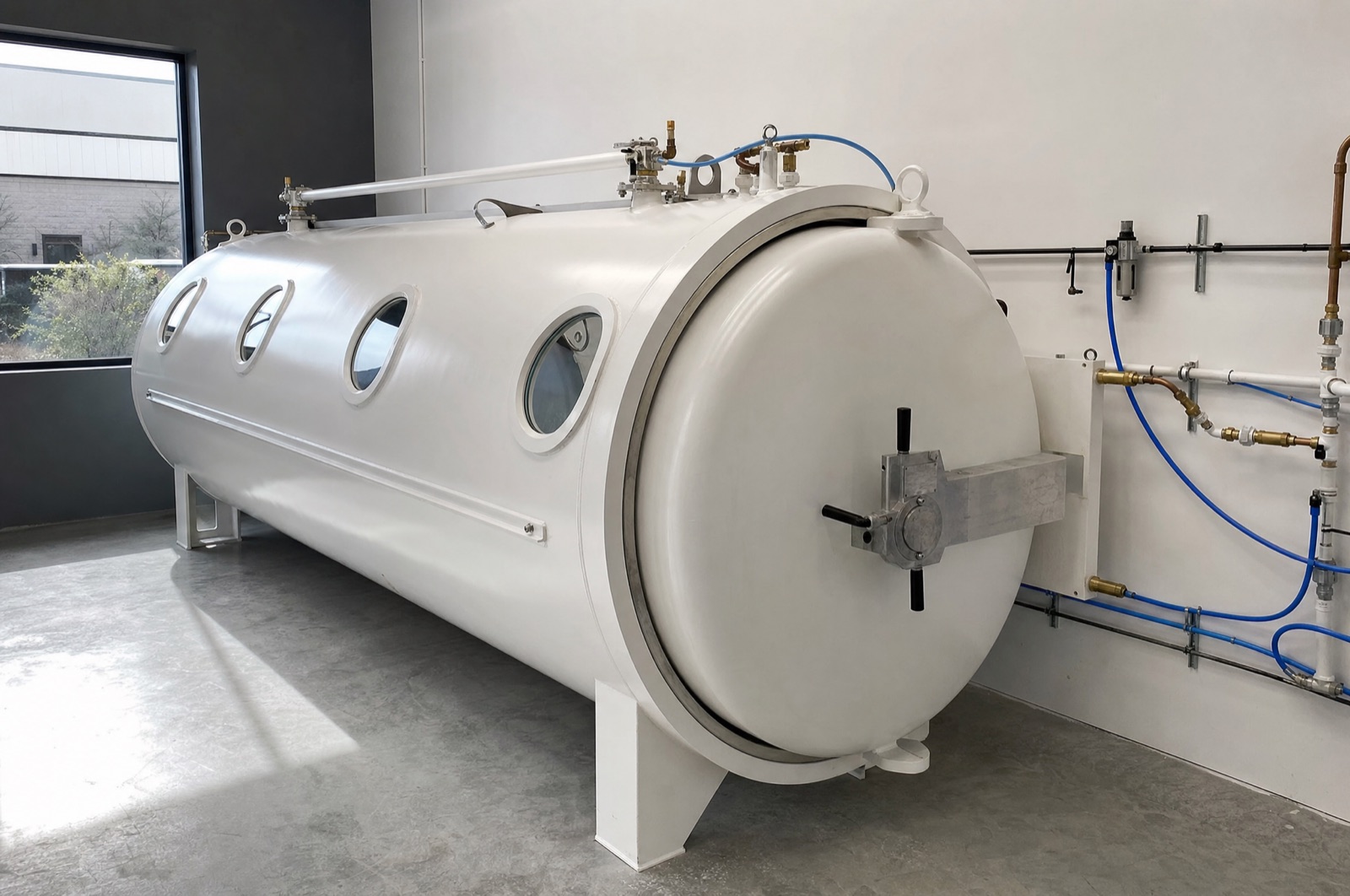
[ Clinic install ] Reference imagery; final photography in production
Hyperbaric chambers are legal in Thailand. A chamber sold for a medical purpose is a medical device under the Medical Devices Act, B.E. 2551 (2008), as amended by the Medical Devices Act (No. 2), B.E. 2562 (2019). The Thai Food and Drug Administration (Thai FDA) runs the law through its Medical Device Control Division. A 2019 Ministry of Public Health notification sorts devices into four risk types, and says its rules are consistent with device control in the ASEAN region. We found no Thai notice that names the class of a hyperbaric chamber. On our reading of the rules, a powered chamber that gives oxygen to the body is Class 2 or Class 3, which means a declaration of specifications before import. Every device ad needs a Thai FDA licence. A clinic needs a licence under the Sanatorium Act, and its ads need approval. This page covers each rule for hospital units and for home or wellness chambers. It uses the Act in an English translation, Royal Gazette notices and Thai FDA translations, a Department of Health Service Support manual and two Royal Thai Navy journal articles. Where a source is only in Thai, the translation is ours. We do not say whether any treatment works, and we do not name or rate any clinic.
Legal, and regulated as a medical device
The Medical Device Control Division lists the Act on its Medical Device Act page, in Thai and in an English translation. The translation was made for the Office of the Council of State. It is marked tentative, and it says the Thai text is the only one with legal force. It folds in the 2019 changes as footnotes.
Section 4 defines a medical device as an apparatus, machine or other object specifically intended by the manufacturer or owner for listed purposes. These include the therapy, alleviation or treatment of a disease, and the same for an injury. A clinical hyperbaric chamber fits that wording. The test is the maker's intended purpose, so the claims made for a chamber matter. The Thai FDA English guide says a business can apply to the Thai FDA to decide whether a product falls under the definition.
Section 46/1 bars anyone from selling a device that has no licence, specification declaration certificate or notification certificate. Section 6(11) lets the Minister ban devices by notification. We found no notice that bans hyperbaric chambers or limits them to hospitals.
Who regulates: the Thai FDA
Section 5 puts the Minister of Public Health in charge of the Act. The Act names the Secretary-General of the Food and Drug Administration, or a person the Secretary-General entrusts, as the permission grantor. That office grants establishment registrations, licences, certificates and ad licences. Section 7 sets up a Medical Devices Commission chaired by the Permanent Secretary for Public Health. The Director of the Medical Device Control Division sits on it as a member and assistant secretary.
The division's site hosts the laws, the ministry notifications, the ad rules and a product search. The Thai FDA also keeps an English list of device laws with its own translations of the main notifications.
The 2019 amendment and the ASEAN directive
The Medical Devices Act (No. 2), B.E. 2562 was given on 26 April 2019 and published in the Royal Gazette, volume 136, part 56 Kor, on 30 April 2019. Section 2 says it took effect the day after publication. Its preamble gives the reason: to bring device control into line with the ASEAN Agreement on Medical Device Directive, to fit changes in the device trade, and to give the public devices of international quality (our translation).
The amendment rewrote section 6(1). Devices are now grouped by their risk to health, body or life, and each group follows one of three routes: a licence, a declaration of specifications, or a notification. The division lists the ASEAN directive itself on the same Act page. For other ASEAN members, see chamber rules in Malaysia, chamber rules in Singapore and chamber rules in the Philippines.
Classes 1 to 4
The Thai FDA publishes an English translation of the risk classification notification, B.E. 2562. It was published in the Royal Gazette on 18 December 2019. Later notifications date it 14 November 2019. It splits devices into in vitro diagnostic devices and all others. Clause 3 sorts the others into four types:
- Type 1: low risk.
- Type 2: low to moderate risk.
- Type 3: moderate to high risk.
- Type 4: high risk.
The annex says the class turns on factors such as how invasive the device is, how long it stays in the body, how it is used and its biological effect. If more than one rule applies, the highest class wins. A device with more than one intended purpose takes the class of its riskiest purpose. Clause 4 says the Secretary-General of the Thai FDA decides any problem over a device's class.
Thailand's four types do not map one to one onto US or EU classes. For how the US files the same device, see FDA cleared vs FDA registered, and for Europe, see CE marking for hyperbaric chambers.
Where a hyperbaric chamber may sit
We searched the English annex for hyperbaric, chamber, oxygen and pressure, and found none of them. So the class must be worked out from the rules. The annex defines an active device as one that runs on electricity or another power source, other than the human body or gravity. A chamber with a powered compressor or control system meets that wording. Three active device rules are relevant:
- Rule 9(1): active therapeutic devices that give or exchange energy are type 2, or type 3 if done in a potentially hazardous way.
- Rule 11: active devices that give or remove medicines, body liquids or other substances are type 2, or type 3 if potentially hazardous, given the substance, the part of the body and the route.
- Rule 12: active devices that fit no other rule are type 1.
Malaysia uses the same rule. Its Medical Device Authority guidance MDA/GD/0009, second edition of 1 April 2022, lists hyperbaric chambers as an example under Rule 11(b), in Class C, which it calls moderate to high risk. That is Malaysia's guidance, not Thailand's. Our reading is that a powered chamber that gives oxygen to the body falls under Thai Rule 11, as Class 2 or Class 3. We found no Thai FDA ruling that confirms it.
A soft or mild chamber sold for wellness raises a separate question. If the maker claims no medical purpose, it may fall outside the section 4 definition. We found no Thai FDA ruling on soft chambers. For the pressure and gas differences, see mild vs medical hyperbaric.
Licence, specifications or notification
Clause 5 of the risk notification links each class to a route. Type 4 needs a licence. Types 2 and 3 need a declaration of specifications. Type 1 needs a notification. In Thai these are อนุญาต, แจ้งรายการละเอียด and จดแจ้ง. Many guides call the last two notification and listing. Three ministry notifications, all signed on 29 December 2020 and published in the Royal Gazette on 15 February 2021, list which groups go to each route.
- The licence notification covers type 4 groups: surgically invasive devices that touch the heart or central nervous system, implants, devices with a drug, devices with animal or microbial tissue, implanted contraceptives and some tests for infectious disease. On our reading, none fits a chamber.
- The specifications notification (No. 2), which the Thai FDA has translated, covers type 2 and 3 groups. Its list of active devices repeats Rule 9(1) and Rule 11, including all active devices intended to administer or remove medicinal drugs, body liquids or other substances. The Thai text is in the Royal Gazette.
- The notification on listed devices covers type 1 groups. For active devices it covers only those without listed features, and one excluded feature is giving or removing substances to or from the body.
Section 29 sets the terms. A licence and a specification declaration certificate stay valid until 31 December of the fifth year after the year of issue. A notification certificate lasts five years from its date. Section 86 sets up to three years in prison, a fine of up to 300,000 baht, or both for making or importing a type 4 device without a licence. Section 87 sets up to two years, up to 200,000 baht, or both for a missing specification declaration certificate.
Importers, sellers and labels
Section 15 says anyone who makes or imports devices must register an establishment with the permission grantor. Under section 16, the applicant must be at least twenty, have a residence in Thailand, and have a place of import and storage that meets ministry rules. For a company, its manager must meet the age and residence tests. On our reading, a foreign maker needs a Thai importer to bring a chamber in. Section 85 sets up to one year in prison, a fine of up to 100,000 baht, or both for importing without registration.
Section 24 requires a seller licence only for devices named in a notification under section 6(3), and a maker or importer is deemed licensed to sell its own devices. The division's seller licence list names dental devices, positive airway pressure machines, hyaluronic acid fillers, blood bags, HIV test kits, eye surgery gels, tooth whiteners and silicone breast implants. It does not name chambers. A 2020 notification on devices sold only to medical facilities does not name them either. Section 44 says labels and manuals must not carry false or exaggerated statements.
Advertising a chamber
Chapter VII of the Act covers device ads. Section 57 says a device ad needs a licence from the permission grantor, valid for up to three years. Section 59 says an ad must not:
- make a false or exaggerated claim about usefulness, quality, standard, parts or origin;
- use a person to vouch for the device's usefulness;
- offer a prize won by chance;
- claim the device can prevent, cure, ease or treat a disease listed in a ministry notification;
- cause basic misunderstanding about the device.
The listed diseases are in a notification of 12 February 2013. They are cancer, diabetes, paresis and paralysis, psychiatric disease, blood pressure disease, disease of the brain, heart and blood vessels, lungs, spleen, liver or kidneys, and AIDS (our translation). The bans do not apply to ads made directly to medical practitioners, and the paralysis ban also lifts for physiotherapists. A 2020 notification exempts ads that show only a trade name, trademark or logo, as long as the device is registered.
The division's advertising page says applicants must be a company, a partnership or a person with a commercial registration whose business relates to devices. Applications go through the online Skynet system. Ads to the public and ads to professionals get a licence. A separate route for ads sent directly to professionals has no licence, and those ads must not appear in public places. Section 116 sets up to six months in prison, a fine of up to 50,000 baht, or both for an ad without a licence. Section 117 sets up to one year, up to 100,000 baht, or both for breaking section 59.
Advertising a clinic: the Sanatorium Act
A clinic that offers sessions falls under a second law, the Sanatorium Act B.E. 2541 (1998), which the device Act calls the law on medical establishments. We did not read the Act itself. We read a Department of Health Service Support manual on clinic ads, which quotes it as amended by the Sanatorium Act (No. 4) B.E. 2559 (2016). The manual says a private facility that treats patients needs a licence to operate under the Act.
The manual quotes the Act's definition. A medical facility is a place, including a vehicle, set up for the regular practice of medicine, nursing, dentistry, physiotherapy, medical technology, Thai traditional medicine or other listed health professions, paid or not. There are two kinds: facilities that do not admit patients overnight, which are clinics, and those that do, which are hospitals. The permission grantor is the Director-General of the Department of Health Service Support (our translations).
Section 38, as the manual quotes it, says anyone who wants to advertise a facility, beyond the name and location on its licence, needs approval of the text, sound or images used. The second paragraph bars ads that use false or exaggerated claims, or claims likely to mislead, to draw people to the facility. Under section 68, an ad without approval carries a fine of up to 20,000 baht. A false or exaggerated ad carries up to one year in prison, a fine of up to 20,000 baht, or both. Both add a daily fine of up to 10,000 baht while the ad continues after an order to stop. The Act does not name hyperbaric therapy, and we found no rule on who may run a session. For the fire and oxygen hazards that drive chamber design, see hyperbaric chamber safety.
Exemptions for state hospitals and personal use
Section 27 lifts the duties in sections 15, 17, 19 and 24 for some cases. They include:
- making, importing or selling devices by state agencies in the course of preventing, diagnosing or treating disease, and by the Thai Red Cross Society;
- making or importing devices in quantities needed for personal use, or as samples, for an exhibition or for research;
- importing devices for particular individual patients.
People who rely on these exemptions must follow rules set by ministry notification. The division's notification list includes rules for several of these cases. A 2025 notice lists devices that may be imported for personal use under section 27(5) without a medical practitioner's certificate. We could not read that notice's list, so we cannot say whether a home chamber qualifies. For a chamber shipped into the US instead, see importing a hyperbaric chamber into the US.
Public hospital units
A 2022 article in the Royal Thai Navy Medical Journal, by authors at Somdech Phra Pinklao Hospital, describes the hyperbaric center of that hospital, run by the Naval Medical Department in Bangkok. It reviews treatments given there from 2018 to 2020. It does not say whether the chamber is monoplace or multiplace. A 2024 article in the same journal says underwater medicine in Thailand began with an Underwater Medicine Section set up in the Naval Medical Department on 29 May 1973, which was later equipped with hyperbaric chambers. We did not find a public list of other state units or the rules that set coverage under Thai public health insurance.
Hospital unit and wellness chamber side by side
| Question | Hospital unit | Home or wellness chamber |
|---|---|---|
| Banned? | No | No ban found |
| Medical device? | Yes, if intended for therapy of disease or injury (section 4) | Depends on the maker's intended purpose; no Thai FDA ruling found |
| Class | Not named; on our reading Class 2 or 3 under Rule 11 | Not addressed |
| Route before import | Declaration of specifications, on our reading | Same, if it is a medical device |
| Importer | Registered establishment with a Thai residence (sections 15 and 16) | Same; personal use exemption under section 27(5) not confirmed |
| Seller licence | Not on the seller licence list | Not on the seller licence list |
| Device ads | Thai FDA licence under section 57; disease claims limited | Same, if it is a medical device |
| Facility ads | Approval under section 38 of the Sanatorium Act | Section 38 applies if the place is a medical facility; not confirmed for spas |
| State hospitals | Section 27(1) exemption, with conditions | Not applicable |
| Public units found | Somdech Phra Pinklao Hospital, Naval Medical Department | None found |
Sources: Medical Devices Act B.E. 2551 (English translation for the Office of the Council of State) and Medical Devices Act (No. 2) B.E. 2562, both on the Thai FDA Medical Device Act page; risk classification notification B.E. 2562 and specifications notification (No. 2), Thai FDA translations; licence, notification and seller notifications on the Medical Device Control Division site; advertising notifications of 2013 and 2020; Thai FDA advertising page; MDA/GD/0009 (Malaysia); Department of Health Service Support manual on clinic ads; Royal Thai Navy Medical Journal, 2022 and 2024. All linked above, read 5 November 2026.
For the chambers we track and what we can verify about each, see the scorecard.
What we have not verified
We found no Thai FDA document that gives the class of a hyperbaric chamber, so Class 2 or 3 under Rule 11 is our reading, not a ruling. We did not read the ASEAN directive's annex, because the copy on the Thai FDA site is a scanned image. The English translation of the risk notification carries a signature date of 14 November B.E. 2563, while the Thai notifications cite 14 November B.E. 2562, and we did not resolve the gap. We did not search the Thai FDA product register, which loads as a script form, so we cannot say how many chambers hold a certificate. We could not read the list in the 2025 personal use notice, and we did not read the notices that set conditions for state agencies. We read the Sanatorium Act only as quoted in a department manual, not in the Royal Gazette. We found no ruling on soft chambers, on spa sessions, or on whether a wellness centre that runs a chamber counts as a medical facility. We did not check Thai rules on pressure vessels or medical gases. We found no national count of chambers and no public insurance coverage rules.
Frequently asked
Are hyperbaric chambers legal in Thailand?
Yes. We found no ban. Section 4 of the Medical Devices Act B.E. 2551 covers any apparatus intended by its maker for the therapy or treatment of a disease or injury, so a chamber sold for that purpose is a medical device. Section 46/1 bars selling a device that lacks a licence, a specification declaration certificate or a notification certificate. A Royal Thai Navy hospital in Bangkok runs a hyperbaric centre.
What class is a hyperbaric chamber in Thailand?
We could not confirm it. The 2019 risk classification notification sorts devices into types 1 to 4 and does not name hyperbaric chambers. Its Rule 11 puts powered devices that give substances to the body in Class 2, or Class 3 if done in a potentially hazardous way. Malaysia's regulator lists hyperbaric chambers under its own Rule 11 as Class C. Under the Thai notification, the Thai FDA Secretary-General decides any doubt.
What does an importer need to bring a chamber into Thailand?
Section 15 of the Act requires registration of an import establishment, and the applicant must have a residence in Thailand. The device then needs a licence, a specification declaration certificate or a notification certificate, depending on its class. On our reading, a chamber would need a declaration of specifications, which is the Class 2 and 3 route. A licence and a specification declaration certificate stay valid until 31 December of the fifth year after issue.
Do chamber ads need approval in Thailand?
Yes, in most cases. Section 57 of the Act says device ads need a licence from the Thai FDA, valid for up to three years. A 2020 notification exempts ads that show only a trade name, trademark or logo. A 2013 notification bars ads claiming a device can prevent or treat cancer, diabetes, paralysis, psychiatric disease, blood pressure disease, AIDS, or disease of the brain, heart, blood vessels, lungs, spleen, liver or kidneys, with exceptions for ads aimed at doctors.
Can a clinic in Thailand advertise hyperbaric sessions?
Only with approval. Section 38 of the Sanatorium Act B.E. 2541, as amended in 2016, says anyone who wants to advertise a medical facility, beyond its licensed name and location, needs approval of the text, sound or images. It also bars false or exaggerated ads. A Department of Health Service Support manual quotes fines of up to 20,000 baht, plus daily fines while an ad continues after an order to stop.

Alex tests the machines himself, in clinics and studios on three continents. Every score comes from the same 27 public criteria, and no manufacturer has a say in them.
Six questions, and we'll match chamber, options, and install to your space and budget.