Hyperbaric Chamber Rules in Hong Kong: Voluntary MDACS Listing, Class III, Advertising and Clinic Licences
Researched and scored by Alex Evans. Last reviewed August 2026. Corrections are dated and public. See corrections
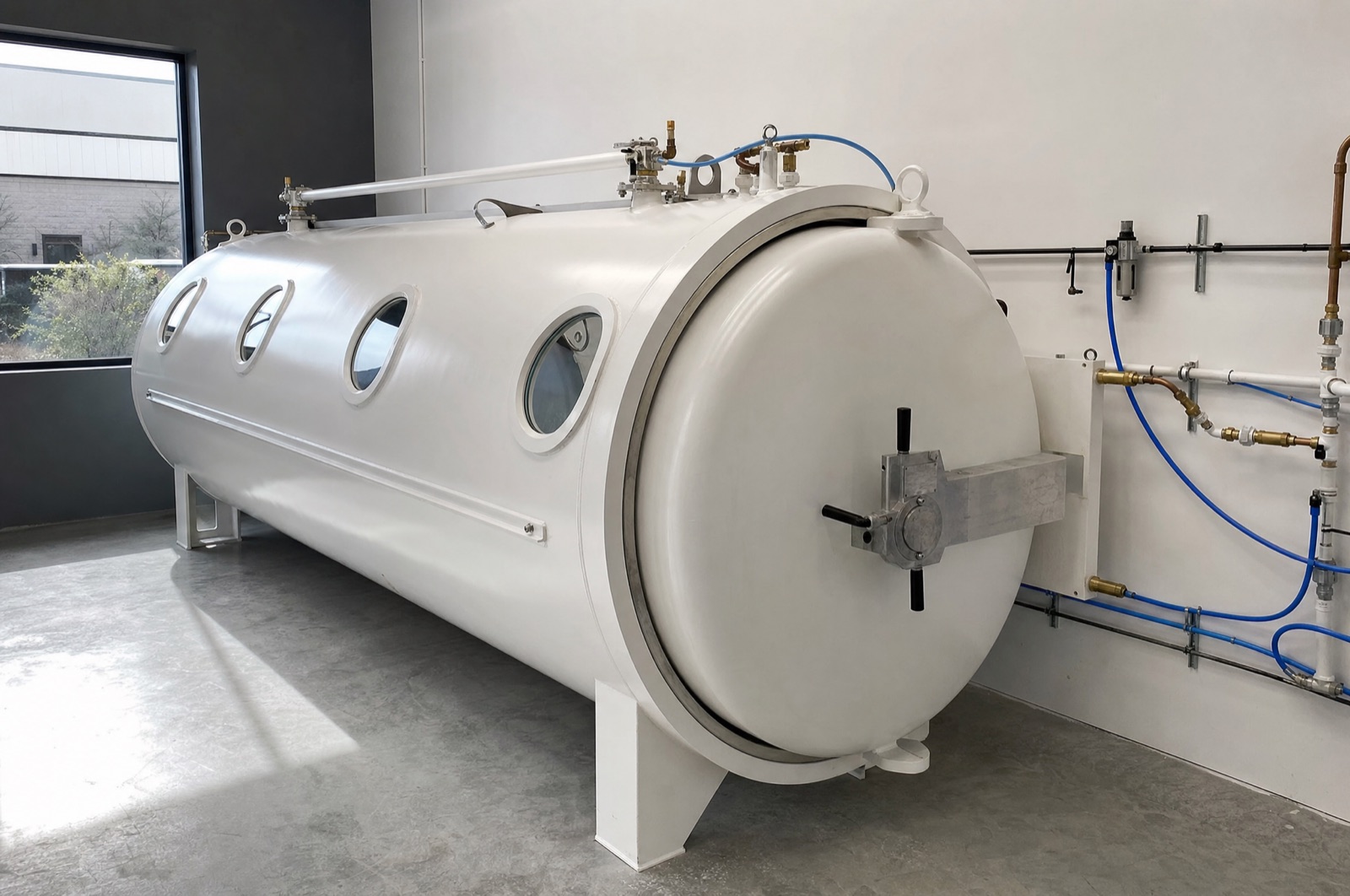
[ Clinic install ] Reference imagery; final photography in production
Hyperbaric chambers are legal in Hong Kong. The Hong Kong Special Administrative Region has no specific law on medical devices yet. The Department of Health runs a voluntary scheme, the Medical Device Administrative Control System (MDACS), and its list of classified examples puts the hyperbaric chamber in Class III. The Government says it will put a device law to the Legislative Council. Until then, the rules that bind a chamber seller or operator come from other laws: a law on medical ads, the Trade Descriptions Ordinance, clinic licensing and the pressure vessel law. This page covers each one for hospital units and for home or wellness chambers, and marks what is voluntary and what is mandatory. It uses Department of Health pages and guidance, Government press releases, Customs and Labour Department documents, and Hospital Authority articles. We do not say whether any treatment works.
Legal, and no device law yet
The Medical Device Division's frequently asked questions state the position plainly. There is no specific legislation that regulates the manufacture, import, distribution, supply and use of medical devices in Hong Kong. Some products may fall under other laws, depending on what they are. The page names the Pharmacy and Poisons Ordinance (Cap. 138), the Radiation Ordinance (Cap. 303) and the Telecommunications Ordinance (Cap. 106).
The Government said the same in a written reply to the Legislative Council on 28 January 2026. It added that some medical products may fall under the Trade Descriptions Ordinance and the Consumer Goods Safety Ordinance. We found no rule that bans hyperbaric chambers or limits them to hospitals.
The voluntary listing system
The Medical Device Division's About Us page says the division was set up in July 2004, as the Medical Device Control Office. It runs MDACS and is developing a long-term statutory framework. The page says MDACS was launched on 26 November 2004, to raise public awareness and to let traders get used to future mandatory requirements.
The FAQ calls MDACS a voluntary system. It covers Class II to IV general medical devices, Class B to D in vitro diagnostic devices, local manufacturers, importers, distributors and conformity assessment bodies. The FAQ says MDACS has the same scope as the proposed legal framework. Its parts include:
- a listing system for medical devices and for traders;
- a local responsible person (LRP), who must hold a business registration certificate and a designation letter from the maker, and who applies together with the device listing;
- adverse event reporting, and a duty on the LRP to tell the Department of Health about a maker's recall or field safety notice within 10 calendar days of its issue.
The Department of Health may delist a device. Its reasons include public health or safety, a breach of MDACS rules, and failure to obey an instruction to withdraw an unjustified claim in an ad. The 28 January 2026 reply said more than 8,900 devices were listed. A newsletter headline on the About Us page now says more than 10,000.
A listing is an option for the trader, not a condition of sale. We found no rule that stops an unlisted chamber from being imported or sold today.
Where the hyperbaric chamber sits in the risk classes
Hong Kong uses four classes for general medical devices. The FAQ says it follows the classification principles of the International Medical Device Regulators Forum. Class IV carries the highest risk and Class I the lowest. The FAQ says a device's class turns on factors such as how long it touches the body, how invasive it is, and whether it delivers medicines or energy to the patient.
The division's examples of general medical devices classification list "Hyperbaric chamber" under Risk Class III, with AMDNS code 12061 and the term "Chambers, Treatment, Hyperbaric". AMDNS is the Asian Medical Device Nomenclature System. Other Class III examples on the same list include anaesthesia machines and home care ventilators.
The page sets limits on this. It says the examples are for reference only, and that each device must be classed on its own design and the use the maker intends. It points to Technical Reference TR-003 for the rules, which we did not read. For how the US files the same device, see FDA cleared vs FDA registered, and for Europe, see CE marking for hyperbaric chambers.
When a wellness chamber counts as a medical device
Under MDACS, the maker's intended purpose decides. The division's online tool asks whether a product is meant for the diagnosis, prevention, monitoring, treatment or alleviation of disease, or for an injury. It also asks whether the product is meant for the investigation, replacement, modification or support of the anatomy or of a physiological process. The tool says its results are rough indications for reference only.
The documents we read do not address soft or mild chambers. A soft chamber sold with wording about a physiological process may fit the plain words. Since MDACS is voluntary, the label matters less today than it will once a law is in force. For the pressure and gas differences between the two kinds of chamber, see mild vs medical hyperbaric.
The planned medical device law
The Government has promised a law for some years. In a reply to the Legislative Council on 9 July 2025, the Secretary for Health said the Department of Health had announced a Hong Kong Centre for Medical Products Regulation (CMPR) by the end of 2026. He said a legislative proposal on devices could go to the Legislative Council within the next year.
The 28 January 2026 reply said the 2025 Policy Address had announced that the CMPR would be set up in 2026, and that the Government would submit a Medical Products Regulation Bill. It said a device proposal would go to the Legislative Council this year. At a symposium on 3 February 2026, the Director of Health repeated that a proposal on devices would come this year. He urged traders to apply early under MDACS, to be better prepared for the move to the future statutory framework.
We found no bill text, so we cannot say what a chamber seller will have to do once a law passes.
Advertising: the Undesirable Medical Advertisements Ordinance
This law is mandatory and in force now. The Drug Office's page on the Ordinance says Cap. 231 was first enacted in 1953. The Department of Health's guidelines, with effect from 1 June 2012, set out the main rule. No person shall publish an ad likely to lead to the use of any medicine, surgical appliance or treatment to treat or prevent a disease or condition in Schedule 1, except for a purpose in column 2. Schedule 1 lists 14 diseases and conditions, and Schedule 2 lists three barred purposes.
The guidelines and the Department's FAQ add points that matter to a chamber business:
- "Advertisement" includes posters, leaflets, signboards, the internet, labels and oral announcements, so a health talk or a sales pitch can count.
- A claim about an effect on a specific disease, its signs or symptoms, or the risk of getting it, is treated as a claim to prevent or treat disease.
- The ad is judged as a whole, including words, pictures and the message.
- A barred claim stays barred even if it is proven. Citing a scientific report is not by itself a defence.
- The Department of Health has no pre-approval system for ads.
There is a defence for ads in technical publications meant mainly for doctors, pharmacists, Chinese medicine practitioners and hospital or clinic staff. The 28 January 2026 reply said the Department of Health reviewed over 200,000 ads from 2021 to 2025 and sent over 2,200 warning letters. It gave the penalty as a fine of HK$50,000 and six months in prison on a first conviction, and HK$100,000 and one year after that. We did not read Schedule 1 itself, so we cannot say which conditions it names.
Advertising: the Trade Descriptions Ordinance
A second law covers whether a claim is true. The Drug Office FAQ says Cap. 231 does not regulate truthfulness, and that this falls to the Trade Descriptions Ordinance (Cap. 362), enforced by the Customs and Excise Department. A Government pamphlet on the 2012 amendments says the amended law came into operation on 19 July 2013. Its main rules:
- Section 7 bars a false trade description of goods, and section 7A bars one for a service supplied to a consumer.
- A false trade description is one that is false to a material degree, or misleading.
- Section 13E bars misleading omissions, such as hiding material information.
- The maximum penalty on indictment is a fine of HK$500,000 and five years in prison.
The pamphlet says the 2013 offences, including section 7A, do not apply to an exempt person, such as a doctor or dentist acting in that role. A wellness centre run without a doctor would not have that exemption. The 9 July 2025 reply shows Customs uses the law on medical products: it received six complaints about contact lenses from 2022 to 2024.
Licensing the premises under Cap. 633
The Private Healthcare Facilities Ordinance (Cap. 633) is mandatory, and it is being brought in by stages. The Office for Regulation of Private Healthcare Facilities' background page says it was gazetted on 30 November 2018 and covers four types of facility: hospitals, day procedure centres, clinics and health services establishments.
The office's FAQ says the law mainly covers premises where registered medical practitioners or dentists practise. Facilities run by the Government, the Hospital Authority or the Hong Kong Garrison are outside it. It says any premises that provide medical services, including those that claim to provide "beauty services", need a licence or a letter of exemption. It also says the law does not cover premises where only Chinese medicine practitioners and allied health professionals practise.
The simple guide sorts premises by what they do. A day procedure centre licence is for scheduled procedures such as surgery, endoscopy and anaesthesia. Other premises need a clinic licence, or a letter of exemption if they meet the small practice clinic rules. Applications for clinic licences opened on 13 October 2025. A 2 April 2026 notice set 13 April 2026 as the deadline for provisional licences. The FAQ says the penalty for running a clinic without a licence will start on a date set by notice in the Gazette. Hyperbaric therapy is not one of the scheduled procedures listed in the guide.
The pressure vessel side
The Labour Department's Boilers and Pressure Vessels Division enforces the Boilers and Pressure Vessels Ordinance (Cap. 56). Its work includes the registration of boilers and pressure vessels and spot checks on pressure equipment.
The department's guide to air receivers, August 2016 edition, quotes the Ordinance's definition. An air receiver includes any vessel for containing compressed air that is connected with an air compressing plant, other than a pipe, coil or compressor part. The guide says the owner of a new air receiver must apply to register it at least 30 days before use. It must be examined by an appointed examiner before use and again within 26 months of each certificate of fitness.
Air storage tanks connected to a compressor would fit those plain words. Whether a rigid chamber fed by a compressor is itself an air receiver is not stated in anything we read, and we found no Labour Department page that names hyperbaric chambers. Many chamber makers cite ASME PVHO-1; see our ASME PVHO-1 guide. For the fire and oxygen hazards, see hyperbaric chamber safety and NFPA 99 and hyperbaric fire safety.
Public hospital and government units
Hong Kong's first hospital unit opened in 2018. The Hospital Authority's HASLink article of July 2018 said the centre at Pamela Youde Nethersole Eastern Hospital would start in late September that year. It described a German-made chamber for up to 16 patients, about 100 tonnes and 13 metres long. Seven doctors and 26 nurses from the hospital's A&E department trained overseas. The article called the older centre, run by the Fire Services Department on Stonecutters Island, inconvenient to reach. A 2016 Hospital Authority Convention abstract said planning for the hospital unit began in 2010.
A later HASLink article said two monoplace chambers had been added alongside the multiplace unit. It said staff may work in the chamber only once every 24 hours and have monthly health checks. A 2025 Hospital Authority Convention abstract counted 1,099 patients and 14,751 patient visits from October 2018 to December 2024.
The Electrical and Mechanical Services Department has described the Fire Services chamber. Its undated article on the Fire Services Diving Base describes a two-chamber deep diving simulator on Stonecutters Island that can reach 10 bar gauge, and says its decompression chamber treats patients with decompression sickness. We found no fee schedule or insurance rule for the treatment. For how US payers code it, see hyperbaric insurance and CPT codes.
Hospital unit and wellness chamber side by side
| Question | Hospital unit | Home or wellness chamber |
|---|---|---|
| Banned? | No | No ban found |
| Specific device law? | None yet; a proposal is promised for 2026 | Same |
| Risk class | Class III in the MDACS examples | Depends on intended purpose; soft chambers not addressed |
| MDACS listing | Voluntary, through a local responsible person | Voluntary, if it is a medical device |
| Ad rules (mandatory) | Cap. 231 bars Schedule 1 disease claims | Same; covers ads for a treatment as well as an appliance |
| Truth of claims (mandatory) | Cap. 362; doctors exempt from the 2013 offences | Cap. 362, including section 7A for services |
| Premises licence | Hospital Authority units outside Cap. 633; private hospitals licensed | Needed if doctors or dentists practise there; clinic penalty not yet in force |
| Pressure vessel rules | Cap. 56 covers air receivers; chamber status not confirmed | Same; soft chambers not addressed |
Sources: Medical Device Division About Us page, FAQ, classified examples list and online tool; Legislative Council replies of 9 July 2025 and 28 January 2026; Department of Health release of 3 February 2026; Drug Office page, guidelines and FAQ on Cap. 231; Government pamphlet on the Trade Descriptions Ordinance; ORPHF background page, simple guide and FAQ; DH notice of 2 April 2026; Labour Department division page and air receiver guide; Hospital Authority and EMSD articles. All linked above, read 3 November 2026.
For the same question nearby, see chamber rules in Singapore and chamber rules in Malaysia. For how a concentrator fits a chamber setup, see oxygen concentrators for hyperbaric chambers. Elsewhere in East and Southeast Asia, see chamber rules in South Korea and chamber rules in the Philippines. For the chambers we track and what we can verify about each, see the scorecard.
What we have not verified
We could not load the e-Legislation site, which returned only a loading page, so we did not read the text of Cap. 231, Cap. 362, Cap. 633 or Cap. 56. Points on those laws come from Government guidance, pamphlets and replies, some of them years old. We did not read Schedule 1 of Cap. 231, so we do not know which 14 conditions it names, or whether a chamber counts as a "surgical appliance". We did not read Technical Reference TR-003. The MDACS device search loads by script, so we did not check whether any chamber is listed. We found no bill text and no sign that a device bill had reached the Legislative Council by 3 November 2026. We do not know whether a rigid chamber is itself registrable under Cap. 56, or whether an exemption order covers it. We did not check rules on oxygen storage under the Dangerous Goods Ordinance. The newest source we found on the Fire Services chamber is undated, so we cannot confirm it still treats patients. We found no Department of Health or Customs action naming a chamber seller.
Frequently asked
Are hyperbaric chambers legal in Hong Kong?
Yes. We found no ban. The Department of Health says there is no specific legislation that regulates the manufacture, import, distribution, supply and use of medical devices in Hong Kong. A public hospital, Pamela Youde Nethersole Eastern Hospital, has run a hyperbaric centre since September 2018.
Does a hyperbaric chamber have to be listed under MDACS?
No, not by law today. The Department of Health calls the Medical Device Administrative Control System a voluntary system set up in 2004 to pave the way for statutory control. A local responsible person may apply to list a Class II, III or IV device. The Government says it plans to put a device law to the Legislative Council, and urged traders in February 2026 to apply early.
What risk class is a hyperbaric chamber in Hong Kong?
The Medical Device Division's list of classified examples puts "Hyperbaric chamber" in Risk Class III, under the AMDNS term Chambers, Treatment, Hyperbaric. Class IV is the highest of the four classes. The page says its examples are for reference only, and that each device must be classed on its own design and intended use.
Can a wellness centre in Hong Kong advertise hyperbaric sessions?
Two laws apply. The Undesirable Medical Advertisements Ordinance (Cap. 231) bars ads likely to lead to the use of any medicine, surgical appliance or treatment for diseases and conditions in its Schedule 1, which lists 14 of them. The Trade Descriptions Ordinance (Cap. 362) bars false or misleading trade descriptions of goods and services. The Department of Health has no pre-approval system for ads.
Does a hyperbaric clinic need a licence in Hong Kong?
If registered medical practitioners or dentists practise there, the Office for Regulation of Private Healthcare Facilities says the premises need a licence or a letter of exemption under Cap. 633. It says this applies to premises that claim to provide beauty services but carry out medical procedures. The penalty for running a clinic without a licence has not yet started; it will be announced in the Gazette.

Alex tests the machines himself, in clinics and studios on three continents. Every score comes from the same 27 public criteria, and no manufacturer has a say in them.
Six questions, and we'll match chamber, options, and install to your space and budget.