Hyperbaric Chamber Rules in South Korea: MFDS Grades, Permits, Ad Review and Clinic Law
Researched and scored by Alex Evans. Last reviewed August 2026. Corrections are dated and public. See corrections
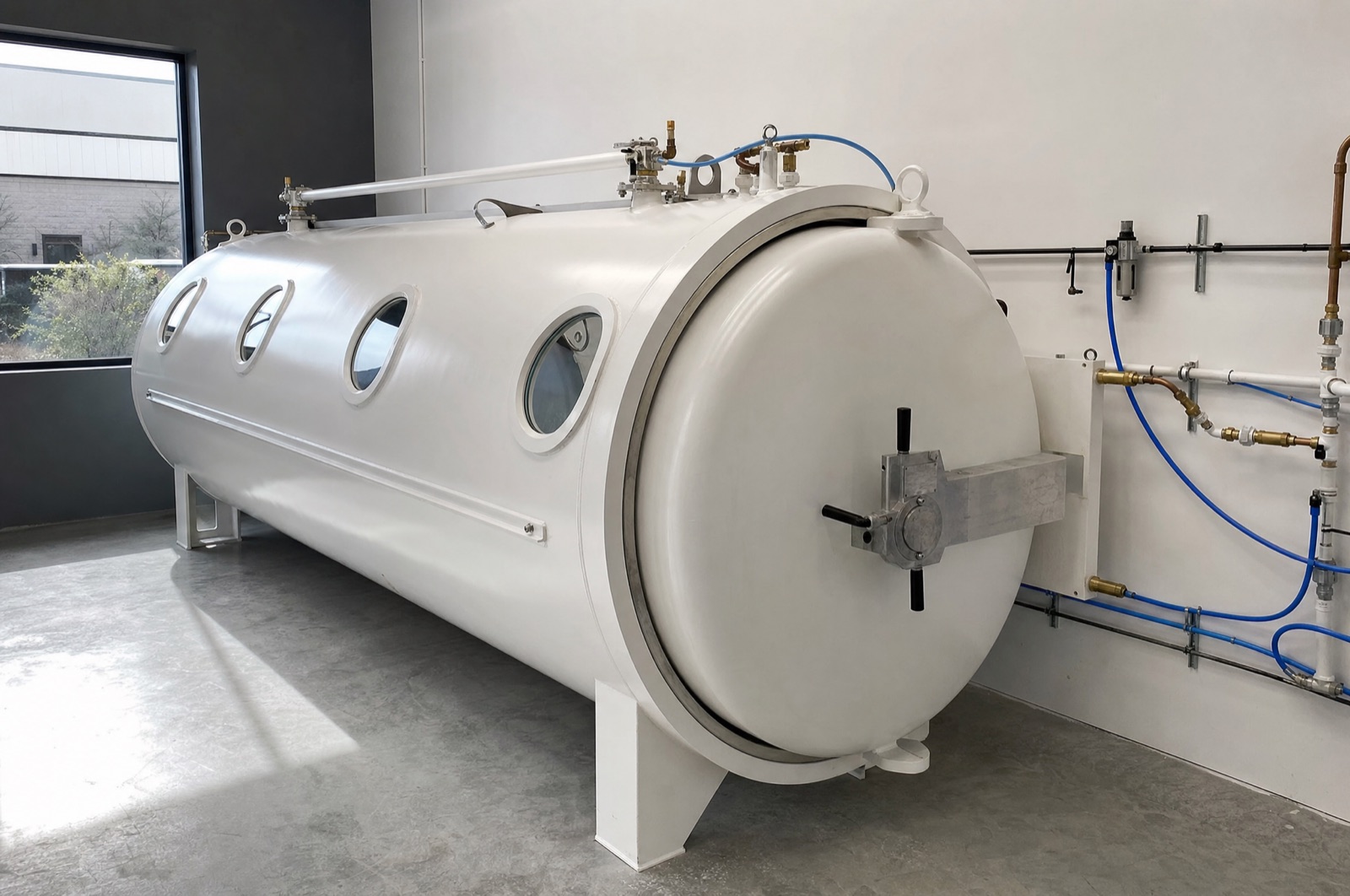
[ Clinic install ] Reference imagery; final photography in production
Hyperbaric chambers are legal in South Korea. A chamber sold for a medical purpose is a medical device under the Medical Devices Act, which the Ministry of Food and Drug Safety (MFDS) runs. A 2016 MFDS item table lists the medical hyperbaric oxygen chamber as a grade 2 device. Makers and importers need MFDS permits, and sellers file a notice with local government. The Act bars anyone, including a clinic, from using a device that has not been permitted, certified or notified. Many ads need advance review by a private body, and clinics that advertise treatment fall under the Medical Service Act. This page covers each rule for hospital units and for home or wellness chambers. It uses English translations of two Acts on the Korea Legislation Research Institute site, MFDS pages, an MFDS draft notice, a law firm note, a 2014 journal article and Korean news reports. Several sources are in Korean, and we mark where a point is our translation. We do not say whether any treatment works.
Legal, and regulated as a medical device
We read the Medical Devices Act in the English translation on the KLRI statutes site, as amended to Act No. 20888 of 1 April 2025. The site says its translations are for reference only and are not official. Article 2 defines a medical device as an instrument, machine, apparatus, material, software or similar product used for one of four purposes:
- diagnosing, curing, alleviating, treating or preventing a disease;
- diagnosing, curing, alleviating or correcting an injury or impairment;
- testing, replacing or transforming a structure or function;
- controlling conception.
The same article defines a medical device handler. The term covers makers, importers, repairers and distributors, and it also covers a person who opens a medical institution under the Medical Service Act. So a clinic that runs a chamber is inside the Act, not only the firm that sells it. We found no rule that bans hyperbaric chambers or limits them to hospitals.
Where the hyperbaric chamber sits in the grades
Article 3 tells the Minister of Food and Drug Safety to classify each device and designate its class by intended use and potential risk. MFDS's English approval process page lists four classes. Class I is very low risk, Class II low risk, Class III moderate risk and Class IV high risk. Class I goes through notification, Class II through certification or approval, and Classes III and IV through approval. The page says some Class II devices must go through approval, such as those that need clinical test reports. It is undated and names more than one agency for the review work.
The item list sits in an MFDS notice called the Regulation on Medical Device Items and Grades by Item (our translation of the Korean title). We read a draft amendment of that notice, MFDS public notice No. 2016-10 of 7 January 2016, filed with the WTO. Its table lists:
- A08010.01, medical hyperbaric oxygen chamber (의료용고압산소챔버), grade 2. Our translation of the definition: a device that applies oxygen at a pressure above atmospheric pressure to deliver oxygen to the patient's tissue; industrial equipment used only to adjust air pressure is not included.
- A08020.01, transcutaneous oxygen chamber for the limbs, also grade 2.
This is a 2016 draft. A Dailypharm report of 31 October 2025 shows the same item name in the current regulation in a figure caption, but the text does not give a grade. We did not read the current table. For how the US files the same device, see FDA cleared vs FDA registered, and for Europe, see CE marking for hyperbaric chambers.
Permits for makers, importers and sellers
The Act splits the market into roles. On the KLRI text:
- Article 6: a maker needs manufacturing business permission from MFDS, and then needs manufacturing permission, certification or a notification for each device. It must have the facilities and quality management systems the rules require, and must submit technical documents and, where needed, clinical data.
- Article 15: an importer needs import business permission, and then import permission, certification or a notification for each device, with the same quality system duty.
- Article 17: a distributor or a firm that leases devices files a notice with the local city, province or district office for each place of business. A maker or importer selling its own devices to a medical device handler may skip this.
Using a chamber: the ban on unapproved devices
Article 26(1) reaches the user, not only the seller. No one shall repair, distribute, lease, provide or use a device that has not been permitted, certified or notified under Article 6 or 15. Article 26(2) bars making, importing, selling or leasing a device that does not match what was approved. Article 26(4) bars altering or remodelling a device in use in a way that does not match its permission, with narrow exceptions.
The penalties are criminal. Under Article 51, breach of Article 26(1) carries prison of up to five years or a fine of up to 50 million won. Under Article 52, breach of Article 26(2) to (7), Article 17(1) or the ad rules in Article 24 carries prison of up to three years or a fine of up to 30 million won.
Safety criteria and the oxygen debate
A Dailypharm report of 9 September 2025 says a medical hyperbaric oxygen chamber must get MFDS device approval. It says the MFDS safety standard keeps oxygen inside the chamber at or below 23.5 percent, and requires an alarm when it goes higher (our translation). The report quotes an industry source who said some chambers are certified with air pressure and a mask, then installed with the whole chamber filled with oxygen. It says MFDS told the paper it had found no recent breach, and that the Act does not separately regulate how a licensed device is used inside a medical institution. It also notes that Korea sells all products under the one name 고압산소치료기 (hyperbaric oxygen therapy device), while Japan treats low-pressure consumer chambers as a separate group.
The 31 October 2025 Dailypharm report says MFDS certifies chambers against criteria for oxygen level, carbon dioxide and humidity. Experts quoted in it call for a mandatory check that units sold match what was certified. The debate is still open. A Medigate News report of 26 June 2026 says the Korean Burn Society disputed the Korean Hyperbaric Medicine Society's view that filling a one-person chamber with 100 percent oxygen is the international standard. The burn group cited fire risk and NFPA 99, and said domestic rules need specific criteria. A patient safety society director quoted in the report said MFDS rules are less detailed than overseas rules. For the hazards behind this debate, see hyperbaric chamber safety and NFPA 99 and hyperbaric fire safety. Many makers also cite ASME PVHO-1; see our ASME PVHO-1 guide.
When a wellness chamber counts as a medical device
In Korea, the use a product is sold for decides. A soft chamber sold with wording about treating a disease or changing a body function may fall inside the Article 2 definition. If it does, it needs a permit before it is sold or used.
A product that is not a medical device has its own limit. Article 26(7) bars any label, package insert or ad for an appliance other than a medical device that may mislead people to believe it works like a medical device. It also bars selling, leasing or displaying such an appliance. A Korea JoongAng Daily report of 6 August 2026 gives an example from another product: MFDS found a breach by a calf massager promoted for circulation and swelling, because it was not a medical device.
We found no MFDS ruling on oxygen capsules or mild chambers as a group. A Medigate News report of 20 April 2019 suggests many low-pressure units are inside the medical system. It quotes a doctor at a Korean Hyperbaric Medicine Society symposium who said HIRA criteria lacked a definition of therapeutic hyperbaric oxygen, so about 130 low-pressure chambers, mostly used for cosmetic or wellness purposes, were being reimbursed. For the pressure and gas differences between the two kinds of chamber, see mild vs medical hyperbaric.
Advertising a chamber: Articles 24 and 25
Article 24(2) lists banned content in any ad for a medical device. It includes:
- false or exaggerated claims about the name, performance, efficacy, effect or mechanism;
- content likely to mislead people into thinking a doctor, dentist, doctor of Korean medicine or other person endorses or uses the device;
- articles, photos or symbols that imply performance or effect;
- claims outside, or not matching, what was permitted, certified or notified;
- an ad that skipped the review in Article 25, or that differs from what was reviewed.
Advance review changed in 2021. MFDS's English site still lists a Regulation on Prior Review of Advertisement on Medical Device, registered in 2016. The Asia Business Daily reported that on 28 August 2020 the Constitutional Court ruled 8 to 1 that the old review rule was unconstitutional. It held that review by an industry body, on standards the Minister set, was prior censorship. The KLRI text notes that the old clause was deleted by Act No. 17978 of 23 March 2021.
The new Article 25 says an ad on TV or radio, in daily or weekly newspapers, online newspapers or magazines, on outdoor media, on electronic display boards or on listed internet media must first be reviewed by a voluntary deliberation agency that has reported to MFDS. Ads that only repeat the permitted contents, and ads aimed at groups of experts such as medical staff, are exempt. A review is valid for three years. A Shin and Kim note of 5 July 2021 says the system took effect on 24 June 2021, and that the Korea Medical Device Industry Association was then the only registered review body.
Advertising a treatment: the Medical Service Act
A clinic that advertises hyperbaric sessions is advertising medical services. We read the Medical Service Act on the KLRI site, as amended to Act No. 19818 of 31 October 2023. Article 56(1) says only the founder or head of a medical institution, or medical personnel, may run an ad for medical services. Article 56(2) bans ads that include:
- patient stories or other content likely to mislead about the effect of treatment;
- false facts, or exaggerated objective facts;
- comparisons with other providers;
- omission of important information such as serious side effects.
Article 57 adds advance review for medical ads in newspapers, magazines, outdoor media, electronic boards and listed internet media, by bodies that report to the Minister of Health and Welfare. We found no ruling that applies these rules to a hyperbaric session.
Who may run a chamber session
The Medical Service Act sets who may give medical care and where. Article 27(1) says no non-medical personnel shall perform medical practices. Article 33(1) says medical personnel shall provide medical services only after opening a medical institution, and within it, with exceptions such as emergencies and home nursing. Article 33(2) limits who may open one: physicians, dentists, doctors of Korean medicine and midwives, the State or local governments, medical corporations and some nonprofit bodies. Article 3 sorts institutions into clinic level, midwifery clinics and hospital level.
Chambers run at both levels. A Smart Today report of 3 May 2024 says an ear, nose and throat clinic in Changwon installed two 3 atmosphere chambers that use air pressure and keep oxygen at or below 23.5 percent. The Act does not name hyperbaric therapy, and we found no Ministry of Health and Welfare notice on whether a session in a wellness centre counts as a medical practice. A 2014 article in the Journal of the Korean Medical Association says Korea had no board certification for hyperbaric competence, and the 2019 Medigate report quotes the society calling for a national certification system.
Hospital units, insurance and chamber numbers
National figures are old. The 2014 journal article says 54 medical institutions filed 55,203 claims for hyperbaric oxygen therapy with HIRA in 2012 and 2013. It says 14 general hospitals with regional emergency centres or higher had chambers, and that no domestic maker of chambers rated at 1.4 atmospheres or more remained. The 2019 Medigate report says the society counted 26 chambers able to treat patients, and that a December 2018 press report cited 159 chambers in all. It notes that military units have limits on public use.
Hospitals have added units since then. Financial News reported on 29 August 2023 that Hallym University Hangang Sacred Heart Hospital opened a hyperbaric centre on 13 July 2023 with two multiplace chambers. Kormedi reported on 26 July 2025 that a third chamber began running there on 21 July, bringing capacity to 36 patients at once, which it called the largest in Korea.
On coverage, a Dailian report of 10 September 2018 says national health insurance rules allow coverage for treatment of carbon monoxide poisoning, decompression sickness, gas embolism, gas gangrene, cyanide poisoning and burns, among others (our translation). The 2019 Medigate report says wound and diabetic foot treatment had a 14 session limit, while carbon monoxide poisoning and decompression sickness had none. HIRA's criteria page for code 자586 timed out each time we tried it. For how US payers code the treatment, see hyperbaric insurance and CPT codes.
Hospital unit and wellness chamber side by side
| Question | Hospital unit | Home or wellness chamber |
|---|---|---|
| Banned? | No | No ban found |
| Medical device? | Yes, under the Article 2 definition | Depends on intended use; no MFDS ruling found |
| Grade | Grade 2 in the 2016 MFDS draft item table | Not addressed in the MFDS documents we read |
| Maker or importer | MFDS permits under Articles 6 and 15 | Same, if it is a medical device |
| Seller or lessor | Notice to local government under Article 17 | Same, if it is a medical device |
| Use of an unapproved unit | Barred by Article 26(1) | Barred, if it is a medical device |
| Device ads | Article 24 limits; Article 25 review for listed media | Same for a device; Article 26(7) bars device-like claims for other products |
| Treatment ads | Medical Service Act Articles 56 and 57 | Not confirmed for wellness centres |
| Who runs it | Medical institution under Article 33 | No rule found on sessions outside a medical institution |
| Insurance | Covered for listed uses, per news reports | A 2019 report says some low-pressure units were reimbursed |
Sources: Medical Devices Act and Medical Service Act, English translations on the KLRI site; MFDS approval process page and regulations listing; MFDS public notice No. 2016-10; Shin and Kim note of 5 July 2021; Asia Business Daily, 28 August 2020; Dailypharm, 9 September and 31 October 2025; Medigate News, 20 April 2019 and 26 June 2026; Dailian, 10 September 2018; Journal of the Korean Medical Association, 2014. All linked above, read 3 November 2026.
For the same question nearby, see chamber rules in Japan and chamber rules in Singapore. For how a concentrator fits a chamber setup, see oxygen concentrators for hyperbaric chambers. Elsewhere in East and Southeast Asia, see chamber rules in Hong Kong and chamber rules in the Philippines. For the chambers we track and what we can verify about each, see the scorecard.
What we have not verified
We read both Acts in unofficial English translations. The official Korean text on law.go.kr did not load as readable text, so amendments after the KLRI versions may be missing. The grade comes from a 2016 draft notice, not the current table, and we did not search the MFDS product database for any approved chamber. We did not read the Enforcement Decree or Enforcement Rule, so we do not know which internet media need ad review, or which bodies are registered now. The 23.5 percent oxygen limit and the MFDS test criteria come from news reports, not an MFDS document. We could not load HIRA's criteria for code 자586, so the covered uses and session limits come from 2018 and 2019 reports and may be out of date. We found no MFDS ruling on oxygen capsules, no Ministry of Health and Welfare notice on wellness sessions, and no current national count of chambers. We could not confirm whether medical chambers need a pressure vessel inspection under labour safety law, or how oxygen supply falls under high-pressure gas rules. We found no public hospital unit in the sources we could load.
Frequently asked
Are hyperbaric chambers legal in South Korea?
Yes. We found no ban. The Medical Devices Act requires makers and importers to hold MFDS permits and to get each device permitted, certified or notified. Article 26 then bars anyone from distributing, leasing or using a device that has not been through that process. Chambers are in use in university hospitals, private hospitals and clinics.
What grade is a hyperbaric chamber in South Korea?
An MFDS draft notice of January 2016 lists item A08010.01, the medical hyperbaric oxygen chamber, as grade 2, in a table of items and grades. It defines the item as a device that applies oxygen at above atmospheric pressure to deliver oxygen to a patient's tissue. We did not read the current table, so the grade may have changed since then.
Is a mild or soft oxygen capsule a medical device in South Korea?
It depends on its intended use. The Act covers products used to diagnose, treat or prevent a disease, or to test, replace or transform a structure or function. A 2019 news report quotes a doctor who said about 130 low-pressure chambers, mostly used for cosmetic or wellness purposes, were being paid for by health insurance. We found no MFDS ruling on oxygen capsules as a group.
Do chamber ads need approval in South Korea?
Many do. Since a 2021 amendment, an ad for a medical device on TV, in newspapers, on outdoor media or on listed internet media must first pass review by a private body that has reported to MFDS. A Constitutional Court ruling in 2020 struck down the older rule. Ads that only repeat the permitted contents are exempt. A clinic that advertises treatment also falls under the Medical Service Act.
Does South Korea cover hyperbaric oxygen therapy under national health insurance?
For some conditions, yes, according to news reports. A 2018 report lists carbon monoxide poisoning, decompression sickness, gas embolism, gas gangrene, cyanide poisoning and burns among the covered uses. A 2014 journal article counts 55,203 claims filed with HIRA by 54 institutions in 2012 and 2013. We could not load the HIRA criteria page, so we have not read the current rules.

Alex tests the machines himself, in clinics and studios on three continents. Every score comes from the same 27 public criteria, and no manufacturer has a say in them.
Six questions, and we'll match chamber, options, and install to your space and budget.