Hyperbaric Chamber Rules in the Philippines: FDA Registration, Licences and Advertising Law
Researched and scored by Alex Evans. Last reviewed August 2026. Corrections are dated and public. See corrections
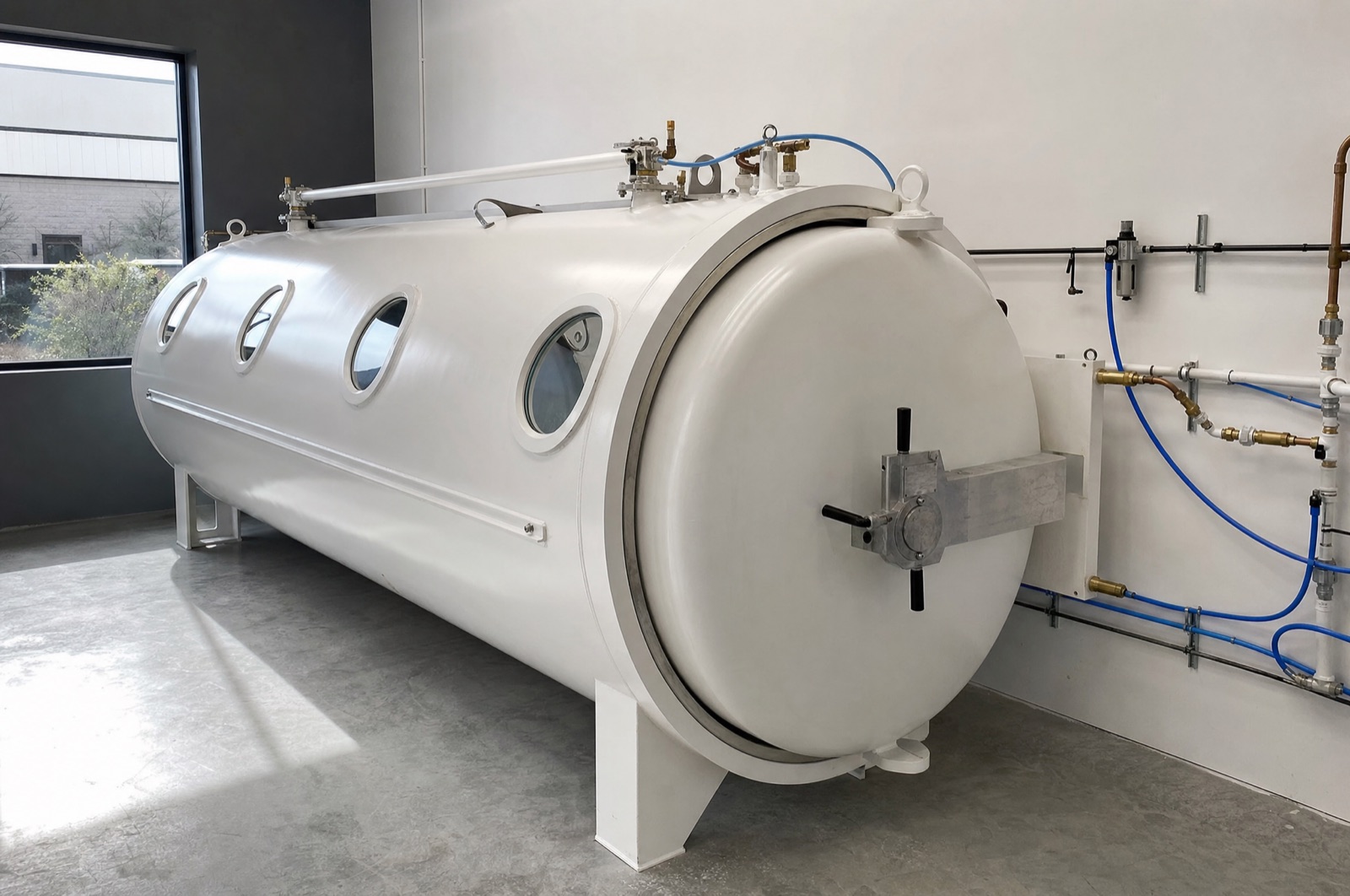
[ Clinic install ] Reference imagery; final photography in production
Hyperbaric chambers are legal in the Philippines. A chamber sold for a medical purpose is a medical device under the Food and Drug Administration Act of 2009 (RA 9711). A 2018 Department of Health order sorts devices into four risk classes, A to D, on ASEAN rules. A Class A device needs a notification, and a Class B, C or D device needs registration with the FDA's device centre. The firms that import, distribute or sell devices need an FDA licence to operate. A device must be registered before it is advertised. Hospital licensing, the Consumer Act and DOLE pressure vessel rules add further layers. This page covers each one for hospital units and for home or wellness chambers. It uses the text of three laws on the Lawphil database, the 2018 order and a 2018 licensing order on two law libraries, a 2023 presentation by the FDA's device centre, a DOLE rule, a Malaysian guidance document and news reports. The FDA's own website refused our requests, so we could not read its circulars or lists directly. We do not say whether any treatment works.
Legal, and regulated as a medical device
The base law is RA 9711. We read it on Lawphil. It is dated 18 August 2009. It renamed the Bureau of Food and Drugs as the Food and Drug Administration (FDA) and rewrote large parts of the older Food, Drug and Cosmetic Act, RA 3720.
The Act set up a Center for Device Regulation, Radiation Health, and Research (CDRRHR) inside the FDA. The Act says the centres regulate the making, import, export, sale, transfer, promotion and advertising of health products, and where appropriate their use and testing. Devices are health products under the Act.
The Act defines a medical device as an instrument, apparatus, machine or similar article intended by the manufacturer for human use for listed purposes. They include diagnosis, prevention, monitoring, treatment or alleviation of disease, and investigation, replacement, modification or support of the anatomy or of a physiological process. The device must not achieve its main action by pharmacological, immunological or metabolic means.
Two prohibited acts matter most for a chamber seller:
- making, importing, selling, distributing, using on others, promoting or advertising a health product that requires registration but is not registered with the FDA;
- making, importing, selling, distributing or retailing a device without the licence to operate the Act requires.
On the Lawphil text, a person convicted of a prohibited act faces one to ten years in prison, a fine of PHP 50,000 to PHP 500,000, or both. For a manufacturer, importer or distributor, the range is five to ten years and a fine of PHP 500,000 to PHP 5,000,000. A daily fine applies for a continuing breach, and the FDA can seize products without a court order where it has reasonable cause to believe they may cause injury. We found no rule that bans hyperbaric chambers or limits them to hospitals.
Where the hyperbaric chamber sits in the risk classes
The device rules sit in Department of Health Administrative Order 2018-0002, adopted on 26 January 2018. We read it on the Supreme Court E-Library. It aligns Philippine registration with the ASEAN Common Submission Dossier Template and the ASEAN Medical Device Directive. It covers all medical devices except in vitro diagnostics and refurbished devices.
The order uses four classes, set by risk:
- Class A, low risk;
- Class B, low to moderate risk;
- Class C, moderate to high risk;
- Class D, high risk.
The applicant classifies the device. It first checks the list of devices per class that the CDRRHR issues. If the device is not on the list, the company classifies it by intended use and the classification rules of the ASEAN Medical Device Directive. The CDRRHR then checks the class and can reclassify the device.
We could not read the CDRRHR list. The CDRRHR slides cited below refer to a list of registrable devices in FDA Circular 2020-001-A, but the FDA site refused our requests. We also could not load a full text of the ASEAN Medical Device Directive.
A neighbouring ASEAN regulator gives a pointer. Malaysia's classification guidance, MDA/GD/0009, second edition, dated 1 April 2022, uses the same four classes. Under its Rule 11, active devices that give or remove substances are Class B, unless this is done in a way that is potentially hazardous, in which case they are Class C. Hyperbaric chambers are one of the Class C examples. This is Malaysian guidance, not a Philippine decision. For how the US files the same device, see FDA cleared vs FDA registered, and for Europe, see CE marking for hyperbaric chambers.
Notification, registration and the transition
AO 2018-0002 sets three kinds of certificate, all issued by the CDRRHR:
- a Certificate of Medical Device Notification (CMDN) for a Class A device;
- a Certificate of Medical Device Registration (CMDR) for a Class B, C or D device;
- a Certificate of Medical Device Listing (CMDL) for a device used for research, clinical trial, exhibit or donation and not for sale.
A CMDN or CMDR lasts five years. Renewal opens 90 days before expiry. A CMDR renewal filed more than 120 days after expiry counts as a new application, and sale must stop until it is approved. The label must show the importer's name and address and the CMDN or CMDR number. A distributor or local maker that stops supplying a device must tell the CDRRHR in writing within 30 days. The order says the FDA will post all approved certificates on its website.
The order phased in registration for devices that were not on the older registrable list. A CDRRHR presentation of 14 September 2023, hosted by the industry group APACMed, tracks the steps. It says FDA Circular 2021-002-A covered Class B, C and D devices not on the list in Circular 2020-001-A. Later circulars moved the deadlines. The slides quote Circular 2021-002-C: from 1 April 2024, making, importing, distributing or selling any Class B, C or D device covered by the circular without a CMDN or CMDR, or a pending application, is prohibited. The slides also note a 2022 circular for abridged review of devices already approved by another ASEAN regulator.
The licence to operate
The product certificate is only half of it. AO 2018-0002 defines a licence to operate (LTO) as the FDA authorisation for a person or firm to operate as a manufacturer, trader, distributor, importer, exporter or wholesaler of medical devices. The FDA Act makes selling or distributing a device without one a prohibited act.
The order sets out who is who. A trader is a local firm that is the registered product owner but has a licensed manufacturer make the product. A distributor, importer or exporter brings in or sends out products for its own use or for wholesale. A legal manufacturer is a foreign firm that places the device on the market under its own name. A foreign chamber maker therefore needs a licensed local firm to hold registration and import.
The FDA Act also lets the FDA require makers, importers, distributors, retailers and non-consumer users of health products to report any incident that suggests a product caused or contributed to death, serious illness or serious injury. The CDRRHR slides say that during the transition, the firm's LTO had to be shown at the point of entry and in bids. We could not read the current LTO rules themselves.
When a wellness chamber counts as a medical device
In the Philippines, the maker's intended purpose decides. Both the FDA Act and AO 2018-0002 define a medical device by what the manufacturer intends it to be used for. A soft chamber sold with wording about disease, injury or a physiological process may fall inside the definition. A chamber sold only for comfort or rest, with no such wording, may not.
The FDA Act adds two other routes. It defines a health-related device as any device not used in health care that the FDA has determined may harm health. It also says health products include products that may affect health and that the FDA decides need regulation. We found no FDA decision that uses either route for hyperbaric chambers, and no FDA ruling on soft or mild chambers as a group. For the pressure and gas differences between the two kinds of chamber, see mild vs medical hyperbaric.
Advertising: the FDA Act and the Consumer Act
Two laws control device ads. The FDA Act bars the promotion, advertising or sponsorship of any health product that is unregistered, misbranded or adulterated. It also gives the FDA power to set standards and rules for ads, promotion and sponsorship of health products. We could not read any FDA circular made under that power.
The second law is the Consumer Act of the Philippines, RA 7394, of 13 April 1992. We read it on Lawphil. Article 109 gives enforcement to the Department of Trade and Industry, but gives it to the Department of Health for food, drugs, cosmetics, devices and hazardous substances. Article 112 sets special rules for devices:
- no claim may be made in an ad that is not on the label or approved by the department;
- no device may be advertised in a way that is false, misleading or deceptive, or likely to create a wrong impression of its character, value, merit or safety;
- an ad may not cite a laboratory report unless the department approved it;
- no device may be advertised unless it is registered and approved by the department for use in any ad.
A business unsure about an ad may ask the department for an opinion first. If the department does not answer within 30 days, the ad is deemed approved. Article 115 says an ad with special claims must back them up and use research results, statistics and quotes properly. On the Lawphil text, breach of Articles 110 to 115 carries a fine of PHP 500 to PHP 5,000, one to six months in prison, or both. The higher FDA Act penalties may also apply where the device is unregistered.
Licensing the hospital or clinic
The Hospital Licensure Act, RA 4226 of 19 June 1965, is the base law for hospitals. We read it on Lawphil. No hospital may operate without registration and a licence, and no hospital may be built without approved plans and a permit. The licence is renewed every year. The Act defines a clinic as a place where patients get consultations or treatment as outpatients. A clinic with six or more beds for 24-hour use counts as a hospital.
The licensing system today runs through Department of Health AO 2018-0016 of 8 June 2018, which we read on Lawyerly. It says all hospitals and other health facilities must hold a DOH licence to operate or a DOH certificate of accreditation. The Health Facilities and Services Regulatory Bureau (HFSRB) handles level 2 and 3 general hospitals, specialty hospitals and some non-hospital facilities such as dialysis clinics. Regional offices handle level 1 hospitals, infirmaries and birthing homes. The FDA takes part in joint inspections and issues certificates that are a condition for the DOH licence. The order defines a health facility as one that provides diagnostic, therapeutic, rehabilitative, palliative or related care. It does not name hyperbaric units, and we found no DOH standard for them.
The pressure vessel side
The Department of Labor and Employment (DOLE) sets workplace rules in its Occupational Safety and Health Standards. We read Rule 1170, on unfired pressure vessels, on Lawyerly, in a version dated 18 December 2001. It defines an unfired pressure vessel as any closed vessel, other than a boiler, built to hold steam, hot water, gas or air. Portable gas cylinders are excluded.
The rule says a pressure vessel must come with a maker's certificate showing the specification it was built to. It must be installed so all parts can be reached for inspection, and it needs safety valves or other safety appliances. Locally made vessels need a permit, and inspection follows Rule 1162, which we did not read.
A rigid chamber is a closed vessel that holds air under pressure, so it may fit the plain words. Rule 1170 does not name hyperbaric chambers or vessels for human occupancy, and we found no DOLE notice on them. Many chamber makers cite ASME PVHO-1; see our ASME PVHO-1 guide. For the hazards these rules aim at, see hyperbaric chamber safety and NFPA 99 and hyperbaric fire safety.
Military, dive and public hospital units
Military, tourism and public hospital buyers run many of the country's chambers. The Manila Times reported on 22 February 2024 that the Navy had recently inaugurated the Baroks Hyperbaric Chamber for naval personnel.
Dive tourism drives others. The Freeman, on Philstar on 26 October 2014, said the Tourism Infrastructure and Enterprise Zone Authority (TIEZA) opened two recompression chambers for divers in its building in front of Mandaue City Hospital in Cebu. X-Ray Magazine reported on 12 June 2024 on the groundbreaking of a Hyperbaric Chamber Center at Ciriaco S. Tirol Memorial Hospital on Boracay, led by the Tourism Secretary. The Scuba News reported on 3 November 2025 that the Philippine Commission on Sports SCUBA Diving (PCSSD) does not endorse in-water recompression, wants divers taken to a chamber under qualified medical supervision, and is mapping recompression chambers.
Public and private hospitals run units too. SunStar reported on 13 June 2022 that Southern Philippines Medical Center in Davao opened a 10+2 multiplace chamber for 12 patients, donated by the Manila Economic and Cultural Office, alongside an existing monoplace chamber. The Freeman, on Philstar on 20 May 2019, said Cebu Doctors' University Hospital had a multiplace chamber for more than seven patients and a monoplace setting. Neither report mentions FDA registration or PhilHealth.
We found no PhilHealth circular or benefit package that names hyperbaric oxygen therapy. For how US payers code it, see hyperbaric insurance and CPT codes.
Hospital unit and wellness chamber side by side
| Question | Hospital unit | Home or wellness chamber |
|---|---|---|
| Banned? | No | No ban found |
| Medical device? | Yes, under the RA 9711 definition | Depends on the maker's intended purpose; no FDA ruling found |
| Risk class | Set from the CDRRHR list or AMDD rules; Philippine class not confirmed | Not addressed in the documents we read |
| Product certificate | CMDR for Class B to D, CMDN for Class A, five years | Same, if it is a medical device |
| Firm that imports or sells it | FDA licence to operate | Same, if it is a medical device |
| Ads | Must be registered; Consumer Act Article 112 limits claims | Same for a device; Article 110 bars misleading ads for any product |
| Premises licence | DOH licence to operate under RA 4226 and AO 2018-0016 | Not confirmed for wellness centres |
| Pressure vessel rules | DOLE Rule 1170 may apply; not confirmed | Same; soft chambers not addressed |
| PhilHealth | No circular found | No circular found |
Sources: RA 9711, RA 7394 and RA 4226 on Lawphil; DOH AO 2018-0002 on the Supreme Court E-Library; DOH AO 2018-0016 and DOLE Rule 1170 on Lawyerly; CDRRHR presentation of 14 September 2023; MDA/GD/0009 second edition, 1 April 2022. All linked above, read 3 November 2026.
For the same question nearby, see chamber rules in Malaysia and chamber rules in Singapore. For how a concentrator fits a chamber setup, see oxygen concentrators for hyperbaric chambers. Further north, see chamber rules in Hong Kong and chamber rules in South Korea. For the chambers we track and what we can verify about each, see the scorecard.
What we have not verified
The FDA website, fda.gov.ph, refused our requests, so we read no FDA page directly. We could not read Circular 2020-001 or its amendments, so we do not know if hyperbaric chambers are on the CDRRHR list or what class they carry there. We could not load a full text of the ASEAN Medical Device Directive, so we cannot say if it names hyperbaric chambers; the Class C example comes from Malaysian guidance only. The transition dates come from a 2023 CDRRHR slide deck, not the circulars, and may have changed since. We did not read the current Department of Health order on the licence to operate (search results point to AO 2020-0017, which we could not load), any FDA circular on advertising, or the implementing rules of RA 9711 and RA 7394. We read the laws on Lawphil and Lawyerly, which are private databases, and did not check later amendments, including to the fines quoted. We did not search the FDA register for any registered chamber. We did not read DOLE Rule 1162, so we do not know how chambers are inspected, if at all. We found no DOH standard for hyperbaric units, no DOH rule on which licence covers a wellness centre with a chamber, and no PhilHealth coverage rule. A 2017 Philippine News Agency report on a chamber bid for the AFP Medical Center no longer loads, and we found it only as a blog repost, so we leave it out. A Manila Bulletin report on Coast Guard training would not load either. We did not check rules on medical oxygen storage.
Frequently asked
Are hyperbaric chambers legal in the Philippines?
Yes. We found no ban. The FDA Act of 2009 (RA 9711) makes it a prohibited act to sell, import, distribute, advertise or use on others a health product that requires registration but is not registered, and to sell or distribute a device without an FDA licence to operate. A chamber sold for a medical purpose falls under those rules. We found no rule that limits chambers to hospitals.
What risk class is a hyperbaric chamber in the Philippines?
We could not confirm it. Department of Health Administrative Order 2018-0002 uses four classes, A to D. The applicant classifies the device from a list the FDA's device centre issues, or, if the device is not listed, from the ASEAN Medical Device Directive rules. The FDA site refused our requests, so we could not read that list. Malaysia's guidance on the same type of rule gives hyperbaric chambers as a Class C example, but that is not a Philippine ruling.
Does a hyperbaric chamber need FDA registration in the Philippines?
Under AO 2018-0002, a Class A device needs a Certificate of Medical Device Notification and a Class B, C or D device needs a Certificate of Medical Device Registration. Both last five years. A CDRRHR presentation from 2023 says that from 1 April 2024, Class B, C and D devices without a notification or registration, or a pending application, may not be made, imported, distributed or sold.
Is a mild or soft hyperbaric chamber a medical device in the Philippines?
It depends on what the maker says it is for. The FDA Act defines a medical device by the purposes the manufacturer intends, including modification or support of the anatomy or of a physiological process. The Act also lets the FDA treat a device not used in health care as a health-related device if it finds the device may harm health. We found no FDA ruling on soft or mild chambers.
Can a clinic in the Philippines advertise hyperbaric treatment?
Several rules apply. The FDA Act bars advertising a health product that is unregistered, misbranded or adulterated. The Consumer Act of the Philippines (RA 7394) says no device may be advertised unless it is registered, no claim may go beyond the label or what the Department of Health approved, and special claims must be backed up. The Department of Health enforces those advertising rules for devices.
Do DOLE pressure vessel rules apply to a hyperbaric chamber?
We could not confirm it. Rule 1170 of the DOLE Occupational Safety and Health Standards defines an unfired pressure vessel as a closed vessel, other than a boiler, built to hold steam, hot water, gas or air. A rigid chamber may fit those words, but the rule does not name hyperbaric chambers or vessels for human occupancy, and we found no DOLE notice on them.

Alex tests the machines himself, in clinics and studios on three continents. Every score comes from the same 27 public criteria, and no manufacturer has a say in them.
Six questions, and we'll match chamber, options, and install to your space and budget.