Are Hyperbaric Chambers Legal in Brazil? ANVISA Registration, Risk Classes and CFM Rules
Researched and scored by Alex Evans. Last reviewed August 2026. Corrections are dated and public. See corrections
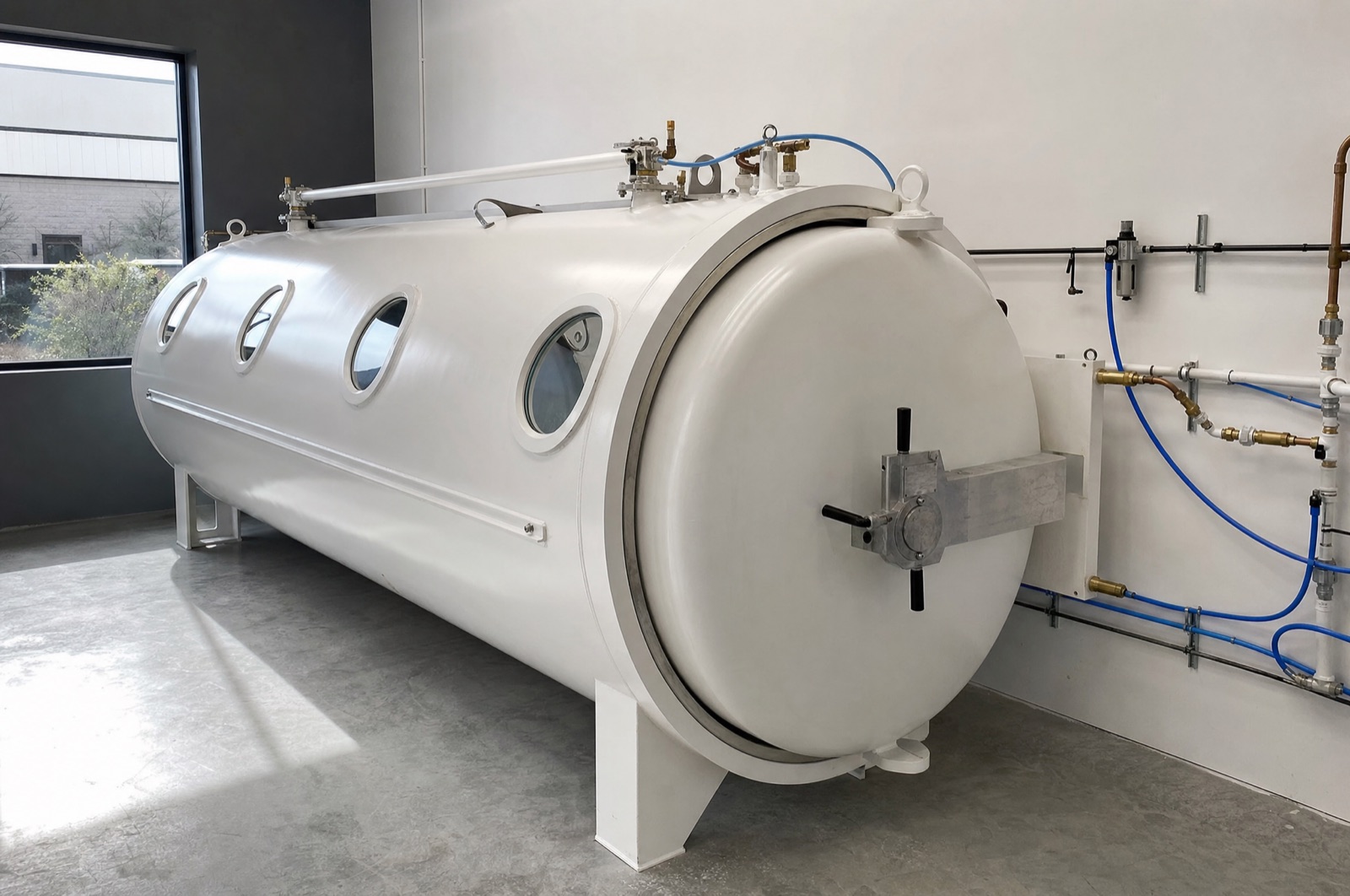
[ Clinic install ] Reference imagery; final photography in production
Hyperbaric chambers are legal in Brazil. A chamber used for treatment is a medical device, and ANVISA, the national health surveillance agency, regulates it. Under ANVISA resolution RDC 751/2022, devices in Classes III and IV need a full registro (registration), while Classes I and II need only a notificação (notification). A 2008 ANVISA technical note put chambers used in health therapies in Class III. The Conselho Federal de Medicina (CFM) says only a doctor may prescribe hyperbaric oxygen. Its ad rules bar doctors from promising results. This page covers each rule for hospital units and for home or wellness chambers. It uses federal law on the Chamber of Deputies site, ANVISA resolutions and a technical note, two CFM resolutions, an ANS technical opinion and a CONITEC report. Most sources are in Portuguese, and the translations are ours. ANVISA publishes RDC 751/2022 in English, and we quote that version. We do not say whether any treatment works, and we do not name or rate any clinic or maker.
Legal, and regulated as a medical device
We read Lei 6.360 of 23 September 1976 on the Chamber of Deputies site, in its updated text. It sets the health surveillance rules for medicines, correlatos (related health products) and other goods. Article 2 says only firms authorised by the health ministry, with premises licensed by the state health body, may make, import, store or ship these products. Article 12 says no product under the law, imported ones included, may be made, offered for sale or delivered for use before it is registered.
Article 25 is the device rule. It covers apparatus, instruments and accessories used in medicine and related fields, and also in physical education, beautification or aesthetic correction. These may only be made or imported for sale once the health ministry has ruled on whether registration is required. Items on ministry lists may be exempt from registration, but they stay under health surveillance (our translation). That wording reaches beyond hospitals. It also covers devices sold for fitness or beauty. We found no federal rule that bans hyperbaric chambers or limits them to hospitals.
Who regulates: ANVISA
ANVISA, the Agência Nacional de Vigilância Sanitária, now holds the powers the 1976 law gave the ministry. RDC 751/2022 cites Law 9.782 of 26 January 1999 as the source of the agency's powers. ANVISA's Nota Técnica 01/2008/GQUIP/GGTPS, on risks in hyperbaric medicine services, quotes the same law. It says the agency's role is to protect public health by controlling the production and sale of products and services under health surveillance (our translation).
ANVISA does not license each clinic. The 2008 note says the Alvará de Licenciamento Sanitário, the health licence for a service, is issued by local health surveillance bodies in the states, the municipalities and the Federal District. So a chamber faces two layers. ANVISA rules on the device, and a local body licenses the place that uses it.
Classes I to IV under RDC 751/2022
We read RDC 751 of 15 September 2022 in ANVISA's English version. It entered into force on 1 March 2023, and Article 66 revoked the older device rule, RDC 185/2001. Article 5 sorts devices by the risk they pose to the user, patient, operator or others:
- Class I: low risk.
- Class II: medium risk.
- Class III: high risk.
- Class IV: maximum risk.
Annex I sets out the rules for assigning a class, and Article 8 says the intended purpose governs which rules apply. If several rules apply, the one that gives the higher class wins. Article 5 says ANVISA decides the class when the rules leave doubt. Article 2 also says active devices for aesthetic correction and beautification count as medical devices. For how other systems file the same product, see FDA cleared vs FDA registered and CE marking for hyperbaric chambers.
Where a hyperbaric chamber sits
The 2008 technical note is the only ANVISA text we found that names a class. It says chambers used in health therapies fall in Class III (high risk) and so must be registered with ANVISA under RDC 185/2001 (our translation). It adds that makers of monoplace and multiplace chambers, whether serial or custom built, should only sell them once they hold a registration, an AFE (company operating authorisation) and a good manufacturing practice certificate.
That note predates RDC 751/2022, and the rule it relied on is now revoked. We found no ANVISA document under the new rules that names the class of a chamber. Two rules in Annex I look relevant on our reading, but we do not know which ANVISA applies. Rule 9 covers active therapeutic devices that supply or exchange energy. They are Class II, or Class III when the energy is delivered in a potentially dangerous way. Rule 12 covers active devices that give substances to the body. They are Class II, or Class III when this is done in a potentially dangerous manner. The open question is whether ANVISA still treats a therapy chamber as Class III. If it does, a registro is required.
Notificação or registro
RDC 751/2022 sets two routes. Article 6 says Classes I and II are subject to notification. Article 7 says Classes III and IV are subject to registration, which the English version calls marketing authorisation. Other points from the resolution:
- Article 11: a registration is valid for ten years from its publication in the Diário Oficial da União, and may be renewed for equal terms.
- Article 28: products under notification do not need renewal.
- Article 59: the same health infractions and penalties apply to both routes.
- Article 60: a device may only be made, imported, offered for sale or delivered for use after its notification or registration number is published.
- Article 62: holders of notifications whose products moved to registration under the new class rules had 365 days to apply for reclassification.
The 2008 note names Lei 6.437, the federal law on health infractions and penalties, as the basis for sanctions on irregular use of chambers. We did not read that law.
What a registration file contains
Article 14 of RDC 751/2022 lists what a registration file needs. For an imported device it includes:
- the completed registration form from ANVISA's website;
- a technical dossier with the structure set in the resolution;
- a statement from the legal maker authorising the Brazilian firm to represent and sell the product;
- proof of marketing authorisation or a free sale certificate from the country where the device is made or sold;
- an ANVISA good manufacturing practice certificate, or proof that one has been applied for;
- a certificate under the Brazilian conformity assessment system, where ANVISA requires one for that type of device.
Article 14 also says a registration is only approved once a valid ANVISA good manufacturing practice certificate is published. Article 10 says forms, instructions for use and labels must be in Portuguese. Other documents may be in Portuguese, Spanish or English. The technical dossier table in the annex asks Classes II to IV for a list of essential safety and performance requirements and a history of sales worldwide. A foreign approval is one part of this file, not a substitute for it. For how a US file is built, see importing a hyperbaric chamber into the US.
Portable and soft chambers
The 2008 note has one line on portable units. It says portable hyperbaric chambers registered with ANVISA for treating symptoms of altitude sickness may not be used for the other hyperbaric treatments listed in CFM Resolution 1.457/1995 (our translation). It says irregular use exposes offenders to the penalties of Lei 6.437.
The note also quotes the CFM on what does not count as hyperbaric oxygen therapy. Breathing 100 percent oxygen at ambient pressure does not count. Nor does exposing limbs to oxygen in bags or tents, even pressurised ones, while the person stays at ambient pressure. The note defines a hyperbaric chamber as a sealed, rigid walled unit built to withstand an internal pressure above 1.4 atmospheres. We found no ANVISA ruling on soft chambers sold for home or spa use under RDC 751/2022. For the pressure and gas differences between the two kinds of chamber, see mild vs medical hyperbaric.
Advertising a chamber
Article 58 of Lei 6.360 says ads for products under the law may only run after authorisation from the health ministry, as set by regulation. When a product needs a prescription, its ads are limited to publications for doctors, dentists and pharmacists. Article 59 bars labels and ads from giving a product purposes or features it does not really have, or from causing confusion about its origin, nature or quality.
The best known ANVISA ad rule does not cover devices. We read RDC 96/2008 on the Ministry of Health legal library. Article 1 says it applies to advertising and promotion of medicines. We did not find an ANVISA resolution written for device ads. So for a chamber, the rules we can confirm are Articles 58 and 59 of the law and the CFM rules below.
Advertising a treatment
A clinic that promotes sessions is subject to the CFM's rules if it is run by doctors. We read CFM Resolution 2.336/2023 on medical advertising, published on 13 September 2023. Article 4 says a doctor's ads must give the doctor's name, CRM (regional council) number and the word MÉDICO. Article 5 says a clinic's ads must name the clinic's CRM number and its medical technical director. Article 11 bars doctors and, where it applies, medical firms from:
- promoting equipment or medicine not registered with ANVISA;
- claiming a device has privileged powers;
- taking part in ads for equipment or other products that imply guaranteed results;
- promoting a method or technique the CFM does not recognise;
- guaranteeing, promising or hinting at good results of treatment.
These rules bind doctors and medical firms. We found no rule that sets the ad limits for a spa or wellness centre with no doctor.
Doctors and the CFM
We read CFM Resolution 1.457/1995 on hyperbaric medicine, dated 15 September 1995 and published in the Diário Oficial on 30 November 1995. It defines hyperbaric oxygen therapy as breathing pure oxygen while under pressure greater than atmospheric, inside a hyperbaric chamber. It describes two kinds of chamber. A multiplace chamber is larger, pressurised with compressed air and holds several people. A monoplace chamber holds one patient and is usually pressurised with oxygen.
Section II says the prescription of hyperbaric oxygen therapy is the exclusive role of a doctor. Section III says a doctor must give the treatment or supervise it. The resolution lists 16 clinical uses it calls currently recognised, including gas embolism, decompression sickness and carbon monoxide poisoning. We report the CFM's list. We do not judge it. Section IV says session length, pressure, number and interval vary by condition and protocol. The resolution sets no pressure limit and no rule on which staff may run the chamber.
Facility rules for hyperbaric units
We read RDC 50/2002 on the Ministry of Health legal library, ANVISA's technical rule for the design of health care buildings. Article 5 says breaking it is an infraction of federal health law. Item 4.14 lists the tasks of a hyperbaric oxygen unit: a medical consultation to plan therapy, treatment in an individual or collective chamber, medical follow up during sessions and immediate care for problems that arise. It also lists nursing procedures and the safety of patients, operators and the room.
The same rule sets room sizes. A room with a one patient chamber needs at least 230 cm of clear space at the chamber entrance and 80 cm at its other edges. A multiplace room needs the same, plus 150 cm at the rear exit, a 3.0 m² control area and a 4.0 m² machine room. It sets an oxygen demand of 120 litres per minute for each chamber, individual or collective. The 2008 note says the oxygen and compressed air supply must meet ABNT NBR 12.188:2003, and that oxygen from on site concentrator plants is not allowed.
The note also lists items for an inspection checklist that ANVISA said it was preparing. They include a conformity certificate for the pressure vessel, tests of acrylic viewports, fire suppression, safety and relief valve tests, and grounding below 1.0 ohm between hull and earth. It cites the Sociedade Brasileira de Medicina Hiperbárica (SBMH) and its 2005 safety guidelines. For the fire and oxygen hazards behind these rules, see hyperbaric chamber safety and NFPA 99 and hyperbaric fire safety.
Private health plans and the SUS
The ANS regulates private health plans. Its technical opinion 36/2018 says hyperbaric oxygen therapy is on the Rol de Procedimentos, the list of mandatory cover, under RN 428/2017. Hospital plans and reference plans must cover it when the conditions of its Diretriz de Utilização (usage guideline), item 58 of Annex II, are met. The guideline lists criteria such as decompression sickness, gas embolism and carbon monoxide poisoning, and sets detailed tests for some wound and radiation injury cases. Plans sold before 2 January 1999 and never adapted to Law 9.656/1998 cover it only if the contract says so. The opinion dates from 2018, and we did not read the current Rol.
For the public SUS, we read a CONITEC report for the public, number 45. The SBMH asked CONITEC, the SUS technology assessment body, to add hyperbaric oxygen for chronic diabetic foot ulcers. The CONITEC plenary cited many uncertainties and, at its meeting of 5 and 6 July 2017, recommended against adding it. The report says the health ministry secretary then decided not to add it to the SUS. For how US payers code the same treatment, see hyperbaric insurance and CPT codes.
Hospital unit and wellness chamber side by side
| Question | Hospital unit | Home or wellness chamber |
|---|---|---|
| Banned? | No | No ban found |
| Medical device? | Yes, under Lei 6.360 Article 25 and RDC 751/2022 | Article 25 also covers fitness and beauty devices; no chamber ruling found |
| Class | Class III in the 2008 note, under a revoked rule | Not addressed |
| Route | Registro, if Class III | Notificação if Class I or II, registro if III or IV |
| Foreign approval | One document in the file; ANVISA still registers | Same |
| Who prescribes | A doctor, under CFM 1.457/1995 | No rule found for sessions without a doctor |
| Portable units | Not relevant | Units registered for altitude sickness may not be used for other CFM listed treatments |
| Ads | Lei 6.360 Articles 58 and 59; CFM 2.336/2023 | Lei 6.360 Articles 58 and 59; CFM rules if doctors are involved |
| Premises | RDC 50/2002 item 4.14; local health licence | No rule found |
| Coverage | ANS guideline item 58 for private plans; not added to the SUS for diabetic foot | None found |
Sources: Lei 6.360/1976 on camara.leg.br; RDC 751/2022 (ANVISA English version); ANVISA Nota Técnica 01/2008/GQUIP/GGTPS; RDC 50/2002 and RDC 96/2008 on bvsms.saude.gov.br; CFM Resolutions 1.457/1995 and 2.336/2023; ANS technical opinion 36/2018; CONITEC report for the public 45. All linked above, read 5 November 2026.
For the same question elsewhere, see chamber rules in Mexico, chamber rules in Australia, Canada and the UK and chamber rules in Germany and France. For the chambers we track and what we can verify about each, see the scorecard.
What we have not verified
We found no ANVISA document under RDC 751/2022 that gives the class of a hyperbaric chamber, so we cannot say whether the Class III view of the 2008 note still holds. We read ANVISA's English version of RDC 751/2022, not the Portuguese text in the Diário Oficial, and we did not check later amendments. We could not search the ANVISA product register, because it blocked our requests, so we cannot say how many chambers hold a registro or a notificação. We did not read Lei 6.437, Law 9.782 or the good manufacturing practice rules. We did not check whether RDC 50/2002 has been amended or replaced, and we did not find the ANVISA inspection checklist the 2008 note describes. We found no ANVISA resolution on device advertising and no ruling on soft chambers or spa sessions. We did not read the current ANS Rol or its usage guideline, so the criteria may have changed since 2018. We did not find SUS rules for uses other than diabetic foot, or any national count of chambers. We did not check state or municipal rules, which may add to the federal ones. We did not look for a fast track that relies on foreign approvals.
Frequently asked
Are hyperbaric chambers legal in Brazil?
Yes. We found no ban. Lei 6.360/1976 says devices used in medicine may only be made or imported for sale once the health ministry has ruled on whether they need registration. ANVISA now runs that system. A 2008 ANVISA technical note says chambers used in health therapies must be registered with the agency. The CFM has recognised hyperbaric oxygen therapy as a medical procedure since 1995.
What class is a hyperbaric chamber in Brazil?
ANVISA put chambers used in health therapies in Class III, high risk, in a technical note dated 29 August 2008. That note relied on RDC 185/2001, which RDC 751/2022 revoked on 1 March 2023. We found no ANVISA document under the new rules that names the class of a chamber. Under RDC 751/2022, ANVISA decides the class when the rules leave doubt.
Can a chamber cleared by the FDA be sold in Brazil without a new review?
Not on our reading. RDC 751/2022 asks an importer to file proof of a foreign marketing authorisation or a free sale certificate, but that is one item in the file. For Classes III and IV the file also needs a technical dossier and an ANVISA good manufacturing practice certificate. A device may only be imported or sold after its number is published in the Diário Oficial da União.
Can a wellness centre offer hyperbaric oxygen sessions in Brazil?
The rules we read point to a doctor. CFM Resolution 1.457/1995 says only a doctor may prescribe hyperbaric oxygen, and a doctor must give it or supervise it. A 2008 ANVISA note adds that portable chambers registered for altitude sickness may not be used for the other treatments the CFM lists. We found no rule written for spas or wellness centres.
Do Brazilian health plans cover hyperbaric oxygen therapy?
Private plans must cover it in set cases. A 2018 ANS technical opinion says the procedure is on the mandatory list for hospital plans, under a usage guideline with listed criteria. For the public SUS, a CONITEC report records a decision in 2017 not to add it for diabetic foot ulcers. We did not find a SUS rule for other uses.

Alex tests the machines himself, in clinics and studios on three continents. Every score comes from the same 27 public criteria, and no manufacturer has a say in them.
Six questions, and we'll match chamber, options, and install to your space and budget.