Importing a Hyperbaric Chamber into the US: FDA Entry Review, Detention, Refusal and CBP Basics
Researched and scored by Alex Evans. Last reviewed August 2026. Corrections are dated and public. See corrections
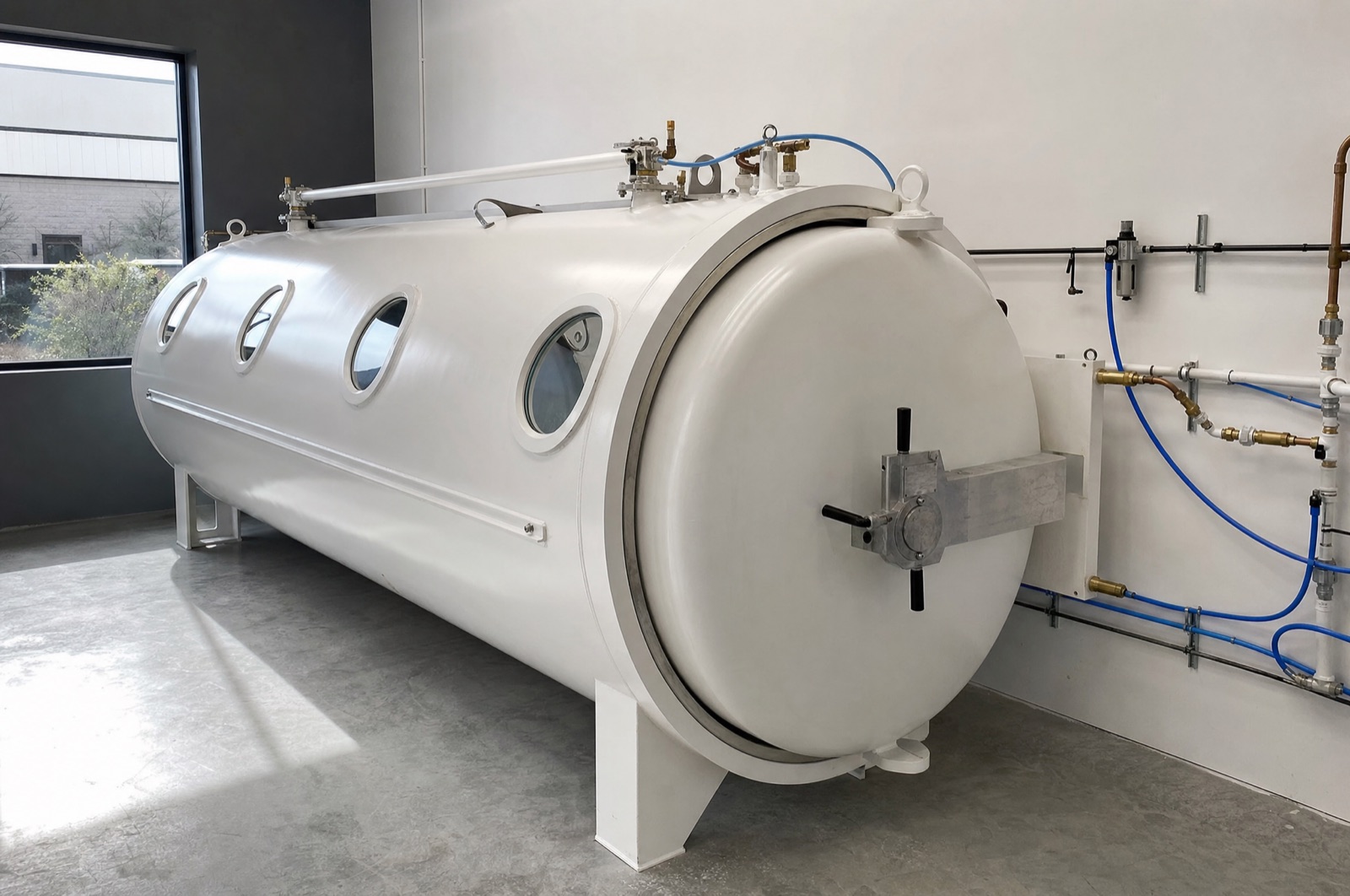
[ Clinic install ] Reference imagery; final photography in production
A hyperbaric chamber shipped into the United States goes through two checks. US Customs and Border Protection (CBP) takes the entry, and it refers anything the FDA regulates to the FDA. The FDA then checks that the maker and shipper are registered, that the device is listed, and that a required 510(k) clearance exists. Hyperbaric chambers are Class II devices under 21 CFR 868.5470, and FDA data lists 510(k) as the route. If the records do not match, the FDA may ask for documents or detain the shipment. If a required 510(k) is missing, the FDA says the product will be subject to refusal, and a refused shipment must be exported or destroyed within 90 days. The foreign maker must have registration, listing, a US agent and, for a chamber, a clearance in place before the crate leaves. This page sets out each step from FDA and CBP pages we read on 4 November 2026. It does not judge any brand, and it does not say whether any treatment works.
Two agencies at the border
The FDA's FDA Import Process page (content current as of 9 October 2024) says FDA regulated products imported into the US must comply with the same laws and regulations that apply to domestic products. It says entries are submitted to CBP, which then refers entries of FDA regulated products to the FDA for review. It also says imported items should not be distributed into commerce until the FDA has determined admissibility.
The FDA's page on importing medical devices into the US (current as of 30 January 2026) splits the jobs. CBP assesses and collects duties, taxes and fees, and reviews entry forms. The FDA and CBP work under an agreement to enforce section 801 of the Food, Drug, and Cosmetic Act together. The same page carries one line that matters to anyone buying from abroad: the FDA does not recognize regulatory authorizations from other countries, and the product must meet the applicable FDA regulation. A CE mark or a foreign licence does not stand in for a US clearance. For what CE marking does mean, see CE marking on hyperbaric chambers.
What the FDA checks on each entry
The FDA's Importing Medical Devices page (current as of 9 October 2024) lists what it verifies at the time of import, as applicable:
- registration of the establishments involved;
- listing of the device;
- a premarket submission, either a 510(k) or a PMA, for devices that need one;
- field examination and sampling, to check standards and label requirements;
- the import alert database, to see whether the maker or product is subject to detention without physical examination.
The page says entry reviewers compare the declared manufacturer, importer or consignee, product description and Affirmation of Compliance codes with the FDA's internal data systems. The declared manufacturer and shipper are checked against the device registration and listing database, and the declared importer is checked too. If the data matches, compliance is verified. If it does not, the FDA may gather more information or may detain the product. The page states two outcomes plainly. If a firm lacks the required registration and listing, the product will be subject to refusal. If the product requires a 510(k) or PMA and does not have one, it will be subject to refusal.
The Entry Review page (current as of 21 January 2026) describes the order. All electronic data is screened by FDA systems first. Entries with complete, accurate and valid data may get a lower risk score and a release with no further review. Entries that do not get a system release go to human review under the FDA ImportShield Program, which the page says took effect on 4 August 2025. Reasons include higher risk products, missing information, products that appear subject to an import alert, and products picked for examination or sampling. The reviewer can release the product, ask for entry documents, examine or sample it, or request detention. The page says a release does not preclude future FDA action if a problem is found later.
The codes on the entry line
The importer or customs broker files entry data with CBP through the Automated Commercial Environment (ACE). The FDA device import page lists the required entry information: country of origin, the FDA product code, the importer's product description, the manufacturer, the shipper, applicable Affirmation of Compliance codes, and the Harmonized Tariff Schedule (HTS) code. For tariff rates, the page tells readers to contact the local CBP port of entry. We did not look up a rate for this page.
Affirmation of Compliance (A of C) codes are three letter codes that carry the numbers the FDA checks. The FDA's A of C quick reference PDF (file dated March 2026) lists these device codes, among others:
- DEV: device foreign manufacturer registration number;
- DFE: device foreign exporter registration number;
- LST: device listing number;
- PM#: device premarket number, such as a 510(k) K-number;
- DI: device identifier.
The FDA's medical device common entry errors page (current as of 25 November 2025) lists the look ups that fail most often. They include no listing number sent, a listing number the FDA cannot find, no DEV or DFE sent, a DEV that does not match a valid non US firm, a registration that does not match the firms on the line, a product code that does not match the listing, and a PM# missing where the product code requires one. The page says that when the data is complete and accurate, the screening system can look it up and issue a May Proceed. When it is missing or wrong, the look up fails and the entry line may be delayed.
What the foreign maker must have in place
The FDA device import page lists the basic requirements for a foreign manufacturer: establishment registration, device listing, a quality management system, a 510(k) unless exempt or a PMA, labeling and medical device reporting. It adds that a foreign manufacturing site is subject to FDA inspection. The FDA page Who Must Register, List and Pay the Fee marks foreign manufacturers and foreign exporters of devices as required to register.
For a hyperbaric chamber, the premarket step is not optional. We read 21 CFR 868.5470 on govinfo, in the edition revised as of 1 April 2025, because the eCFR site blocked our request. It identifies a hyperbaric chamber as a device intended to increase the environmental oxygen pressure, to promote the movement of oxygen to a patient's tissue, by pressurization greater than atmospheric pressure. Topical oxygen chambers for extremities are excluded. The classification is Class II (performance standards). How a 510(k) clearance works, and why a registration is not one, is covered in FDA cleared vs FDA registered. This page does not repeat that ground.
Two points from the FDA import pages are easy to miss. First, the FDA checks at entry that the declared premarket number matches the listing number sent on the line, and that the product code matches the listing. Second, the FDA device import page says a finished device that is not legally marketed in the US may not be imported, even if it is only meant to be exported again later.
The US agent
The FDA's US Agents page (current as of 23 December 2017) says any foreign establishment that makes or processes a device imported into the US must identify a US agent. Each foreign establishment may name only one. The agent must live in the US or keep a place of business there, cannot use a post office box as an address, and cannot rely on an answering service alone. The agent must confirm consent through an automated email check, and if they deny or do not respond within 10 business days, the foreign establishment must name a new one.
The page says the agent's duties are limited. They help the FDA communicate with the foreign establishment, answer questions about its imported devices, and help schedule inspections. If the FDA cannot reach the foreign establishment quickly, documents given to the US agent count as given to the establishment. The page also says the US agent has no duty to report adverse events or to submit 510(k) notifications. A US agent is a contact point, not a sign that the device was reviewed.
Who counts as the initial importer
The FDA device import page quotes 21 CFR 807.3(g): an initial importer is any importer who furthers the marketing of a device from a foreign manufacturer to the person who makes the final delivery or sale to the ultimate consumer or user, but does not repackage or change the container, wrapper or labeling. The FDA registration chart adds that the initial importer must have a physical US address staffed by people responsible for the compliance of imported devices.
The FDA lists the initial importer's duties as establishment registration, medical device reporting, reports of corrections and removals, and device tracking where it applies. Under the reporting rule, the page says an importer must report incidents in which a device may have caused or contributed to a death or serious injury, and certain malfunctions. It must keep an event file for each adverse event and forward all complaints to the manufacturer. The registration chart marks import agents, brokers and other parties who do not take first possession of an imported device as not required to register or list.
Whether a clinic that orders one chamber for its own use is an initial importer is a question we could not settle from these pages. The definition turns on furthering the marketing of a device to the person who makes the final sale or delivery. The FDA's device import page gives a contact for the Division of Industry and Consumer Education, DICE, at DICE@fda.hhs.gov and (800) 638-2041, for questions like this one.
Detained: the Notice of FDA Action
The FDA's Detention and Hearing page (current as of 17 October 2024) says that when products appear to violate FDA laws, the FDA may detain them and issue a Notice of FDA Action marked Detained. That notice counts as the Notice of Detention and Hearing. It lists the charges and gives a respond by date. The page says the FDA's Regulatory Procedures Manual allows 10 business days from detention, and that the notice generally gives 20 calendar days to allow for weekends, holidays and mail. An extension may be asked for within that window, with a reasonable basis.
The owner, the consignee or the importer of record may respond. The page says the importer of record may be the broker, consignee, owner or whoever owns the bond covering the shipment. A representative may respond only if authorized in writing. The hearing can be a series of emails or calls, or a formal meeting, usually with the compliance officer named on the notice. Evidence, which the FDA calls testimony, is sent through the ITACS system or to the local import office. The importer may also apply on Form FDA 766 to relabel or recondition the goods.
The page says a detained product does not have to sit in a set place, but the FDA expects the entry process to happen within the declared port of entry area. If the FDA wants to examine a product that has been moved, it may ask CBP to demand redelivery to the port.
Refused: export or destroy within 90 days
The FDA's Import Refusals page (current as of 9 October 2024) defines a refusal as the FDA's final decision that a detained shipment violates FDA laws. A refused shipment must be destroyed or exported under CBP and FDA supervision within 90 days of the refusal notice. Reasons it gives include no response to the detention notice, evidence that did not overcome the violation, and a reconditioning plan the FDA denied.
The notice of refusal always goes to the importer of record. If the goods are not exported or destroyed in 90 days, CBP may assess liquidated damages against the bond. The page says the FDA has no authority to extend the 90 days, and that a refusal is a final decision unless the FDA issued it in error. The FDA publishes an import refusals report, updated monthly, by country and product.
A separate FDA administrative destruction page says the FDA may destroy certain refused devices valued at $2,500 or less, offered through international mail or express couriers, without the option to export. Its final rule took effect on 1 July 2024.
Import alerts and detention without examination
The FDA's Import Alerts page (current as of 3 March 2025) says the FDA can place a product on an import alert after finding a violation, and then detain later shipments without testing or examining them. It calls this detention without physical examination, or DWPE. A shipment subject to DWPE will be detained and refused unless the importer shows it does not have the listed violation.
Each alert names the reason, the products and firms covered, and how to get a release. Firms on a yellow or red list are subject to DWPE under that alert, and firms on a green list are exempt from it. The FDA device import page gives Import Alert 89-04 as an example: it lists foreign manufacturers not in compliance with device good manufacturing rules. The FDA says importers should check whether their products are subject to DWPE before importing. We did not search the alert database for any chamber maker.
Personal importation and a chamber
The FDA device import page defines a personal importation as an up to 90 day supply of a medical device, not for further sale or distribution, carried in baggage or sent by courier or mail. The FDA's Personal Importation page (current as of 18 August 2025) says that in most circumstances it is illegal for individuals to import drugs or devices for personal use, because products bought abroad often have not been approved for US use and sale. It says the same considerations generally apply to devices as to drugs. The FDA may be more permissive when, for example, a product is not for a serious condition and carries no known significant health risk, or when the buyer affirms in writing that it is for personal use.
The page lists when the FDA would refuse a personal importation. Reasons include a product on an import alert, a shipment that appears meant for commercial distribution, a product that appears to present a serious risk to health, and a product that appears to be health fraud. We found no FDA statement that applies the personal importation policy to a hyperbaric chamber in particular. Whether a chamber needs a prescription is a separate question; see do you need a prescription for a hyperbaric chamber.
CBP basics: importer, broker and formal entry
CBP's internet purchases page (last modified 6 March 2024) says that when you buy goods from foreign sources, you become the importer, and that the importer is ultimately responsible for paying any duty owed. It says a purchase price that includes shipping and handling does not include duty. Goods valued at more than $2,500 need a formal entry, which can require extensive paperwork and a CBP bond, and CBP recommends that importers consider hiring a customs broker for it. The page says goods not claimed within 15 days of arrival may go to a warehouse at the importer's cost.
CBP's importer tips page (last modified 27 August 2024) says the importer of record is ultimately responsible for the correctness of the entry documents and for all duties, taxes and fees, even when a broker is used. It says brokers are licensed by CBP but are not CBP employees. It also says CBP does not require an importer to hold a licence, while other agencies may require a permit or certification depending on the goods. For a chamber, that other agency is the FDA. CBP's customs brokers page says licences are issued to people and firms to conduct customs business for others.
A seller may act as the importer and deliver a cleared chamber, or ship to the buyer, who then becomes the importer in CBP's terms. Ask in writing who will be the importer of record, who files the entry, and who answers an FDA notice if one comes. After the chamber clears, see hyperbaric chamber delivery and installation for the freight and install steps.
Checking a chamber before you order
The FDA runs the same checks at the port that a buyer can partly run before paying. The FDA device import page says anyone may search the public registration and listing database for any registered device firm, and the public 510(k) database for clearances. The listing number is not public. The common errors page says the FDA cannot confirm or provide listing numbers to anyone who is not the official correspondent on the firm's registration, and points importers to that correspondent.
A practical order of checks:
- Ask the seller for the maker's FDA registration number, the device listing number, the K-number of the clearance, and the product code.
- Search the registration and listing database for the maker by name or registration number, and note the FEI number and the US agent shown on the record.
- Search the 510(k) database for the K-number, and check that the product code is CBF and the applicant matches the maker or a firm it names.
- Check that the model you are ordering is the device the clearance describes.
- Search the import alert database for the maker's name.
- Get in writing who is the importer of record and who pays duty, broker fees and storage if the entry is held.
A used chamber bought abroad raises the same entry checks, plus condition. See the used hyperbaric chamber inspection checklist.
What FDA data shows for product code CBF
We queried openFDA, the FDA's public data service, on 4 November 2026. Its data was last updated on 26 October 2026, and openFDA says to assume all results are unvalidated. The classification record names product code CBF as "Chamber, Hyperbaric", regulation 868.5470, device class 2, anesthesiology panel, with the life sustaining or supporting flag set and 69 K-numbers attached. The registration and listing data returned 44 listing records under product code CBF. We counted them by field and did not read them by firm.
| Field in the openFDA listing records for CBF | Count |
|---|---|
| All listing records | 44 |
| Establishment address in the US | 35 |
| Establishment address outside the US (Argentina 2, Australia 2, India 2, Austria 1, United Kingdom 1, Peru 1) | 9 |
| Initial importer flag set to yes | 7 |
| Registration expiry year 2026 | 44 |
| Type: manufacture medical device | 38 |
| Type: repack or relabel | 3 |
| Type: contract manufacturer | 2 |
| Type: complaint file establishment | 2 |
| Type: develops specifications, does not manufacture there | 1 |
Sources: openFDA device classification and registration and listing endpoints, data last updated 26 October 2026, queried by product code CBF. Type counts can overlap, because one record can list more than one establishment type. Read 4 November 2026.
These counts are a snapshot of filings, not a list of chambers you can buy. A record lists the establishment's own address, so the country column does not show where every part was made. A chamber sold under a different product code would not appear here.
Entry outcomes side by side
| Stage | What the FDA or CBP does | What the importer can do | Source |
|---|---|---|---|
| Electronic screening | Checks entry data against FDA systems; may release with no further review | Send complete product code, DEV, LST and PM# data | FDA Entry Review; common entry errors |
| Human review | Releases, asks for documents, examines, samples or requests detention | Upload documents through ITACS | FDA Entry Review |
| Detention | Issues a Notice of FDA Action marked Detained, with charges and a respond by date | Give testimony, ask for an extension, or apply to recondition on Form FDA 766 | FDA Detention and Hearing |
| Refusal | Issues a Notice of Refusal of Admission to the importer of record | Export or destroy under supervision within 90 days | FDA Import Refusals |
| Import alert | Detains future shipments without examination | Show the shipment does not have the listed violation | FDA Import Alerts |
| Formal entry | Required for goods over $2,500; may need a bond | Hire a licensed customs broker, as CBP suggests | CBP internet purchases page |
Sources: FDA Entry Review, Detention and Hearing, Import Refusals, Import Alerts and Medical Device Common Entry Errors pages; CBP internet purchases page. All linked above, read 4 November 2026.
For the chambers we track and what we can verify about each, see the scorecard.
What we have not verified
The eCFR site blocked our scripted request, so we read 21 CFR 868.5470 in the govinfo edition revised as of 1 April 2025; a later change would not show there. The FDA's accessdata site returned a rate limit page, so we did not load the registration and listing, 510(k), product classification or import alert search pages, and we did not search any firm. The counts above come from openFDA instead. We did not settle whether a clinic that imports one chamber for its own use is an initial importer; the FDA's DICE contact is the place to ask. We found no FDA statement on personal importation of a hyperbaric chamber in particular. We did not look up the HTS code or any duty or tariff rate for a chamber. We did not read CBP's bond rules or broker fee practice. We did not check state pressure vessel or boiler rules, local fire codes, or how oxygen equipment shipped with a chamber is treated at entry. CBP's site refused direct requests, so the CBP points come from a page fetch tool, not a full copy of each page.
Frequently asked
Can I import a hyperbaric chamber from an overseas factory into the US?
The FDA says imported devices must meet the same rules as domestic ones, and that it verifies registration, listing and, where required, a 510(k) or PMA when a device is offered for import. Hyperbaric chambers are Class II under 21 CFR 868.5470, and FDA classification data lists 510(k) as the submission type. The FDA says a product that needs a 510(k) and does not have one will be subject to refusal.
Does a CE mark let a chamber into the US?
No. The FDA page on importing medical devices says the FDA does not recognize regulatory authorizations from other countries and that the product must meet the applicable FDA regulation. A chamber with a CE mark still needs FDA registration, listing and, for a hyperbaric chamber, a 510(k) clearance to enter.
What happens if the FDA detains my chamber at the port?
The FDA issues a Notice of FDA Action marked Detained, which it treats as the Notice of Detention and Hearing. It gives a respond by date, generally 20 calendar days from the date of detention, to submit evidence or a request to recondition. If the evidence does not overcome the appearance of a violation, the shipment is refused and must be exported or destroyed under CBP and FDA supervision within 90 days.
Who is the importer when I order a chamber online from abroad?
CBP says that when you buy goods from foreign sources, you become the importer, and that the importer is ultimately responsible for paying any duty owed. Its importer tips page says the importer of record is ultimately responsible for the correctness of the entry documentation, even when a broker is used. For goods valued at more than $2,500, CBP says a formal entry is required.
Can I check a chamber maker in FDA databases myself?
Yes, in part. The FDA says anyone may search the public registration and listing database for a registered device firm, and the public 510(k) database for clearances. The device listing number is not public: the FDA says it cannot provide listing numbers to anyone other than the official correspondent on the firm's registration, so you ask the maker for it.

Alex tests the machines himself, in clinics and studios on three continents. Every score comes from the same 27 public criteria, and no manufacturer has a say in them.
Six questions, and we'll match chamber, options, and install to your space and budget.