Are Hyperbaric Chambers Legal in Mexico? COFEPRIS Registration, Device Classes and Ad Permits
Researched and scored by Alex Evans. Last reviewed August 2026. Corrections are dated and public. See corrections
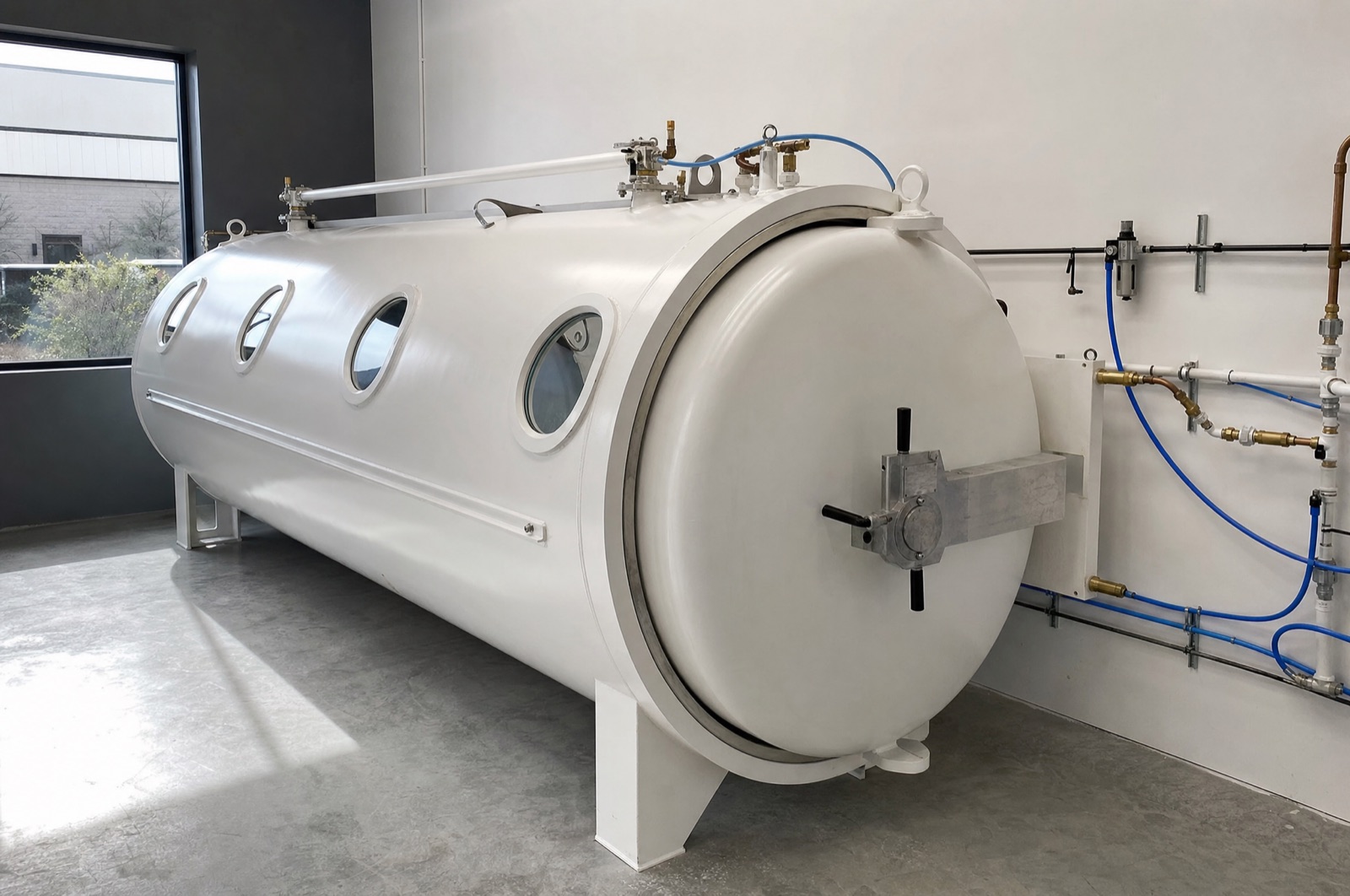
[ Clinic install ] Reference imagery; final photography in production
Hyperbaric chambers are legal in Mexico. A chamber sold for medical care is medical equipment, which the Ley General de Salud counts as a medical device. Article 376 of that law requires a registro sanitario (health registration) for medical devices, except those listed as low risk. COFEPRIS, the federal health risk agency, grants it. The chamber is not on the July 2025 low-risk lists. A US, Canadian or Japanese approval can shorten the file, but COFEPRIS still issues its own registration. Many ads for devices and health services need a COFEPRIS permit. This page covers each rule for hospital units and for home or wellness chambers. It uses the federal law and the advertising regulation on the Chamber of Deputies site, notices in the Diario Oficial de la Federación (DOF), COFEPRIS guides, a hospital page and two government press items. All sources are in Spanish, and the translations are ours. We do not say whether any treatment works, and we do not name or rate any clinic.
Legal, and regulated as a medical device
We read the Ley General de Salud on the Chamber of Deputies site, with its last reform published in the DOF on 15 January 2026. Article 194 Bis counts medical devices as insumos para la salud (health supplies). Article 262 lists the groups of medical devices. The first is equipo médico, which the law defines as apparatus, accessories and instruments for specific use in medical or surgical care, or in examination, diagnosis, treatment and rehabilitation of patients (our translation). A clinical hyperbaric chamber fits that wording. Article 262 also says the Secretaría de Salud will classify these products by their features and the risk of their use, under the Reglamento de Insumos para la Salud.
Two articles set the duty. Article 204 says medical devices need a health authorisation for sale or supply. Article 376 says the registro sanitario is required for medical devices other than those found to be low risk and not to need it. A registration lasts five years and may be extended for ten year terms on request. Article 262 Bis, added on 15 January 2026, requires tecnovigilancia, the tracking of incidents with devices in use, once a registration is granted. We found no rule that bans hyperbaric chambers or limits them to hospitals.
Who regulates: COFEPRIS
Article 17 Bis of the law says the health ministry exercises its powers of sanitary regulation, control and oversight through a decentralised body called the Comisión Federal para la Protección contra Riesgos Sanitarios (COFEPRIS). The DOF agreements we read state that these powers include granting and revoking the registro sanitario of health supplies.
COFEPRIS publishes a guide to the registro sanitario for medical devices. It carries no date on its face. It quotes Article 82 of the Reglamento de Insumos para la Salud: medical equipment and other devices need a registro sanitario for their production, sale and distribution (our translation). It says the registration is the authorisation that lets a Mexican or foreign device be distributed and sold in Mexico. We could not load the Reglamento itself from an official site, so we rely on the text as COFEPRIS quotes it.
Classes I, II and III
The same guide quotes Article 83 of the Reglamento. It sorts devices into three classes for registration, by the risk of their use (our translation):
- Class I: supplies known in medical practice, with proven safety and efficacy, that are generally not introduced into the body.
- Class II: supplies known in medical practice that may vary in material or concentration, and that are generally introduced into the body for less than thirty days.
- Class III: supplies that are new or recently accepted in medical practice, or that are introduced into the body and stay for more than thirty days.
The guide points to an appendix of the Farmacopea de los Estados Unidos Mexicanos device supplement for detailed classification criteria. We did not read that appendix, and we found no COFEPRIS document that names the class of a hyperbaric chamber. Mexico's three classes do not map one to one onto other systems. For how the US files the same device, see FDA cleared vs FDA registered, and for Europe, see CE marking for hyperbaric chambers.
The low-risk lists and where chambers sit
On 7 July 2025 COFEPRIS published a DOF agreement with three lists. Annex One lists low-risk devices that still need a registro sanitario, with a 20 working day limit for COFEPRIS to decide. Annex Two lists low-risk devices that need no registration, though they still must meet good manufacturing practice and tecnovigilancia. Annex Three lists products that are not medical devices at all. We searched the text for hyperbaric, chamber, oxygen and pressure. We found items such as oxygen depletion alarms, audiometry booths and a body massage unit with heat and pressure, but no hyperbaric chamber in any of the three lists.
The COFEPRIS guide tells applicants to check these lists first. Since a chamber is not on them, our reading is that a chamber sold as a medical device needs a full registro sanitario. The 2025 lists replaced a 2014 version published in the DOF on 22 December 2014, which we also read and which also had no hyperbaric chamber.
Using a US, Canadian or Japanese approval
Article 161 Bis of the Reglamento lets the health ministry recognise foreign requirements as equivalent to Mexican ones. Two agreements apply to devices. We read the agreement of 26 October 2010 on the FDA and Health Canada and the agreement of 25 January 2012 on Japan, both as DOF page images on the Farmacopea site.
- The 2010 text covers applicants with FDA establishment registration, 510(k) clearance or premarket approval, or a Health Canada medical device licence. For US Class II and III devices it asks for an FDA certificate to foreign government, the last establishment inspection report, a postmarket surveillance summary and the FDA document that approves the device and names its class, all translated into Spanish.
- Health Canada Class I devices are excluded. Japan's Class I is also excluded under the 2012 text.
- Both texts give COFEPRIS 30 working days to decide once the file is complete.
- Both say that, whatever the foreign class, COFEPRIS classifies the device under Article 83 of the Reglamento.
So a foreign approval is a faster route, not a substitute. The importer still needs a Mexican registration, and the 2012 text says the agreement does not exempt importers and distributors from other Mexican requirements. For how a US file differs between cleared and registered, see our FDA guide.
The 2025 abbreviated pathway
On 18 July 2025 the health ministry published general guidelines for an abbreviated regulatory pathway in the DOF. They took effect 30 working days after publication. For devices, Article 24 says COFEPRIS recognises the decisions of reference regulators in countries on the IMDRF Management Committee, and of full MDSAP members for manufacturing certificates. Article 36 says COFEPRIS will check only that the file is complete and properly filled in, without further evaluation. Article 38 sets a 30 working day limit for a device decision. Article 32 again says COFEPRIS classifies devices under Article 83 of the Reglamento.
The guidelines withdrew a list of older equivalence agreements, which on our reading are mostly about medicines. A COFEPRIS requirements guide, whose file name dates it to June 2026, still lists the 2010 FDA and Health Canada agreement and the 2012 Japan agreement next to the 2025 pathway. It says applicants must pick one route on the form and file papers that match it. It notes that the device procedure, COFEPRIS-04-050, could not yet be filed digitally, so a paper filing was still required.
What a registration file contains
The general COFEPRIS guide lists what an ordinary file holds. For a foreign maker it includes:
- a power of attorney for a legal representative established in Mexico;
- a draft label or counter label in Spanish under NOM-137-SSA1;
- a certificate of free sale, or equivalent, from the health authority of the country of origin;
- a good manufacturing practice certificate for the real maker, for which an ISO 13485 certificate or a CE certificate for medical devices may serve as an equivalent;
- a letter of representation if the product is not made by the applicant's parent, subsidiary or affiliate;
- the operating notice and health officer notice for the Mexican establishment.
The 2025 guidelines list a similar set for the abbreviated route, plus a clinical evaluation, a risk analysis and a tecnovigilancia report. A Mexican maker needs a COFEPRIS good manufacturing practice certificate instead of a foreign one.
Advertising a chamber
We read the Reglamento de la Ley General de Salud en materia de Publicidad, with its last reform published on 8 September 2022. Article 301 of the law says the health ministry authorises ads that promote the use or sale of health supplies. In the regulation:
- Article 79 requires a permit for ads for medical equipment, but for devices only when the ad is aimed at the general public.
- Articles 86 and 88 require only a notice for ads for health supplies aimed at health professionals.
- Article 52 says the ministry authorises device ads in line with the features and purposes for which the device was registered.
- Article 6 bars ads from giving a product preventive, therapeutic or rehabilitative qualities that do not match its function or its authorisation.
- Article 9 treats an ad as not provable if it misleads, hides needed contraindications or exaggerates features.
- Article 83 bars changing an approved ad in a way that alters the basis of the permit.
Articles 110 to 112 set fines in multiples of the daily minimum wage. Breach of listed articles such as 7, 8, 10, 18 and 83 carries 6,000 to 8,000 times that wage, and other breaches up to 16,000 times.
Advertising a treatment or a wellness service
A clinic that advertises sessions is advertising a health service. Article 79 requires a permit for those ads too, except for services given individually. Article 18 says the ministry will not authorise an ad for health services that offers a medical or paramedical treatment whose efficacy has not been scientifically proven, or where the provider cannot show it has trained staff and suitable equipment. Article 19 says professionals must state in their ads the institution that issued their title and, where relevant, their cédula profesional (licence number).
A wellness centre may fall under a different title. Articles 63 to 65 cover beauty services that use apparatus or equipment to change features of the body. They bar giving such services preventive, rehabilitative or therapeutic qualities, and they require proof of claims, a statement of risks and contraindications. We found no COFEPRIS ruling on whether a mild chamber in a spa counts as a beauty service, a health service or neither. For the pressure and gas differences between the two kinds of chamber, see mild vs medical hyperbaric.
Clinics, staff and hospital standards
The law sets general duties for places of care. Article 45 gives the health ministry control over the creation and running of all health service establishments. Article 47 requires an operating notice at least thirty days before opening, naming the type of service and, for private sites, a health officer. Article 79 says practice in medicine, nursing and other listed fields needs a professional title or specialty certificate that is lawfully issued and registered with the education authorities. The law does not name hyperbaric therapy, and we found no rule on who may run a session.
We looked for a Norma Oficial Mexicana on hyperbaric units and found none. We read NOM-016-SSA3-2012 in the DOF of 8 January 2013, which sets minimum infrastructure and equipment for hospitals and specialist clinics. It has detailed rules for medical gas centres, oxygen manifolds and colour coded oxygen lines, but it does not mention hyperbaric chambers. For the fire and oxygen hazards that drive chamber design, see hyperbaric chamber safety and NFPA 99 and hyperbaric fire safety.
Public hospital units
The Hospital General de México page for unit 106C says the hospital added a hyperbaric medicine unit in September 2008. It lists sessions on weekdays from 07:00 to 15:00, at 1.8 ATA for 60 minutes and at 2.3 ATA for 60 or 90 minutes. It does not say whether the chamber is monoplace or multiplace.
A Yucatán state release of 12 October 2026 says a public health centre in Progreso has run a one-person chamber since June 2026, with 181 sessions and 130 wound treatments. It says the unit is meant in part for local divers with decompression injuries, and that it has international certification and a COFEPRIS registro sanitario. A presidency transcript of 16 May 2026 says the new naval hospital at Yucalpetén has a hyperbaric chamber and serves naval staff and their families. We did not find the rules that decide when IMSS or ISSSTE cover hyperbaric sessions. For how US payers code the treatment, see hyperbaric insurance and CPT codes.
For US readers looking at treatment in Mexico
Many US readers ask about Mexico because they are weighing treatment across the border. The rules above give a few things a patient can check, without any view from us on a clinic or a treatment:
- whether the chamber has a COFEPRIS registro sanitario, which COFEPRIS lists in a public device register;
- whether the clinic filed its operating notice and names a health officer;
- whether the doctor's ads give the issuing institution and cédula profesional, as Article 19 requires;
- whether the clinic's claims go beyond what the device was registered for.
The COFEPRIS device registration page links to a search tool by generic name, brand name or registration number. It uses a captcha, so we did not run searches on it.
Hospital unit and wellness chamber side by side
| Question | Hospital unit | Home or wellness chamber |
|---|---|---|
| Banned? | No | No ban found |
| Medical device? | Yes, medical equipment under Article 262 | Depends on intended use; no COFEPRIS ruling found |
| Class | Not named in any COFEPRIS document we read | Not addressed |
| On the 2025 low-risk lists? | No | No |
| Registro sanitario | Required under Article 376 | Required, if it is a medical device |
| Foreign approval | 2010 and 2012 agreements, or the 2025 pathway; COFEPRIS still registers | Same, if it is a medical device |
| Device ads to the public | Permit under Article 79 | Permit, if it is a medical device |
| Service ads | Permit under Article 79, with the Article 18 limits | Health service or beauty service rules may apply; not confirmed |
| Premises | Operating notice under Article 47; NOM-016-SSA3-2012 for hospitals | No rule found on sessions outside a health establishment |
| Public units | Hospital General de México; Progreso health centre; naval hospital | None found |
Sources: Ley General de Salud and Reglamento en materia de Publicidad on diputados.gob.mx; DOF agreements of 26 October 2010, 25 January 2012, 22 December 2014, 7 July 2025 and 18 July 2025; NOM-016-SSA3-2012; COFEPRIS registration guide and abbreviated pathway guide; Hospital General de México unit 106C page; Yucatán state release, 12 October 2026; presidency transcript, 16 May 2026. All linked above, read 4 November 2026.
For the same question elsewhere, see chamber rules in Australia, Canada and the UK, chamber rules in Germany and France and chamber rules in Japan. For a chamber shipped into the US, see importing a hyperbaric chamber into the US. For the chambers we track and what we can verify about each, see the scorecard.
What we have not verified
We could not load the Reglamento de Insumos para la Salud from an official site, so Articles 82 and 83 come from the text quoted in the COFEPRIS guide. We found no document that gives the class of a hyperbaric chamber, and we did not read the Farmacopea appendix on classification. We did not search the COFEPRIS device register, because it uses a captcha, so we cannot say how many chambers hold a registration. We read the 2010 and 2012 agreements as page images on the Farmacopea site, not on dof.gob.mx, and we did not confirm whether later notices amended them. We found no COFEPRIS ruling on soft or mild chambers, on spa sessions, or on importing a chamber for personal use. We found no Norma Oficial Mexicana on hyperbaric units and did not read the medical gas standards. We did not find IMSS or ISSSTE coverage rules, or any national count of chambers. We did not check state rules, which may add to the federal ones.
Frequently asked
Are hyperbaric chambers legal in Mexico?
Yes. We found no ban. The Ley General de Salud treats medical equipment as a medical device, and Article 376 requires a registro sanitario for medical devices other than those listed as low risk. COFEPRIS grants the registration. Public hospitals run chambers, including a unit at the Hospital General de Mexico and a one-person chamber at a state health centre in Progreso, Yucatan.
What class is a hyperbaric chamber in Mexico?
We could not confirm it. The Reglamento de Insumos para la Salud sorts devices into Classes I, II and III by risk, and COFEPRIS decides the class of each product. We found no COFEPRIS document that names the class of a hyperbaric chamber. The chamber does not appear in the July 2025 lists of low-risk devices or of products that are not medical devices.
Can a chamber cleared by the FDA be sold in Mexico without a new review?
Not without a Mexican registration. An October 2010 agreement lets an applicant with FDA or Health Canada authorisation file a shorter dossier, and COFEPRIS has 30 working days to decide. A July 2025 abbreviated pathway also accepts decisions of reference regulators. In each case COFEPRIS still issues its own registro sanitario and assigns its own class.
Do chamber ads need approval in Mexico?
Many do. Article 79 of the advertising regulation requires a permit for ads for medical equipment aimed at the general public, and for ads for health services, except services given individually. Ads aimed at health professionals need only a notice. Under Article 52, an ad for a device must match the uses for which it was registered.
Does Mexican public health care offer hyperbaric oxygen therapy?
Some public units do. The Hospital General de Mexico lists a hyperbaric medicine unit that opened in September 2008, with session times at 1.8 and 2.3 ATA. Yucatan state reports that a chamber at a public health centre in Progreso ran 181 sessions from June to October 2026. We did not find the rules that set coverage under IMSS or ISSSTE.

Alex tests the machines himself, in clinics and studios on three continents. Every score comes from the same 27 public criteria, and no manufacturer has a say in them.
Six questions, and we'll match chamber, options, and install to your space and budget.