Hyperbaric Chamber Rules in Colombia: INVIMA Registration, Risk Classes, Ad Limits and Clinic Habilitation
Researched and scored by Alex Evans. Last reviewed August 2026. Corrections are dated and public. See corrections
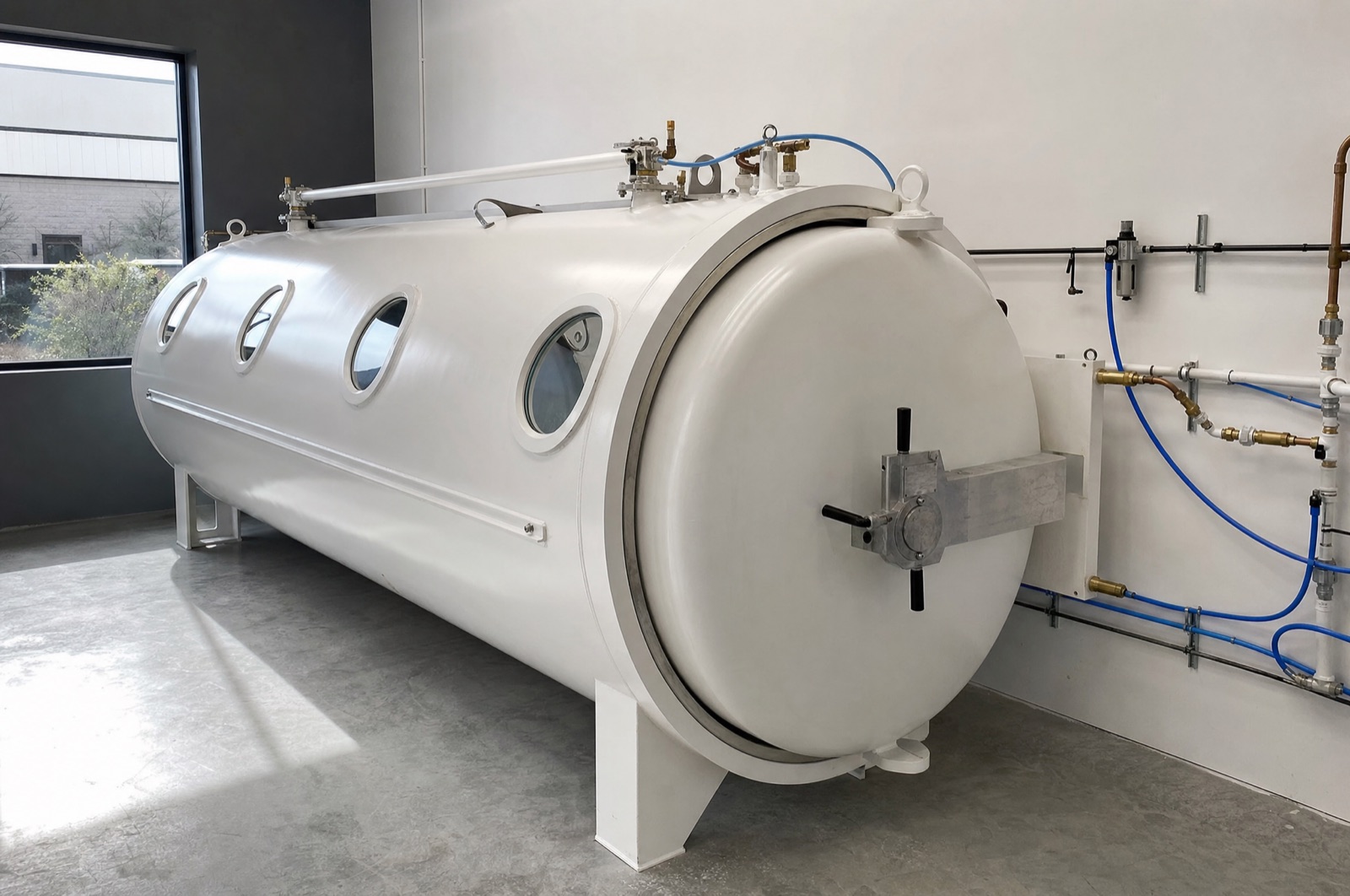
[ Clinic install ] Reference imagery; final photography in production
Hyperbaric chambers are legal in Colombia. A chamber that its maker proposes for the treatment of a disease or injury is a medical device under Decreto 4725 de 2005, and it needs a registration from INVIMA, the national drug and food regulator, before it is imported or sold. The decree sorts devices into Classes I, IIa, IIb and III, and the maker proposes the class. We found no INVIMA ruling on the class of a chamber. The only chamber file we found in INVIMA's open register lists Class IIb. Devices of Classes IIa, IIb and III that are used or prescribed by health professionals may be advertised only in scientific or technical publications, unless the authority allows other media. A clinic must be on the national register of providers, the REPS, under Resolución 3100 de 2019, which does not name hyperbaric oxygen. The 2026 list of procedures funded by the public system includes hyperbaric oxygenation. This page covers each rule for hospital units and for home or wellness chambers. All sources are in Spanish, and the translations are ours. We do not say whether any treatment works, and we do not name or rate any clinic.
Legal, and regulated as a medical device
The device rules are in Decreto 4725 de 2005, dated 26 December 2005 and hosted by the Ministerio de Salud y Protección Social. It governs the registration, marketing permits and health surveillance of medical devices for human use. Article 1 says it covers production, storage, sale, use, import, export, marketing and maintenance, and binds every person or company in those activities.
Article 2 defines a medical device for human use as any instrument, apparatus, machine, software, biomedical equipment or similar article proposed by the maker for listed uses. These include the diagnosis, prevention, monitoring, treatment or relief of a disease, and the same for an injury or a deficiency (our translation). A clinical chamber fits that wording. The test is the maker's proposed use, so the claims made for a chamber matter.
The same article defines biomedical equipment as an operational device with electrical, electronic or hydraulic systems, meant by the maker for prevention, diagnosis, treatment or rehabilitation in humans. A powered chamber with a compressor and control panel meets that wording. We found no rule that bans hyperbaric chambers or limits them to hospitals. Decreto 582 de 2017 later rewrote Articles 21 and 30, on the registration procedure and on changes to a registration, and left the classes untouched.
Who regulates: INVIMA
The Instituto Nacional de Vigilancia de Medicamentos y Alimentos, INVIMA, issues device registrations and marketing permits. Article 65 gives it inspection, surveillance and control, in coordination with departmental and district health offices, and lets it take safety measures and impose sanctions. Under Article 80, INVIMA may fine up to 10,000 daily legal minimum wages, among other sanctions. The decree also sets up a national technovigilance programme. Article 59 says makers, registration holders, users and anyone else who learns of a device fault that could cause death or serious harm must report it at once to the local health office, with a copy to INVIMA.
A second set of bodies handles clinics. Under Resolución 3100 de 2019, departmental and district health secretariats register providers and verify that they meet the standards. The Superintendencia Nacional de Salud also oversees compliance.
Classes I, IIa, IIb and III
Article 5 says the maker classes the device, based on the risks of its use and possible failure, the length of contact with the body, how invasive it is, and local against systemic effect. It sets four classes (our translations):
- Class I: low risk, subject to general controls.
- Class IIa: moderate risk, subject to special controls in manufacture.
- Class IIb: high risk, subject to special controls in design and manufacture.
- Class III: very high risk, subject to special controls, meant to protect or sustain life.
Article 6 says the rules follow the device's intended purpose. If several rules apply, the highest class wins. Article 7 then lists the rules, grouped into non-invasive devices, invasive devices, active devices and special rules. Colombia's four classes do not map one to one onto US classes. For how Europe files the same device, see CE marking for hyperbaric chambers, and for the US, see FDA cleared vs FDA registered.
Where a hyperbaric chamber may sit
The decree does not use the words hyperbaric or chamber in its rules. Article 2 defines an active device as one that runs on electricity or another power source other than the human body or gravity. A chamber with a powered compressor or control system meets that wording. Three active device rules are relevant (our translations):
- Rule 9: active therapeutic devices that give or exchange energy are Class IIa, or Class IIb if done in a potentially hazardous way.
- Rule 11: active devices that give medicines, body fluids or other substances to the body, or remove them, are Class IIa, or Class IIb if done in a potentially hazardous way, given the substance, the part of the body and the method.
- Rule 12: all other active devices are Class I.
On our reading, a powered chamber that gives oxygen to the body falls under Rule 11, as Class IIa or IIb. INVIMA's open register adds one data point, covered below, where a chamber file was entered as Class IIb. We found no INVIMA ruling that settles it. A soft or mild chamber sold for wellness raises a separate question. If the maker proposes no medical use, it may fall outside the Article 2 definition, and we found no INVIMA statement either way. For the pressure and gas differences, see mild vs medical hyperbaric.
Registro sanitario or marketing permit
The class decides the route. Article 16 says devices of Classes IIb and III need a registro sanitario from INVIMA for production, import, export, storage, sale and marketing. Article 17 gives Classes I and IIa an automatic registration. Article 18 lists the file for a technical review: the risk class, the uses, warnings, a quality system certificate, test summaries and a free sale certificate. Classes IIa, IIb and III must add a risk analysis and the science behind the device's safety. Classes IIb and III must also submit clinical studies on use to show safety and effectiveness. Article 49 lets technical data come in English with an official Spanish translation.
A third route applies to biomedical equipment of controlled technology. The decree uses that label for several groups, including Class IIb and III equipment that costs more than 700 legal minimum monthly wages to buy, install and use, and meets the terms of Article 65 of Ley 715 de 2001. Article 23 says this equipment needs a marketing permit from INVIMA instead. Article 35 requires manuals, permanent technical support and spare parts for the life of the equipment. We did not confirm whether any chamber falls in this group.
Article 31 says registrations and permits last ten years. Article 46 says the holder must start selling the product within 36 months, or the registration is cancelled automatically.
What the INVIMA records show
INVIMA publishes its device registrations as an open dataset on datos.gov.co, titled registrations of medical devices and other technologies. On 6 November 2026 we searched its product field for hiperb, hyperb, monoplaza and multiplaza. We found one product, listed as cámaras hiperbáricas. It sits in the surgical and medical group with risk level IIb and the mode import and sell. Its status is abandonment, it carries no registration number, and the file names a foreign maker and a Colombian importer. The file shows how one applicant classed a chamber. It is not an INVIMA decision.
INVIMA has registered at least one chamber all the same. INVIMA alert 155-2024, published on 5 June 2024 by its directorate for medical devices, concerns a monoplace hyperbaric chamber and gives its registro sanitario number and holder. The alert says chambers were being resold and brought into the Dominican Republic without the maker's knowledge (our translation). Its category is defective product, its source is the maker, and its status is closed. It tells users to check the registration on the INVIMA site and to report incidents to the technovigilance programme. That registration number does not appear in the open dataset, so the dataset is not a complete list.
Imports, used chambers and manuals
Article 43 says an importer must attach the registro sanitario or marketing permit to the import record, and state the brand, the models and whether the devices are new or used. Article 44 says official foreign documents need consular legalisation or an apostille. Article 45 lets unregistered devices appear at trade fairs with prior permission, but they may not be sold or used on patients until registered.
Article 37 is the rule most likely to matter for a used chamber. INVIMA may authorise the import, purchase or donation of used biomedical equipment of Classes I and IIa, which is then treated as controlled technology. The file needs a certificate from the maker, its representative or the importer that the equipment is no more than five years old and in good working order. It may not authorise used equipment of Classes IIb and III. Refurbished equipment of any class may enter with a certificate of good working order from the legal maker or its representative. If a chamber is Class IIb, a used one could not come in except as refurbished. For a chamber shipped into the US instead, see importing a hyperbaric chamber into the US.
Advertising a chamber
Article 58 covers device information and ads. Scientific, promotional or advertising material must follow the terms of the registration, stick to the truth, have scientific evidence behind it and not exaggerate the benefits of use (our translation). No ad may run if it:
- breaks the general rules on health or therapeutic education;
- leads people into deceit or error;
- defames, harms or makes a negative comparison with other brands, products, services or firms.
The first paragraph of the article splits devices by class. Class I devices may be advertised in mass media, within the terms of their automatic registration. Devices of Classes IIa, IIb and III meant only for use by health professionals, or prescribed by them, may be announced or promoted only in scientific or technical publications. The health authority may authorise other media. The second paragraph makes registration holders and sellers liable for any breach. On our reading, a chamber in Class IIa or IIb could not be advertised to the public without that authority's approval, but we found no INVIMA ruling on chamber ads.
The consumer statute, Ley 1480 de 2011, also applies. Article 30 bans misleading advertising and makes the advertiser liable for the harm it causes. Article 5 defines misleading advertising as a message that does not match reality, or is incomplete, so that it leads or may lead to error, deceit or confusion. Article 2 says the statute applies where no special rule exists, and alongside one where it does.
Clinics: the REPS and Resolución 3100
A clinic that offers sessions falls under the habilitation system. We read Resolución 3100 de 2019 in the Superintendencia's compiled text, which folds in later changes, including Resolución 465 de 2025. Among others, it applies to health care institutions, independent health professionals, patient transport and entities whose main business is not health care. Article 4 says every provider must be on the REPS with at least one site and one habilitated service. Article 10 makes a first registration valid for four years, and Article 22 makes registration free. Article 18 bars health secretariats from asking for requirements beyond the resolution.
The annexed manual lists the services a provider may habilitate. We searched the full compiled text for hiperb and found no match. The supporting diagnostics and therapy group lists therapies, pharmacy, imaging, nuclear medicine, radiotherapy, dialysis and others, and its therapy service names physiotherapy, speech therapy, occupational therapy and respiratory therapy. The resolution does not say which service a hyperbaric unit should be filed under, and we found no Ministry guidance on it.
Some standards apply to every service. The equipment standard says a provider must keep a list of its biomedical equipment with brand, model, series, the registro sanitario or marketing permit, and the risk class where required. It must also have a preventive maintenance programme that follows the maker's advice, a life record for each item, and training in the use of devices that need it. For staffing practice elsewhere, see hyperbaric clinic staffing and certification.
The resolution exempts health services of the special and exception regimes under Article 279 of Ley 100 de 1993, unless they choose to register or want to sell services in the general system. Article 279 lists the Fuerzas Militares and the Policía Nacional among those regimes.
Doctors and their ads: Ley 23 de 1981
Ley 23 de 1981 sets the rules of medical ethics. Article 12 says a doctor may use only diagnostic or therapeutic means accepted by legally recognised scientific institutions. Article 55 says the advertising methods a doctor uses to gain patients must be ethical. Article 56 limits a professional notice to the doctor's name, a legally recognised specialty, the university, the Ministry registration number, and the address and phone number. A notice for a medical centre must name its manager or person in charge. Article 58 lets the medical college inspect any notice and order it changed or withdrawn. Article 60 bars a doctor from backing articles that do not stick strictly to proven scientific facts, or that mislead (our translations). The law does not name hyperbaric therapy, and we found no rule on who may run a session. For the fire and oxygen hazards that shape chamber design, see hyperbaric chamber safety.
Coverage: the CUPS code and the UPC list
Colombia codes procedures in the CUPS, its single classification of health procedures. Resolución 2706 de 2025, dated 23 December 2025 and in force from 1 January 2026, sets the current list. It gives category 93.9.5, hyperbaric oxygenations, with one subcategory, 93.9.5.01, hyperbaric oxygenation. It sits next to respiratory therapy and other oxygen therapy. Its rules say a procedure's description does not cover habilitation requirements, the equipment or devices used, or the value of the procedure.
Funding is set separately. Resolución 2765 de 2025, dated 30 December 2025 and in force from 1 January 2026, updates the services funded through the UPC, the per capita payment the system makes to health insurers. Its Annex 2, the list of procedures funded through the UPC, includes 93.9.5, hyperbaric oxygenations. Article 6 says every subcategory in a listed category is included, unless a note excludes it, and we found no note on this category. Article 32 says listed procedures are funded when they have a functional purpose, as judged by the treating professional. The Ministry's open dataset of PBS procedures also lists hyperbaric oxygenation as funded through the UPC, under a different six digit code, 939500. For the US codes, see hyperbaric insurance and CPT codes.
The military high command has published an undated item from the Hospital Militar Central in Bogotá about its hyperbaric medicine unit. It says the hospital bought its current chamber in 2016 and calls it the only one in Bogotá set up for clinical use. We did not find a public list of other units. For how two other Latin American countries handle the same device, see chamber rules in Mexico and chamber rules in Brazil.
Hospital unit and wellness chamber side by side
| Question | Hospital unit | Home or wellness chamber |
|---|---|---|
| Banned? | No | No ban found |
| Medical device? | Yes, if proposed for treatment of disease or injury (Article 2) | Depends on the maker's proposed use; no INVIMA statement found |
| Class | Not ruled; IIa or IIb under Rule 11 on our reading; one abandoned file lists IIb | Not addressed |
| Route before import | Registro sanitario if IIb (Article 16); marketing permit if controlled technology | Same, if it is a medical device |
| Used units | Barred if IIb or III, except refurbished (Article 37) | Same, if it is a medical device |
| Device ads | Scientific or technical publications only, unless authorised (Article 58) | Same, if it is a medical device; Ley 1480 bans misleading ads |
| Provider register | REPS and habilitation under Resolución 3100; no named hyperbaric service | Applies if the place provides health services; not confirmed for spas |
| Military hospitals | Exception regime, outside Resolución 3100 unless they opt in | Not applicable |
| Public funding | CUPS 93.9.5.01 on the 2026 UPC list, for a functional purpose | Not applicable |
Sources: Decreto 4725 de 2005 (Ministerio de Salud PDF); Decreto 582 de 2017 (INVIMA normograma); INVIMA device registrations dataset on datos.gov.co; INVIMA alert 155-2024; Resolución 3100 de 2019, Ley 23 de 1981, Ley 100 de 1993 and Ley 1480 de 2011 (Superintendencia Nacional de Salud normograma); Resolución 2706 de 2025 and Resolución 2765 de 2025; Ministerio de Salud PBS procedures dataset; Comando General de las Fuerzas Militares news item. All linked above, read 6 November 2026.
For the chambers we track and what we can verify about each, see the scorecard.
What we have not verified
We found no INVIMA ruling that gives the class of a hyperbaric chamber, so Class IIa or IIb under Rule 11 is our reading, and the IIb entry is one applicant's abandoned file. We did not open the registration named in alert 155-2024, so we cannot confirm its class or whether it is still in force, and we did not resolve what its EBC prefix stands for. We did not search INVIMA's own online register, which runs as a form, so we cannot say how many chambers hold a registration. We did not confirm whether any chamber counts as controlled technology needing a marketing permit. We read Decreto 4725 de 2005 in its original text and checked only Decreto 582 de 2017 for later changes. We found no rule on which REPS service a hyperbaric unit uses, on soft chambers, or on whether a wellness centre that runs a chamber is a health provider. The code 939500 in the Ministry dataset differs from the 2026 CUPS code, and we did not trace the change. We read the Resolución 2706 de 2025 text from a private legal publisher's copy, not the Diario Oficial. We did not check Colombian rules on pressure vessels or medical gases, and we found no national count of chambers.
Frequently asked
Are hyperbaric chambers legal in Colombia?
Yes. We found no ban. Decreto 4725 de 2005 defines a medical device by the use its maker proposes, including the treatment or relief of a disease or injury, so a chamber sold for that use is a medical device. It needs an INVIMA registration before it is imported or sold. An INVIMA alert from June 2024 lists a monoplace chamber with a registration number, and the Hospital Militar Central in Bogotá runs a hyperbaric medicine unit.
What class is a hyperbaric chamber in Colombia?
We could not confirm it from a ruling. The decree sorts devices into Classes I, IIa, IIb and III, and Article 5 says the maker does the classing. Its Rule 11 puts active devices that give substances to the body in Class IIa, or Class IIb if done in a potentially hazardous way. The one chamber file we found in INVIMA's open register lists Class IIb, but that application was abandoned and no registration was issued under it.
Can a used hyperbaric chamber be imported into Colombia?
Not if it is Class IIb or III. Article 37 of Decreto 4725 de 2005 says INVIMA may not authorise the import, purchase or donation of used biomedical equipment of Classes IIb and III. Used Class I and IIa equipment may come in under extra conditions, including a certificate that it is no more than five years old. Refurbished equipment of any class may enter with a certificate of good working order from the maker.
Can a chamber be advertised to the public in Colombia?
Only within limits. Article 58 of the decree says devices of Classes IIa, IIb and III meant only for use by health professionals, or prescribed by them, may be advertised only in scientific or technical publications, unless the health authority allows other media. Device ads must match the registration, stick to the truth and not exaggerate benefits. Ley 1480 de 2011 also bans misleading advertising in general.
Does the Colombian health system pay for hyperbaric oxygen?
The procedure is on the funded list. Resolución 2765 de 2025, in force from 1 January 2026, lists category 93.9.5, hyperbaric oxygenations, in its annex of procedures funded through the UPC, the per capita payment to health insurers. The CUPS code list for 2026 gives the single procedure as 93.9.5.01. Article 32 ties funding to a functional purpose, as judged by the treating professional.

Alex tests the machines himself, in clinics and studios on three continents. Every score comes from the same 27 public criteria, and no manufacturer has a say in them.
Six questions, and we'll match chamber, options, and install to your space and budget.